REVIEW 2 major objections 6 minor 3 cited by
"It was 80% me, 20% AI": Seeking Authenticity in Co-Writing with Large Language Models
T0 review · 2 major / 6 minor · reviewed 2026-08-12 · deepseek-v4-flash
Pith's one-line read Writers see authenticity as process, not output, when co-writing with AI.
desk verdict Solid qualitative core on writer-centered authenticity, but the personalization finding lacks a manipulation check and the abstract overstates the reader data. read the letter →
The pith
A machine-rendered reading of the paper's core claim, the machinery that carries it, and where it could break.
The reading
What carries the argument
The central object is the writer-centered conception of authenticity, a three-part construct of source authenticity, authentic self, and content authenticity, in which the second part, authentic self, defined as the writer's lived experience, identity, passion, and autonomy expressed through the process of writing, carries most of the weight. The argument runs on content gatekeeping: the practice by which writers decide what goes into the text, which the paper identifies as the main way writers claim contribution and preserve authenticity when co-writing with AI. The study's comparative machinery is a within-subject writing session using the CoAuthor interface with GPT-4, personalized by in-context learning from each writer's 200-word sample versus a non-personalized version, followed by a reader survey that assessed likeability, enjoyment, creativity, attribution, and perceived authenticity.
What would settle it
A replication with a manipulation check, asking writers after each session how much the suggestions sounded like their own voice, would settle the personalization claims: if writers rate the personalized tool no higher than the non-personalized one, the preference and null behavior findings cannot be attributed to personalization; if, with stronger personalization, writers' acceptance rates rise and readers can distinguish the output, the paper's claim that personalization does not change behavior or reader perception would fail.
Extended reading notes
Core claim
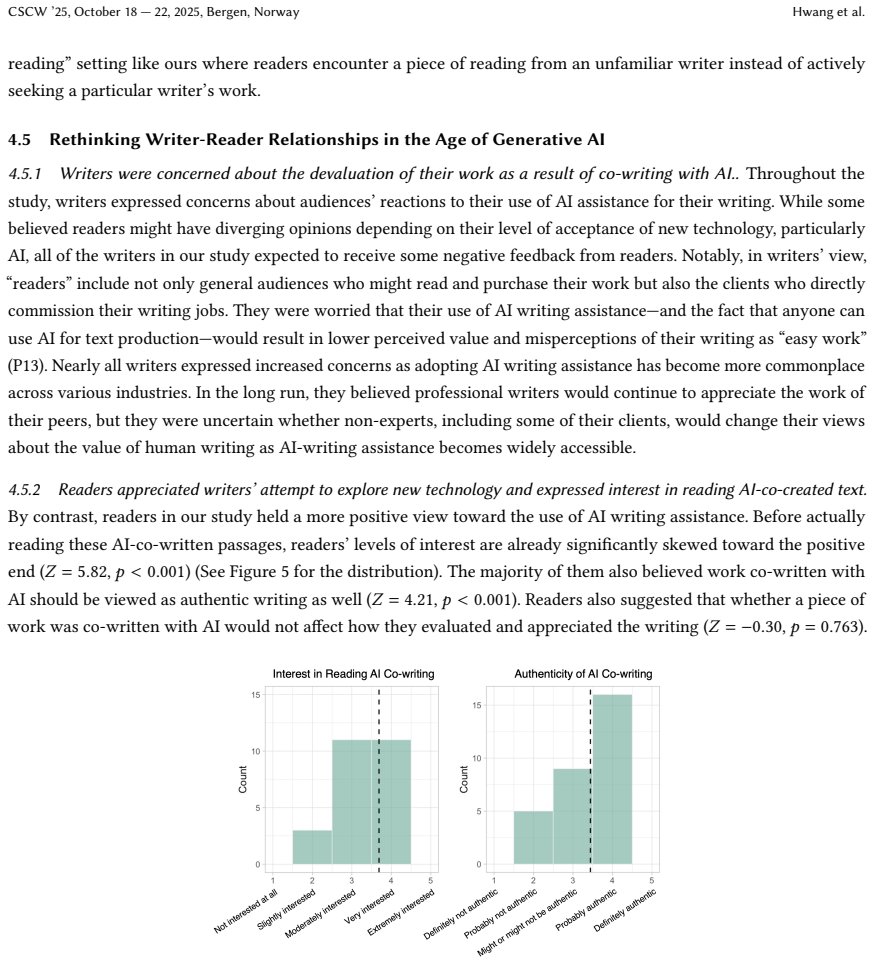
On the paper's own terms, the discovery is that writers' conception of authenticity extends beyond the three classic themes of category, source, and value to a fourth, dominant theme: the authentic self. Writers treat authenticity as grounded in lived experience, emotions, passion, autonomy, and the ability to justify putting one's name on the work; they see the work as authentic when it could only have been written by them. Co-writing with AI does not change this definition, but it changes how writers can protect it: the practices that matter include holding a clear vision before writing, calling on AI mainly in the "fuzzy area" between an initial idea and a developed draft, and performing content gatekeeping, which means actively selecting, rejecting, and revising AI suggestions. The paper also claims that readers in a leisurely reading setting cannot reliably distinguish AI-assisted passages from solo work, rate both kinds of AI-assisted work as preserving the writer's authentic voice, and respond positively rather than negatively to writers' use of AI.
Load-bearing premise
The central comparison between personalized and non-personalized AI assumes that one 200-word writing sample is enough for writers to experience the tool as reflecting their voice, but the study never checks whether writers actually did experience it that way.
Editorial extensions
If this is right
- AI writing tools should be judged by whether they support writers' growth and internal experience, not just by the quality of generated text.
- Personalization that only mimics a writer's surface style is insufficient; support is most valuable before and around text production, in early ideation and feedback.
- Writers' fear of reader backlash may be overstated in leisurely-reading contexts, since readers in this study could not distinguish AI-assisted writing and viewed AI experimentation positively.
- Contribution and authorship in co-writing should be understood through content gatekeeping decisions rather than by the proportion of text a writer typed.
Reading between the lines
- If authenticity is process-oriented, then tools that maximize output efficiency may undermine the internalization writers value; a testable extension is to compare feedback-only tools against text-generation tools on writers' sense of authenticity.
- The paper's null behavioral results may reflect a weak personalization manipulation rather than the absence of an effect; a replication with stronger personalization and a manipulation check could change the design implications.
- The reader positivity may be specific to casual, leisurely reading; professional editing, journalistic, or academic contexts with stricter provenance norms may produce different reactions, which the paper does not test.
- The "80% me" framing suggests writers track a quantitative contribution ratio; future work could study how that ratio is negotiated when AI suggestions are adopted verbatim versus revised, and whether tools that display such a ratio change behavior.
Signed reviews
Editorial analysis
A structured set of objections, weighed in public.
Referee Report
Summary. The paper examines how professional writers and avid readers conceptualize authenticity in human-AI co-writing, and whether personalization of AI writing assistance supports writers' authentic voice. Part 1 uses semi-structured interviews with 19 professional writers, who each completed two writing sessions with a GPT-4-based CoAuthor interface, one personalized via in-context learning from a 200-word writing sample and one non-personalized. Part 2 is an online survey with 30 avid readers who rated and compared solo-written, personalized-AI, and non-personalized-AI passages produced by six of the writers. The paper reports three main contributions: a writer-centered definition of authenticity emphasizing internal experiences and process, design implications for co-writing tools targeting writer growth, and an account of readers' largely positive and undifferentiating responses to AI-assisted creative writing.
Significance. If the findings hold, the paper makes a useful contribution to CSCW/HCI by grounding authenticity in writers' lived experiences and by distinguishing process-oriented authenticity from the category/source/value frameworks in prior literature. The qualitative core is a strength: the study provides a transparent interview protocol, a detailed codebook, a participant table, and extensive verbatim quotes, giving readers direct access to the evidence behind the thematic claims. The mixed-methods design, combining writing logs with interviews and a reader survey, adds behavioral texture. The authors also showed methodological care in screening AI-generated survey responses. The central qualitative claim about process-oriented authenticity is well supported by the interview data; the main weaknesses concern the strength of the claims about reader discrimination and the lack of a manipulation check for the personalization condition.
major comments (2)
- [Abstract; Section 4.4.3; Table 7] The abstract states that "Readers could not distinguish AI-assisted work, personalized or not, from writers' solo-written work," but the paper's own statistical models contradict this. In Table 7 (Round 2), the likelihood-of-human-writing rating differs significantly for solo vs. personalized AI (β = −0.73, SE = 0.25, t = −2.94, p = 0.004) and for solo vs. non-personalized AI (β = −0.64, SE = 0.24, t = −2.57, p = 0.012). Section 4.4.3 correctly reports that reader participants rated the solo human work as more likely to have been written independently. The abstract and the concluding section therefore overstate the finding. The supported claim is that likeability, enjoyment, and creativity ratings did not differ significantly across conditions and readers could not reliably identify which text segments were AI-generated, while judgments of how likely a piece is to have been written by a human did distinguish solo from AI-assisted work. Please revise the abstract, Section 5 discussion, and Section 6 conclusion to align with the actual statistical results.
- [Section 3.2.3; Section 4.4.2; Appendix B.3] The paper lacks a manipulation check for the personalization condition. The personalized tool was built by in-context learning from a single ~200-word writing sample, but no pre-reveal measure verifies that writers actually experienced this tool as reflecting their own voice. The only direct question ("Does the personalized AI tool pick up your unique voice, tone, style, etc. in writing?") appears in Appendix B.3, after the experimenter disclosed which of the two tools was personalized. Behavioral logs (Section 4.4.2) show no significant difference between conditions in the frequency of requesting AI assistance or in the rate of accepting suggestions. As a result, the subjective preference findings in Section 4.4.1 and the design implication in Section 5.2 that personalization should support writers' growth rather than merely text production are not firmly tied to the personalization manipulation; they could reflect the condition label, demand characteristics, or the mere presence of the writer's own sample in the prompt. Because RQ3 asks whether personalization can support authenticity, this gap is load-bearing. Please add an appropriate manipulation check (e.g., a pre-reveal rating of perceived stylistic closeness, or a style-similarity analysis of the writing logs using the authors' own writing samples) and temper the causal language in Sections 4.4 and 5.2 accordingly.
minor comments (6)
- [Table 7] In the Creativity row for round 1 ("Solo vs. Personalized AI"), the reported values are β = 0.91, SE = 0.25, t = 0.01, p = 0.999. A t value of 0.01 is inconsistent with β/SE ≈ 3.6, and the p value also does not correspond to that t. Please correct the entry and re-verify the reported statistics.
- [Appendix G] The survey question in G.2 reads "How much do you creative the writing?" and should be "How creative do you find the writing?".
- [Section 4.4.1] The text says "the majority of writers preferred working with personalized writing tools" but does not state the number or proportion; given the quantifier convention defined in Section 4.1 (a few, some, most, nearly all), please report the explicit count for this claim.
- [Section 4.4.3] The statement "the rate of correct identification has no significant difference between the personalized and non-personalized conditions" reports only the absence of a difference between conditions; please also report the actual rates and, if available, compare them to chance to support the claim that readers could not identify AI-assisted segments.
- [Appendix C] In the codebook, the code "Expedite internationalization" appears; the intended word is presumably "Expedite internalization."
- [Section 3.3.2 and Table 7] The relationship among the three data columns ("Round 1", "Round 1 (removed 7 responses)", and "Round 2") is unclear: it is not stated which column corresponds to the primary analysis reported in the text, what the sample size of each column is, and why multiple columns are presented as co-equal. Please clarify the analysis pipeline and designate the primary dataset.
Circularity Check
No significant circularity: the paper's qualitative findings are induced from interview data, no fitted parameter is relabeled as a prediction, and the single background self-citation is not load-bearing.
full rationale
This paper contains no mathematical derivation, no fitted constants, and no quantity that is defined in terms of the outcome it is used to explain. The central claims about writer-centered authenticity (Sections 4.2 and 5.1) are thematic findings drawn from semi-structured interviews, with the codebook in Appendix C and extensive participant quotes in Table 6 providing transparent grounding. The pre-interview survey does ask writers to define authenticity before they use the AI tools, but that is the research question itself (RQ1), not a presupposed conclusion; the themes of source authenticity, authentic self, and content authenticity are presented as induced from participants' own definitions and reflections. The personalization manipulation in Section 3.2.3 uses a writer's own 200-word sample for in-context learning, but this is an independent-variable manipulation rather than a parameter fitted to a later outcome, so the writers' and readers' reactions to the two conditions are empirical results rather than reductions. The absence of a manipulation check for whether writers actually perceived the personalized tool as voice-matched is a genuine construct-validity concern for RQ3, but it is not circularity; the comparison still tests the manipulation as delivered, and the paper does not claim a statistically forced equivalence. The only apparent self-citation is reference [59] (Robertson et al. 2021), cited in Section 2.2.2 as background on AI-mediated communication; that citation is used to motivate a literature gap, not to justify the paper's findings, and it is externally published empirical work, so under the stated rules it does not raise the circularity score. No uniqueness theorem is imported from the authors' prior work, no ansatz is smuggled in via citation, and no known empirical pattern is merely renamed as a new contribution. The paper is self-contained against external benchmarks: the interview protocol, codebook, writing-log analyses, and reader-survey statistics in Tables 4, 5, and 7 provide independent support for the reported claims. Accordingly, no circular step is present, and the appropriate score is 0.
Assumptions & free parameters
free parameters (1)
- GPT-4 generation parameters =
temperature=0.9, top_p=1, presence_penalty=0.5, frequency_penalty=0.5, max_tokens=5
assumptions (4)
- domain assumption Writers' self-reported definitions and experiences reliably capture authenticity in writing.
- ad hoc to paper In-context learning with a single 200-word writing sample creates a tool perceived as personalized by writers.
- domain assumption Readers recruited from genre subreddits represent avid readers of the six writers' genres.
- standard math Five-point Likert responses can be treated as ordinal for Wilcoxon tests and as interval for lmer models.
Cite this review
Pith. "Pith review of "It was 80% me, 20% AI": Seeking Authenticity in Co-Writing with Large Language Models." pith.science (2026). https://pith.science/paper/YNGCJATY
@misc{pith2026241113032,
  author       = {Pith},
  title        = {Pith review of: "It was 80% me, 20% AI": Seeking Authenticity in Co-Writing with Large Language Models},
  year         = {2026},
  howpublished = {\url{https://pith.science/paper/YNGCJATY}},
  note         = {Machine review of arXiv:2411.13032}
}
read the original abstract
Given the rising proliferation and diversity of AI writing assistance tools, especially those powered by large language models (LLMs), both writers and readers may have concerns about the impact of these tools on the authenticity of writing work. We examine whether and how writers want to preserve their authentic voice when co-writing with AI tools and whether personalization of AI writing support could help achieve this goal. We conducted semi-structured interviews with 19 professional writers, during which they co-wrote with both personalized and non-personalized AI writing-support tools. We supplemented writers' perspectives with opinions from 30 avid readers about the written work co-produced with AI collected through an online survey. Our findings illuminate conceptions of authenticity in human-AI co-creation, which focus more on the process and experience of constructing creators' authentic selves. While writers reacted positively to personalized AI writing tools, they believed the form of personalization needs to target writers' growth and go beyond the phase of text production. Overall, readers' responses showed less concern about human-AI co-writing. Readers could not distinguish AI-assisted work, personalized or not, from writers' solo-written work and showed positive attitudes toward writers experimenting with new technology for creative writing.
Figures


Figures from the paper (6 more)



Forward citations
Cited by 3 Pith papers
-
Feeling Guilty Being a c(ai)borg: Navigating the Tensions Between Guilt and Empowerment in AI Use
Using three authors' year-long autoethnographic reflections, the paper argues that guilt about AI use can be reframed as growth through literacy, transparency, and critical engagement.
-
The Future of Work is Blended, Not Hybrid
The paper reframes future work as 'blended', with human effort and AI output inseparable, and charts four HCI research directions.
-
What Shapes Writers' Decisions to Disclose AI Use?
A literature synthesis identifies 12 procedural, social, and personal factors that may shape writers' decisions to disclose AI use.
Reference graph
Works this paper leans on
-
[1]
Nadia Abbas, Asbjørn Følstad, and Cato A. Bjørkli. 2023. Chatbots as Part of Digital Government Service Provision – A User Perspective . Vol. 13815. Springer International Publishing, Cham, 66–82. https://doi.org/10.1007/978-3-031-25581-6_5
- [2]
-
[3]
Tom Brown, Benjamin Mann, Nick Ryder, Melanie Subbiah, Jared D Kaplan, Prafulla Dhariwal, Arvind Neelakantan, Pranav Shyam, Girish Sastry, Amanda Askell, et al. 2020. Language models are few-shot learners. Advances in neural information processing systems 33 (2020), 1877–1901
2020
-
[4]
Edward M Bruner. 1993. Epilogue: Creative persona and the problem of authenticity. Creativity/anthropology (1993), 321–334
work page 1993
-
[5]
Daniel Buschek, Martin Zürn, and Malin Eiband. 2021. The Impact of Multiple Parallel Phrase Suggestions on Email Input and Composition Behaviour of Native and Non-Native English Writers. In Proceedings of the 2021 CHI Conference on Human Factors in Computing Systems (Yokohama, Japan) (CHI ’21). Association for Computing Machinery, New York, NY, USA, Artic...
arXiv 2021
-
[6]
Kelly Caine. 2016. Local Standards for Sample Size at CHI. In Proceedings of the 2016 CHI Conference on Human Factors in Computing Systems (CHI ’16). Association for Computing Machinery, New York, NY, USA, 981–992. https://doi.org/10.1145/2858036.2858498
arXiv 2016
-
[7]
Christopher Candlin and Ken Hyland. 1999. Writing: texts, processes, and practices . Longman, London; New York. 29 CSCW ’25, October 18 — 22, 2025, Bergen, Norway Hwang et al
work page 1999
- [8]
Show all 63 references
-
[9]
Zheng Chen, Ziyan Jiang, Fan Yang, Zhankui He, Yupeng Hou, Eunah Cho, Julian McAuley, Aram Galstyan, Xiaohua Hu, and Jie Yang. 2023. The First Workshop on Personalized Generative AI @ CIKM 2023: Personalization Meets Large Language Models. InProceedings of the 32nd ACM Interna...
2023
-
[10]
Hai Dang, Karim Benharrak, Florian Lehmann, and Daniel Buschek. 2022. Beyond Text Generation: Supporting Writers with Continuous Automatic Text Summaries. InProceedings of the 35th Annual ACM Symposium on User Interface Software and Technology (Bend, OR, USA) (UIST ’22). Assoc...
2022
-
[11]
Hai Dang, Sven Goller, Florian Lehmann, and Daniel Buschek. 2023. Choice Over Control: How Users Write with Large Language Models Using Diegetic and Non-Diegetic Prompting. In Proceedings of the 2023 CHI Conference on Human Factors in Computing Systems (Hamburg, Germany) (CHI ...
2023
-
[12]
Sara De Candia, Gianmarco De Francisci Morales, Corrado Monti, and Francesco Bonchi. 2022. Social Norms on Reddit: A Demographic Analysis. In 14th ACM Web Science Conference 2022 . ACM, Barcelona Spain, 139–147. https://doi.org/10.1145/3501247.3531549
2022
-
[13]
Fiona Draxler, Anna Werner, Florian Lehmann, Matthias Hoppe, Albrecht Schmidt, Daniel Buschek, and Robin Welsch. 2023. The AI Ghostwriter Effect: When Users Do Not Perceive Ownership of AI-Generated Text But Self-Declare as Authors. ACM Trans. Comput.-Hum. Interact. (dec 2023)...
2023 doi
-
[14]
Shiran Dudy, Steven Bedrick, and Bonnie Webber. 2021. Refocusing on Relevance: Personalization in NLG. In Proceedings of the 2021 Conference on Empirical Methods in Natural Language Processing , Marie-Francine Moens, Xuanjing Huang, Lucia Specia, and Scott Wen-tau Yih (Eds.). ...
2021 doi
-
[15]
Tyna Eloundou, Sam Manning, Pamela Mishkin, and Daniel Rock. 2024. GPTs are GPTs: Labor market impact potential of LLMs. Science 384, 6702 (June 2024), 1306–1308. https://doi.org/10.1126/science.adj0998
2024 doi
-
[16]
Kahn, Alan Borning, and Alina Huldtgren
Batya Friedman, Peter H. Kahn, Alan Borning, and Alina Huldtgren. 2013. Value Sensitive Design and Information Systems . Vol. 16. Springer Netherlands, Dordrecht, 55–95. https://doi.org/10.1007/978-94-007-7844-3_4
2013 doi
-
[17]
Katy Ilonka Gero, Vivian Liu, and Lydia Chilton. 2022. Sparks: Inspiration for Science Writing Using Language Models. In Proceedings of the 2022 ACM Designing Interactive Systems Conference (Virtual Event, Australia) (DIS ’22). Association for Computing Machinery, New York, NY...
2022
-
[18]
Katy Ilonka Gero, Tao Long, and Lydia B Chilton. 2023. Social Dynamics of AI Support in Creative Writing. InProceedings of the 2023 CHI Conference on Human Factors in Computing Systems (Hamburg, Germany) (CHI ’23). Association for Computing Machinery, New York, NY, USA, Articl...
2023
-
[19]
Matej Gjurković, Mladen Karan, Iva Vukojević, Mihaela Bošnjak, and Jan Snajder. 2021. PANDORA Talks: Personality and Demographics on Reddit. In Proceedings of the Ninth International Workshop on Natural Language Processing for Social Media , Lun-Wei Ku and Cheng-Te Li (Eds.). ...
2021 doi
- [20]
-
[21]
Charles Guignon. 2008. Authenticity. Philosophy Compass 3, 2 (March 2008), 277–290. https://doi.org/10.1111/j.1747-9991.2008.00131.x
2008
-
[22]
Jeffrey T Hancock, Mor Naaman, and Karen Levy. 2020. AI-Mediated Communication: Definition, Research Agenda, and Ethical Considerations. Journal of Computer-Mediated Communication 25, 1 (March 2020), 89–100. https://doi.org/10.1093/jcmc/zmz022
2020 doi
-
[23]
Richard Handler. 1986. Authenticity. Anthropology Today 2, 1 (1986), 2–4. https://doi.org/10.2307/3032899
1986 doi
-
[24]
Kizilcec, Dominic DiFranzo, Zhila Aghajari, Hannah Mieczkowski, Karen Levy, Mor Naaman, Jeffrey Hancock, and Malte F
Jess Hohenstein, Rene F. Kizilcec, Dominic DiFranzo, Zhila Aghajari, Hannah Mieczkowski, Karen Levy, Mor Naaman, Jeffrey Hancock, and Malte F. Jung. 2023. Artificial intelligence in communication impacts language and social relationships. Scientific Reports 13, 1 (April 2023),...
2023 doi
-
[25]
Nanna Inie, Jeanette Falk, and Steve Tanimoto. 2023. Designing Participatory AI: Creative Professionals’ Worries and Expectations about Generative AI. In Extended Abstracts of the 2023 CHI Conference on Human Factors in Computing Systems (Hamburg, Germany) (CHI EA ’23). Associ...
2023
-
[26]
Daphne Ippolito, Ann Yuan, Andy Coenen, and Sehmon Burnam. 2022. Creative Writing with an AI-Powered Writing Assistant: Perspectives from Professional Writers. arXiv:2211.05030 (Nov. 2022). http://arxiv.org/abs/2211.05030 arXiv:2211.05030 [cs]
2022 arXiv
- [28]
-
[30]
Maurice Jakesch, Advait Bhat, Daniel Buschek, Lior Zalmanson, and Mor Naaman. 2023. Co-Writing with Opinionated Language Models Affects Users’ Views. In Proceedings of the 2023 CHI Conference on Human Factors in Computing Systems (Hamburg, Germany) (CHI ’23). Association for 3...
2023
-
[31]
Maurice Jakesch, Megan French, Xiao Ma, Jeffrey T Hancock, and Mor Naaman. 2019. AI-mediated communication: How the perception that profile text was written by AI affects trustworthiness. In Proceedings of the 2019 CHI Conference on Human Factors in Computing Systems . 1–13
2019
-
[32]
Hancock, and Mor Naaman
Maurice Jakesch, Megan French, Xiao Ma, Jeffrey T. Hancock, and Mor Naaman. 2019. AI-Mediated Communication: How the Perception That Profile Text Was Written by AI Affects Trustworthiness. InProceedings of the 2019 CHI Conference on Human Factors in Computing Systems (Glasgow,...
2019
-
[33]
Maurice Jakesch, Jeffrey T Hancock, and Mor Naaman. 2023. Human heuristics for AI-generated language are flawed. Proceedings of the National Academy of Sciences 120, 11 (2023), e2208839120
2023
-
[34]
Elise Karinshak, Sunny Xun Liu, Joon Sung Park, and Jeffrey T. Hancock. 2023. Working With AI to Persuade: Examining a Large Language Model’s Ability to Generate Pro-Vaccination Messages. Proc. ACM Hum.-Comput. Interact. 7, CSCW1, Article 116 (apr 2023), 29 pages. https: //doi...
2023 doi
-
[35]
Donal Khosrowi, Finola Finn, and Elinor Clark. 2023. Diffusing the Creator: Attributing Credit for Generative AI Outputs. In Proceedings of the 2023 AAAI/ACM Conference on AI, Ethics, and Society (Montréal, QC, Canada) (AIES ’23). Association for Computing Machinery, New York,...
2023
-
[37]
Molly Kinder, Xavier de Souza Briggs, Mark Muro, and Sifan Liu. [n. d.]. Generative AI, the American worker, and the future of work. https: //www.brookings.edu/articles/generative-ai-the-american-worker-and-the-future-of-work/
-
[38]
Barry M. Kroll. 1984. Writing for Readers: Three Perspectives on Audience. College Composition and Communication 35, 2 (May 1984), 172. https://doi.org/10.2307/358094
1984 doi
-
[39]
Tomas Lawton, Kazjon Grace, and Francisco J Ibarrola. 2023. When is a Tool a Tool? User Perceptions of System Agency in Human–AI Co-Creative Drawing. In Proceedings of the 2023 ACM Designing Interactive Systems Conference (Pittsburgh, PA, USA) (DIS ’23). Association for Comput...
2023
-
[40]
Mina Lee, Percy Liang, and Qian Yang. 2022. CoAuthor: Designing a Human-AI Collaborative Writing Dataset for Exploring Language Model Capabilities. In Proceedings of the 2022 CHI Conference on Human Factors in Computing Systems (New Orleans, LA, USA) (CHI ’22). Association for...
2022
-
[41]
Victor R. Lee. 2023. Generative AI is forcing people to rethink what it means to be authentic. http://theconversation.com/generative-ai-is-forcing- people-to-rethink-what-it-means-to-be-authentic-204347
2023
-
[42]
Lehman, Kieran O’Connor, Balázs Kovács, and George E
David W. Lehman, Kieran O’Connor, Balázs Kovács, and George E. Newman. 2019. Authenticity. Academy of Management Annals 13, 1 (Jan. 2019), 1–42. https://doi.org/10.5465/annals.2017.0047
2019
-
[43]
Charles Lindholm. 2013. The Rise of Expressive Authenticity.Anthropological Quarterly 86, 2 (2013), 361–395. https://www.jstor.org/stable/41857330
2013
-
[44]
Yihe Liu, Anushk Mittal, Diyi Yang, and Amy Bruckman. 2022. Will AI console me when I lose my pet? Understanding perceptions of AI-mediated email writing. In Proceedings of the 2022 CHI conference on human factors in computing systems . 1–13
2022
-
[45]
Yihe Liu, Anushk Mittal, Diyi Yang, and Amy Bruckman. 2022. Will AI Console Me When I Lose My Pet? Understanding Perceptions of AI-Mediated Email Writing. In Proceedings of the 2022 CHI Conference on Human Factors in Computing Systems (New Orleans, LA, USA) (CHI ’22). Associat...
2022
-
[46]
Bryan Marshall, Peter Cardon, Amit Poddar, and Renee Fontenot. 2013. Does Sample Size Matter in Qualitative Research?: A Review of Qualitative Interviews in is Research. Journal of Computer Information Systems 54, 1 (Sept. 2013), 11–22. https://doi.org/10.1080/08874417.2013.11645667
2013
- [47]
-
[48]
Hancock, Mor Naaman, Malte Jung, and Jess Hohenstein
Hannah Mieczkowski, Jeffrey T. Hancock, Mor Naaman, Malte Jung, and Jess Hohenstein. 2021. AI-Mediated Communication: Language Use and Interpersonal Effects in a Referential Communication Task. Proc. ACM Hum.-Comput. Interact. 5, CSCW1, Article 17 (apr 2021), 14 pages. https:/...
2021 doi
-
[49]
Hannah Nicole Mieczkowski. 2022. AI-Mediated Communication: Examining Agency, Ownership, Expertise, and Roles of AI Systems . Stanford University
2022
-
[50]
Mathewson, Jaylen Pittman, and Richard Evans
Piotr Mirowski, Kory W. Mathewson, Jaylen Pittman, and Richard Evans. 2023. Co-Writing Screenplays and Theatre Scripts with Language Models: Evaluation by Industry Professionals. In Proceedings of the 2023 CHI Conference on Human Factors in Computing Systems (Hamburg, Germany)...
2023
-
[51]
Newman and Paul Bloom
George E. Newman and Paul Bloom. 2012. Art and authenticity: The importance of originals in judgments of value. Journal of Experimental Psychology: General 141, 3 (2012), 558–569. https://doi.org/10.1037/a0026035
2012 doi
-
[52]
Martin Nystrand. 1990. Sharing Words: The Effects of Readers on Developing Writers. Written Communication 7, 1 (Jan. 1990), 3–24. https: //doi.org/10.1177/0741088390007001001
1990 doi
-
[53]
Michigan Journal of Economics. 2024. Is AI taking over the job market? https://sites.lsa.umich.edu/mje/2024/01/03/is-ai-taking-over-the-job-market/
2024
-
[54]
Hiroyuki Osone, Jun-Li Lu, and Yoichi Ochiai. 2021. BunCho: AI Supported Story Co-Creation via Unsupervised Multitask Learning to Increase Writers’ Creativity in Japanese. In Extended Abstracts of the 2021 CHI Conference on Human Factors in Computing Systems (Yokohama, Japan) ...
2021
-
[55]
Zhenhui Peng, Xingbo Wang, Qiushi Han, Junkai Zhu, Xiaojuan Ma, and Huamin Qu. 2023. Storyfier: Exploring Vocabulary Learning Support with Text Generation Models. In Proceedings of the 36th Annual ACM Symposium on User Interface Software and Technology (San Francisco, CA, USA)...
2023
-
[57]
Ritika Poddar, Rashmi Sinha, Mor Naaman, and Maurice Jakesch. 2023. AI Writing Assistants Influence Topic Choice in Self-Presentation. In Extended Abstracts of the 2023 CHI Conference on Human Factors in Computing Systems (Hamburg, Germany) (CHI EA ’23). Association for Comput...
2023
- [58]
-
[59]
I can’t reply with that
Ronald E Robertson, Alexandra Olteanu, Fernando Diaz, Milad Shokouhi, and Peter Bailey. 2021. “I can’t reply with that”: Characterizing problematic email reply suggestions. In Proceedings of the 2021 CHI Conference on Human Factors in Computing Systems . 1–18
2021
-
[60]
Melissa Roemmele and Andrew S. Gordon. 2018. Automated Assistance for Creative Writing with an RNN Language Model. In Proceedings of the 23rd International Conference on Intelligent User Interfaces Companion (Tokyo, Japan) (IUI ’18 Companion). Association for Computing Machine...
2018
-
[62]
Jeremy D. Safran. 2017. The unbearable lightness of being: Authenticity and the search for the real. Psychoanalytic Psychology 34, 1 (2017), 69–77. https://doi.org/10.1037/pap0000093
2017 doi
-
[63]
Glassman
Nikhil Singh, Guillermo Bernal, Daria Savchenko, and Elena L. Glassman. 2023. Where to Hide a Stolen Elephant: Leaps in Creative Writing with Multimodal Machine Intelligence. ACM Trans. Comput.-Hum. Interact. 30, 5, Article 68 (sep 2023), 57 pages. https://doi.org/10.1145/3511599
2023 doi
-
[64]
Somogy Varga and Charles Guignon. 2023. Authenticity (summer 2023 ed.). Metaphysics Research Lab, Stanford University. https://plato.stanford. edu/archives/sum2023/entries/authenticity/
2023
-
[65]
Diyi Yang and Lucie Flek. 2021. Towards User-Centric Text-to-Text Generation: A Survey. Vol. 12848. Springer International Publishing, Cham, 3–22. https://doi.org/10.1007/978-3-030-83527-9_1
2021 doi
-
[66]
Ann Yuan, Andy Coenen, Emily Reif, and Daphne Ippolito. 2022. Wordcraft: Story Writing With Large Language Models. In 27th International Conference on Intelligent User Interfaces (Helsinki, Finland) (IUI ’22). Association for Computing Machinery, New York, NY, USA, 841–852. ht...
2022
-
[67]
Zheng Zhang, Jie Gao, Ranjodh Singh Dhaliwal, and Toby Jia-Jun Li. 2023. VISAR: A Human-AI Argumentative Writing Assistant with Visual Programming and Rapid Draft Prototyping. InProceedings of the 36th Annual ACM Symposium on User Interface Software and Technology(San Francisc...
2023
-
[68]
authentic
Jiawei Zhou, Yixuan Zhang, Qianni Luo, Andrea G Parker, and Munmun De Choudhury. 2023. Synthetic Lies: Understanding AI-Generated Misinformation and Evaluating Algorithmic and Human Solutions. InProceedings of the 2023 CHI Conference on Human Factors in Computing Systems (Hamb...
2023 doi
Reviewed August 12, 2026 · model on record in the stance chip above.
Discussion (0). Continue with ORCID to comment.