REVIEW 5 major objections 6 minor 2 cited by
AnomalyControl: Learning Cross-modal Semantic Features for Controllable Anomaly Synthesis
T0 review · 5 major / 6 minor · reviewed 2026-08-11 · deepseek-v4-flash
Pith's one-line read AnomalyControl uses cross-modal semantic features from a text-image reference to generate realistic, controllable synthetic anomalies without retraining the diffusion model.
desk verdict Solid method paper with a useful new prompt formulation, but the SOTA claim rests on unreplicated single-run numbers and a Tg chosen on the test metrics. read the letter →
The pith
A machine-rendered reading of the paper's core claim, the machinery that carries it, and where it could break.
The reading
What carries the argument
The carrying mechanism is the cross-modal semantic feature $F_c$, produced by a frozen vision-language model from the text-image reference prompt. ASEA extracts the anomaly-relevant part of the VLM's attention by averaging the cross-attention map over the anomaly tokens, masking it to the anomaly region $M_A$, and optimizing a trainable guidance variable $e_g$ for a few steps to minimize an energy function that penalizes attention outside the mask. SGA then injects $F_c$ into Stable Diffusion using decoupled cross-attention: for each of the 16 cross-attention layers, two trainable projection matrices ($W'_k$, $W'_v$) are added to condition generation on the cross-modal features, while the base model stays frozen. Because the VLM is frozen and the features depend only on the reference prompt, they can be cached, which makes the added computation during training small.
What would settle it
Generate the same anomaly type (e.g., a scratch) on a metal surface twice, once with a reference image of a scratch on leather and once with a reference image of a scratch on the same metal. If the cross-material reference yields visibly worse synthesis or makes downstream metal-defect detection drop, the claimed generalization of cross-modal semantic features is not holding; the comparison can be scored with the same IS, IC-LPIPS, and detection metrics used in the paper.
Extended reading notes
Core claim
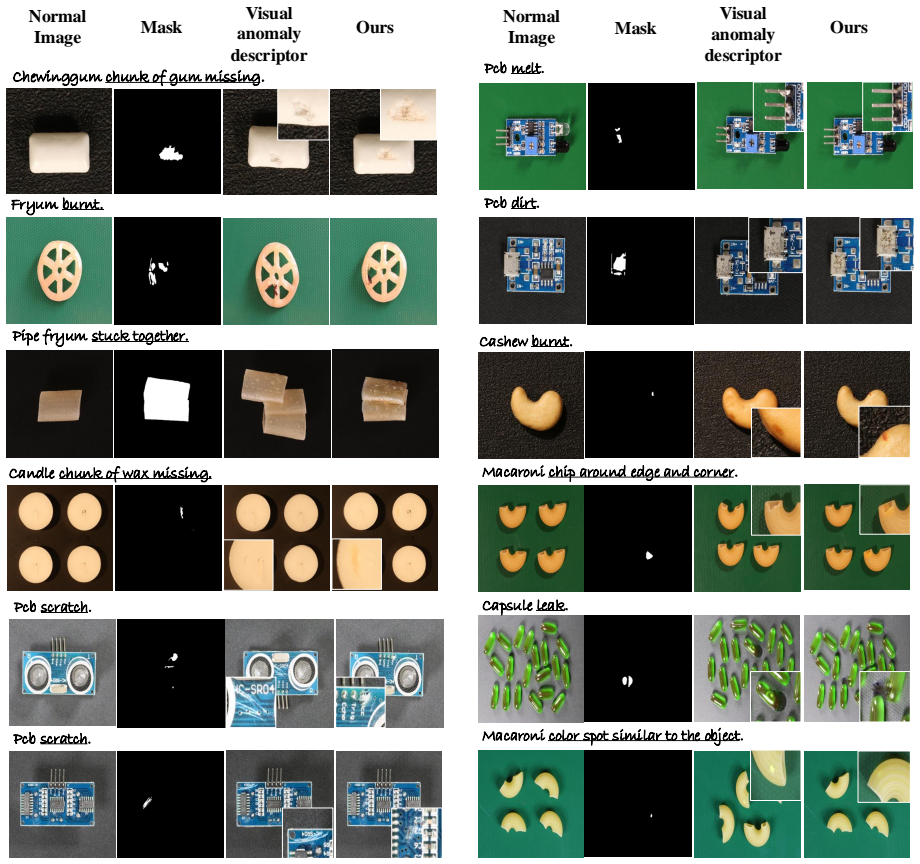
The paper's central claim is that a non-matching text-image reference prompt — a visual anomaly descriptor (a magnified crop of the defect) and a textual anomaly descriptor (e.g., 'This is an image with red stains') that need not match the target surface or material — supplies enough cross-modal semantic information to guide a frozen diffusion model toward high-fidelity, generalizable anomaly synthesis. AnomalyControl implements this with three modules: Cross-modal Semantic Modeling (CSM) fuses the visual and textual descriptors through a frozen BLIP-2 vision-language model; Anomaly-Semantic Enhanced Attention (ASEA) refines the VLM's cross-attention map by iteratively optimizing a trainable guidance variable so that attention concentrates on the anomaly region; and the Semantic Guided Adapter (SGA) routes the resulting cross-modal features $F_c$ into Stable Diffusion through a decoupled cross-attention branch with only two trainable projection matrices per layer. The framework reports state-of-the-art generation quality on MVTec AD (IS 1.84, IC-LPIPS 0.35) and the best downstream anomaly-localization results among compared methods (pixel-level AUC 99.5, AP 87.4), and the qualitative figures show anomaly types transferring across wood, leather, metal, and other surfaces.
Load-bearing premise
The load-bearing premise is that cross-modal semantic features extracted by a frozen vision-language model from a small defect crop and a short phrase encode the anomaly type itself, rather than the specific surface, material, or background of the reference image.
Editorial extensions
If this is right
- Anomaly-free manufacturing lines can create pixel-aligned defect samples for any new product category on demand, converting unsupervised anomaly detection into a supervised task without collecting real defective items.
- Synthetic training data produced by AnomalyControl improve downstream localization performance beyond the best previous anomaly-synthesis baselines: pixel-level AUC reaches 99.5 and AP 87.4 on MVTec AD.
- A single anomaly reference (image plus phrase) can synthesize that anomaly type across different objects and materials seen only at test time, enabling out-of-distribution defect generation beyond the training set.
- Because only two projection matrices per cross-attention layer are trained and the VLM features are cacheable, the method can be adapted to new anomaly types with small training cost and without retraining the diffusion backbone.
Reading between the lines
- The same cross-modal transfer idea could be applied to medical imaging, where a single radiograph of a pathology (e.g., a fracture) could be turned into controllable synthetic training examples on unseen anatomies, easing the chronic shortage of annotated abnormal medical images.
- The ASEA refinement loop (three gradient steps per sample) could be replaced by a small feed-forward attention predictor that regresses the energy-minimizing attention map directly, removing the per-prompt optimization and further reducing inference latency.
- Because the guidance strength $\gamma$ and the number of guidance steps $T_g$ are free hyperparameters, an adaptive scheme that increases $T_g$ for high-entropy attention maps could push realism further on hard categories such as grid and screw, where the reported scores are lowest.
- A controlled evaluation that varies only the reference surface (same anomaly type on many materials) would isolate how much of the generalization gain comes from cross-modal features versus from the frozen diffusion model's own priors.
Signed reviews
Editorial analysis
A structured set of objections, weighed in public.
Referee Report
Summary. The paper proposes AnomalyControl, a diffusion-based anomaly synthesis framework that augments Stable Diffusion with a Cross-modal Semantic Modeling (CSM) module, an Anomaly-Semantic Enhanced Attention (ASEA) mechanism, and a Semantic Guided Adapter (SGA). CSM uses a frozen BLIP-2 VLM to extract cross-modal features from a non-matching text-image reference pair (a visual anomaly descriptor and a textual anomaly descriptor), ASEA refines the VLM attention toward the anomaly region via a trainable guidance variable, and SGA injects the resulting features into the denoising U-Net through a decoupled cross-attention layer. The authors report state-of-the-art results on MVTec AD, MPDD, and ViSA for generation quality (IS, IC-LPIPS) and downstream anomaly detection/localization (AUC, AP, F1), and they provide qualitative demonstrations of controllable and cross-material anomaly synthesis.
Significance. If the empirical claims hold, the work would provide a practical plug-and-play adapter for controllable anomaly synthesis, building on frozen diffusion and vision-language models, with released code and a caching mechanism for efficiency. The use of non-matching text-image reference prompts is a useful idea for separating anomaly type from surface appearance. However, at present the headline state-of-the-art claim rests on single-run evaluations without statistical uncertainty, on hyperparameters selected using the same test metrics as the final comparison, and on comparisons that omit a closely related multi-modal baseline. These issues must be addressed before the significance claim is trustworthy.
major comments (5)
- [Table 4 and Experimental Setup] The ablation in Table 4 is used to set Tg=3 by selecting the row with the best IS, IL, AUC-P, and AUC-I, and these same metrics are subsequently reported in Tables 2 and 3 as the main evidence for the state-of-the-art claim. Because the test metrics are used for hyperparameter selection, the reported numbers constitute test-set tuning. Please provide a validation split for selecting Tg, or report the full range of Tg in the main comparisons and show that the conclusions are insensitive to this choice.
- [Tables 2, 3, and 5] All quantitative results are reported as single runs without error bars, confidence intervals, or seed counts. The differences over AnoDiff are small in several key metrics (e.g., MVTec AD IS 1.84 vs 1.80; AUC-I 99.3 vs 99.2), so with one seed the comparison cannot be distinguished from noise. Please re-run the experiments with at least three seeds, report mean and standard deviation, and perform significance tests (e.g., paired tests) where appropriate.
- [Experimental Results, Comparisons] AnomalyXFusion (Hu et al. 2024a) is cited in the introduction and related work as a multi-modal anomaly synthesis method, and the MVTec AD captions used in the paper come from this work, yet AnomalyXFusion is absent from all comparisons in Tables 2, 3, and 5. This omission is load-bearing for the state-of-the-art claim. Please add AnomalyXFusion under the same protocol, or provide a clear justification for its exclusion.
- [Cross-modal Semantic Modeling and Figure 8] The central generalization claim—that cross-modal semantic features transfer anomaly patterns across different materials and object surfaces—is supported only by qualitative examples in Figure 8. This leaves open the possibility that the VLM features are surface-specific rather than anomaly-type-specific. Please provide a quantitative evaluation of cross-material transfer, for instance by using a reference prompt from one material to synthesize anomalies on another material and measuring downstream detection performance or perceptual similarity, so that the generalization claim is grounded in quantitative evidence.
- [Metrics, Experimental Setup] The primary generation metrics, Inception Score (IS) and IC-LPIPS, are weak proxies for the realism of synthesized anomalies: IS reflects a pre-trained classifier's label distribution rather than photorealism, and IC-LPIPS can be inflated by intra-cluster repetition or memorization. Because the paper's claim of 'realism' relies heavily on these metrics, please supplement them with a human evaluation or additional measures such as FID on the generated set, and report how these correlate with downstream detection performance.
minor comments (6)
- [Table 5] In the ViSA row, the IL (IC-LPIPS) values for AnoDiff (1.73) and Ours (2.12) appear inconsistent with the usual [0,1] range of LPIPS-based similarity metrics; please clarify the scaling or correct the values.
- [References] Ojha et al. appears twice in the reference list, as 2021a and 2021b, with identical titles; these should be merged or properly distinguished.
- [Table 1] The venue label 'W ACV'21' in Table 1 should be 'WACV'21'.
- [Methods, Overall Framework and Figure 2] The text says 'Our framework consists of two main modules: CSM and SGA,' but Figure 2 and the abstract describe three modules (CSM, ASEA, SGA). Clarify that ASEA is an inner mechanism of CSM rather than a separate module.
- [Equation (6)] Equation (6) contains a stray comma in 'concat(zt, MA, zm, )'; please remove it.
- [Appendix B, Limitation] The limitation that some anomalies are difficult to describe textually, and that image references partially compensate, appears only in Appendix B; consider stating this limitation in the main paper's discussion.
Circularity Check
No constructional circularity: the cross-modal features are extracted from the supplied reference prompts, and the SOTA claim is benchmarked, not defined by the inputs; only a minor test-set hyperparameter-selection caveat remains.
full rationale
The paper's derivation chain is not circular under the enumerated patterns. CSM extracts cross-modal semantic features Fc from the user-supplied visual and textual anomaly descriptors (Ia and Ta) using a frozen VLM plus attention guidance (Eqs. 2-4); ASEA only steers attention toward the mask; SGA is trained with the denoising objective in Eq. 6 to map Fc and the targeted text prompt into the target image. The reported IS, IL, and downstream AUROC/AP values are evaluations against held-out test anomalies, not quantities algebraically equal to the model's inputs. The AnoDiff protocol and mask-generation method are cited as external prior work (Hu et al. 2024b) with no author overlap, so the self-citation and uniqueness-import patterns do not apply. The one legitimate concern is that Tg=3 is selected from Table 4 using the same metrics later used for the headline comparison; this is test-set hyperparameter tuning rather than constructional circularity, because the final numbers are not forced to equal the ablation rows by any equation. For these reasons, no specific circular step can be quoted.
Assumptions & free parameters
free parameters (4)
- gamma (cross-modal attention weight in SGA) =
1
- T_g (ASEA guidance steps) =
3
- alpha (ASEA attention guidance learning rate) =
not reported
- Inference classifier-free guidance scale =
7.5
assumptions (4)
- domain assumption Pre-trained Stable Diffusion 1.5 and BLIP-2 provide sufficiently rich representations for industrial anomaly patterns.
- domain assumption A short text phrase 'This is an image with [anomaly]' plus a small anomaly crop Ia forms a consistent cross-modal description of the defect.
- domain assumption The anomaly masks produced by learned textual inversion (mask embedding em, following AnoDiff) are valid and diverse proxies for real anomaly masks.
- domain assumption The cross-attention guidance energy function of Chen et al. (2024), designed for Stable Diffusion cross-attention, transfers directly to BLIP-2 cross-attention layers.
Cite this review
Pith. "Pith review of AnomalyControl: Learning Cross-modal Semantic Features for Controllable Anomaly Synthesis." pith.science (2026). https://pith.science/paper/FDOCL6CL
@misc{pith2026241206510,
  author       = {Pith},
  title        = {Pith review of: AnomalyControl: Learning Cross-modal Semantic Features for Controllable Anomaly Synthesis},
  year         = {2026},
  howpublished = {\url{https://pith.science/paper/FDOCL6CL}},
  note         = {Machine review of arXiv:2412.06510}
}
read the original abstract
Anomaly synthesis is a crucial approach to augment abnormal data for advancing anomaly inspection. Based on the knowledge from the large-scale pre-training, existing text-to-image anomaly synthesis methods predominantly focus on textual information or coarse-aligned visual features to guide the entire generation process. However, these methods often lack sufficient descriptors to capture the complicated characteristics of realistic anomalies (e.g., the fine-grained visual pattern of anomalies), limiting the realism and generalization of the generation process. To this end, we propose a novel anomaly synthesis framework called AnomalyControl to learn cross-modal semantic features as guidance signals, which could encode the generalized anomaly cues from text-image reference prompts and improve the realism of synthesized abnormal samples. Specifically, AnomalyControl adopts a flexible and non-matching prompt pair (i.e., a text-image reference prompt and a targeted text prompt), where a Cross-modal Semantic Modeling (CSM) module is designed to extract cross-modal semantic features from the textual and visual descriptors. Then, an Anomaly-Semantic Enhanced Attention (ASEA) mechanism is formulated to allow CSM to focus on the specific visual patterns of the anomaly, thus enhancing the realism and contextual relevance of the generated anomaly features. Treating cross-modal semantic features as the prior, a Semantic Guided Adapter (SGA) is designed to encode effective guidance signals for the adequate and controllable synthesis process. Extensive experiments indicate that AnomalyControl can achieve state-of-the-art results in anomaly synthesis compared with existing methods while exhibiting superior performance for downstream tasks.
Figures


Figures from the paper (6 more)


Forward citations
Cited by 2 Pith papers
-
DeCo: Zero-Shot Industrial Anomaly Generation through Decoupling and Recoupling
DeCo decouples the shape of an industrial defect from its source product and recouples it with a new product, improving downstream defect detection by 5-8% pixel AP.
-
NexViTAD: Few-shot Unsupervised Cross-Domain Defect Detection via Vision Foundation Models and Multi-Task Learning
NexViTAD fuses Hiera and DINOv2 features with a multi-task decoder and Sinkhorn K-means memory bank to detect industrial defects across domains, reporting MVTec AD target AUC of 97.5%.
Reference graph
Works this paper leans on
-
[1]
write newline
" write newline "" before.all 'output.state := FUNCTION n.dashify 't := "" t empty not t #1 #1 substring "-" = t #1 #2 substring "--" = not "--" * t #2 global.max substring 't := t #1 #1 substring "-" = "-" * t #2 global.max substring 't := while if t #1 #1 substring * t #2 global.max substring 't := if while FUNCTION format.date year duplicate empty "emp...
-
[2]
Omri Avrahami, Ohad Fried, and Dani Lischinski. Blended latent diffusion. ACM transactions on graphics (TOG), 42 0 (4): 0 1--11, 2023
work page 2023
-
[3]
ediff-i: Text-to-image diffusion models with an ensemble of expert denoisers
Yogesh Balaji, Seungjun Nah, Xun Huang, Arash Vahdat, Jiaming Song, Qinsheng Zhang, Karsten Kreis, Miika Aittala, Timo Aila, Samuli Laine, et al. ediff-i: Text-to-image diffusion models with an ensemble of expert denoisers. arXiv preprint arXiv:2211.01324, 2022
arXiv 2022
-
[4]
Mvtec ad--a comprehensive real-world dataset for unsupervised anomaly detection
Paul Bergmann, Michael Fauser, David Sattlegger, and Carsten Steger. Mvtec ad--a comprehensive real-world dataset for unsupervised anomaly detection. In Proceedings of the IEEE/CVF Conference on Computer Vision and Pattern Recognition (CVPR), pages 9592--9600, 2019
work page 2019
-
[5]
Paul Bergmann, Kilian Batzner, Michael Fauser, David Sattlegger, and Carsten Steger. The mvtec anomaly detection dataset: a comprehensive real-world dataset for unsupervised anomaly detection. International Journal of Computer Vision (IJCV), 129 0 (4): 0 1038--1059, 2021
work page 2021
-
[6]
Miko aj Bi \'n kowski, Danica J Sutherland, Michael Arbel, and Arthur Gretton. Demystifying mmd gans. arXiv preprint arXiv:1801.01401, 2018
arXiv 2018
-
[7]
Training-free layout control with cross-attention guidance
Minghao Chen, Iro Laina, and Andrea Vedaldi. Training-free layout control with cross-attention guidance. In Proceedings of the IEEE/CVF Winter Conference on Applications of Computer Vision (WACV), pages 5343--5353, 2024
work page 2024
-
[8]
Easynet: An easy network for 3d industrial anomaly detection
Ruitao Chen, Guoyang Xie, Jiaqi Liu, Jinbao Wang, Ziqi Luo, Jinfan Wang, and Feng Zheng. Easynet: An easy network for 3d industrial anomaly detection. In Proceedings of the 31st ACM International Conference on Multimedia (ACM MM), pages 7038--7046, 2023
work page 2023
Show all 41 references
-
[9]
Few-shot defect image generation via defect-aware feature manipulation
Yuxuan Duan, Yan Hong, Li Niu, and Liqing Zhang. Few-shot defect image generation via defect-aware feature manipulation. In Proceedings of the AAAI Conference on Artificial Intelligence (AAAI), pages 571--578, 2023
2023
-
[10]
An image is worth one word: Personalizing text-to-image generation using textual inversion
Rinon Gal, Yuval Alaluf, Yuval Atzmon, Or Patashnik, Amit H Bermano, Gal Chechik, and Daniel Cohen-Or. An image is worth one word: Personalizing text-to-image generation using textual inversion. arXiv preprint arXiv:2208.01618, 2022
2022 arXiv
-
[11]
Gans trained by a two time-scale update rule converge to a local nash equilibrium
Martin Heusel, Hubert Ramsauer, Thomas Unterthiner, Bernhard Nessler, and Sepp Hochreiter. Gans trained by a two time-scale update rule converge to a local nash equilibrium. Advances in Neural Information Processing Systems (NeurIPS), 30, 2017
2017
-
[12]
Classifier-free diffusion guidance
Jonathan Ho and Tim Salimans. Classifier-free diffusion guidance. arXiv preprint arXiv:2207.12598, 2022
2022 arXiv
-
[13]
Anomalyxfusion: Multi-modal anomaly synthesis with diffusion
Jie Hu, Yawen Huang, Yilin Lu, Guoyang Xie, Guannan Jiang, and Yefeng Zheng. Anomalyxfusion: Multi-modal anomaly synthesis with diffusion. arXiv preprint arXiv:2404.19444, 2024 a
2024 arXiv
-
[14]
Anomalydiffusion: Few-shot anomaly image generation with diffusion model
Teng Hu, Jiangning Zhang, Ran Yi, Yuzhen Du, Xu Chen, Liang Liu, Yabiao Wang, and Chengjie Wang. Anomalydiffusion: Few-shot anomaly image generation with diffusion model. In Proceedings of the AAAI Conference on Artificial Intelligence (AAAI), pages 8526--8534, 2024 b
2024
-
[15]
Adapting visual-language models for generalizable anomaly detection in medical images
Chaoqin Huang, Aofan Jiang, Jinghao Feng, Ya Zhang, Xinchao Wang, and Yanfeng Wang. Adapting visual-language models for generalizable anomaly detection in medical images. In Proceedings of the IEEE/CVF Conference on Computer Vision and Pattern Recognition (CVPR), pages 11375--...
2024
-
[16]
Auto-encoding variational bayes
Diederik P Kingma. Auto-encoding variational bayes. arXiv preprint arXiv:1312.6114, 2013
2013 arXiv
-
[17]
Blip-2: Bootstrapping language-image pre-training with frozen image encoders and large language models
Junnan Li, Dongxu Li, Silvio Savarese, and Steven Hoi. Blip-2: Bootstrapping language-image pre-training with frozen image encoders and large language models. In International Conference on Machine Learning (ICML), pages 19730--19742, 2023
2023
-
[18]
Deep industrial image anomaly detection: A survey
Jiaqi Liu, Guoyang Xie, Jinbao Wang, Shangnian Li, Chengjie Wang, Feng Zheng, and Yaochu Jin. Deep industrial image anomaly detection: A survey. Machine Intelligence Research, 21 0 (1): 0 104--135, 2024
2024
-
[19]
Decoupled weight decay regularization
I Loshchilov. Decoupled weight decay regularization. arXiv preprint arXiv:1711.05101, 2017
2017 arXiv
-
[20]
T2i-adapter: Learning adapters to dig out more controllable ability for text-to-image diffusion models
Chong Mou, Xintao Wang, Liangbin Xie, Yanze Wu, Jian Zhang, Zhongang Qi, and Ying Shan. T2i-adapter: Learning adapters to dig out more controllable ability for text-to-image diffusion models. In Proceedings of the AAAI Conference on Artificial Intelligence (AAAI), pages 4296--...
2024
-
[21]
Glide: Towards photorealistic image generation and editing with text-guided diffusion models
Alex Nichol, Prafulla Dhariwal, Aditya Ramesh, Pranav Shyam, Pamela Mishkin, Bob McGrew, Ilya Sutskever, and Mark Chen. Glide: Towards photorealistic image generation and editing with text-guided diffusion models. arXiv preprint arXiv:2112.10741, 2021
2021 arXiv
-
[22]
Defect image sample generation with gan for improving defect recognition
Shuanlong Niu, Bin Li, Xinggang Wang, and Hui Lin. Defect image sample generation with gan for improving defect recognition. IEEE Transactions on Automation Science and Engineering, 17 0 (3): 0 1611--1622, 2020
2020
-
[23]
Few-shot image generation via cross-domain correspondence
Utkarsh Ojha, Yijun Li, Jingwan Lu, Alexei A Efros, Yong Jae Lee, Eli Shechtman, and Richard Zhang. Few-shot image generation via cross-domain correspondence. In Proceedings of the IEEE/CVF Conference on Computer Vision and Pattern Recognition (CVPR), pages 10743--10752, 2021 a
2021
-
[24]
Few-shot image generation via cross-domain correspondence
Utkarsh Ojha, Yijun Li, Jingwan Lu, Alexei A Efros, Yong Jae Lee, Eli Shechtman, and Richard Zhang. Few-shot image generation via cross-domain correspondence. In Proceedings of the IEEE/CVF Conference on Computer Vision and Pattern Recognition (CVPR), pages 10743--10752, 2021 b
2021
-
[25]
Diffusers: State-of-the-art diffusion models
Patrick von Platen, Suraj Patil, Anton Lozhkov, Pedro Cuenca, Nathan Lambert, Kashif Rasul, Mishig Davaadorj, and Thomas Wolf . Diffusers: State-of-the-art diffusion models . https://github.com/huggingface/diffusers, 2022
2022
-
[26]
Learning transferable visual models from natural language supervision
Alec Radford, Jong Wook Kim, Chris Hallacy, Aditya Ramesh, Gabriel Goh, Sandhini Agarwal, Girish Sastry, Amanda Askell, Pamela Mishkin, Jack Clark, et al. Learning transferable visual models from natural language supervision. In International Conference on Machine Learning (IC...
2021
-
[27]
Hierarchical text-conditional image generation with clip latents
Aditya Ramesh, Prafulla Dhariwal, Alex Nichol, Casey Chu, and Mark Chen. Hierarchical text-conditional image generation with clip latents. arXiv preprint arXiv:2204.06125, 1 0 (2): 0 3, 2022
2022 arXiv
-
[28]
High-resolution image synthesis with latent diffusion models
Robin Rombach, Andreas Blattmann, Dominik Lorenz, Patrick Esser, and Bj \"o rn Ommer. High-resolution image synthesis with latent diffusion models. In Proceedings of the IEEE/CVF Conference on Computer Vision and Pattern Recognition (CVPR), pages 10684--10695, 2022
2022
-
[29]
U-net: Convolutional networks for biomedical image segmentation
Olaf Ronneberger, Philipp Fischer, and Thomas Brox. U-net: Convolutional networks for biomedical image segmentation. In Medical image computing and computer-assisted intervention (MICCAI), pages 234--241. Springer, 2015
2015
-
[30]
Photorealistic text-to-image diffusion models with deep language understanding
Chitwan Saharia, William Chan, Saurabh Saxena, Lala Li, Jay Whang, Emily L Denton, Kamyar Ghasemipour, Raphael Gontijo Lopes, Burcu Karagol Ayan, Tim Salimans, et al. Photorealistic text-to-image diffusion models with deep language understanding. Advances in Neural Information...
2022
-
[31]
Improved techniques for training gans
Tim Salimans, Ian Goodfellow, Wojciech Zaremba, Vicki Cheung, Alec Radford, and Xi Chen. Improved techniques for training gans. Advances in Neural Information Processing Systems (NeurIPS), 29, 2016
2016
-
[32]
Cut: A controllable, universal, and training-free visual anomaly generation framework
Han Sun, Yunkang Cao, and Olga Fink. Cut: A controllable, universal, and training-free visual anomaly generation framework. arXiv preprint arXiv:2406.01078, 2024
2024 arXiv
-
[33]
Raphael: Text-to-image generation via large mixture of diffusion paths
Zeyue Xue, Guanglu Song, Qiushan Guo, Boxiao Liu, Zhuofan Zong, Yu Liu, and Ping Luo. Raphael: Text-to-image generation via large mixture of diffusion paths. Advances in Neural Information Processing Systems (NeurIPS), 36, 2024
2024
-
[34]
Ip-adapter: Text compatible image prompt adapter for text-to-image diffusion models
Hu Ye, Jun Zhang, Sibo Liu, Xiao Han, and Wei Yang. Ip-adapter: Text compatible image prompt adapter for text-to-image diffusion models. arXiv preprint arXiv:2308.06721, 2023
2023 arXiv
-
[35]
Draem-a discriminatively trained reconstruction embedding for surface anomaly detection
Vitjan Zavrtanik, Matej Kristan, and Danijel Sko c aj. Draem-a discriminatively trained reconstruction embedding for surface anomaly detection. In Proceedings of the IEEE/CVF international conference on computer vision (ICCV), pages 8330--8339, 2021
2021
-
[36]
Defect-gan: High-fidelity defect synthesis for automated defect inspection
Gongjie Zhang, Kaiwen Cui, Tzu-Yi Hung, and Shijian Lu. Defect-gan: High-fidelity defect synthesis for automated defect inspection. In Proceedings of the IEEE/CVF Winter Conference on Applications of Computer Vision (WACV), pages 2524--2534, 2021
2021
-
[37]
Prototypical residual networks for anomaly detection and localization
Hui Zhang, Zuxuan Wu, Zheng Wang, Zhineng Chen, and Yu-Gang Jiang. Prototypical residual networks for anomaly detection and localization. In Proceedings of the IEEE/CVF Conference on Computer Vision and Pattern Recognition (CVPR), pages 16281--16291, 2023 a
2023
-
[38]
Adding conditional control to text-to-image diffusion models
Lvmin Zhang, Anyi Rao, and Maneesh Agrawala. Adding conditional control to text-to-image diffusion models. In Proceedings of the IEEE/CVF International Conference on Computer Vision (ICCV), pages 3836--3847, 2023 b
2023
-
[39]
Realnet: A feature selection network with realistic synthetic anomaly for anomaly detection
Ximiao Zhang, Min Xu, and Xiuzhuang Zhou. Realnet: A feature selection network with realistic synthetic anomaly for anomaly detection. In Proceedings of the IEEE/CVF Conference on Computer Vision and Pattern Recognition (CVPR), pages 16699--16708, 2024
2024
-
[40]
Differentiable augmentation for data-efficient gan training
Shengyu Zhao, Zhijian Liu, Ji Lin, Jun-Yan Zhu, and Song Han. Differentiable augmentation for data-efficient gan training. Advances in Neural Information Processing Systems (NeurIPS), 33: 0 7559--7570, 2020
2020
-
[41]
Uni-controlnet: All-in-one control to text-to-image diffusion models
Shihao Zhao, Dongdong Chen, Yen-Chun Chen, Jianmin Bao, Shaozhe Hao, Lu Yuan, and Kwan-Yee K Wong. Uni-controlnet: All-in-one control to text-to-image diffusion models. Advances in Neural Information Processing Systems (NeurIPS), 36, 2023
2023
Reviewed August 11, 2026 · model on record in the stance chip above.
Discussion (0). Continue with ORCID to comment.