The β-decay spectrum of Tritiated graphene: combining nuclear quantum mechanics with Density Functional Theory
Reviewed by Pith T0 review T1 audit T2 compute T3 formal T4 kernel 2026-05-22 18:47 UTCgrok-4.3pith:U5RRKSRGrecord.jsonopen to challenge →
The pith
The graphene substrate modifies the tritium beta-decay spectrum by folding lattice interaction potentials into the nuclear decay rate.
A machine-rendered reading of the paper's core claim, the machinery that carries it, and where it could break.
Core claim
We combine Density Functional Theory to evaluate the interaction potentials between tritium, helium and the graphene lattice with calculations of the decay rate in order to study the consequences that the presence of the substrate has on the β-decay spectrum of Tritium. We determine the shape of the event rate, accounting for the effects of condensed matter degrees of freedom. In the context of future neutrino experiments, our results provide important information aimed at the optimization of hosting material, as well as the determination of the physics reach. Our work outlines a novel theoretical and computational scheme to address a question at the boundary between high and low energy.
What carries the argument
DFT-derived interaction potentials between tritium/helium and the graphene lattice, inserted into nuclear quantum mechanics calculations of the beta-decay rate.
If this is right
- The shape of the observed event rate in tritium beta decay must include contributions from the graphene lattice degrees of freedom.
- Hosting-material choice in neutrino experiments becomes an active design variable rather than a passive container.
- The physics reach of a tritium-based neutrino-mass search can be reassessed once substrate effects are quantified.
- A calculational pathway now exists for treating other condensed-matter hosts at the interface of nuclear and low-energy physics.
Where Pith is reading between the lines
- The same DFT-plus-nuclear-quantum approach could be applied to tritium decay inside other two-dimensional materials to rank their suitability as hosts.
- If graphene is adopted in a next-generation experiment, the modified spectrum would need to be folded into the analysis pipeline before claiming a neutrino-mass limit.
- Temperature-dependent lattice vibrations or different tritium loadings could be added as extensions to refine the predicted spectrum shift.
- Direct comparison of measured spectra from free tritium versus tritiated graphene samples would provide an immediate experimental test.
Load-bearing premise
The interaction potentials obtained from DFT are accurate enough to be inserted directly into the nuclear decay-rate formula without large many-body or relativistic corrections.
What would settle it
A high-precision measurement of the beta-decay electron spectrum from tritium embedded in graphene that matches the free-atom spectrum to within the claimed substrate correction would falsify the predicted modification.
Figures


read the original abstract
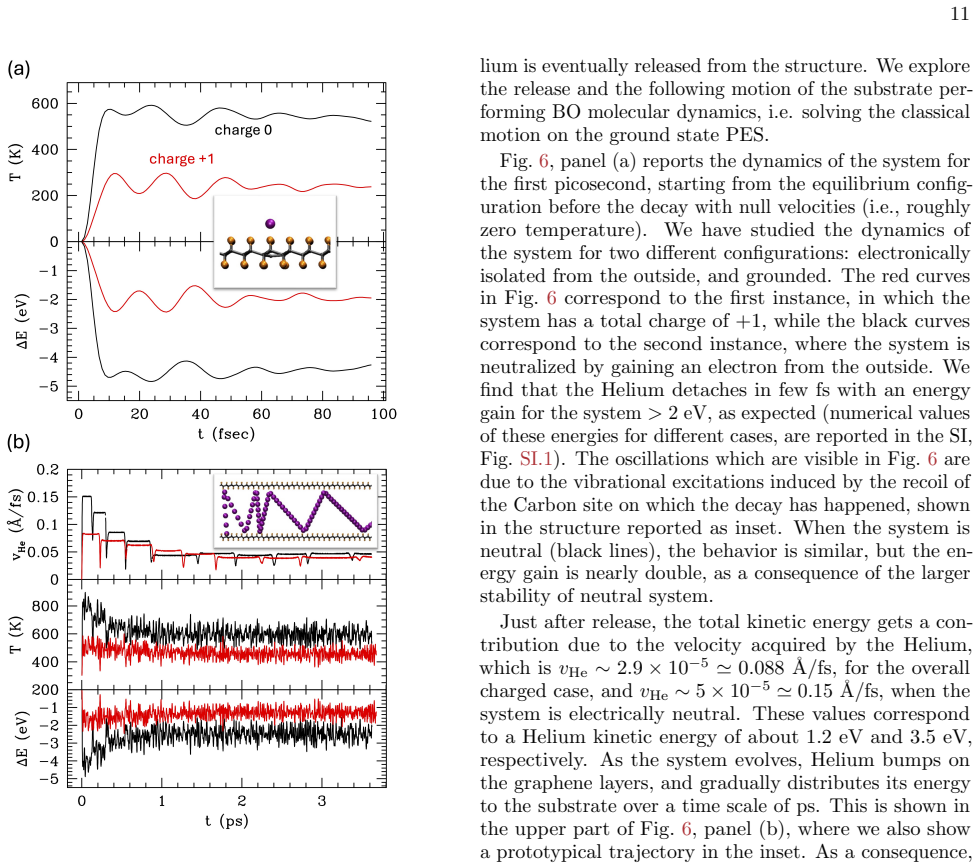
We present the results of a multi-methodological study aimed at investigating the interaction between graphene and Tritium during its $\beta$-decay to Helium, under different levels of loading and geometrical configurations. We combine Density Functional Theory (DFT), to evaluate the interaction potentials, with calculations of the decay rate, in order to study the consequences that the presence of the substrate has on the $\beta$-decay spectrum of Tritium. We determine the shape of the event rate, accounting for the effects of (part of) the corresponding condensed matter degrees of freedom. In the context of future neutrino experiments, our results provide important information aimed at the optimization of hosting material, as well as the determination of the physics reach. Furthermore, our work outlines a novel theoretical and computational scheme to address a question at the boundary between high and low energy physics. This requires non-conventional declinations of DFT combined with full quantum treatments of the nuclear configuration involved in the decay process.
Editorial analysis
A structured set of objections, weighed in public.
Referee Report
Summary. The paper presents a multi-methodological study that combines Density Functional Theory (DFT) calculations of interaction potentials between tritium, helium, and graphene (under varying loadings and geometries) with nuclear quantum-mechanical treatments of the decay process. The central claim is that these condensed-matter degrees of freedom modify the tritium β-decay spectrum shape and endpoint, providing guidance for material optimization in future neutrino-mass experiments.
Significance. If the central results hold, the work supplies a concrete computational bridge between nuclear β-decay and substrate effects that is directly relevant to tritium-based neutrino-mass searches. The explicit combination of first-principles electronic-structure potentials with a full quantum treatment of the nuclear configuration is a methodological strength that could be reused for other light-nucleus decays in condensed-matter hosts.
major comments (2)
- [Decay-rate calculation section] The manuscript must demonstrate that the decay-rate calculation employs the sudden approximation with explicit overlap integrals between the initial (tritium + graphene) and final (helium + graphene) many-body electronic states. Beta decay occurs on ~10^{-21} s timescales; if only static DFT potentials are inserted into a time-independent nuclear Schrödinger equation without these overlaps or time-dependent DFT validation, the reported spectrum shape and endpoint shift rest on an uncontrolled approximation (see skeptic note and abstract description of the decay-rate step).
- [DFT potential evaluation] The accuracy of the DFT-derived T–He–graphene potentials for the final-state distribution must be quantified. The paper should report convergence tests with respect to functional, basis set, and supercell size, together with an estimate of missing many-body or relativistic corrections, because these directly propagate into the claimed substrate-induced modification of the spectrum.
minor comments (2)
- [Abstract and introduction] The abstract states that the study accounts for “(part of) the corresponding condensed matter degrees of freedom”; the manuscript should clarify which degrees of freedom are omitted and why they are expected to be sub-dominant.
- [Methods] Notation for the nuclear wave functions and the interaction potentials should be made uniform between the DFT and nuclear-QM sections to avoid ambiguity when the potentials are transferred.
Simulated Author's Rebuttal
We thank the referee for their careful reading of our manuscript and for the constructive comments. We appreciate the positive evaluation of the work's significance and methodological approach. We address each of the major comments below.
read point-by-point responses
-
Referee: [Decay-rate calculation section] The manuscript must demonstrate that the decay-rate calculation employs the sudden approximation with explicit overlap integrals between the initial (tritium + graphene) and final (helium + graphene) many-body electronic states. Beta decay occurs on ~10^{-21} s timescales; if only static DFT potentials are inserted into a time-independent nuclear Schrödinger equation without these overlaps or time-dependent DFT validation, the reported spectrum shape and endpoint shift rest on an uncontrolled approximation (see skeptic note and abstract description of the decay-rate step).
Authors: We thank the referee for pointing out the need for clarity on this aspect. Our calculation of the decay rate does employ the sudden approximation, justified by the short timescale of the beta decay process (~10^{-21} s) compared to nuclear motion. The DFT interaction potentials are used to solve the nuclear Schrödinger equation for the initial tritium-graphene and final helium-graphene systems. The spectrum is then obtained from the overlap integrals of the corresponding nuclear wave functions. This captures the effect of the substrate on the nuclear configuration. We will revise the relevant section to explicitly describe this procedure and the underlying assumptions of the sudden approximation. A full explicit calculation of many-body electronic overlap integrals is not performed; instead, the effective potentials from DFT encode the electronic contributions. We believe this is a controlled approximation for the purposes of this study, though we acknowledge the referee's concern and will discuss its limitations. revision: partial
-
Referee: [DFT potential evaluation] The accuracy of the DFT-derived T–He–graphene potentials for the final-state distribution must be quantified. The paper should report convergence tests with respect to functional, basis set, and supercell size, together with an estimate of missing many-body or relativistic corrections, because these directly propagate into the claimed substrate-induced modification of the spectrum.
Authors: We agree that quantifying the accuracy of the DFT potentials is crucial. In the revised manuscript, we will add a subsection detailing convergence tests with respect to supercell size and the number of k-points. We will also discuss the choice of functional (PBE) and provide an estimate of the effects of missing van der Waals corrections and relativistic effects on the potentials and resulting spectrum shifts. These will be presented as systematic uncertainties in the final results. revision: yes
Circularity Check
No significant circularity; DFT potentials and nuclear decay rate are independent computational steps
full rationale
The paper computes interaction potentials via standard DFT electronic-structure methods and feeds the resulting potentials into a separate nuclear quantum-mechanical treatment of the decay rate. No equations reduce the final spectrum to a fit of the same data, no self-citation supplies a uniqueness theorem that forces the result, and no ansatz is smuggled in. The derivation chain therefore adds independent content at each stage and remains self-contained against external benchmarks.
Axiom & Free-Parameter Ledger
axioms (2)
- domain assumption Standard DFT exchange-correlation functionals provide accurate interaction potentials between tritium, helium, and graphene carbon atoms.
- domain assumption The nuclear decay can be treated quantum-mechanically on top of the DFT-derived potentials without significant back-reaction from the electronic system during the decay.
Lean theorems connected to this paper
-
IndisputableMonolith/Cost/FunctionalEquation.leanwashburn_uniqueness_aczel unclear?
unclearRelation between the paper passage and the cited Recognition theorem.
We combine Density Functional Theory (DFT), to evaluate the interaction potentials, with calculations of the decay rate... sudden approximation... semi-sudden approximation... Schrödinger equation for the nuclei
-
IndisputableMonolith/Foundation/AlexanderDuality.leanalexander_duality_circle_linking unclear?
unclearRelation between the paper passage and the cited Recognition theorem.
We combine Density Functional Theory (DFT), to evaluate the interaction potentials, with calculations of the decay rate... sudden approximation... semi-sudden approximation... Schrödinger equation for the nuclei
What do these tags mean?
- matches
- The paper's claim is directly supported by a theorem in the formal canon.
- supports
- The theorem supports part of the paper's argument, but the paper may add assumptions or extra steps.
- extends
- The paper goes beyond the formal theorem; the theorem is a base layer rather than the whole result.
- uses
- The paper appears to rely on the theorem as machinery.
- contradicts
- The paper's claim conflicts with a theorem or certificate in the canon.
- unclear
- Pith found a possible connection, but the passage is too broad, indirect, or ambiguous to say the theorem truly supports the claim.
Forward citations
Cited by 1 Pith paper
-
Pathways and impediments towards a detection of the relic neutrino wind
Detecting the cosmic neutrino background's dipole anisotropy via tritium capture requires ~10^5 times the exposure needed for flux detection, with Majorana neutrinos suffering an additional (m_ν/T_ν)^2 suppression.
discussion (0)
Sign in with ORCID, Apple, or X to comment. Anyone can read and Pith papers without signing in.