REVIEW 4 major objections 5 minor 39 references
Meta-PerSER: Few-Shot Listener Personalized Speech Emotion Recognition via Meta-learning
T0 review · 4 major / 5 minor · reviewed 2026-08-07 · deepseek-v4-flash
Pith's one-line read Meta-learning can personalize categorical speech emotion recognition to a new listener using only 32 labeled samples, with the largest gains on utterances never heard during training.
desk verdict The message is useful but the CSMT shortcut is not justified; the paper needs a MAML baseline, error bars, and an honest ablation before its claims hold. read the letter →
The pith
A machine-rendered reading of the paper's core claim, the machinery that carries it, and where it could break.
The reading
What carries the argument
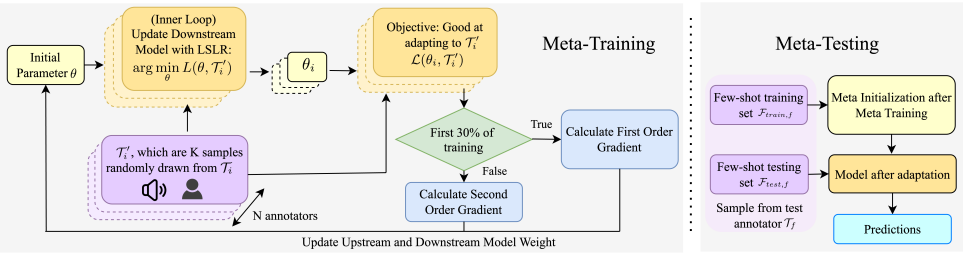
The central mechanism is Model-Agnostic Meta-Learning (MAML), a training procedure where the model is updated in an inner loop on a few samples from one listener and then improved in an outer loop across listeners, so the shared initialization is tuned for fast adaptation. The paper's modifications are Combined-Set Meta-Training (CSMT), which removes the support/query split and uses all available listener data for both adaptation and meta-update; Derivative Annealing (DA), which uses first-order gradients for the first 30% of inner-loop steps and second-order derivatives later; and Learning Per-Layer Per-Step Learning Rates and Gradient Directions (LSLR), which learns separate learning rates per layer per step. These are stacked on representations from pretrained self-supervised speech models and a two-layer downstream classifier.
What would settle it
Reproduce the Unseen Data experiment with a strict MAML split in which each listener's 32 adaptation utterances and 128 evaluation utterances are disjoint and drawn from different sessions; if Meta-PerSER's margin over the Entire-Few baseline collapses, Combined-Set Meta-Training's same-pool evaluation is the source of the claims.
Extended reading notes
Core claim
On the paper's own terms, the central discovery is that a categorical SER model pretrained on aggregated emotion labels can be reshaped by MAML into a personalizable model: each annotator defines a task, the inner loop adapts the shared initialization to that annotator's labels, and the outer loop improves the initialization across annotators. The three additions—Combined-Set Meta-Training, which drops the support/query split because all annotators label the same domain; Derivative Annealing, which delays second-order gradients; and per-layer per-step learned learning rates—are what make the adaptation stable and cheap. The result is consistent gains over baselines in both application scenarios across three self-supervised upstream models, including, in the unseen-data scenario, improvements of up to about 7 percentage points in macro-F1, micro-F1, and unweighted accuracy over SSL fine-tuning baselines.
Load-bearing premise
The approach depends on the idea that every annotator's labels come from the same speech pool with similar feature distributions, so the same samples can serve both as the adaptation set and as the evaluation set; if that idea is false, the measured gains may reflect fitting the adaptation set rather than generalizing to a new listener.
Editorial extensions
If this is right
- A new listener's categorical emotion judgments can be captured with 32 labeled utterances, so per-user data collection becomes practical rather than requiring thousands of samples.
- Personalized models gain the most when the test audio was never heard in training: in the Unseen Data scenario Meta-PerSER improves macro-F1, micro-F1, and unweighted accuracy by up to about 7 percentage points over SSL fine-tuning.
- Adaptation quality peaks at $K=32$ few-shot samples; increasing to 64 slightly hurts, suggesting an optimal personalization budget rather than monotonic gains.
- The full Meta-PerSER stack (pretrained initialization, Combined-Set Meta-Training, Derivative Annealing, and per-layer per-step learning rates) is needed: ablations show each contributes, and their combination gives the best unseen-data results.
- The framework is the first categorical (rather than dimensional) SER approach that personalizes to individual listeners' emotion interpretations.
Reading between the lines
- An implication the authors leave implicit: if the gains come mainly from Combined-Set Meta-Training, the same recipe should transfer to other subjective label tasks with a shared input domain, but only when annotator label distributions are as alike as in IEMOCAP; on more divergent annotators, a true support/query split would likely be needed.
- A testable extension beyond the paper: report per-annotator results for the five test raters; the annotation tables suggest rater C-E5 has an unusual profile (high Fear and Disgust), so checking whether Meta-PerSER's margin over baselines persists for outlier raters would clarify whether the method personalizes or just fine-tunes to the average.
- A neighbouring problem this connects to: speaker-personalized and dimensional rater-personalized SER have been studied separately; Meta-PerSER's categorical listener personalization could be combined with speaker adaptation, since the upstream SSL features already encode speaker characteristics, to personalize by both who speaks and who listens.
Editorial analysis
A structured set of objections, weighed in public.
Referee Report
Summary. The paper proposes Meta-PerSER, a MAML-based meta-learning framework for listener-personalized categorical speech emotion recognition. The method combines a pre-trained SSL backbone (WavLM, Wav2Vec2, or HuBERT) with three proposed components: Combined-Set Meta-Training (CSMT), Derivative Annealing (DA), and per-layer per-step learning rates (LSLR). Experiments on IEMOCAP are reported under two scenarios (Seen Data and Unseen Data), with a few-shot setup of K=32 adaptation samples and Q=128 test samples per held-out annotator. The central claim is that Meta-PerSER consistently outperforms all baselines across both scenarios and all upstream models, with especially large gains when test utterances are unseen during training.
Significance. If the empirical claims hold, the paper would make a useful contribution by shifting SER personalization from speaker adaptation to listener/annotator adaptation and by demonstrating that meta-learning can adapt a categorical SER model to a new annotator with only 32 labeled samples. The use of three SSL upstream models and two application scenarios is a strength, and the authors state that code will be released, which supports reproducibility. However, the central claim currently rests on a meta-training objective that does not measure generalization to held-out utterances, and the reported numerical evidence lacks variance or significance testing. These issues are addressable but are load-bearing for the paper's main conclusion.
major comments (4)
- [Section 2.3.2 and Section 2.3.4] The CSMT objective is not a meta-learning objective in the usual sense: the outer loop optimizes L(θ_i, T'_i) after an inner-loop update on the same set T'_i. This means the meta-gradient rewards fitting the adaptation examples rather than generalizing to new utterances from the same annotator. The justification that 'all annotators label data from the same domain and share similar feature distributions' conflates input-domain overlap with the need to evaluate post-adaptation generalization on unseen query examples. In standard MAML, the support/query split exists precisely to prevent the meta-objective from rewarding memorization of the support set, independent of domain shift. With K=32 and a 94M-parameter model, optimizing the loss on the same samples used for adaptation can drive the training loss down without improving held-out performance. Because no standard MAML baseline with disjoint support/query sets is reported, the gains in Table 1 cannot currently be attributed to meta-generalization rather than to a fine-tuning or regularization effect.
- [Table 2 and Section 4.3] The text in Section 4.3 states that 'the individual application of CSMT, DA, and LSLR consistently enhances performance across all evaluation metrics,' but Table 2 contradicts this for CSMT on micro-F1. Comparing the INI-only row with the INI+CSMT row, micro-F1 decreases for Wav2vec2 (39.4 to 39.1) and for HuBERT (41.9 to 41.5), while macro-F1 improves. The claim of consistent improvement is therefore too strong. The presentation should either restrict the claim to macro-F1 and UA for CSMT or provide a corrected interpretation of the ablation.
- [Section 3.3 and Table 1] The evaluation section states that each experiment is repeated 10 times with different random seeds, but Tables 1, 2, and A4 report only point estimates. Many of the reported differences between Meta-PerSER and the best baseline are small (e.g., Seen Data WavLM maF1: 35.7 vs. 34.3; HuBERT miF1: 51.2 vs. 47.1), and without standard deviations, confidence intervals, or significance tests, the reader cannot judge whether these differences are stable or noise. The central comparative claim would be substantially strengthened by reporting variance across the 10 runs and running paired tests across the held-out annotators.
- [Section 4.2 and Table A4] The claim that performance peaks at K=32 and then declines at K=64 is presented as a finding about the optimal few-shot size, but the differences between K=32 and K=64 are small and often non-monotonic across models and metrics. For example, in Seen Data, WavLM maF1 improves from 35.7 (K=32) to 36.0 (K=64), while Wav2vec2 maF1 improves from 35.6 to 36.5. The conclusion that 'exceeding an optimal size ... may introduce outlier or ambiguous samples' is speculative given the absence of error bars and the inconsistent pattern; this should be softened or supported with statistical evidence.
minor comments (5)
- [Section 2.2] There is a typo in the first sentence: 'ince' should be 'since'.
- [Section 4.1] The text refers to a baseline named 'SSL-FT', but the baselines in Section 2.4 are named Linear-Few, Entire-Few, Entire-Zero, Multi-Few, and Entire-Sim. The comparison should be stated in terms of the actual baseline names, likely Entire-Few.
- [References] References [14] and [20] appear to be the same publication (Davani, Díaz, and Prabhakaran, 'Dealing with Disagreements'); the duplicate should be removed or replaced.
- [Supplementary Material] The phrase 'Append Table A4' should be 'Appendix Table A4', and Figure 2's caption ('shown on legend') is awkward and should be rewritten.
- [Section 2.3.3] The description of Derivative Annealing as using 'first 30% of inner-loop steps' is imprecise; the manuscript should specify whether this is 30% of the 50 adaptation steps, and should give the exact transition schedule used in the experiments.
Circularity Check
No significant circularity: the central claim is an empirical comparison on held-out annotator data; the CSMT shared adaptation/evaluation set is a training-objectivity caveat, not a circular derivation.
full rationale
Meta-PerSER's central claim is an empirical comparison on held-out annotator data (Section 4.1, Table 1; meta-testing in Section 2.3.4 uses F_test,f disjoint from F_train,f), so the reported gains are not forced by construction. No fitted constant is renamed as a prediction, and the method is compared against baselines on the same held-out splits. The only self-referential design element is Combined-Set Meta-Training (Section 2.3.2), where the inner loop updates on T'_i and the outer loop evaluates L(theta_i, T'_i) on the same T'_i; this makes the meta-training signal reward fitting the adaptation set rather than generalization to new utterances, and the justification that 'all annotators label data from the same domain and share similar feature distributions' does not address the need for a disjoint query set. However, this is a validity caveat about the meta-objective, not circularity in the final evaluation, because meta-testing still uses disjoint F_test. DA and LSLR are adopted from the external reference Antoniou et al. [30], the SSL backbones and IEMOCAP are external, and self-citations to SUPERB [25], Open-Emotion [12], and Emobias [33] are toolkit or metric references that are not load-bearing. One additional inconsistency (not circularity): Section 4.3 claims CSMT 'consistently enhances performance across all evaluation metrics,' but Table 2 shows INI+CSMT lowers micro-F1 relative to INI for Wav2vec2 (39.4 to 39.1) and HuBERT (41.9 to 41.5). Score 1 reflects the mildly self-referential CSMT design without treating it as a circular derivation.
Assumptions & free parameters
free parameters (4)
- few-shot training set size K =
32
- Derivative Annealing transition point =
30% of inner-loop steps
- outer loop learning rate =
9e-5
- inner loop learning rate =
0.001
assumptions (3)
- standard math MAML with first-order/second-order gradients converges to a good initialization
- domain assumption IEMOCAP's external annotator labels represent learnable individual annotation styles
- ad hoc to paper Feature distributions are similar across annotators, making support/query split unnecessary
Cite this review
Pith. "Pith review of Meta-PerSER: Few-Shot Listener Personalized Speech Emotion Recognition via Meta-learning." pith.science (2026). https://pith.science/paper/QIAZLCBN
@misc{pith2026250516220,
  author       = {Pith},
  title        = {Pith review of: Meta-PerSER: Few-Shot Listener Personalized Speech Emotion Recognition via Meta-learning},
  year         = {2026},
  howpublished = {\url{https://pith.science/paper/QIAZLCBN}},
  note         = {Machine review of arXiv:2505.16220}
}
read the original abstract
This paper introduces Meta-PerSER, a novel meta-learning framework that personalizes Speech Emotion Recognition (SER) by adapting to each listener's unique way of interpreting emotion. Conventional SER systems rely on aggregated annotations, which often overlook individual subtleties and lead to inconsistent predictions. In contrast, Meta-PerSER leverages a Model-Agnostic Meta-Learning (MAML) approach enhanced with Combined-Set Meta-Training, Derivative Annealing, and per-layer per-step learning rates, enabling rapid adaptation with only a few labeled examples. By integrating robust representations from pre-trained self-supervised models, our framework first captures general emotional cues and then fine-tunes itself to personal annotation styles. Experiments on the IEMOCAP corpus demonstrate that Meta-PerSER significantly outperforms baseline methods in both seen and unseen data scenarios, highlighting its promise for personalized emotion recognition.
Figures

Reference graph
Works this paper leans on
-
[13]
Speaker Attentive Speech Emotion Recognition,
C. L. Moine, N. Obin, and A. Roebel, “Speaker Attentive Speech Emotion Recognition,” inInterspeech 2021, 2021
work page 2021
-
[1]
Introduction Speech Emotion Recognition(SER) aims to automatically iden- tify emotional states from vocal cues [1, 2, 3]. Despite substan- tial progress with deep learning, SER remains challenging due to the complexity of emotional expressions and the subjectivity of emotion perception [4]. One fundamental challenge in SER is the variability across speake...
arXiv 2025
-
[2]
Backbone SER Framework We employ a unified model architecture based on the s3prl toolkit [25]
Methodology 2.1. Backbone SER Framework We employ a unified model architecture based on the s3prl toolkit [25]. Our SER framework comprises two principal com- ponents: an upstream module and a downstream module. The upstream module leverages pre-trained self-supervised learning (SSL) models, the base variants of Wav2Vec2 [26] 2, HuBERT [27]3, and WavLM [2...
-
[3]
Experiments Settings 3.1. Resource We use the IEMOCAP corpus [24], which contains 10,039 ut- terances by 10 professional actors. Each utterance is labeled by at least three annotators, who may assign one or more emotion labels from a set of 10 categories—namely, frustrated, angry, sad, disgust, excited, fear, neutral, surprise, happy, and “other.” We excl...
-
[4]
Results and Analysis 4.1. Proposed Meta-PerSER Table 1 demonstrates that Meta-PerSER consistently outper- forms all baseline methods across both Seen and Unseen Data scenarios and across all upstream models. Under the Seen Data setting, Meta-PerSER improves macro-F1, micro-F1, and unweighted accuracy scores by approximately 1–2 percentage points over the ...
-
[5]
Limitations We are among the first to investigate categorical personalized SER systems. However, our current experimental settings do not incorporate conversational context, as emotional ratings are based solely on conversational-level audio-visual cues provided by annotators. This limitation may hinder the system’s ability to accurately capture the natur...
-
[6]
Conclusion and Future Work This paper introduces a novel framework,Meta-PerSER, de- signed to effectively adapt to unseen annotators in SER tasks with only a few labeled examples. Meta-PerSER integrates a pre-trained self-supervised backbone with Combined-Set Meta- Training, Derivative Annealing, and per-layer adaptive learning rates. This design enables ...
-
[7]
B. Schuller, G. Rigoll, and M. Lang, “Speech emotion recognition combining acoustic features and linguistic information in a hy- brid support vector machine-belief network architecture,” in2004 IEEE International Conference on Acoustics, Speech, and Signal Processing, 2004
work page 2004
Show all 39 references
-
[8]
Speech Emotion Recognition Using Deep Learn- ing Techniques: A Review,
R. A. Khalil, E. Jones, M. I. Babar, T. Jan, M. H. Zafar, and T. Alhussain, “Speech Emotion Recognition Using Deep Learn- ing Techniques: A Review,”IEEE Access, 2019
2019
-
[9]
Speech Emotion Recognition with Fusion of Acoustic- and Linguistic-Feature- Based Decisions,
R. Nagase, T. Fukumori, and Y . Yamashita, “Speech Emotion Recognition with Fusion of Acoustic- and Linguistic-Feature- Based Decisions,” in2021 Asia-Pacific Signal and Information Processing Association Annual Summit and Conference (APSIPA ASC), 2021
2021
-
[10]
EMO-Codec: An In-Depth Look at Emotion Preservation Capacity of Legacy and Neural Codec Models with Subjective and Objective Evaluations,
W. Ren, Y .-C. Lin, H.-C. Chou, H. Wu, Y .-C. Wu, C.-C. Lee, H.-Y . Lee, H.-M. Wang, and Y . Tsao, “EMO-Codec: An In-Depth Look at Emotion Preservation Capacity of Legacy and Neural Codec Models with Subjective and Objective Evaluations,” in2024 Asia Pacific Signal and Informa...
2024
-
[11]
Interpreting ambiguous emotional expressions,
E. Mower, A. Metallinou, C.-C. Lee, A. Kazemzadeh, C. Busso, S. Lee, and S. Narayanan, “Interpreting ambiguous emotional expressions,” in2009 3rd International Conference on Affective Computing and Intelligent Interaction and Workshops, 2009, pp. 1–8
2009
-
[12]
The Ambiguous World of Emotion Representation,
V . Sethu, E. M. Provost, J. Epps, C. Busso, N. Cummins, and S. Narayanan, “The Ambiguous World of Emotion Representation,” 2019. [Online]. Available: https://arxiv.org/abs/ 1909.00360
2019 arXiv
-
[14]
Personalized Adapta- tion with Pre-trained Speech Encoders for Continuous Emotion Recognition,
M. Tran, Y . Yin, and M. Soleymani, “Personalized Adapta- tion with Pre-trained Speech Encoders for Continuous Emotion Recognition,” inInterspeech 2023, 2023
2023
-
[15]
The “Problem
B. Plank, “The “Problem” of Human Label Variation: On Ground Truth in Data, Modeling and Evaluation,” inProceedings of the 2022 Conference on Empirical Methods in Natural Language Processing, 2022
2022
-
[16]
DICES Dataset: Diversity in Conversational AI Evaluation for Safety,
L. Aroyo, A. Taylor, M. D ´ıaz, C. Homan, A. Parrish, G. Serapio- Garc´ıa, V . Prabhakaran, and D. Wang, “DICES Dataset: Diversity in Conversational AI Evaluation for Safety,” inAdvances in Neu- ral Information Processing Systems, 2023
2023
-
[17]
On Re- leasing Annotator-Level Labels and Information in Datasets,
V . Prabhakaran, A. Mostafazadeh Davani, and M. Diaz, “On Re- leasing Annotator-Level Labels and Information in Datasets,” in Proceedings of the Joint 15th Linguistic Annotation Workshop (LAW) and 3rd Designing Meaning Representations (DMR) Work- shop, C. Bonial and N. Xue, Eds., 2021
2021
-
[18]
Open-Emotion: A Reproducible EMO-Superb For Speech Emotion Recognition Systems,
H. Wu, H.-C. Chou, K.-W. Chang, L. Goncalves, J. Du, J.-S. R. Jang, C.-C. Lee, and H.-Y . Lee, “Open-Emotion: A Reproducible EMO-Superb For Speech Emotion Recognition Systems,” in2024 IEEE Spoken Language Technology Workshop (SLT), 2024, pp. 510–517
2024
-
[19]
Every Rating Matters: Joint Learn- ing of Subjective Labels and Individual Annotators for Speech Emotion Classification,
H.-C. Chou and C.-C. Lee, “Every Rating Matters: Joint Learn- ing of Subjective Labels and Individual Annotators for Speech Emotion Classification,” inICASSP 2019 - 2019 IEEE Interna- tional Conference on Acoustics, Speech and Signal Processing (ICASSP), 2019
2019
-
[20]
Dealing with Dis- agreements: Looking Beyond the Majority V ote in Subjective Annotations,
A. M. Davani, M. D ´ıaz, and V . Prabhakaran, “Dealing with Dis- agreements: Looking Beyond the Majority V ote in Subjective Annotations,”Transactions of the Association for Computational Linguistics, 2022
2022
-
[21]
Meta- Learning in Neural Networks: A Survey,
T. Hospedales, A. Antoniou, P. Micaelli, and A. Storkey, “Meta- Learning in Neural Networks: A Survey,”IEEE Transactions on Pattern Analysis and Machine Intelligence, vol. 44, no. 9, pp. 5149–5169, 2022
2022
-
[22]
Model-agnostic meta-learning for fast adaptation of deep networks,
C. Finn, P. Abbeel, and S. Levine, “Model-agnostic meta-learning for fast adaptation of deep networks,” inProceedings of the 34th International Conference on Machine Learning - Volume 70, ser. ICML’17. JMLR.org, 2017, p. 1126–1135
2017
-
[23]
Optimization as a Model for Few- Shot Learning,
S. Ravi and H. Larochelle, “Optimization as a Model for Few- Shot Learning,” inInternational Conference on Learning Repre- sentations, 2017
2017
-
[24]
Meta-Learning for Speech Emotion Recognition Considering Ambiguity of Emotion Labels,
T. Fujioka, T. Homma, and K. Nagamatsu, “Meta-Learning for Speech Emotion Recognition Considering Ambiguity of Emotion Labels,” inInterspeech 2020, 2020, pp. 2332–2336
2020
-
[25]
Meta- Learning for Low-Resource Speech Emotion Recognition,
S. Chopra, P. Mathur, R. Sawhney, and R. R. Shah, “Meta- Learning for Low-Resource Speech Emotion Recognition,” in ICASSP 2021 - 2021 IEEE International Conference on Acous- tics, Speech and Signal Processing (ICASSP), 2021, pp. 6259– 6263
2021
-
[26]
Dealing with Dis- agreements: Looking Beyond the Majority V ote in Subjective Annotations,
A. M. Davani, M. D ´ıaz, and V . Prabhakaran, “Dealing with Dis- agreements: Looking Beyond the Majority V ote in Subjective Annotations,”Transactions of the Association for Computational Linguistics, vol. 10, pp. 92–110, 01 2022
2022
-
[27]
Speech emotion recognition based on meta-transfer learning with domain adaption,
Z.-T. Liu, B.-H. Wu, M.-T. Han, W.-H. Cao, and M. Wu, “Speech emotion recognition based on meta-transfer learning with domain adaption,”Applied Soft Computing, vol. 147, p. 110766, 2023
2023
-
[28]
On efficacy of Meta-Learning for Domain Generalization in Speech Emotion Recognition,
R. K. Gandhi, V . Tsouvalas, and N. Meratnia, “On efficacy of Meta-Learning for Domain Generalization in Speech Emotion Recognition,” in2023 IEEE International Conference on Perva- sive Computing and Communications Workshops and other Affili- ated Events (PerCom Workshops), 20...
2023
-
[29]
Learning to Recognize Per-Rater’s Emotion Perception Using Co-Rater Training Strategy with Soft and Hard Labels,
H.-C. Chou and C.-C. Lee, “Learning to Recognize Per-Rater’s Emotion Perception Using Co-Rater Training Strategy with Soft and Hard Labels,” inInterspeech 2020, 2020, pp. 4108–4112
2020
-
[30]
IEMOCAP: Interactive emotional dyadic motion capture database,
C. Busso, M. Bulut, C.-C. Lee, A. Kazemzadeh, E. Mower, S. Kim, J. N. Chang, S. Lee, and S. S. Narayanan, “IEMOCAP: Interactive emotional dyadic motion capture database,”Language resources and evaluation, 2008
2008
-
[31]
SUPERB: Speech Processing Universal PERformance Benchmark,
S. wen Yang, P.-H. Chi, Y .-S. Chuang, C.-I. J. Lai, K. Lakhotia, Y . Y . Lin, A. T. Liu, J. Shi, X. Chang, G.-T. Lin, T.-H. Huang, W.-C. Tseng, K. tik Lee, D.-R. Liu, Z. Huang, S. Dong, S.-W. Li, S. Watanabe, A. Mohamed, and H. yi Lee, “SUPERB: Speech Processing Universal PER...
2021
-
[32]
wav2vec 2.0: a framework for self-supervised learning of speech representa- tions,
A. Baevski, H. Zhou, A. Mohamed, and M. Auli, “wav2vec 2.0: a framework for self-supervised learning of speech representa- tions,” inProceedings of the 34th International Conference on Neural Information Processing Systems, 2020
2020
-
[33]
HuBERT: Self-Supervised Speech Rep- resentation Learning by Masked Prediction of Hidden Units,
W.-N. Hsu, B. Bolte, Y .-H. H. Tsai, K. Lakhotia, R. Salakhutdi- nov, and A. Mohamed, “HuBERT: Self-Supervised Speech Rep- resentation Learning by Masked Prediction of Hidden Units,” IEEE/ACM Transactions on Audio, Speech, and Language Pro- cessing, 2021
2021
-
[34]
WavLM: Large-Scale Self-Supervised Pre- Training for Full Stack Speech Processing,
S. Chenet al., “WavLM: Large-Scale Self-Supervised Pre- Training for Full Stack Speech Processing,”IEEE Journal of Se- lected Topics in Signal Processing, 2022
2022
-
[35]
Class- Balanced Loss Based on Effective Number of Samples,
Y . Cui, M. Jia, T.-Y . Lin, Y . Song, and S. Belongie, “Class- Balanced Loss Based on Effective Number of Samples,” inPro- ceedings of the IEEE/CVF Conference on Computer Vision and Pattern Recognition (CVPR), June 2019
2019
-
[36]
How to train your MAML,
A. Antoniou, H. Edwards, and A. Storkey, “How to train your MAML,” inInternational Conference on Learning Representa- tions, 2019
2019
-
[37]
Few-Shot Acoustic Event Detection Via Meta Learn- ing,
B. Shi, M. Sun, K. C. Puvvada, C.-C. Kao, S. Matsoukas, and C. Wang, “Few-Shot Acoustic Event Detection Via Meta Learn- ing,” inICASSP 2020 - 2020 IEEE International Conference on Acoustics, Speech and Signal Processing (ICASSP), 2020
2020
-
[38]
Macro f1 and macro f1,
J. Opitz and S. Burst, “Macro f1 and macro f1,”arXiv preprint arXiv:1911.03347, 2019
1911 arXiv
-
[39]
Emo- bias: A large scale evaluation of social bias on speech emotion recognition,
Y .-C. Lin, H. Wu, H.-C. Chou, C.-C. Lee, and H. yi Lee, “Emo- bias: A large scale evaluation of social bias on speech emotion recognition,” inInterspeech 2024, 2024, pp. 4633–4637. Supplementary Material In this Supplementary Material, we provide additional ex- perimental res...
2024
Reviewed August 7, 2026 · model on record in the stance chip above.
Discussion (0). Sign in to comment.