REVIEW 4 major objections 8 minor 1 cited by
Class-Proportional Coreset Selection for Difficulty-Separable Data
T0 review · 4 major / 8 minor · reviewed 2026-08-06 · deepseek-v4-flash
Pith's one-line read This paper argues that difficulty-based coreset selection should allocate sampling budgets per class rather than globally, because in security and medical datasets data difficulty often clusters by class, and shows that this simple…
desk verdict A genuinely useful but modest paper: class-proportional coreset selection shows consistent gains, but an unreported per-class minimum and a missing stratified-random control leave the mechanism underdetermined. read the letter →
The pith
A machine-rendered reading of the paper's core claim, the machinery that carries it, and where it could break.
The reading
What carries the argument
The load-bearing object is CDSC plus the class-proportional allocation rule. CDSC is defined as $\delta_{\mathrm{CD}} = \frac{1}{\log_2 C}\left(H(M) - \frac{1}{C}\sum_{c=1}^C H(P_c)\right)$, a normalized Jensen-Shannon divergence between class-conditional difficulty-score distributions $P_c$ and their equal-weight mixture $M$; it is 0 when all classes share the same difficulty profile and approaches 1 when the profiles are disjoint. The second piece is Algorithm 1, which assigns each class a budget proportional to its size, subject to a minimum $m$ per class, and runs the existing sampling function $f$ independently on each class's difficulty scores. Together they convert any difficulty-based selector into a class-aware one, with CDSC providing the diagnostic that tells a practitioner when the conversion will help.
What would settle it
Compare CCS-CP against a class-proportional random sampler at the same per-class budgets, and separately ablate the per-class minimum $m$, on CTU-13 at a 99% pruning rate. If the random sampler matches CCS-CP, or if setting $m=0$ erases the gains, then the claimed advantage is carried by the guaranteed minimum rather than by difficulty-based proportional selection.
Extended reading notes
Core claim
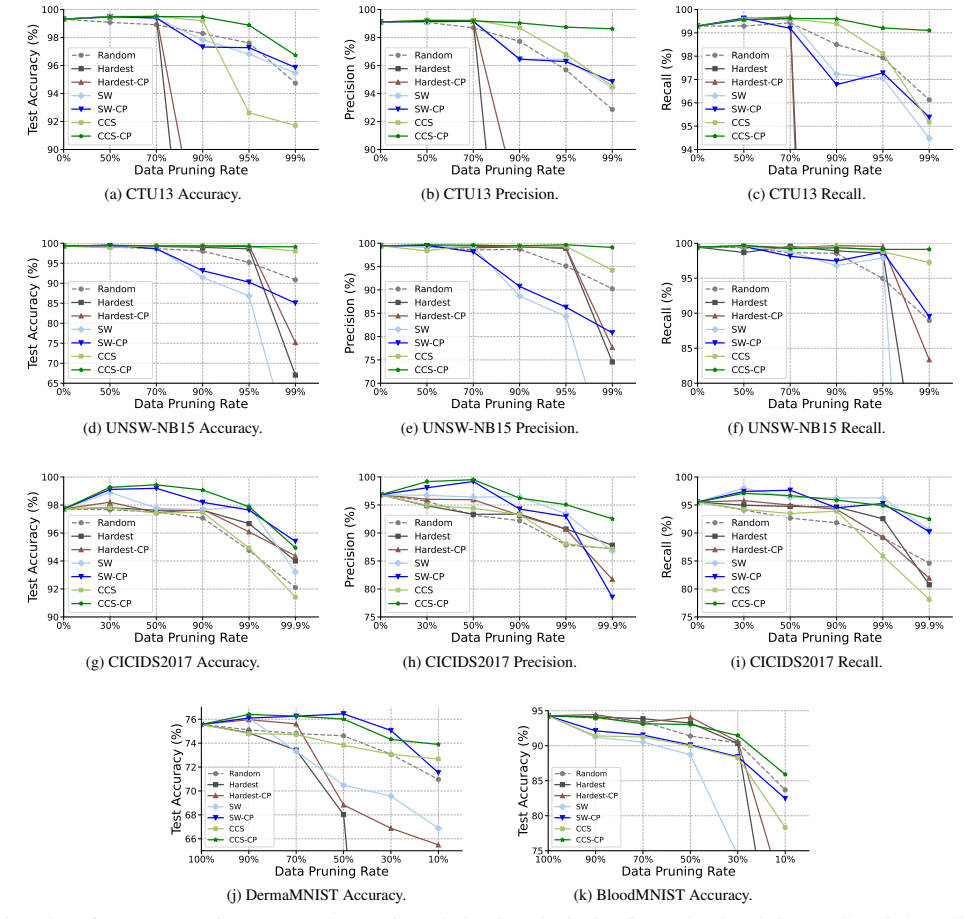
The central claim is that class-proportional variants of difficulty-based coreset selectors consistently outperform class-agnostic selectors on class-difficulty-separable data, and that the gains grow with pruning rate and with the measured separability. The supporting claim is that CDSC, defined as the normalized Jensen-Shannon divergence between class-conditional difficulty distributions, is a usable predictor of when class-aware selection matters: datasets with higher $\delta_{\mathrm{CD}}$ show larger accuracy, precision, and recall gaps between CCS-CP and CCS. The authors present this as an extension of existing one-shot coreset methods rather than a new selector: the same intra-class procedure (hardest, sliding window, or coverage-centric) is run independently within each class under a proportional quota.
Load-bearing premise
The per-class minimum $m$ in Algorithm 1 is a free input that the paper never reports or ablates, so at extreme pruning rates the reported gains could come from this floor guaranteeing rare-class representation rather than from proportional allocation or within-class difficulty sampling.
Editorial extensions
If this is right
- On CTU-13, CCS-CP loses only 2.58% accuracy at 99% pruning while CCS loses 7.59%, with similar margins in precision and recall.
- Datasets with higher CDSC values show larger gains from class-proportional CCS, so CDSC can serve as a pre-screening diagnostic for when class-aware pruning will matter.
- Class-proportional variants of three selectors (hardest, sliding window, CCS) all improve over their class-agnostic versions, meaning the benefit transfers across selection strategies.
- On several datasets, pruning up to 90% can match or exceed full-data test accuracy, precision, or recall, indicating that removing redundant and noisy examples helps generalization.
- CCS-CP's performance is nearly insensitive to the choice of difficulty metric (AUM, Forgetting, EL2N), suggesting the class-aware allocation, not the exact score, drives the gains.
Reading between the lines
- The CDSC predictor is only validated on five datasets; a natural extension is to test whether the same $\delta_{\mathrm{CD}}$ threshold transfers to other imbalanced domains such as fraud detection or rare-event forecasting, where class-conditional difficulty can be computed from a warm-up model.
- Because the class-proportional patch is modular, it could be applied to score-based selectors beyond the three studied, such as EL2N- or influence-based methods, and likely inherit the same robustness at high pruning rates.
- If the gains are driven mostly by the per-class minimum floor rather than proportional allocation, the method could be simplified to stratified random sampling with a rare-class guarantee; the paper does not include that control.
- The observation that aggressive pruning improves generalization on noisy data suggests class-proportional coresets could serve as a training-data cleaning step before full training, but the paper does not measure downstream training-time savings.
Editorial analysis
A structured set of objections, weighed in public.
Referee Report
Summary. The paper challenges the implicit assumption made by difficulty-based coreset selection methods that class-wise difficulty distributions are homogeneous. It introduces the Class Difficulty Separability Coefficient (CDSC, δCD), a normalized Jensen–Shannon divergence over class-conditional AUM distributions, and proposes class-proportional variants of three difficulty-based selectors: Hardest-example, Sliding-Window, and Coverage-Centric Coreset Selection (CCS). The variants allocate sampling budgets to classes proportionally to class size, subject to a per-class minimum m, and then sample within each class. Experiments on three network intrusion datasets (CICIDS2017, CTU-13, UNSW-NB15) and two medical imaging datasets (BloodMNIST, DermaMNIST) report accuracy, precision, and recall at pruning rates up to 99.9%. The paper claims that class-proportional variants consistently outperform class-agnostic baselines, especially at high pruning rates, and that datasets with higher δCD show larger gains, as summarized in Table 3.
Significance. If the empirical claims are supported, the paper identifies a practically relevant failure mode of class-agnostic coreset selection and proposes a simple, modular remedy that can be grafted onto existing methods. The formalization of class-difficulty separability through CDSC is a useful descriptive contribution, and the choice of security and medical domains is well motivated. The main strengths are the clear problem statement, the simple algorithmic modification, and the breadth of datasets tested. However, the central claim is currently under-supported: the per-class minimum m is never reported or ablated, there is no stratified-random control to isolate the effect of proportional allocation, all results come from single runs without error bars, and the CDSC-gain correlation rests on five un-tested points. These gaps are addressable within the scope of a revision and do not, on the current evidence, invalidate the idea; they do mean that the paper should not be accepted in its present form.
major comments (4)
- [§3.4, Algorithm 1] The per-class minimum m in Algorithm 1 is a free input that is never reported, swept, or ablated. At high pruning rates, B'_c = max(⌊B·n_c/n⌋, m) forces every class to retain at least m examples, while the class-agnostic CCS baseline applies a global cutoff and can drop rare classes entirely (the paper itself notes in §3.2 that a 1% cutoff removes the Web Attack–XSS class in CICIDS2017). The headline CTU-13 result (CCS-CP accuracy drop 2.58% vs. 7.59% for CCS at 99% pruning) could therefore be driven by the rare-class representation floor rather than by the proportional allocation or the within-class difficulty-based sampling. Please report m for every experiment, ablate m (including m=0 and m=1), and add a stratified-random (class-proportional random) baseline to separate these effects.
- [§5.1, Fig. 3] All results are reported as single trajectories with no repeated runs, error bars, or significance tests. Statements such as 'consistently outperform' and 'remarkable stability' in §5.1, and the claims that aggressive pruning improves generalization, cannot be distinguished from run-to-run noise, especially for the smaller medical datasets (DermaMNIST has 10,015 samples). Please report means and standard deviations over multiple seeds (or at least bootstrap estimates) for the principal comparisons, and indicate which differences are statistically reliable.
- [§5.2.1, Table 3] The central supporting claim that higher δCD predicts larger gains from class-proportional selection rests on five dataset-level points with no statistical test, no confidence intervals, and no control for confounders such as m, β, pruning rate, and dataset size. The relationship is not even monotone across metrics: UNSW-NB15 has δCD=0.067 but ΔPrecision=4.87, while DermaMNIST has δCD=0.082 and ΔAccuracy=1.21. Please provide a correlation test (e.g., Spearman) with uncertainty, or downgrade the claim to an observation rather than a validated predictive statement.
- [§3.3, Eq. (2)] CDSC is computed from KDE-based class-conditional distributions, but the bandwidth and discretization are not described. Because δCD is normalized by log2 C and depends on KDE smoothing, the cross-dataset comparisons in Table 3 are only meaningful if the estimator is stable to these choices. Please specify the bandwidth selection rule and include a sensitivity analysis (e.g., varying the bandwidth by ±50%) to show that δCD is not an artifact of over- or under-smoothing.
minor comments (8)
- [Table 1] The row labeled 'Total' reports 2,828,743, but the sum of the listed class counts is 2,830,743; please reconcile the discrepancy with Table 2 and the main text.
- [Algorithm 1] Line 16 reads 'Sc ← Sc ∪ Sc', which appears to be a typo: the two operands are identical, so the line is a no-op as written. It should probably be 'S_c ← S_c ∪ {selected subset}' or similar.
- [Algorithm 1] Lines 5 and 12 use the shorthand 'P B′c' without explicit summation bounds; write ∑_{c∈C} B′_c for clarity.
- [Appendix B.1] The hierarchical β search is described but the final β values for each dataset and method are never reported; please make these values available for reproducibility.
- [§3.3] The kernel density estimation used to obtain P_c is not specified; please state the kernel and bandwidth selection rule.
- [§4.2] The 'Random' baseline is uniform random sampling. Adding a class-proportional random baseline would help separate the effect of proportional allocation from the effect of the difficulty-based scoring, which is directly relevant to the m-floor concern raised above.
- [Figure 2] The caption labels the third panel as 'Stratified' while the text refers to the method as 'CCS (stratified sampling)'; please use consistent terminology throughout.
- [§5.2.2, Table 4] The sensitivity to difficulty metrics is shown only on UNSW-NB15; please state whether similar stability holds on the other datasets, particularly CTU-13 and CICIDS2017.
Circularity Check
No significant circularity: CDSC and class-proportional sampling are constructed independently of the measured performance gains, and the paper's self-citations are not load-bearing.
full rationale
The paper's central claim is that class-proportional variants of difficulty-based coreset selectors outperform class-agnostic baselines on class-difficulty-separable data. The class-proportional methods are defined by applying the same selection procedure within each class and allocating the sampling budget proportionally (Algorithm 1); no parameter is fitted to the target accuracy, precision, or recall values that are later reported. The Class Difficulty Separability Coefficient (CDSC, Eq. 2) is a normalized Jensen–Shannon divergence computed from class-conditional AUM distributions, and it is not used to construct the class-proportional selectors. The correlation in Table 3 between CDSC and performance gains is an a posteriori observation on the same datasets, not a fitted model that is then presented as a prediction; no regression or calibration step makes the measured gains a direct algebraic consequence of CDSC. The per-class minimum m in Algorithm 1 is never reported or ablated, which is a legitimate experimental-control concern and a potential confound, but it is not circular reasoning: the reported gains could be inflated by this floor, yet the floor is not defined in terms of the outcome metric and the authors do not claim that m is derived from the results. Self-citations, including the CCS baseline from prior work by the same group, are used as external baselines and algorithmic building blocks rather than as the sole justification for the paper's conclusions. The central results are experimentally self-contained against external datasets, so no step in the derivation chain reduces to its own inputs by construction.
Assumptions & free parameters
free parameters (3)
- m (minimum examples per class)
- beta (cutoff rate for CCS/SW) =
not reported (tuned per dataset)
- KDE bandwidth for CDSC
assumptions (4)
- domain assumption AUM score reflects data difficulty
- domain assumption CDSC, computed from a single model, is treated as a stable dataset property
- domain assumption Class-level aggregation is the right grouping for difficulty separability
- standard math JSD normalization by log2(C) gives a fair cross-dataset comparison
Cite this review
Pith. "Pith review of Class-Proportional Coreset Selection for Difficulty-Separable Data." pith.science (2026). https://pith.science/paper/WXOUUBNM
@misc{pith2026250710904,
  author       = {Pith},
  title        = {Pith review of: Class-Proportional Coreset Selection for Difficulty-Separable Data},
  year         = {2026},
  howpublished = {\url{https://pith.science/paper/WXOUUBNM}},
  note         = {Machine review of arXiv:2507.10904}
}
read the original abstract
High-quality training data is essential for building reliable and efficient machine learning systems. One-shot coreset selection addresses this by pruning the dataset while maintaining or even improving model performance, often relying on training-dynamics-based data difficulty scores. However, most existing methods implicitly assume class-wise homogeneity in data difficulty, overlooking variation in data difficulty across different classes. In this work, we challenge this assumption by showing that, in domains such as network intrusion detection and medical imaging, data difficulty often clusters by class. We formalize this as class-difficulty separability and introduce the Class Difficulty Separability Coefficient (CDSC) as a quantitative measure. We demonstrate that high CDSC values correlate with performance degradation in class-agnostic coreset methods, which tend to overrepresent easy majority classes while neglecting rare but informative ones. To address this, we introduce class-proportional variants of multiple sampling strategies. Evaluated on five diverse datasets spanning security and medical domains, our methods consistently achieve state-of-the-art performance. For instance, on CTU-13, at an extreme 99% pruning rate, a class-proportional variant of Coverage-centric Coreset Selection (CCS-CP) shows remarkable stability, with accuracy dropping only 2.58%, precision 0.49%, and recall 0.19%. In contrast, the class-agnostic CCS baseline, the next best method, suffers sharper declines of 7.59% in accuracy, 4.57% in precision, and 4.11% in recall. We further show that aggressive pruning enhances generalization in noisy, imbalanced, and large-scale datasets. Our results underscore that explicitly modeling class-difficulty separability leads to more effective, robust, and generalizable data pruning, particularly in high-stakes scenarios.
Figures


Figures from the paper (1 more)

Forward citations
Cited by 1 Pith paper
-
A Coreset Selection Framework with Ensemble Aggregation for Image Classification
SCOSS stratified sampling over class-centroid scores, with optional class balance and ensemble averaging, matches or beats random and moderate coresets for SGC and SVM at 2.5–20% sampling ratios.
Reference graph
Works this paper leans on
-
[1]
Super-samples from kernel herding
Yutian Chen, Max Welling, and Alex Smola. Super-samples from kernel herding. arXiv preprint arXiv:1203.3472, 2012. 3
arXiv 2012
-
[2]
What is your data worth to gpt? llm-scale data valuation with in- fluence functions
Sang Keun Choe, Hwijeen Ahn, Juhan Bae, Kewen Zhao, Minsoo Kang, Youngseog Chung, Adithya Pratapa, Willie 8 Neiswanger, Emma Strubell, Teruko Mitamura, et al. What is your data worth to gpt? llm-scale data valuation with in- fluence functions. arXiv preprint arXiv:2405.13954 , 2024. 1
arXiv 2024
-
[3]
Bws: best window selection based on sample scores for data pruning across broad ranges
Hoyong Choi, Nohyun Ki, and Hye Won Chung. Bws: best window selection based on sample scores for data pruning across broad ranges. In Proceedings of the 41st International Conference on Machine Learning, pages 8672–8701, 2024. 1, 2, 3, 4, 5, 6
work page 2024
-
[4]
Network Traffic Flow Generator
CICFlowMeter. Network Traffic Flow Generator. https: / / github . com / ahlashkari / CICFlowMeter ,
-
[5]
Selection via proxy: Efficient data se- lection for deep learning
Cody Coleman, Christopher Yeh, Stephen Mussmann, Baha- ran Mirzasoleiman, Peter Bailis, Percy Liang, Jure Leskovec, and Matei Zaharia. Selection via proxy: Efficient data se- lection for deep learning. In International Conference on Learning Representations, 2019. 1, 3
work page 2019
-
[6]
Re- marks on some nonparametric estimates of a density func- tion
Richard A Davis, Keh-Shin Lii, and Dimitris N Politis. Re- marks on some nonparametric estimates of a density func- tion. In Selected Works of Murray Rosenblatt, pages 95–100. Springer, 2011. 4
work page 2011
-
[7]
Imagenet: A large-scale hierarchical image database
Jia Deng, Wei Dong, Richard Socher, Li-Jia Li, Kai Li, and Li Fei-Fei. Imagenet: A large-scale hierarchical image database. In 2009 IEEE conference on computer vision and pattern recognition, pages 248–255. Ieee, 2009. 1
work page 2009
-
[8]
Characterization of encrypted and vpn traffic using time-related
Gerard Draper-Gil, Arash Habibi Lashkari, Mohammad Sai- ful Islam Mamun, and Ali A Ghorbani. Characterization of encrypted and vpn traffic using time-related. In Proceedings of the 2nd international conference on information systems security and privacy (ICISSP), pages 407–414, 2016. 5
work page 2016
Show all 45 references
-
[9]
An empirical comparison of botnet detection meth- ods
Sebastian Garcia, Martin Grill, Jan Stiborek, and Alejandro Zunino. An empirical comparison of botnet detection meth- ods. computers & security, 45:100–123, 2014. 1, 2, 3, 5, 6, 11
2014
-
[10]
Network intrusion de- tection based on lstm and feature embedding
H Gwon, C Lee, R Keum, and H Choi. Network intrusion de- tection based on lstm and feature embedding. arXiv preprint arXiv:1911.11552, 2019. 5, 7
1911 arXiv
-
[11]
Deep residual learning for image recognition
Kaiming He, Xiangyu Zhang, Shaoqing Ren, and Jian Sun. Deep residual learning for image recognition. In Proceed- ings of the IEEE conference on computer vision and pattern recognition, pages 770–778, 2016. 7
2016
-
[12]
Evolution-aware variance (eva) coreset selection for medical image classification
Yuxin Hong, Xiao Zhang, Xin Zhang, and Joey Tianyi Zhou. Evolution-aware variance (eva) coreset selection for medical image classification. In Proceedings of the 32nd ACM Inter- national Conference on Multimedia , pages 301–310, 2024. 2, 3
2024
-
[13]
To- wards a universal features set for iot botnet attacks detection
Faisal Hussain, Syed Ghazanfar Abbas, Ubaid U Fayyaz, Ghalib A Shah, Abdullah Toqeer, and Ahmad Ali. To- wards a universal features set for iot botnet attacks detection. In 2020 IEEE 23rd international multitopic conference (IN- MIC), pages 1–6. IEEE, 2020. 5
2020
-
[14]
In2core: Leveraging influence functions for coreset selec- tion in instruction finetuning of large language models.arXiv preprint arXiv:2408.03560, 2024
Ayrton San Joaquin, Bin Wang, Zhengyuan Liu, Nicholas Asher, Brian Lim, Philippe Muller, and Nancy F Chen. In2core: Leveraging influence functions for coreset selec- tion in instruction finetuning of large language models.arXiv preprint arXiv:2408.03560, 2024. 1
2024 arXiv
-
[15]
Retrieve: Coreset selection for efficient and robust semi-supervised learning
Krishnateja Killamsetty, Xujiang Zhao, Feng Chen, and Rishabh Iyer. Retrieve: Coreset selection for efficient and robust semi-supervised learning. Advances in neural infor- mation processing systems, 34:14488–14501, 2021. 1
2021
-
[16]
Learning multiple layers of features from tiny images
Alex Krizhevsky, Geoffrey Hinton, et al. Learning multiple layers of features from tiny images. Technical report, Cite- seer, 2009. 1, 2, 4
2009
-
[17]
Coreset selection for object detection
Hojun Lee, Suyoung Kim, Junhoo Lee, Jaeyoung Yoo, and Nojun Kwak. Coreset selection for object detection. In Pro- ceedings of the IEEE/CVF Conference on Computer Vision and Pattern Recognition, pages 7682–7691, 2024. 1
2024
-
[18]
Divergence measures based on the shannon en- tropy
Jianhua Lin. Divergence measures based on the shannon en- tropy. IEEE Transactions on Information theory, 37(1):145– 151, 2002. 2, 4
2002
-
[19]
Less is more: High-value data selection for visual instruction tuning
Zikang Liu, Kun Zhou, Wayne Xin Zhao, Dawei Gao, Yaliang Li, and Ji-Rong Wen. Less is more: High-value data selection for visual instruction tuning. arXiv preprint arXiv:2403.09559, 2024. 1
2024 arXiv
-
[20]
Decoupled weight decay regularization
Ilya Loshchilov and Frank Hutter. Decoupled weight decay regularization. arXiv preprint arXiv:1711.05101, 2017. 11
2017 arXiv
-
[21]
D2 pruning: Message passing for balancing diversity and dif- ficulty in data pruning
Adyasha Maharana, Prateek Yadav, and Mohit Bansal. D2 pruning: Message passing for balancing diversity and dif- ficulty in data pruning. arXiv preprint arXiv:2310.07931 ,
-
[22]
Unsw-nb15: a comprehensive data set for network intrusion detection systems (unsw-nb15 network data set)
Nour Moustafa and Jill Slay. Unsw-nb15: a comprehensive data set for network intrusion detection systems (unsw-nb15 network data set). In 2015 military communications and information systems conference (MilCIS), pages 1–6. IEEE,
2015
-
[23]
Deep learning on a data diet: Finding important ex- amples early in training
Mansheej Paul, Surya Ganguli, and Gintare Karolina Dziu- gaite. Deep learning on a data diet: Finding important ex- amples early in training. Advances in Neural Information Processing Systems, 34, 2021. 1, 3, 4, 8
2021
-
[24]
Identifying mislabeled data using the area under the margin ranking
Geoff Pleiss, Tianyi Zhang, Ethan Elenberg, and Kilian Q Weinberger. Identifying mislabeled data using the area under the margin ranking. Advances in Neural Information Pro- cessing Systems, 33:17044–17056, 2020. 1, 2, 3, 4, 5, 8
2020
-
[25]
Detecting so- cial engineering scams while preserving user privacy in the digital era (proposal position paper)
Atul Prakash, Shivani Kumar, and Elisa Tsai. Detecting so- cial engineering scams while preserving user privacy in the digital era (proposal position paper). In Proceedings of the IEEE Symposium on Security and Privacy Workshops (Con- Pro). IEEE, 2024. 3
2024
-
[26]
Active learning for convolu- tional neural networks: A core-set approach
Ozan Sener and Silvio Savarese. Active learning for convolu- tional neural networks: A core-set approach. arXiv preprint arXiv:1708.00489, 2017. 3, 4
2017 arXiv
-
[27]
Toward generating a new intrusion detection dataset and intrusion traffic characterization
Iman Sharafaldin, Arash Habibi Lashkari, Ali A Ghorbani, et al. Toward generating a new intrusion detection dataset and intrusion traffic characterization. ICISSp, 1(2018):108– 116, 2018. 1, 2, 3, 4, 5, 6, 11
2018
-
[28]
Beyond neural scaling laws: beat- ing power law scaling via data pruning
Ben Sorscher, Robert Geirhos, Shashank Shekhar, Surya Ganguli, and Ari Morcos. Beyond neural scaling laws: beat- ing power law scaling via data pruning. Advances in Neural Information Processing Systems, 35:19523–19536, 2022. 3
2022
-
[29]
An empirical study of example forgetting during deep neural network learning
Mariya Toneva, Alessandro Sordoni, Remi Tachet des Combes, Adam Trischler, Yoshua Bengio, and Geoffrey J Gordon. An empirical study of example forgetting during deep neural network learning. In International Conference on Learning Representations, 2018. 1, 3, 4, 5, 7, 8 9
2018
-
[30]
Modeling and detecting internet censorship events
Elisa Tsai, Ram Sundara Raman, Atul Prakash, and Roya Ensafi. Modeling and detecting internet censorship events. In Proceedings of the 2024 Network and Distributed System Security Symposium (NDSS). Internet Society, 2024. 3
2024
-
[31]
Terms of de- ception: Exposing obscured financial obligations in online agreements with deep learning
Elisa Tsai, Anoop Singhal, and Atul Prakash. Terms of de- ception: Exposing obscured financial obligations in online agreements with deep learning. In 7th Deep Learning Secu- rity and Privacy Workshop, 2024
2024
-
[32]
Harmful terms and where to find them: Measuring and modeling unfavorable financial terms and conditions in shopping websites at scale
Elisa Tsai, Neal Mangaokar, Boyuan Zheng, Haizhong Zheng, and Atul Prakash. Harmful terms and where to find them: Measuring and modeling unfavorable financial terms and conditions in shopping websites at scale. In Proceed- ings of the ACM on Web Conference 2025, pages 990–1003,
2025
-
[33]
Resdnvit: A hybrid architecture for netflow-based attack detection using a residual dense network and vision trans- former
Hassan Wasswa, Hussein A Abbass, and Timothy Lynar. Resdnvit: A hybrid architecture for netflow-based attack detection using a residual dense network and vision trans- former. Expert Systems with Applications , page 127504,
-
[34]
Herding dynamical weights to learn
Max Welling. Herding dynamical weights to learn. In Pro- ceedings of the 26th annual international conference on ma- chine learning, pages 1121–1128, 2009. 3
2009
-
[35]
Less: Selecting influen- tial data for targeted instruction tuning
Mengzhou Xia, Sadhika Malladi, Suchin Gururangan, San- jeev Arora, and Danqi Chen. Less: Selecting influen- tial data for targeted instruction tuning. arXiv preprint arXiv:2402.04333, 2024. 1
2024 arXiv
-
[36]
Rethinking data selection at scale: Random selection is almost all you need
Tingyu Xia, Bowen Yu, Kai Dang, An Yang, Yuan Wu, Yuan Tian, Yi Chang, and Junyang Lin. Rethinking data selection at scale: Random selection is almost all you need. arXiv preprint arXiv:2410.09335, 2024. 1
2024 arXiv
-
[37]
Moderate coreset: A universal method of data selection for real-world data-efficient deep learning
Xiaobo Xia, Jiale Liu, Jun Yu, Xu Shen, Bo Han, and Tongliang Liu. Moderate coreset: A universal method of data selection for real-world data-efficient deep learning. In The Eleventh International Conference on Learning Repre- sentations, 2023. 1, 3
2023
-
[38]
Medmnist clas- sification decathlon: A lightweight automl benchmark for medical image analysis
Jiancheng Yang, Rui Shi, and Bingbing Ni. Medmnist clas- sification decathlon: A lightweight automl benchmark for medical image analysis. In IEEE 18th International Sympo- sium on Biomedical Imaging (ISBI) , pages 191–195, 2021. 1, 2, 3, 5, 6, 11
2021
-
[39]
Analyzing and storing network in- trusion detection data using bayesian coresets: a preliminary study in offline and streaming settings
Fabio Massimo Zennaro. Analyzing and storing network in- trusion detection data using bayesian coresets: a preliminary study in offline and streaming settings. In Joint European Conference on Machine Learning and Knowledge Discovery in Databases, pages 208–222. Springer, 2019. 3
2019
-
[40]
Spanning training progress: Temporal dual-depth scoring (tdds) for enhanced dataset pruning
Xin Zhang, Jiawei Du, Yunsong Li, Weiying Xie, and Joey Tianyi Zhou. Spanning training progress: Temporal dual-depth scoring (tdds) for enhanced dataset pruning. In Proceedings of the IEEE/CVF Conference on Computer Vi- sion and Pattern Recognition, pages 26223–26232, 2024. 3
2024
-
[41]
Bridging Data and Hardware Gap for Ef- ficient Machine Learning Model Scaling
Haizhong Zheng. Bridging Data and Hardware Gap for Ef- ficient Machine Learning Model Scaling . PhD thesis, Uni- versity of Michigan, 2024. 1
2024
-
[42]
Coverage-centric coreset selection for high pruning rates
Haizhong Zheng, Rui Liu, Fan Lai, and Atul Prakash. Coverage-centric coreset selection for high pruning rates. In The Eleventh International Conference on Learning Repre- sentations, 2023. 1, 2, 3, 4, 5, 6, 11
2023
-
[43]
Learn to be efficient: Build structured sparsity in large lan- guage models
Haizhong Zheng, Xiaoyan Bai, Xueshen Liu, Zhuo- qing Morley Mao, Beidi Chen, Fan Lai, and Atul Prakash. Learn to be efficient: Build structured sparsity in large lan- guage models. Advances in Neural Information Processing Systems, 37:101969–101991, 2024. 1
2024
-
[44]
Elfs: enhancing label-free coreset selection via clustering-based pseudo-labeling
Haizhong Zheng, Elisa Tsai, Yifu Lu, Jiachen Sun, Brian R Bartoldson, Bhavya Kailkhura, and Atul Prakash. Elfs: enhancing label-free coreset selection via clustering-based pseudo-labeling. arXiv preprint arXiv:2406.04273, 2024. 1, 2, 3, 4, 5, 6, 7 10 Appendix A. Dataset Detail...
2024 arXiv
-
[2017]
Accessed: 2025-06-28. 5
2025
Reviewed August 6, 2026 · model on record in the stance chip above.
Discussion (0). Sign in to comment.