Quantum circuit evolutionary framework applied on set partitioning problem
Pith reviewed 2026-05-19 02:52 UTC · model grok-4.3
The pith
A quantum framework using variable-topology circuits and a pseudo-counterdiabatic term solves set partitioning problems without classical optimizers.
A machine-rendered reading of the paper's core claim, the machinery that carries it, and where it could break.
Core claim
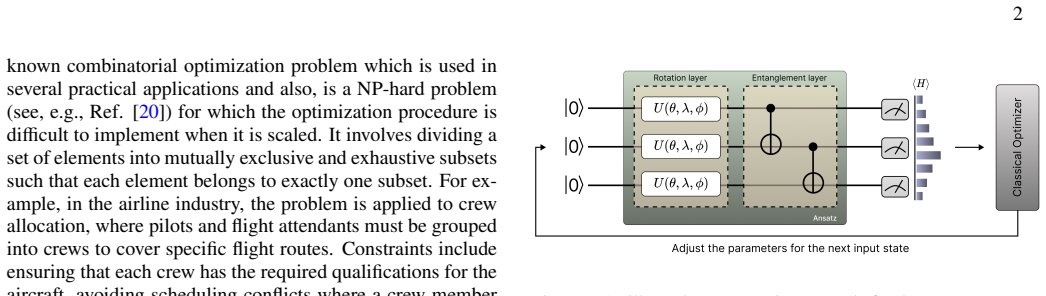
A framework based on circuits with variable topology with two approaches, one based on ansatz-free evolutionary method known from literature and the other using an introduction of an ansatz with circuital structure inspired by the physics of the Hamiltonian related to the problem, considering a named here pseudo-counterdiabatic evolutionary term. The efficiency of the proposed framework was tested on several instances of the set partitioning problem. The two approaches were compared with the Variational Quantum Eigensolver in noisy and non-noisy scenarios. The results demonstrated that optimization using circuits with variable topology presented very encouraging results. Notably, thestrategy
What carries the argument
circuits with variable topology that incorporate a pseudo-counterdiabatic evolutionary term inspired by the problem Hamiltonian
Load-bearing premise
The pseudo-counterdiabatic evolutionary term combined with variable-topology search will continue to avoid stagnation and produce strong results on new and larger set partitioning instances without any post-hoc tuning or classical assistance.
What would settle it
Applying the framework to a previously unseen collection of set partitioning problems with substantially more variables and finding that it frequently stagnates or underperforms compared to VQE would indicate the claim does not hold.
Figures


read the original abstract
Quantum algorithms are of great interest for their possible use in optimization problems. In particular, variational algorithms that use classical counterparts to optimize parameters hold promise for use in currently existing devices. However, convergence stagnation phenomena pose a challenge for such algorithms. Seeking to avoid such difficulties, we present a framework based on circuits with variable topology with two approaches, one based on ansatz-free evolutionary method known from literature and the other using an introduction of an ansatz with circuital structure inspired by the physics of the Hamiltonian related to the problem, considering a, named here, pseudo-counterdiabatic evolutionary term. The efficiency of the proposed framework was tested on several instances of the set partitioning problem. The two approaches were compared with the Variational Quantum Eigensolver in noisy and non-noisy scenarios. The results demonstrated that optimization using circuits with variable topology presented very encouraging results. Notably, the strategy employing a pseudo-counterdiabatic evolutionary term exhibited remarkable performance, avoiding convergence stagnation in most instances considered. This framework circumvents the need for classical optimizers, and, as a consequence, this procedure based on circuits with variable topology indicates an interesting path in the search for algorithms to solve integer optimization problems targeting efficient applications in larger-scale scenarios.
Editorial analysis
A structured set of objections, weighed in public.
Referee Report
Summary. The manuscript presents a quantum circuit evolutionary framework for the set partitioning problem using circuits with variable topology. It describes two approaches: an ansatz-free evolutionary method drawn from prior literature and a second method that augments the search with a pseudo-counterdiabatic evolutionary term whose circuit structure is inspired by the problem Hamiltonian. Both are tested on several instances of the set partitioning problem and compared against the Variational Quantum Eigensolver (VQE) in noisy and noiseless regimes. The central claim is that the variable-topology methods, particularly the pseudo-counterdiabatic variant, deliver encouraging results by avoiding convergence stagnation and removing the need for classical optimizers.
Significance. If the reported avoidance of stagnation holds under scrutiny and generalizes, the framework would constitute a useful direction for NISQ-era combinatorial optimization by sidestepping classical gradient-based optimizers and the associated barren-plateau or stagnation issues. The explicit incorporation of Hamiltonian-derived structure into an evolutionary ansatz is a conceptually interesting step. At present, however, the absence of concrete performance metrics and scaling data limits the ability to judge whether the approach offers a genuine advance over existing variational or evolutionary quantum methods.
major comments (3)
- [Abstract] Abstract: the statement that the pseudo-counterdiabatic strategy 'exhibited remarkable performance, avoiding convergence stagnation in most instances considered' is unsupported by any numerical values (success rates, instance sizes, iteration counts, or statistical tests). Without these data the central performance claim cannot be evaluated.
- [Results] Results section (comparison with VQE): the manuscript reports results on 'several instances' but supplies no table or text listing the concrete problem sizes (number of variables or constraints), the number of independent runs, or error bars. This omission makes it impossible to assess whether the observed lack of stagnation is robust or merely an artifact of small test cases.
- [Methods] Methods (definition of the pseudo-counterdiabatic term): the term is introduced as 'inspired by the physics of the Hamiltonian' without an independent derivation, a closed-form expression, or an ablation study that isolates its contribution from the variable-topology search itself. Consequently it is unclear whether the reported benefit is reproducible or tied to choices made inside the same experimental loop.
minor comments (2)
- [Introduction] The phrase 'ansatz-free evolutionary method known from literature' should be accompanied by an explicit citation to the prior work being referenced.
- [Methods] Notation for the evolutionary operators and the pseudo-counterdiabatic term should be defined once in a dedicated subsection rather than introduced piecemeal.
Simulated Author's Rebuttal
We thank the referee for the constructive and detailed feedback on our manuscript. We have addressed each major comment point by point below and revised the manuscript to improve clarity, reproducibility, and support for the claims.
read point-by-point responses
-
Referee: [Abstract] Abstract: the statement that the pseudo-counterdiabatic strategy 'exhibited remarkable performance, avoiding convergence stagnation in most instances considered' is unsupported by any numerical values (success rates, instance sizes, iteration counts, or statistical tests). Without these data the central performance claim cannot be evaluated.
Authors: We agree that the abstract would benefit from explicit quantitative support to substantiate the performance claim. In the revised manuscript we will update the abstract to include specific metrics such as the number of instances tested, the fraction where stagnation was avoided, and reference to success rates and iteration counts reported in the Results section. This will allow readers to evaluate the claim directly from the abstract. revision: yes
-
Referee: [Results] Results section (comparison with VQE): the manuscript reports results on 'several instances' but supplies no table or text listing the concrete problem sizes (number of variables or constraints), the number of independent runs, or error bars. This omission makes it impossible to assess whether the observed lack of stagnation is robust or merely an artifact of small test cases.
Authors: We acknowledge that the current presentation lacks sufficient detail on the experimental setup. In the revised manuscript we will add a dedicated table listing each set-partitioning instance by number of variables and constraints, the number of independent runs performed for each method (including the evolutionary approaches and VQE), and include error bars or standard deviations on all performance figures and tables to demonstrate robustness. revision: yes
-
Referee: [Methods] Methods (definition of the pseudo-counterdiabatic term): the term is introduced as 'inspired by the physics of the Hamiltonian' without an independent derivation, a closed-form expression, or an ablation study that isolates its contribution from the variable-topology search itself. Consequently it is unclear whether the reported benefit is reproducible or tied to choices made inside the same experimental loop.
Authors: The pseudo-counterdiabatic term is constructed from circuit elements whose structure is directly motivated by the counterdiabatic correction to the set-partitioning Hamiltonian. In the revised manuscript we will supply an explicit derivation of the term, including the closed-form expression for the additional evolutionary operator, and we will add an ablation study that compares performance with and without this term while keeping the variable-topology search fixed. This will clarify its isolated contribution and improve reproducibility. revision: yes
Circularity Check
No significant circularity; empirical framework is self-contained
full rationale
The paper proposes an evolutionary quantum-circuit framework for set partitioning, referencing an ansatz-free method from literature and introducing a new pseudo-counterdiabatic term inspired by the problem Hamiltonian. It reports direct performance comparisons against VQE on multiple concrete instances in both noisy and noiseless regimes. No equations, fitted parameters, or self-citations are shown to reduce the reported outcomes to the inputs by construction; the central results are presented as observed empirical findings on the tested cases rather than as predictions forced by prior definitions or internal loops.
Axiom & Free-Parameter Ledger
axioms (2)
- domain assumption Quantum circuits can be variationally optimized to approximate ground states of problem Hamiltonians.
- ad hoc to paper Evolutionary search on circuit topology can be performed without classical gradient-based optimizers.
invented entities (1)
-
pseudo-counterdiabatic evolutionary term
no independent evidence
Lean theorems connected to this paper
-
IndisputableMonolith/Cost/FunctionalEquation.leanwashburn_uniqueness_aczel unclear?
unclearRelation between the paper passage and the cited Recognition theorem.
The strategy employing a pseudo-counterdiabatic evolutionary term exhibited remarkable performance, avoiding convergence stagnation... This framework circumvents the need for classical optimizers.
-
IndisputableMonolith/Foundation/AlexanderDuality.leanalexander_duality_circle_linking unclear?
unclearRelation between the paper passage and the cited Recognition theorem.
ansatz with circuital structure inspired by the physics of the Hamiltonian... pseudo-counterdiabatic evolutionary term
What do these tags mean?
- matches
- The paper's claim is directly supported by a theorem in the formal canon.
- supports
- The theorem supports part of the paper's argument, but the paper may add assumptions or extra steps.
- extends
- The paper goes beyond the formal theorem; the theorem is a base layer rather than the whole result.
- uses
- The paper appears to rely on the theorem as machinery.
- contradicts
- The paper's claim conflicts with a theorem or certificate in the canon.
- unclear
- Pith found a possible connection, but the passage is too broad, indirect, or ambiguous to say the theorem truly supports the claim.
Reference graph
Works this paper leans on
-
[1]
Quantum circuit evolutionary framework applied on set partitioning problem
presented a variational method based on variable circuits without the use of classical optimizers in the procedure and with a very low convergence stagnation e ffect. The method presented posterior good results when applied to supervised learning problems [14]. The set partitioning problem is useful to modeling practi- cal applications as, for example, ai...
work page internal anchor Pith review Pith/arXiv arXiv 2025
-
[2]
becomes: min θ PX a wa ⟨0| U(θ)†PaU(θ) |0⟩ , (8) Here, the hybrid nature of VQE becomes apparent: each term EPa = ⟨0| U(θ)†PaU(θ) |0⟩ represents the expectation value of the Pauli string Pa, which is computed on a quan- tum device. The summation and minimization, EV QE = minθ PP a waEPa, are then carried out using a classical opti- mization algorithm. A g...
-
[3]
In reference [26], algebraic expressions for the adiabatic gauge potential (AGP) were introduced
Furthermore, a variation of this approach based on an im- pulse regime (characterized by a classical optimization) was presented in [29]. In reference [26], algebraic expressions for the adiabatic gauge potential (AGP) were introduced. As a consequence, this term describes non-adiabatic transitions and, if such term is added to a time evolution Hamiltonia...
work page 2023
-
[4]
D. Deutsch, Proceedings of the Royal Society A: Mathematical, Physical and Engineering Sciences 400, 97 (1985)
work page 1985
-
[5]
E. Bernstein and U. Vazirani, inProceedings of the Twenty-Fifth Annual ACM Symposium on Theory of Computing (STOC ’93) (ACM, 1993) pp. 11–20
work page 1993
-
[6]
Shor, in Proceedings 35th Annual Symposium on F oundations of Computer Science (1994) pp
P. Shor, in Proceedings 35th Annual Symposium on F oundations of Computer Science (1994) pp. 124–134
work page 1994
-
[7]
L. K. Grover, in Proceedings of the Twenty-Eighth Annual ACM Symposium on Theory of Computing (STOC ’96) (ACM, 1996) pp. 212–219
work page 1996
- [8]
- [9]
- [10]
-
[11]
A. Peruzzo, J. McClean, P. Shadbolt, M.-H. Yung, X.-Q. Zhou, P. J. Love, A. Aspuru-Guzik, and J. L. O’Brien, Nature Com- munications 5, 4213 (2014)
work page 2014
-
[12]
Quan- tum computation by adiabatic evolution,
E. Farhi, J. Goldstone, S. Gutmann, and M. Sipser, “Quan- tum computation by adiabatic evolution,” (2000), arXiv:quant- ph/0001106 [quant-ph]
-
[13]
J. R. McClean, S. Boixo, V . N. Smelyanskiy, R. Babbush, and H. Neven, Nature Communications 9, 4812 (2018)
work page 2018
- [14]
-
[15]
S. Wang, E. Fontana, M. Cerezo, K. Sharma, A. Sone, L. Cin- cio, and P. J. Coles, Nature Communications 12, 6961 (2021)
work page 2021
-
[16]
L. Franken, B. Georgiev, S. Mucke, M. Wolter, R. Heese, C. Bauckhage, and N. Piatkowski, in 2022 IEEE Congress on Evolutionary Computation (CEC) (2022) pp. 1–8
work page 2022
-
[17]
Evolutionary-enhanced quantum supervised learning model,
A. Simen, R. Bloot, O. M. Pires, and E. G. S. Nascimento, “Evolutionary-enhanced quantum supervised learning model,” (2023), arXiv:2311.08081 [quant-ph]
-
[18]
A. Bengtsson, P. Vikstål, C. Warren, M. Svensson, X. Gu, A. F. Kockum, P. Krantz, C. Kriˇzan, and D. Shiri, Physical Review Applied 14, 034010 (2020)
work page 2020
-
[19]
W. Qian, R. A. M. Basili, M. M. Eshaghian-Wilner, A. Khokhar, G. Luecke, and J. P. Vary, Entropy 25, 1238 (2023)
work page 2023
-
[20]
A. Kandala, A. Mezzacapo, K. Temme, M. Takita, M. Brink, J. M. Chow, and J. M. Gambetta, Nature 549, 242 (2017). 9
work page 2017
- [21]
-
[22]
A. S. Albino, R. Bloot, and R. F. I. Gomes, Quantum Informa- tion Processing 22, 233 (2023)
work page 2023
-
[23]
M. R. Garey and D. S. Johnson, Computers and Intractability. A Guide to the Theory of NP-Completeness (W.H. Freeman, New York, 1979)
work page 1979
-
[24]
N. N. Hegade, X. Chen, and E. Solano, Phys. Rev. Res. 4, L042030 (2022)
work page 2022
- [25]
- [26]
-
[27]
M. J. Kochenderfer and T. A. Wheeler, Algorithms for Opti- mization, 1st ed. (The MIT Press, 2019)
work page 2019
- [28]
- [29]
-
[30]
Quantum circuit evolution on nisq devices,
L. Franken, B. Georgiev, S. M ¨ucke, M. Wolter, R. Heese, C. Bauckhage, and N. Piatkowski, “Quantum circuit evolution on nisq devices,” (2020)
work page 2020
-
[31]
Suzuki, Communications in Mathematical Physics 51, 183 (1976)
M. Suzuki, Communications in Mathematical Physics 51, 183 (1976)
work page 1976
-
[32]
Efficient dcqo algorithm within the impulse regime for portfolio optimization,
A. G. Cadavid, I. Montalban, A. Dalal, E. Solano, and N. N. Hegade, “Efficient dcqo algorithm within the impulse regime for portfolio optimization,” (2023), arXiv:2308.15475 [quant- ph]
-
[33]
M. J. D. Powell, “A direct search optimization method that models the objective and constraint functions by linear interpo- lation,” in Advances in Optimization and Numerical Analysis , edited by S. Gomez and J.-P. Hennart (Springer Netherlands, Dordrecht, 1994) pp. 51–67
work page 1994
-
[34]
M. Svensson, M. Andersson, M. Gr ¨onkvist, P. Vikstål, D. Dub- hashi, G. Ferrini, and G. Johansson, Phys. Rev. Appl. 20, 034062 (2023)
work page 2023
-
[35]
G. Di Bartolomeo, M. Vischi, F. Cesa, R. Wixinger, M. Grossi, S. Donadi, and A. Bassi, Phys. Rev. Res. 5, 043210 (2023)
work page 2023
-
[36]
A. Arrasmith, M. Cerezo, P. Czarnik, L. Cincio, and P. J. Coles, Quantum 5, 558 (2021), arXiv:2011.12245v2
discussion (0)
Sign in with ORCID, Apple, or X to comment. Anyone can read and Pith papers without signing in.