Coherent heat exchange in a prethermalizing open quantum system
Pith reviewed 2026-05-19 01:15 UTC · model grok-4.3
The pith
Quantum coherence in the initial state alters heat exchange statistics in a prethermalizing open quantum system, as captured by a fluctuation theorem derived with the end-point measurement scheme.
A machine-rendered reading of the paper's core claim, the machinery that carries it, and where it could break.
Core claim
The authors derive a heat-exchange fluctuation theorem for a prethermalizing open quantum system using the End-Point Measurement scheme. This scheme accounts for the initial quantum coherence in the statistics of energy exchanges during a non-equilibrium process, in contrast to the Two-Point Measurement scheme which does not capture such quantum effects.
What carries the argument
The End-Point Measurement (EPM) scheme, a protocol that measures the system only at the end of the process to retain the contribution of initial quantum coherence to energy-exchange statistics.
If this is right
- Coherence adds a distinct term to the entropy production quantified by the fluctuation theorem during the prethermal stage.
- Heat-exchange probabilities differ measurably between coherent and incoherent initial states under the same bath interaction.
- The prethermal phase extends the time window in which these coherence-dependent thermodynamic relations can be observed before equilibration.
- Standard two-point measurements systematically miss the coherence contribution and therefore yield an incomplete fluctuation relation.
Where Pith is reading between the lines
- The same measurement protocol could be applied to other delayed-thermalization settings to test whether coherence modifies fluctuation theorems more generally.
- If verified, the result suggests that coherence might be used to steer heat currents in open quantum devices before full thermalization sets in.
- Numerical simulations of larger prethermalizing models could check how the strength of the coherence term scales with system size or coupling strength.
Load-bearing premise
The model genuinely exhibits a prethermal metastable phase before full thermalization and the end-point measurement scheme isolates the coherence contribution without hidden assumptions on the bath or the system-bath coupling.
What would settle it
An experiment that prepares a coherent initial state in a known prethermalizing system, measures the heat-exchange probability distribution with the end-point scheme, and checks whether the observed statistics obey the derived fluctuation theorem would confirm or refute the central claim.
Figures



read the original abstract
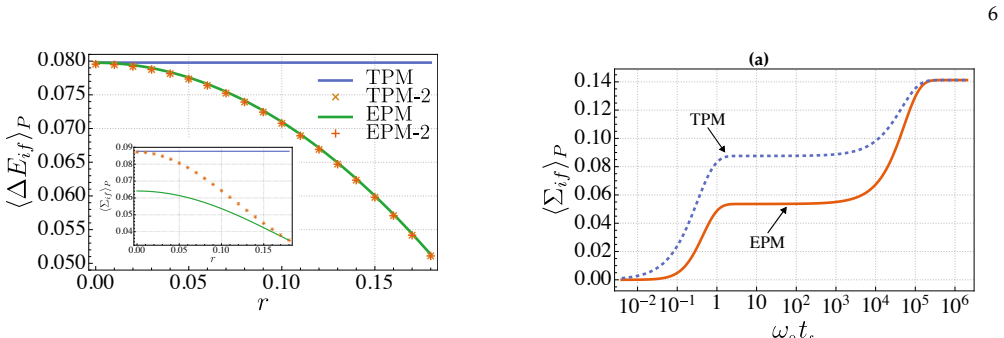
We investigate a simple model exhibiting a prethermal phase, i.e. a metastable state that emerges before full thermalization, through the framework of quantum stochastic thermodynamics. We explore the effects of quantum coherence in the energy eigenbasis of the initial state of the system on the process of heat exchange with a bath, and their contribution to entropy production as quantified by a heat-exchange fluctuation theorem. Such relation is derived using the End-Point Measurement (EPM) scheme, a protocol that accounts for initial quantum coherence in the statistics of energy exchanges resulting from a non-equilibrium process. We compare these results with those obtained from the widely used Two-Point Measurement (TPM) scheme which, by construction, fails to capture such quantum effects.
Editorial analysis
A structured set of objections, weighed in public.
Referee Report
Summary. The manuscript investigates a simple open quantum system model that exhibits a prethermal phase before full thermalization. It derives a heat-exchange fluctuation theorem within quantum stochastic thermodynamics using the End-Point Measurement (EPM) scheme, which incorporates the effects of initial quantum coherence in the energy eigenbasis on heat-exchange statistics and entropy production. Results are compared to the standard Two-Point Measurement (TPM) scheme, which by construction excludes coherence contributions.
Significance. If the central derivation holds, the work provides a concrete illustration of how initial coherence modifies fluctuation relations in a prethermal regime, extending quantum stochastic thermodynamics beyond standard TPM approaches. The use of an explicit model Hamiltonian and master equation, together with the EPM construction from two-time correlation functions, supplies a falsifiable framework for coherence effects in non-equilibrium heat exchange.
minor comments (3)
- [§2] §2: The definition of the prethermal phase via the metastable state in the master equation could be made more quantitative by specifying the timescale separation between prethermal and thermal regimes.
- [Figure 3] Figure 3: The plotted fluctuation theorem curves would benefit from explicit indication of the coherence contribution term (e.g., via a separate panel or overlay) to facilitate direct comparison with the TPM case.
- [§4.2] §4.2: The statement that EPM 'accounts for initial quantum coherence' is correct but would be strengthened by a brief remark on the measurement back-action assumptions implicit in the scheme.
Simulated Author's Rebuttal
We thank the referee for their positive assessment of our manuscript and for recommending minor revision. We are pleased that the referee recognizes the value of our explicit model and the EPM construction in illustrating coherence effects on heat-exchange fluctuation theorems within a prethermal regime.
Circularity Check
No significant circularity detected in derivation chain
full rationale
The paper presents a derivation of a heat-exchange fluctuation theorem for a prethermalizing open quantum system using the End-Point Measurement (EPM) scheme, contrasting it with the Two-Point Measurement (TPM) scheme. The central steps rely on standard constructions from quantum stochastic thermodynamics, including two-time correlation functions for energy exchanges and the system's master equation, which are externally defined and not reduced to self-referential definitions or fitted inputs. No load-bearing self-citations, uniqueness theorems imported from the authors' prior work, or ansatzes smuggled via citation are evident in the provided abstract and skeptic analysis. The EPM protocol is constructed from usual correlation functions without the result being equivalent to its inputs by construction. The model Hamiltonian and prethermal phase are treated as given for the simple system under study, with the fluctuation relation following independently. This qualifies as a self-contained derivation against external benchmarks in the field.
Axiom & Free-Parameter Ledger
Lean theorems connected to this paper
-
IndisputableMonolith/Cost/FunctionalEquation.leanwashburn_uniqueness_aczel unclear?
unclearRelation between the paper passage and the cited Recognition theorem.
We derive a heat-exchange fluctuation theorem using the End-Point Measurement (EPM) scheme... pEPM(ΔEif) = Tr[Πi ρ0] Tr[Πf Φtf [ρ0]]
What do these tags mean?
- matches
- The paper's claim is directly supported by a theorem in the formal canon.
- supports
- The theorem supports part of the paper's argument, but the paper may add assumptions or extra steps.
- extends
- The paper goes beyond the formal theorem; the theorem is a base layer rather than the whole result.
- uses
- The paper appears to rely on the theorem as machinery.
- contradicts
- The paper's claim conflicts with a theorem or certificate in the canon.
- unclear
- Pith found a possible connection, but the passage is too broad, indirect, or ambiguous to say the theorem truly supports the claim.
Reference graph
Works this paper leans on
-
[1]
Coherent heat exchange in a prethermalizing open quantum system
in order to recover the correct energy marginals, which have led to modified versions of the classical FTs. In order to characterize possible deviations from the usual FTs due to initial coherences in the system and possibly being able to experimentally verify them, it is necessary to look at dynamics that, at least for a large enough time window, preserv...
work page internal anchor Pith review Pith/arXiv arXiv 2025
-
[2]
G. E. Crooks, Entropy production fluctuation theorem and the nonequilibrium work relation for free energy differences, Physical Review E 60, 2721 (1999)
work page 1999
-
[3]
C. Jarzynski, Nonequilibrium equality for free energy differences, Physical Review Letters 78, 2690 (1997)
work page 1997
-
[4]
C. Jarzynski and D. K. W ´ojcik, Classical and quantum fluctuation theorems for heat exchange, Physical Review Letters 92, 230602 (2004)
work page 2004
-
[5]
M. Esposito, U. Harbola, and S. Mukamel, Nonequi- librium fluctuations, fluctuation theorems, and count- ing statistics in quantum systems, Reviews of Modern Physics 81, 1665 (2009)
work page 2009
- [6]
- [7]
- [8]
-
[9]
T. B. Batalh˜ao, A. M. Souza, L. Mazzola, R. Auccaise, R. S. Sarthour, I. S. Oliveira, J. Goold, G. De Chiara, M. Pater- nostro, and R. M. Serra, Experimental reconstruction of work distribution and study of fluctuation relations in a closed quantum system, Physical Review Letters 113, 140601 (2014)
work page 2014
-
[10]
M. Lostaglio, A. Belenchia, A. Levy, S. Hern ´andez- G´omez, N. Fabbri, and S. Gherardini, Kirkwood-dirac quasiprobability approach to quantum fluctuations: The- oretical and experimental perspectives, Quantum 7, 1128 (2023)
work page 2023
-
[11]
M. G. D´ıaz, G. Guarnieri, and M. Paternostro, Quantum work statistics with initial coherence, Entropy 22, 1223 (2020)
work page 2020
-
[12]
K. Micadei, G. T. Landi, and E. Lutz, Quantum fluctua- tion theorems beyond two-point measurements, Physical Review Letters 124, 090602 (2020)
work page 2020
- [13]
-
[14]
B. Bertini, F. H. L. Essler, S. Groha, and N. J. Robinson, Prethermalization and thermalization in models with weak integrability breaking, Phys. Rev. Lett.115, 180601 (2015)
work page 2015
- [15]
-
[16]
A. Angles-Castillo, M. C. Ba˜nuls, A. Perez, and I. De Vega, Prethermalization of quantum systems interacting with non-equilibrium environments, New Journal of Physics 22, 083067 (2020)
work page 2020
-
[17]
M. Marcuzzi, J. Marino, A. Gambassi, and A. Silva, Prethermalization in a nonintegrable quantum spin chain after a quench, Physical Review Letters 111, 197203 (2013)
work page 2013
-
[18]
M. Marcuzzi, J. Marino, A. Gambassi, and A. Silva, Prethermalization from a low-density holstein-primakoff expansion, Physical Review B 94, 214304 (2016)
work page 2016
-
[19]
M. Ueda, Quantum equilibration, thermalization and prethermalization in ultracold atoms, Nature Reviews Physics 2, 669 (2020)
work page 2020
-
[20]
S. Saha and R. Bhattacharyya, Prethermalization in an open quantum system coupled to a spatially correlated bosonic bath, Journal of Statistical Mechanics: Theory and Experiment 2024, 023103 (2024)
work page 2024
-
[21]
M. Campisi, P . H ¨anggi, and P . Talkner, Colloquium: Quantum fluctuation relations: Foundations and applica- tions, Rev. Mod. Phys. 83, 771 (2011)
work page 2011
-
[22]
S. Gherardini, A. Belenchia, M. Paternostro, and A. Trom- bettoni, End-point measurement approach to assess quan- tum coherence in energy fluctuations, Physical Review A 104, L050203 (2021)
work page 2021
-
[23]
S. Hern ´andez-G´omez, S. Gherardini, A. Belenchia, A. Trombettoni, M. Paternostro, and N. Fabbri, Experi- mental signature of initial quantum coherence on entropy production, npj Quantum Information 9, 86 (2023)
work page 2023
-
[24]
J. Goold and K. Modi, Energetic fluctuations in an open quantum process, AVS Quantum Science3, 045001 (2021)
work page 2021
-
[25]
U. Seifert, Stochastic thermodynamics: principles and perspectives, The European Physical Journal B 64, 423 (2008)
work page 2008
-
[26]
U. Seifert, Stochastic thermodynamics, fluctuation the- orems and molecular machines, Reports on progress in physics 75, 126001 (2012)
work page 2012
-
[27]
T. Tom´e and M. J. de Oliveira, Entropy production in irre- versible systems described by a fokker-planck equation, Physical Review E 82, 021120 (2010)
work page 2010
-
[28]
A. Imparato and L. Peliti, The distribution function of entropy flow in stochastic systems, Journal of Statistical Mechanics: Theory and Experiment 2007, L02001 (2007)
work page 2007
-
[29]
G. T. Landi and M. Paternostro, Irreversible entropy pro- duction: From classical to quantum, Rev. Mod. Phys. 93, 035008 (2021)
work page 2021
discussion (0)
Sign in with ORCID, Apple, or X to comment. Anyone can read and Pith papers without signing in.