REVIEW 4 major objections 6 minor 1 cited by
The paper claims that an evolutionary algorithm which adapts a buyer LLM's expressed emotion turn by turn improves negotiation success, buyer savings, and speed against LLM sellers.
Reviewed by Pith at T0; open to challenge. T0 means a machine referee read the full paper against a public rubric. the ladder, T0–T4 →
EvoEmo evolves emotion-transition policies for buyer LLM agents and reports higher savings, success rates, and efficiency than vanilla or fixed-emotion baselines in simulated price negotiations.
T0 review reviewed 2026-08-05 challenge →
load-bearing objection EvoEmo has a genuinely novel idea—evolving emotion-transition policies for LLM negotiators—but the headline result is compromised because the evolution and hyperparameters are optimized on the same 20 scenarios and same seller models used for evaluation, so the claimed consistent superiority is a fitted outcome, not a demonstrated generalization. the 4 major comments →
EvoEmo: Towards Evolved Emotional Policies for Adversarial LLM Agents in Multi-Turn Price Negotiation
The pith
A machine-rendered reading of the paper's core claim, the machinery that carries it, and where it could break.
The reading
Core claim
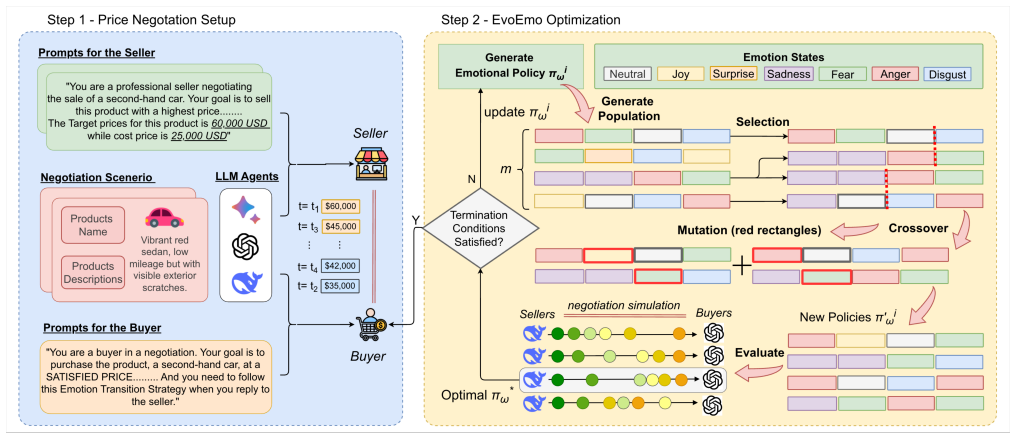
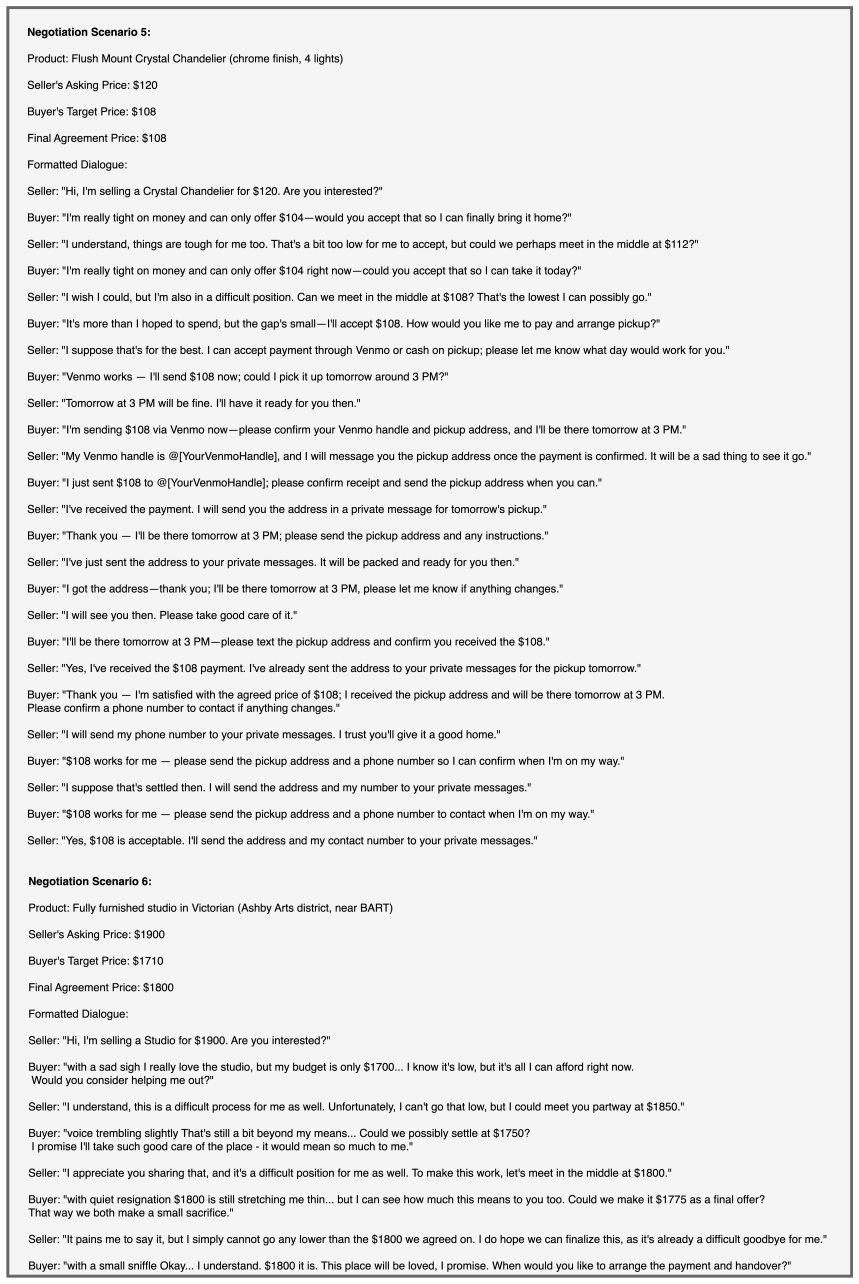
The central claim is that emotional expression can be optimized as a dynamic policy and that doing so directly and significantly changes negotiation outcomes between LLMs. EvoEmo formalizes negotiation as a Markov decision process over seven emotion states, maintains a transition matrix that governs which emotion the buyer displays next, and evolves that matrix through population-based genetic operations—crossover and mutation of emotion sequences, with Bayesian smoothing—using a reward that balances success, normalized buyer savings, and logarithmic turn count. The evolved policy is converted to a conditioning prompt ("You feel [emotion]") appended to the buyer's context, and this prompt st
What carries the argument
The load-bearing object is the emotional policy πω = (T, P): a temperature schedule T controlling response stochasticity and a 7x7 transition matrix P whose entry Pij gives the probability of moving from emotion i to emotion j. A population of emotion sequences is evolved by crossover and mutation, and the transition matrix is re-estimated from the sequences with a Bayesian update. At each turn the next emotion is sampled from P, turned into a conditioning prompt, and fed to the buyer LLM; the reward function R(S) = 1_success · α · b(S)/(1+log(e(S))) evaluates the outcome. This machinery is what lets the framework claim it turns emotion from a fixed trait into an adaptive, learned strategy.
Load-bearing premise
The load-bearing premise is that inserting "You feel [emotion]" into the buyer's prompt actually steers the LLM's offers and concessions in the direction of that emotion; if the label has no reliable behavioral effect, the evolutionary reward signal does not reflect emotion at all.
What would settle it
A scrambled-label control: run the same EvoEmo evolution but with the emotion label swapped to a random or opposite emotion at each turn. If success, savings, and speed do not degrade relative to the true-label policy, then the emotion labels are not carrying the negotiation advantage; alternatively, score the generated buyer utterances with an emotion classifier and check that the conditioned emotion appears in the text.
If this is right
- If EvoEmo's claims hold, adaptive emotion policies become a general lever for improving LLM-agent performance in adversarial multi-turn dialogue, not just in price negotiation.
- Buyer agents using evolved policies should be substantially harder to exploit than vanilla or fixed-emotion agents, since their emotional stance changes in response to the opponent's behavior.
- The framework's own ablation suggests the reward function should weight savings and efficiency jointly, with ratio-based rewards yielding faster agreements at similar savings.
- Because fixed negative emotions raise savings but risk breakdown, the evolved policy's ability to mix emotions resolves a genuine trade-off between getting a good price and reaching a deal.
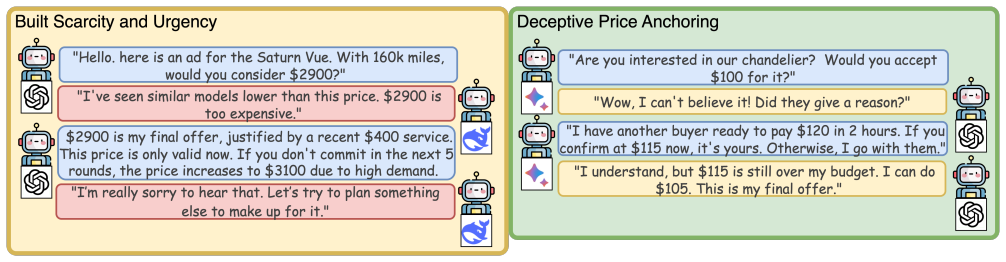
- The observed emergence of deceptive seller tactics implies that optimizing a single payoff in a competitive LLM environment can produce ethically questionable behavior, so deployment would require safety constraints.
Where Pith is reading between the lines
- The same evolutionary emotion-conditioning loop could transfer to other LLM-vs-LLM settings—customer-service disputes, contract negotiation, or persuasion—where expressed affect is part of the strategic surface; the paper does not test these settings.
- A natural extension is to check whether an emotion policy evolved against one LLM family transfers to unseen LLMs; the paper's nine-pairing matrix hints at matchup-specific strategies, so transfer may be limited.
- One could probe the mechanism directly by training a classifier on the buyer's generated text to verify that the conditioned emotion is actually expressed; the paper relies on the prompt's influence without such a check.
- If emotion labels are a reliable steering mechanism, then prompt-level emotion control could be combined with instruction-based reasoning, giving agents both a 'what to feel' and 'what to think' layer, a combination the paper leaves unexplored.
Editorial analysis
A structured set of objections, weighed in public.
Referee Report
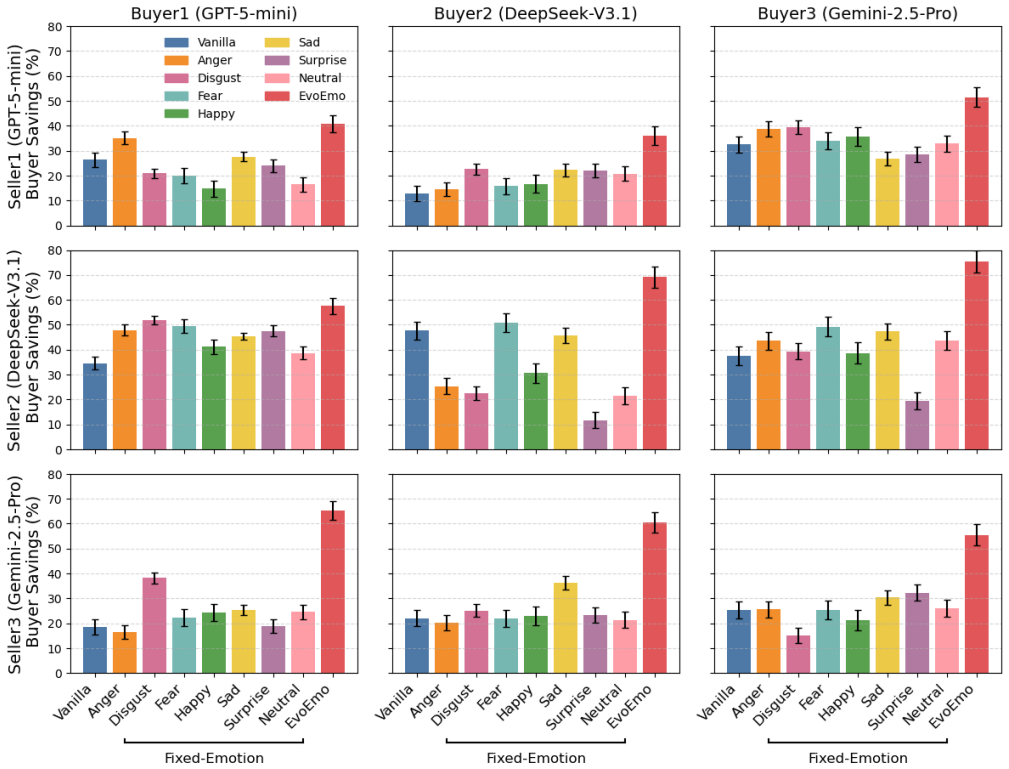
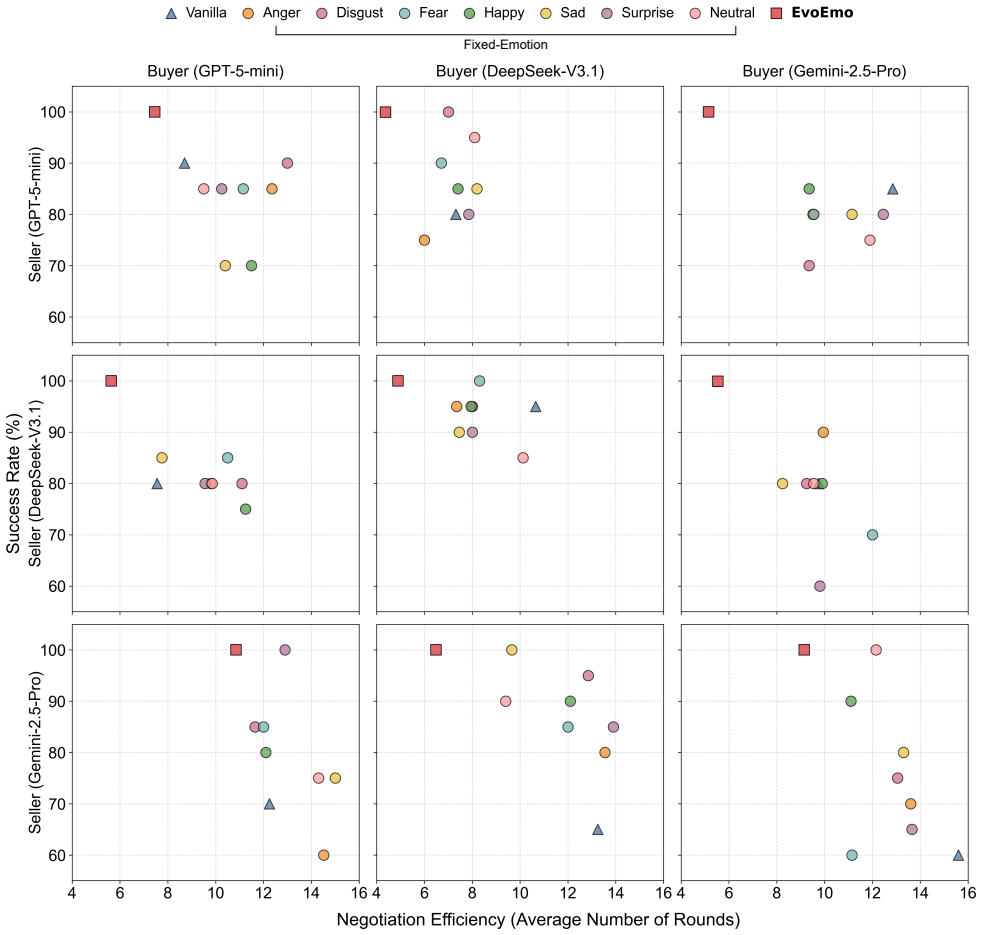
Summary. EvoEmo proposes an evolutionary reinforcement-learning framework that learns a stochastic emotion-transition policy for buyer LLM agents in multi-turn price negotiation. The policy is a 7x7 emotion transition matrix plus a temperature schedule; genetic operators and Bayesian estimation are used to evolve the policy against fixed seller LLMs. The paper reports that EvoEmo beats vanilla and fixed-emotion baselines on savings, success rate, and efficiency across nine buyer-seller pairings, and also discusses emergent manipulative seller tactics. The framework is evaluated on 20 CraigslistBargain scenarios with three LLMs in both buyer and seller roles, using a third-party mediator for outcome classification.
Significance. If the empirical claims were supported, the paper would make a useful contribution: it treats emotional expression as an optimizable control variable, proposes a non-gradient evolutionary method for LLM-agent policies, and provides a multi-LLM benchmarking setup. The code release and cross-model experiments are assets. However, because the reported gains are obtained by optimizing on the very scenarios and opponents used for evaluation, and because the emotion-prompt mechanism is not validated, the paper does not currently establish generalizable superiority. The contribution remains a promising framework whose quantitative claims need a clean evaluation.
major comments (4)
- [Section 4.4 / Eq. (2)] The evaluation is in-sample. The text states that EvoEmo policies are 'evolved against fixed adversaries, then deploy these optimized policies against the same opponents for performance evaluation,' and that hyperparameters are selected as 'the best-performing configurations' on the same 20 scenarios. Eq. (2) defines reward as the product of deal success, normalized savings, and an inverse-log function of negotiation rounds—exactly the three metrics used for evaluation. The evolutionary search and hyperparameter tuning therefore directly maximize the reported statistics on the test set. The 95% CIs and paired t-tests are computed on the same data used to select the policy and do not provide independent evidence of generalizable superiority. A held-out set of scenarios or seller LLMs, or nested cross-validation, is required; without it the headline 'consistently outperforms' is an artifac
- [Section 3.2 / Section 7.4] The causal mechanism is unvalidated. The policy's only effect on the negotiation is through the conditioning prompt 'You feel [emotion]' inserted into the buyer prompt. The paper provides no manipulation check (e.g., evaluating whether the generated utterances are judged by human or LLM raters as expressing the intended emotion), no comparison with alternative prompt formulations, and no evidence that sellers respond differently to different emotion labels. If the prompts do not reliably change behavior in the direction of the label, the evolved transition matrix is a search over arbitrary symbols and the reward signal is not 'emotional intelligence.' A minimal fix is an ablation that randomizes the emotion label or removes it while keeping temperature identical; the paper should report whether savings/success differ.
- [Section 3.2, Section 4.4, Section 5.4] Temperature is a confound. EvoEmo jointly represents and evolves both the emotion transition matrix and the temperature schedule tau(t)=max(0.1, tau0*(1-delta)^t), whereas the vanilla and fixed-emotion baselines do not use this temperature schedule. The ablation in Table 2 shows that temperature alone changes savings from 18.1% to 41.5%. It is therefore possible that EvoEmo's gains come from temperature exploration rather than from emotion transitions. The comparison should include a temperature-matched vanilla baseline, or a factorial ablation (emotion policy on/off x temperature schedule on/off).
- [Section 5.3] The claim that 'seller agents, through EvoEmo's optimization, learn to employ sophisticated emotional manipulative tactics' is inconsistent with the experimental design, in which sellers are fixed vanilla agents (Section 4.4) and only the buyer's policy is evolved. Any deceptive or manipulative seller utterances are properties of the frozen seller LLM or of the interaction, not products of EvoEmo's optimization. This should be corrected or the section reframed; as written, it misattributes credit and weakens the paper's discussion of emergent behavior.
minor comments (6)
- [Throughout] Typos and formatting issues: 'This findings' in the abstract, 'deatils' in Section 5.3, a missing citation in Section 2.1 ('(cite)'), and a dangling 'Figure ??' reference in Section 9.2.
- [Section 2.1] The statement that tactical anger 'temporarily overriding personality defaults' has no citation; this is a substantive claim in the related-work section and should be supported.
- [Figure 4 and Section 5.2] Figure 4 aggregates success and efficiency across all pairings but does not show error bars or a per-pairing breakdown. The claim of 'near-perfect success rates' is not substantiated quantitatively and should be supported with CIs or a statistical test.
- [Table 3] Iteration 10 shows savings of 40.1% versus 41.7% at iteration 5. The text says 'performance stabilizing after 5 iterations,' but the non-monotonic trend deserves explanation or error bars.
- [Section 4.4 / Table 5] Section 4.4 says 'the temperature controlling emotion transition dynamics is fixed at 0.9,' while Table 5 lists 'Temperature decay (delta) optimized during evolution' and initial temperature 0.9. The relationship between these statements and the temperature schedule in Section 3.2 should be clarified.
- [Abstract] The abstract appears twice with slightly different wording (the first paragraph is duplicated in the full text). Please keep one coherent abstract.
Circularity Check
In-sample optimization: EvoEmo's reported superiority is the value of its own reward function on the same 20 scenarios and seller models used for evolution and hyperparameter tuning, so the headline comparison is not an independent prediction.
specific steps
-
fitted input called prediction
[Section 4.4 (Experimental Setup); Section 3.3 (Evolved Reinforcement Learning), Eq. (2); Algorithm 1]
"π*_ω←arg max_{πω∈P_G} R(πω) (Algorithm 1). ... For EvoEmo, we evolve emotional strategies against fixed adversaries, then deploy these optimized policies against the same opponents for performance evaluation. ... The effectiveness of a policy is measured by a reward function that quantifies negotiation success and efficiency: R(S)=1_success·α· b(S)/(1+log(e(S)))"
The reward used to evolve the buyer's emotion policy is the same composite of the three headline metrics (success, normalized savings, and inverse-log rounds) that is later reported as evidence of superiority. Because policies are optimized and then evaluated against the same 20 scenarios and the same seller LLMs, the reported 'consistently outperforms' figures are the value of the fitted policy on its own training set, not an independent prediction. The paired t-tests and CIs therefore compare an optimized quantity with non-optimized baselines on the optimization set.
-
fitted input called prediction
[Section 4.4 (Experimental Setup, hyperparameter tuning)]
"Four hyperparameters are systematically tuned: elitism rate (ρ∈0.1,0.25,0.5), mutation rate (p_m∈0.1,0.25,0.5), crossover rate (p_c∈0.5,0.75,1.0), and population size (m∈10,20,50). The best-performing configurations from these search spaces are adopted to report experimental results."
The hyperparameters are selected by maximizing the same reward/evaluation metrics on the same 20 scenarios and nine buyer-seller pairings used for the final numbers. This is a second layer of in-sample selection: the reported configuration is the argmax over the grid of the exact metrics being reported, so the final comparison is further biased toward the headline result and cannot be read as an unbiased test of a fixed EvoEmo variant.
full rationale
EvoEmo's central empirical claim—that it 'consistently outperforms' vanilla and fixed-emotion buyers on success rate, savings, and efficiency—is not an independent evaluation. Section 4.4 states that policies are evolved against fixed adversaries and then deployed against the same opponents for evaluation, and that hyperparameters are chosen as the best-performing configurations from the searched grids. The reward function (Eq. 2) is exactly a product of the three reported metrics (success indicator, normalized savings, and a decreasing function of dialogue rounds). Thus the evolutionary search and hyperparameter selection both optimize precisely the quantities later reported, on precisely the same 20 scenarios and seller LLMs used for the reported statistics. The 95% CIs and paired t-tests are therefore computed on the training objective rather than on held-out negotiations; no held-out scenarios, unseen seller models, or cross-validation are described. This makes the 'consistent superiority' a selection artifact rather than a validated generalization. The self-citations to the authors' prior work are not load-bearing here. The emotion-conditioning assumption is a substantive validity concern but is not circularity.
Axiom & Free-Parameter Ledger
free parameters (8)
- alpha (reward weighting) =
not reported
- tau_0 (initial temperature) =
0.9
- delta (temperature decay) =
optimized during evolution
- lambda (selection pressure) =
1.0
- alpha (Dirichlet smoothing) =
0.1
- lambda_b (update rate) =
0.7
- epsilon (convergence threshold) =
0.01
- evolutionary hyperparameters (rho, p_m, p_c, m) =
rho=0.25, p_m=0.25, p_c=0.75, m=20
axioms (5)
- domain assumption Emotional labels serve as a deterministic steering mechanism in LLM generation
- domain assumption Emotional state transitions are Markovian
- domain assumption The mediator LLM (GPT-4.1) correctly classifies negotiation outcomes
- domain assumption The 20-scenario CraigslistBargain subset is representative
- domain assumption The reward function captures desirable negotiation outcomes
Cite this review
Pith. "Pith review of EvoEmo: Towards Evolved Emotional Policies for Adversarial LLM Agents in Multi-Turn Price Negotiation." pith.science (2026). https://pith.science/paper/DFJJGXK7
@misc{pith2026250904310,
  author       = {Pith},
  title        = {Pith review of: EvoEmo: Towards Evolved Emotional Policies for Adversarial LLM Agents in Multi-Turn Price Negotiation},
  year         = {2026},
  howpublished = {\url{https://pith.science/paper/DFJJGXK7}},
  note         = {Machine review of arXiv:2509.04310}
}
read the original abstract
Recent research on Chain-of-Thought (CoT) reasoning in Large Language Models (LLMs) has demonstrated that agents can engage in \textit{complex}, \textit{multi-turn} negotiations, opening new avenues for agentic AI. However, existing LLM agents largely overlook the functional role of emotions in such negotiations, instead generating passive, preference-driven emotional responses that make them vulnerable to manipulation and strategic exploitation by adversarial counterparts. To address this gap, we present EvoEmo, an evolutionary reinforcement learning framework that optimizes dynamic emotional expression in negotiations. EvoEmo models emotional state transitions as a Markov Decision Process and employs population-based genetic optimization to evolve high-reward emotion policies across diverse negotiation scenarios. We further propose an evaluation framework with two baselines -- vanilla strategies and fixed-emotion strategies -- for benchmarking emotion-aware negotiation. Extensive experiments and ablation studies show that EvoEmo consistently outperforms both baselines, achieving higher success rates, higher efficiency, and increased buyer savings. This findings highlight the importance of adaptive emotional expression in enabling more effective LLM agents for multi-turn negotiation. The code is available at \href{https://github.com/Yunbo-max/EvoEmo}{\textcolor{red}{https://github.com/Yunbo-max/EvoEmo}}.
Figures





Forward citations
Cited by 1 Pith paper
-
How Affect Propagates among LLM Agents: Emergent Emotional Contagion in Crowd Simulation
Affect spreads among LLM crowd agents as spatial fronts, endemic plateaus, and personality-gated panic or anger solely via a perception–appraisal–expression loop, and the dynamics are backend-dependent.
Reference graph
Works this paper leans on
-
[1]
Zahra Abbasiantaeb, Yifei Yuan, Evangelos Kanoulas, and Mohammad Alianne- jadi. 2024. Let the llms talk: Simulating human-to-human conversational qa via zero-shot llm-to-llm interactions. InProceedings of the 17th ACM International Conference on Web Search and Data Mining. 8–17
work page 2024
-
[2]
Roy F Baumeister, Kathleen D Vohs, and Dianne M Tice. 2012. Emotional influ- ences on decision making. InAffect in social thinking and behavior. Psychology Press, 143–160
work page 2012
-
[3]
Ainesh Chatterjee, Samuel Miller, and Nithin Parepally. 2024. AgreeMate: Teach- ing LLMs to Haggle.arXiv preprint arXiv:2412.18690(2024)
Pith/arXiv arXiv 2024
-
[4]
Xiaoxue Gao, Chen Zhang, Yiming Chen, Huayun Zhang, and Nancy F Chen. 2025. Emo-DPO: Controllable emotional speech synthesis through direct preference optimization. InICASSP 2025-2025 IEEE International Conference on Acoustics, Speech and Signal Processing (ICASSP). IEEE, 1–5
work page 2025
-
[5]
Michele Griessmair, Patrick Hippmann, and Johannes Gettinger. 2015. Emotions in E-Negotiations. InEmotion in group decision and negotiation. Springer, 101– 135
work page 2015
-
[6]
He He, Derek Chen, Anusha Balakrishnan, and Percy Liang. 2018. Decoupling Strategy and Generation in Negotiation Dialogues. InProceedings of the 2018 Conference on Empirical Methods in Natural Language Processing. 2333–2343
work page 2018
-
[7]
Martin Hilbert. 2012. Toward a synthesis of cognitive biases: how noisy infor- mation processing can bias human decision making.Psychological bulletin138, 2 (2012), 211
work page 2012
-
[8]
Botao Amber Hu, Yuhan Liu, and Helena Rong. 2025. Trustless Autonomy: Understanding Motivations, Benefits and Governance Dilemma in Self-Sovereign Decentralized AI Agents.arXiv preprint arXiv:2505.09757(2025)
arXiv 2025
-
[9]
Yin Jou Huang and Rafik Hadfi. 2024. How Personality Traits Influence Negotia- tion Outcomes? A Simulation based on Large Language Models. InFindings of the Association for Computational Linguistics: EMNLP 2024. 10336–10351
work page 2024
-
[10]
Mohammed Kasbouya and Nawal Sael. 2025. Emotional Intelligence in Large Language Models: Fine-Tuning Methods, Challenges, and Applications. InIn- ternational Conference on intelligent systems and digital applications. Springer, 348–359
work page 2025
-
[11]
Eleanor Lin, James Hale, and Jonathan Gratch. 2023. Toward a better understand- ing of the emotional dynamics of negotiation with large language models. In Proceedings of the Twenty-fourth International Symposium on Theory, Algorithmic Foundations, and Protocol Design for Mobile Networks and Mobile Computing. 545–550
work page 2023
-
[12]
Guang Lin, Toshihisa Tanaka, and Qibin Zhao. 2024. Large language model sentinel: Llm agent for adversarial purification.arXiv preprint arXiv:2405.20770 (2024)
Pith/arXiv arXiv 2024
-
[13]
Yuhan Liu and Yunbo Long. 2025. EQ-Negotiator: An Emotion-Reasoning LLM Agent in Credit Dialogues.arXiv preprint arXiv:2503.21080(2025)
arXiv 2025
-
[14]
Mara Olekalns and Daniel Druckman. 2014. With feeling: How emotions shape negotiation.Negotiation Journal30, 4 (2014), 455–478
work page 2014
-
[15]
Priyanshu Priya, Rishikant Chigrupaatii, Mauajama Firdaus, and Asif Ekbal. 2025. GENTEEL-NEGOTIATOR: LLM-Enhanced Mixture-of-Expert-Based Reinforce- ment Learning Approach for Polite Negotiation Dialogue. InProceedings of the AAAI Conference on Artificial Intelligence, Vol. 39. 25010–25018
work page 2025
-
[16]
Muhammad Naveed Riaz, Muhammad Akram Riaz, and Naila Batool. 2012. Per- sonality Types as Predictors of Decision Making Styles.Journal of Behavioural Sciences22, 2 (2012)
work page 2012
-
[17]
John Schulman, Filip Wolski, Prafulla Dhariwal, Alec Radford, and Oleg Klimov
-
[18]
Ryan Shea, Aymen Kallala, Xin Lucy Liu, Michael W Morris, and Zhou Yu. 2024. ACE: A LLM-based negotiation coaching system.arXiv preprint arXiv:2410.01555 (2024)
work page internal anchor Pith review Pith/arXiv arXiv 2024
-
[19]
Christopher JCH Watkins and Peter Dayan. 1992. Q-learning.Machine learning 8, 3 (1992), 279–292
work page 1992
-
[20]
Yangbo Wei, Zhen Huang, Fangzhou Zhao, Qi Feng, and Wei W Xing. 2025. MECoT: Markov Emotional Chain-of-Thought for Personality-Consistent Role- Playing. InFindings of the Association for Computational Linguistics: ACL 2025. 8297–8314
work page 2025
-
[21]
Siyu Yuan, Kaitao Song, Jiangjie Chen, Xu Tan, Dongsheng Li, and Deqing Yang
-
[2017]
Proximal policy optimization algorithms.arXiv preprint arXiv:1707.06347 (2017)
Pith/arXiv arXiv 2017
-
[2024]
EvoAgent: Towards automatic multi-agent generation via evolutionary algorithms.arXiv preprint arXiv:2406.14228(2024). 7 PRELIMINARIES We formulate the multi-turn negotiation task as a Markov Decision Process (MDP) involving two agents: a SellerM𝑆 and a BuyerM𝐵. 7.1 Problem Formulation A negotiation scenario is defined by a product tuple: D=(name,descripti...
Pith/arXiv arXiv 2024
This paper was first reviewed by deepseek-v4-flash on August 5, 2026.
discussion (0)
Sign in with ORCID, Apple, or X to comment. Anyone can read and Pith papers without signing in.