REVIEW 3 major objections 5 minor 1 cited by
Optimal interim-analysis timing in a group sequential trial depends only on the error rates and stopping rule, not the effect size or endpoint; switching to it cuts expected sample size by up to 5.4% in O'Brien-Fleming designs.
Reviewed by Pith at T0; open to challenge. T0 means a machine referee read the full paper against a public rubric. the ladder, T0–T4 →
Optimal interim analysis schedules that minimize expected sample size under the alternative are independent of effect size and endpoint type, and yield modest gains over equal spacing (up to 5.4% for O'Brien-Fleming designs).
T0 review reviewed 2026-08-05 challenge →
load-bearing objection Normal-endpoint optimization is sound and the tool is useful; the binary generalization is asserted, and the abstract oversells the MSS trade-off and the size of the savings. the 3 major comments →
Optimal scheduling of interim analyses in group sequential trials
The pith
A machine-rendered reading of the paper's core claim, the machinery that carries it, and where it could break.
The reading
Core claim
The central claim is an invariance: for a prespecified stopping rule with fixed type I and type II error rates, the information rates t1:K−1 that minimize the expected sample size under H1 are the same for every standardized effect size and for every asymptotically normal test statistic, binary endpoints included. The proof runs through Eq. (7), where E(N|H1) factors into an effect-size constant times a bracket of information rates, stopping regions and the drift θ fixed by the error rates — so the minimizer never sees the effect size. Observed consequence: optimal schedules hold early looks later; for O'Brien-Fleming designs they cut expected sample size under H1 by up to 5.4% with at most
What carries the argument
The machinery is the canonical joint multivariate normal distribution of the standardized test statistics Z1:K (mean δ√Ik, covariance √(min/max) of information), with trial progress encoded in the information rate tk = Ik/IK = Nk/NK. The Armitage recursion fixes the drift θ for given error allocation, and Eq. (7) collapses E(N|H1) to N0·θ²/(z1−α+z1−β)² times a bracket of continuation-region probabilities — effect size confined to the constant N0, which yields the invariance. OptimInterim minimizes the bracket via Nelder-Mead from many starting points, evaluating probabilities through rpact, and the paper's tables give the resulting optimal information rates.
Load-bearing premise
The load-bearing premise is that the information accumulated at an interim analysis equals the fraction of the total sample size observed — exact for normally distributed endpoints with known variance, but only asserted as an asymptotic approximation for binary endpoints, where it is neither derived nor simulated.
What would settle it
Simulate a two-arm binary-endpoint trial (e.g., 45% vs 30% event rates) under a three-stage O'Brien-Fleming design, one-sided α=0.025, β=0.1, and compute the expected sample size under H1 directly from the binomial likelihood at the paper's optimal schedule (first look at 54.9% information) and at equal spacing. If the binomial-optimal schedule shifts materially from the table, or the relative gain departs from the normal-approximation prediction, the binary-extension claim fails. Second test: for a logistic-regression score statistic, recompute the optimal schedule at two very different effec
If this is right
- Reference tables give planners a ready-to-use optimal schedule for up to eight interim analyses: for fixed error rates and stopping rule, the same information rates apply whatever the anticipated treatment effect or endpoint.
- O'Brien-Fleming designs gain the most — up to 5.4% lower expected sample size under H1 for at most ~1% higher maximum sample size — and can match an equally spaced design's efficiency with one fewer interim look.
- Haybittle-Peto and Pocock designs improve by at most 1.2% under optimal spacing, implying equal spacing is already close to optimal for those error-spending patterns.
- Adding a futility boundary to an optimized schedule yields much larger savings under no effect (≥25.9% ESS reduction) and under a halved effect (≥8.8%), at the cost of a larger maximum sample size (up to 29.0% for Pocock, 14.6% for O'Brien-Fleming).
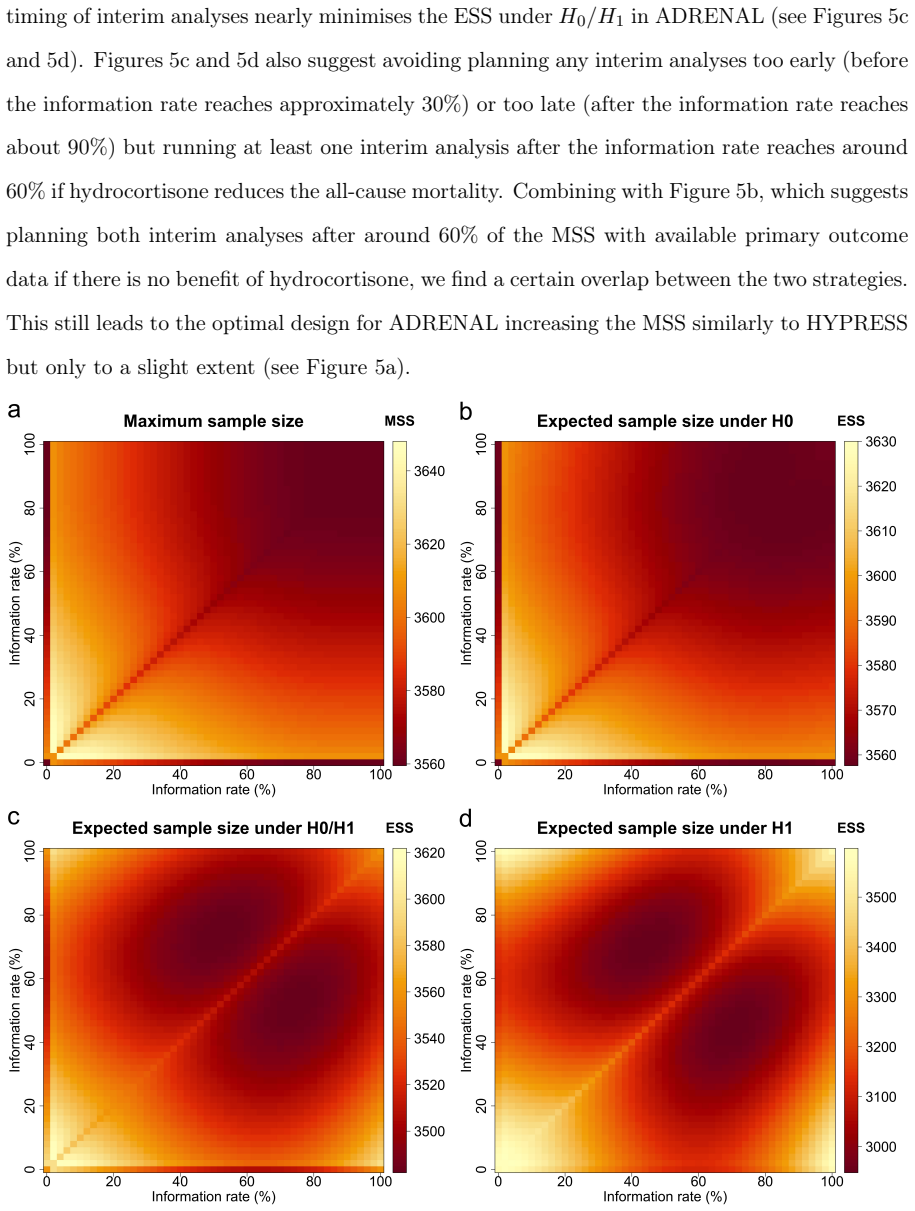
- Optimal schedules shift the first interim look later — in the HYPRESS redesign from 33% to 57% of information — which raises the probability of early efficacy stopping at the first look from 1.9% to 27.6% under H1.
Where Pith is reading between the lines
- Because the schedule depends only on error rates and the stopping rule, the reference tables plausibly transfer to trials with different design margins (e.g., non-inferiority or larger/smaller target effects) than those simulated — a transfer the paper does not itself claim.
- The invariance proof assumes the information fraction equals the sample-size fraction; for binary endpoints that identity is only asymptotic, so the natural stress test is exact binomial enumeration at modest sample sizes to see how far the tables drift from the normal-approximation optimum.
- Reading across the tables, the optimal schedules share a pattern: the first interim look moves later (roughly 55–65% of information for O'Brien-Fleming designs) and later looks are moderately spaced — suggesting a simple planning heuristic: delay the first look to concentrate stopping probability where the test statistic is informative.
- The same minimization could be run for survival endpoints through the log-rank statistic — noted by the paper as conceptually straightforward — with information accumulated in events rather than patients; whether the effect-size independence survives that change is a concrete open question.
Editorial analysis
A structured set of objections, weighed in public.
Referee Report
Summary. The paper proposes a method and an R tool, OptimInterim, for choosing the timing (information rates) of interim analyses in group sequential trials. The objective is to minimize the expected sample size under the alternative hypothesis H1 while preserving overall type I and type II error rates, given a prespecified stopping rule. For normally distributed endpoints with known variance, the paper derives Eq. (9), showing that the optimal information rates are independent of the standardized effect size, and provides reference tables for up to eight interim analyses for Haybittle-Peto, Pocock, and O'Brien-Fleming designs. The operating characteristics are evaluated by simulation for continuous endpoints, and the tool is illustrated by redesigning the HYPRESS and ADRENAL trials, both of which have binary primary endpoints.
Significance. If the claims hold, this is a practically useful contribution: the public R tool is built on the validated rpact package, and the reference tables give immediate design guidance. The derivation for normal endpoints with known variance is sound, and the effect-size independence is a useful simplification. However, the broad generalization to binary endpoints is asserted rather than demonstrated, and the abstract's claim about not compromising the maximum sample size is inconsistent with the paper's own O'Brien-Fleming results. The paper is likely to be a valuable methods/software contribution after these gaps are addressed.
major comments (3)
- [Section 2.2, Eq. (9); Section 2.4] The assertion that the results are 'equally applicable to test statistics that are asymptotically normally distributed, e.g., those arising from binary endpoints' is not supported. Equation (9) is derived under the exact normal, known-variance model with I_k proportional to N_k and t_k = N_k/N_K. For binary endpoints, the asymptotic information is proportional to N_k only under fixed response probabilities and a chosen variance estimator, and the covariance structure and cancellation in Eq. (9) hold only asymptotically. The simulations in Section 2.4 use only normally distributed endpoints, while the case studies (Sections 3.2-3.3) apply the normal-derived optimal schedules to binary endpoints. Because the abstract and discussion claim applicability across endpoint types and the reference tables are recommended for binary trials, this gap is load-bearing. The authors should provide a rig
- [Abstract; Sections 3.1.3 and 4] The abstract states that optimal scheduling yields savings 'without compromising the maximum sample size.' This is contradicted by the O'Brien-Fleming results: the Discussion reports that the optimal O'Brien-Fleming design is 'accompanied by a modest increase in the MSS, up to 1.0%,' and the HYPRESS redesign (Table 5) has MSS 310.3 with optimal timing vs. 307.6 with the original timing. The abstract should be revised to state that the maximum sample size may increase slightly for some designs, or the claim should be restricted to the designs and comparisons where it holds.
- [Section 2.3; Tables 1-3] The numerical optimization is described as using Nelder-Mead with multiple starting values, but the paper does not report convergence diagnostics, the number of starting values, or any verification that the reported schedules are global optima. Since the reference tables are presented as optimal schedules and are the main practical output, the authors should provide evidence that the reported minima are stable, for example by comparing against a fine grid or alternative optimization methods for at least a subset of the scenarios.
minor comments (5)
- [Eq. (8) vs. Section 2.1] The symbol N0 is used both for the fixed-design total sample size in Eq. (8) and for the control-arm cumulative sample size N_{0,k} in Section 2.1. Rename the fixed-design quantity, e.g., N_fixed, to avoid confusion.
- [Section 2.1] For two-sided alternatives, the continuation and rejection regions are only described verbally. Please state the explicit regions for the two-sided case, since the reference tables are used for both one- and two-sided designs.
- [Section 2.3] The phrase 'a restricted global search' is vague. Please clarify what restriction is imposed on the Nelder-Mead search and how the multiple starting values are generated.
- [Eq. (1)] The typeset formula for I_k is hard to read; inserting parentheses or using a display fraction would improve clarity.
- [References] The reference to Lewis (2023) is incomplete; please provide the full title if available.
Circularity Check
No significant circularity: optimal schedules are obtained by minimizing a well-defined ESS objective with standard error-spending constraints; the effect-size/endpoint-type independence follows from the algebraic structure of Eq. (9), not from fitted inputs.
full rationale
The central derivation chain is self-contained. Section 2.2 defines the information rate t_k = I_k/I_K; for the assumed known-variance normal model this equals N_k/N_K. The optimization in Eq. (9) minimizes E(N|H_1) over t_1:K-1 subject to type I/II error constraints. The claimed independence from the standardized effect size is a direct algebraic cancellation: in Eqs. (6)-(8), delta* enters only through the fixed-design sample size N0, while the canonical drift theta is determined solely by t, alpha, and beta via the error equations. None of the schedule outputs are fitted to the data used for evaluation; the simulations in Section 2.4 are independent operating-characteristic checks. The binary-endpoint extension is asserted via asymptotic normality and an information fraction equal to the sample-size fraction (Section 2.2), and the authors acknowledge in Section 2.4 that the performance evaluation focuses on a continuous endpoint. This is a robustness/evidence limitation, not a circular step: the binary claim is not obtained by renaming a known result or by using the binary endpoint to define the optimization. The only self-citation (Li et al., 2023, with co-author Billot) is cited for background on the value of multiple interim analyses and for a futility re-analysis in ADRENAL; it is not load-bearing for the optimal-scheduling derivation. Per hard rule 4, a non-load-bearing self-citation does not raise the circularity score.
Axiom & Free-Parameter Ledger
axioms (5)
- standard math The standardized test statistics Z1:K follow the canonical joint multivariate normal distribution with independent increments (Jennison & Turnbull 1999).
- domain assumption The outcome is normally distributed with known common variance sigma^2, and recruitment halts at each interim analysis with all outcomes immediately available.
- domain assumption The information rate t_k equals the cumulative sample size fraction N_k/N_K.
- ad hoc to paper For binary endpoints, the test statistics are asymptotically normally distributed and the same independence and scheduling results hold.
- standard math The canonical drift parameter theta is uniquely determined by t1:K, alpha1:K and beta1:K via the recursive formulation of Armitage et al. (1969).
Cite this review
Pith. "Pith review of Optimal scheduling of interim analyses in group sequential trials." pith.science (2026). https://pith.science/paper/IPRXTFVG
@misc{pith2026250905537,
  author       = {Pith},
  title        = {Pith review of: Optimal scheduling of interim analyses in group sequential trials},
  year         = {2026},
  howpublished = {\url{https://pith.science/paper/IPRXTFVG}},
  note         = {Machine review of arXiv:2509.05537}
}
read the original abstract
Group sequential designs (GSDs) are well established and the most commonly used adaptive design in confirmatory clinical trials with interim analyses. However, they remain underutilised, and their implementation involves unique theoretical and practical decisions that demand careful consideration to optimise efficiency. A common practice is to schedule interim analyses at equal intervals based on calendar time or accumulated data. While straightforward, this approach does not completely exploit the potential sample size savings achievable with GSDs. To address this challenge, we develop OptimInterim, an R-based tool that can determine the optimal scheduling of interim analyses to minimise the expected sample size under the alternative hypothesis while controlling overall type I and type II errors. Our method accommodates trials with continuous or binary endpoints, allows multiple interim analyses and supports a range of stopping boundaries. Through extensive simulations, we demonstrate that optimally spaced interim analyses can yield substantial savings in expected sample size compared to equally spaced interim analyses, without compromising the maximum sample size, across various endpoint types, effect sizes, error rates and stopping rules. We illustrate its practical utility with two landmark trials evaluating steroid use in septic shock. Notably, for given type I and type II error rates, the optimal scheduling is independent of endpoint types and effect sizes, ensuring broad applicability across a wide range of trial contexts. To facilitate implementation, we offer a ready-to-use reference table of optimal schedules for up to eight interim analyses under commonly used error rates and stopping rules. Access OptimInterim at https://github.com/zhangyi-he/GSD_OptimInterim.
Figures


Forward citations
Cited by 1 Pith paper
-
A Bayesian predictive framework for adaptive interim-analysis timing with robust borrowing in confirmatory trials
B²-FIC calibrates Bayesian phase-II borrowing for type I error, then uses IA1 predictive probability to schedule the earliest admissible IA2, yielding earlier decisions than fixed GSD when evidence is favorable while ...
Reference graph
Works this paper leans on
-
[1]
write newline
" write newline "" before.all 'output.state := FUNCTION n.dashify 't := "" t empty not t #1 #1 substring "-" = t #1 #2 substring "--" = not "--" * t #2 global.max substring 't := t #1 #1 substring "-" = "-" * t #2 global.max substring 't := while if t #1 #1 substring * t #2 global.max substring 't := if while FUNCTION word.in bbl.in ":" * " " * FUNCTION f...
-
[2]
" write newline "" before.all 'output.state := FUNCTION n.dashify 't := "" t empty not t #1 #1 substring "-" = t #1 #2 substring "--" = not "--" * t #2 global.max substring 't := t #1 #1 substring "-" = "-" * t #2 global.max substring 't := while if t #1 #1 substring * t #2 global.max substring 't := if while FUNCTION word.in bbl.in ":" * " " * FUNCTION f...
-
[3]
write newline
" write newline "" before.all 'output.state := FUNCTION n.dashify 't := "" t empty not t #1 #1 substring "-" = t #1 #2 substring "--" = not "--" * t #2 global.max substring 't := t #1 #1 substring "-" = "-" * t #2 global.max substring 't := while if t #1 #1 substring * t #2 global.max substring 't := if while FUNCTION word.in bbl.in ":" * " " * FUNCTION f...
-
[4]
write newline
" write newline "" before.all 'output.state := FUNCTION n.dashify 't := "" t empty not t #1 #1 substring "-" = t #1 #2 substring "--" = not "--" * t #2 global.max substring 't := t #1 #1 substring "-" = "-" * t #2 global.max substring 't := while if t #1 #1 substring * t #2 global.max substring 't := if while FUNCTION word.in bbl.in ":" * " " * FUNCTION f...
-
[5]
" write newline "" before.all 'output.state := FUNCTION n.dashify 't := "" t empty not t #1 #1 substring "-" = t #1 #2 substring "--" = not "--" * t #2 global.max substring 't := t #1 #1 substring "-" = "-" * t #2 global.max substring 't := while if t #1 #1 substring * t #2 global.max substring 't := if while FUNCTION word.in bbl.in capitalize ":" * " " *...
-
[6]
" write newline "" before.all 'output.state := FUNCTION n.dashify 't := "" t empty not t #1 #1 substring "-" = t #1 #2 substring "--" = not "--" * t #2 global.max substring 't := t #1 #1 substring "-" = "-" * t #2 global.max substring 't := while if t #1 #1 substring * t #2 global.max substring 't := if while FUNCTION word.in bbl.in capitalize ":" * " " *...
-
[7]
write newline
" write newline "" before.all 'output.state := FUNCTION n.dashify 't := "" t empty not t #1 #1 substring "-" = t #1 #2 substring "--" = not "--" * t #2 global.max substring 't := t #1 #1 substring "-" = "-" * t #2 global.max substring 't := while if t #1 #1 substring * t #2 global.max substring 't := if while FUNCTION word.in bbl.in capitalize "" * " " * ...
-
[8]
" write newline "" before.all 'output.state := FUNCTION n.dashify 't := "" t empty not t #1 #1 substring "-" = t #1 #2 substring "--" = not "--" * t #2 global.max substring 't := t #1 #1 substring "-" = "-" * t #2 global.max substring 't := while if t #1 #1 substring * t #2 global.max substring 't := if while FUNCTION word.in bbl.in capitalize ":" * " " *...
-
[9]
author Anderson, K. M. ( year 2007 ). title Optimal spending functions for asymmetric group sequential designs . journal Biometrical Journal \/ , volume 49 \/ , pages 337--345
work page 2007
-
[10]
author Armitage, P. , author McPherson, C. K. , & author Rowe, B. C. ( year 1969 ). title Repeated significance tests on accumulating data . journal Journal of the Royal Statistical Society: Series A (General) \/ , volume 132 \/ , pages 235--244
work page 1969
-
[11]
author Barber, S. , & author Jennison, C. ( year 2002 ). title Optimal asymmetric one-sided group sequential tests . journal Biometrika \/ , volume 89 \/ , pages 49--60
work page 2002
-
[12]
author Bhatt, D. L. , & author Mehta, C. ( year 2016 ). title Adaptive designs for clinical trials . journal New England Journal of Medicine \/ , volume 375 \/ , pages 65--74
work page 2016
-
[13]
author Brittain, E. H. , & author Bailey, K. R. ( year 1993 ). title Optimization of multistage testing times and critical values in clinical trials . journal Biometrics \/ , volume 49 \/ , pages 763--772
work page 1993
-
[14]
author Chang, M. N. ( year 1996 ). title Optimal designs for group sequential clinical trials . journal Communications in Statistics - Theory and Methods \/ , volume 25 \/ , pages 361--379
work page 1996
-
[15]
author Chow, S.-C. , & author Chang, M. ( year 2008 ). title Adaptive design methods in clinical trials -- a review . journal Orphanet Journal of Rare Diseases \/ , volume 3 \/ , pages 1--13
work page 2008
-
[16]
author Eales, J. D. , & author Jennison, C. ( year 1992 ). title An improved method for deriving optimal one-sided group sequential tests . journal Biometrika \/ , volume 79 \/ , pages 13--24
work page 1992
-
[17]
author Emerson, S. S. , & author Fleming, T. R. ( year 1989 ). title Symmetric group sequential test designs . journal Biometrics \/ , volume 45 \/ , pages 905--923
work page 1989
-
[18]
author Grayling, M. J. , & author Mander, A. P. ( year 2021 ). title Accounting for variation in the required sample size in the design of group-sequential trials . journal Contemporary Clinical Trials \/ , volume 107 \/ , pages 106459
work page 2021
-
[19]
author Hatfield, I. , author Allison, A. , author Flight, L. , author Julious, S. A. , & author Dimairo, M. ( year 2016 ). title Adaptive designs undertaken in clinical research: a review of registered clinical trials . journal Trials \/ , volume 17 \/ , pages 1--13
work page 2016
-
[20]
author Haybittle, J. L. ( year 1971 ). title Repeated assessment of results in clinical trials of cancer treatment . journal The British Journal of Radiology \/ , volume 44 \/ , pages 793--797
work page 1971
-
[21]
author Hwang, I. K. , author Shih, W. J. , & author De Cani, J. S. ( year 1990 ). title Group sequential designs using a family of type I error probability spending functions . journal Statistics in Medicine \/ , volume 9 \/ , pages 1439--1445
work page 1990
-
[22]
author Jennison, C. ( year 1987 ). title Efficient group sequential tests with unpredictable group sizes . journal Biometrika \/ , volume 74 \/ , pages 155--165
work page 1987
-
[23]
author Jennison, C. , & author Turnbull, B. W. ( year 1999 ). title Group Sequential Methods with Applications to Clinical Trials \/ . address Boca Raton : publisher Chapman & Hall/CRC
work page 1999
-
[24]
author Kairalla, J. A. , author Coffey, C. S. , author Thomann, M. A. , & author Muller, K. E. ( year 2012 ). title Adaptive trial designs: a review of barriers and opportunities . journal Trials \/ , volume 13 \/ , pages 1--9
work page 2012
-
[25]
author Keh, D. , author Trips, E. , author Marx, G. , author Wirtz, S. P. , author Abduljawwad, E. et al. ( year 2016 ). title Effect of hydrocortisone on development of shock among patients with severe sepsis: the HYPRESS randomized clinical trial . journal JAMA \/ , volume 316 \/ , pages 1775--1785
work page 2016
-
[26]
author Kim, K. , & author DeMets, D. L. ( year 1987 ). title Design and analysis of group sequential tests based on the type I error spending rate function . journal Biometrika \/ , volume 74 \/ , pages 149--154
work page 1987
-
[27]
author Lan, K. K. G. , & author DeMets, D. L. ( year 1983 ). title Discrete sequential boundaries for clinical trials . journal Biometrika \/ , volume 70 \/ , pages 659--663
work page 1983
-
[28]
author Lewis, F. I. ( year 2023 ). title An introduction to group sequential methods: planning and multi-aspect optimization . journal arXiv \/ , (p. pages 2303.01040 )
Pith/arXiv arXiv 2023
-
[29]
author Li, W. , author Cornelius, V. , author Finfer, S. , author Venkatesh, B. , & author Billot, L. ( year 2023 ). title Adaptive designs in critical care trials: a simulation study . journal BMC Medical Research Methodology \/ , volume 23 \/ , pages 236
work page 2023
-
[30]
author Lokhnygina, Y. , & author Tsiatis, A. A. ( year 2008 ). title Optimal two-stage group-sequential designs . journal Journal of Statistical Planning and Inference \/ , volume 138 \/ , pages 489--499
work page 2008
-
[31]
author Meurer, W. J. , & author Tolles, J. ( year 2021 ). title Interim analyses during group sequential clinical trials . journal JAMA \/ , volume 326 \/ , pages 1524--1525
work page 2021
-
[32]
author Nash, J. C. , author Varadhan, R. , & author Grothendieck, G. ( year 2023 ). title optimx: Expanded Replacement and Extension of the `optim' Function \/ . https://cran.r-project.org/web/packages/optimx note R package version 2023-10.21
work page 2023
-
[33]
author Nelder, J. A. , & author Mead, R. ( year 1965 ). title A simplex method for function minimization . journal The Computer Journal \/ , volume 7 \/ , pages 308--313
work page 1965
-
[34]
author O'Brien, P. C. , & author Fleming, T. R. ( year 1979 ). title A multiple testing procedure for clinical trials . journal Biometrics \/ , volume 35 \/ , pages 549--556
work page 1979
-
[35]
author Pallmann, P. , author Bedding, A. W. , author Choodari-Oskooei, B. , author Dimairo, M. , author Flight, L. et al. ( year 2018 ). title Adaptive designs in clinical trials: why use them, and how to run and report them . journal BMC Medicine \/ , volume 16 \/ , pages 1--15
work page 2018
-
[36]
author Pampallona, S. , & author Tsiatis, A. A. ( year 1994 ). title Group sequential designs for one-sided and two-sided hypothesis testing with provision for early stopping in favor of the null hypothesis . journal Journal of Statistical Planning and Inference \/ , volume 42 \/ , pages 19--35
work page 1994
-
[37]
author Peto, R. , author Pike, M. C. , author Armitage, P. , author Breslow, N. E. , author Cox, D. R. et al. ( year 1976 ). title Design and analysis of randomized clinical trials requiring prolonged observation of each patient. I. Introduction and design . journal British Journal of Cancer \/ , volume 34 \/ , pages 585--612
work page 1976
-
[38]
author Pilz, M. , author Kunzmann, K. , author Herrmann, C. , author Rauch, G. , & author Kieser, M. ( year 2021 ). title Optimal planning of adaptive two-stage designs . journal Statistics in Medicine \/ , volume 40 \/ , pages 3196--3213
work page 2021
-
[39]
author Pocock, S. J. ( year 1977 ). title Group sequential methods in the design and analysis of clinical trials . journal Biometrika \/ , volume 64 \/ , pages 191--199
work page 1977
-
[40]
author Stevely, A. , author Dimairo, M. , author Todd, S. , author Julious, S. A. , author Nicholl, J. et al. ( year 2015 ). title An investigation of the shortcomings of the CONSORT 2010 statement for the reporting of group sequential randomised controlled trials: a methodological systematic review . journal PLoS One \/ , volume 10 \/ , pages e0141104
work page 2015
-
[41]
author Todd, S. , author Whitehead, A. , author Stallard, N. , & author Whitehead, J. ( year 2001 ). title Interim analyses and sequential designs in phase III studies . journal British Journal of Clinical Pharmacology \/ , volume 51 \/ , pages 394--399
work page 2001
-
[42]
author Togo, K. , & author Iwasaki, M. ( year 2013 ). title Optimal timing for interim analyses in clinical trials . journal Journal of Biopharmaceutical Statistics \/ , volume 23 \/ , pages 1067--1080
work page 2013
-
[43]
author Venkatesh, B. , author Finfer, S. , author Cohen, J. , author Rajbhandari, D. , author Arabi, Y. et al. ( year 2018 ). title Adjunctive glucocorticoid therapy in patients with septic shock . journal New England Journal of Medicine \/ , volume 378 \/ , pages 797--808
work page 2018
-
[44]
author Wang, S. K. , & author Tsiatis, A. A. ( year 1987 ). title Approximately optimal one-parameter boundaries for group sequential trials . journal Biometrics \/ , volume 43 \/ , pages 193--199
work page 1987
-
[45]
author Wason, J. M. S. ( year 2015 ). title OptGS: an R package for finding near-optimal group-sequential designs . journal Journal of Statistical Software \/ , volume 66 \/ , pages 1--13
work page 2015
-
[46]
author Wason, J. M. S. , & author Mander, A. P. ( year 2012 ). title Minimizing the maximum expected sample size in two-stage phase II clinical trials with continuous outcomes . journal Journal of Biopharmaceutical Statistics \/ , volume 22 \/ , pages 836--852
work page 2012
-
[47]
author Wason, J. M. S. , author Mander, A. P. , & author Thompson, S. G. ( year 2012 ). title Optimal multistage designs for randomised clinical trials with continuous outcomes . journal Statistics in Medicine \/ , volume 31 \/ , pages 301--312
work page 2012
-
[48]
author Wassmer, G. , & author Brannath, W. ( year 2016 ). title Group Sequential and Confirmatory Adaptive Designs in Clinical Trials \/ . address Heidelberg : publisher Springer
work page 2016
-
[49]
author Wassmer, G. , author Pahlke, F. , author Jensen, T. , author Schueuerhuis, S. , & author Muetze, T. ( year 2024 ). title rpact: Confirmatory Adaptive Clinical Trial Design and Analysis \/ . https://cran.r-project.org/web/packages/rpact note R package version 4.0.0
work page 2024
-
[50]
author Xi, D. , author Gallo, P. , & author Ohlssen, D. ( year 2017 ). title On the optimal timing of futility interim analyses . journal Statistics in Biopharmaceutical Research \/ , volume 9 \/ , pages 293--301
work page 2017
-
[51]
author Zhang, J. , & author Saju, C. ( year 2023 ). title A systematic review of randomised controlled trials with adaptive and traditional group sequential designs -- applications in cardiovascular clinical trials . journal BMC Medical Research Methodology \/ , volume 23 \/ , pages 200
work page 2023
This paper was first reviewed by deepseek-v4-flash on August 5, 2026.
discussion (0)
Sign in with ORCID, Apple, or X to comment. Anyone can read and Pith papers without signing in.