In situ estimation of the acoustic surface impedance using simulation-based inference
Pith reviewed 2026-05-18 17:29 UTC · model grok-4.3
The pith
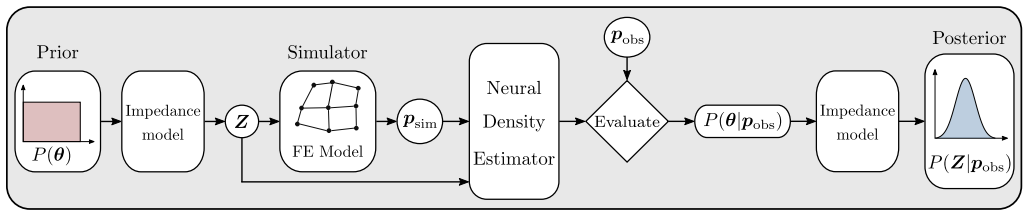
A Bayesian simulation-based inference framework estimates frequency-dependent acoustic surface impedances from sparse interior sound pressure measurements.
A machine-rendered reading of the paper's core claim, the machinery that carries it, and where it could break.
Core claim
The authors present a Bayesian framework employing simulation-based inference to map simulated sound pressure data to posterior distributions over the parameters of a damped oscillator model with a fractional calculus term for surface impedance. Verified on a cuboid room finite element model and tested against impedance tube measurements, the method estimates all six individual impedances robustly. It further demonstrates reliable uncertainty quantification and high predictive accuracy on a numerical car cabin model with complex geometry.
What carries the argument
Simulation-based inference using neural networks to approximate posterior distributions of impedance model parameters from simulated interior pressure fields.
If this is right
- The framework achieves accurate estimation of all six surface impedances individually.
- It provides well-calibrated uncertainty quantification for the estimates.
- Posterior predictive checks confirm the model's ability to reproduce observed sound fields.
- High predictive accuracy holds even for complex-shaped geometries like car cabins.
- The approach bypasses traditional sampling-based Bayesian methods for high-dimensional problems.
Where Pith is reading between the lines
- This approach could extend to real-time monitoring of acoustic environments by integrating with sensor networks.
- Similar inference techniques might apply to estimating other boundary conditions in wave propagation problems, such as in electromagnetics or seismics.
- Future work could test the method on physical prototypes with varying surface materials to validate generalization.
- If the neural network architecture is made more efficient, it could enable on-site impedance characterization during acoustic design iterations.
Load-bearing premise
The damped oscillator model extended with a fractional calculus term sufficiently captures the frequency-dependent impedance of real acoustic surfaces, and the finite-element simulations accurately represent the physical sound field.
What would settle it
If applying the method to a real enclosure with independently measured reference impedances yields posterior distributions whose predicted sound pressure fields deviate substantially from new measurements, beyond the quantified uncertainty, the estimation accuracy would be falsified.
Figures




read the original abstract
Accurate acoustic simulations of enclosed spaces require precise boundary conditions, typically expressed through surface impedances for wave-based methods. Conventional measurement techniques often rely on simplifying assumptions about the sound field and mounting conditions, limiting their validity for real-world scenarios. To overcome these limitations, this study introduces a Bayesian framework for the in situ estimation of frequency-dependent acoustic surface impedances from sparse interior sound pressure measurements. The approach employs simulation-based inference, which leverages the expressiveness of modern neural network architectures to directly map simulated data to posterior distributions of model parameters, bypassing conventional sampling-based Bayesian approaches and offering advantages for high-dimensional inference problems. Impedance behavior is modeled using a damped oscillator model extended with a fractional calculus term. The framework is verified on a finite element model of a cuboid room and further tested with impedance tube measurements used as reference, achieving robust and accurate estimation of all six individual impedances. Application to a numerical car cabin model further demonstrates reliable uncertainty quantification and high predictive accuracy even for complex-shaped geometries. Posterior predictive checks and coverage diagnostics confirm well-calibrated inference, highlighting the method's potential for generalizable, efficient, and physically consistent characterization of acoustic boundary conditions in real-world interior environments.
Editorial analysis
A structured set of objections, weighed in public.
Referee Report
Summary. The manuscript proposes a simulation-based inference (SBI) framework to estimate the frequency-dependent acoustic surface impedances of all six enclosure walls from sparse interior pressure measurements. Impedance is represented by a damped-oscillator model augmented with a fractional-calculus term. The method is verified on a finite-element cuboid-room model, compared against impedance-tube reference data, and demonstrated on a car-cabin geometry, with claims of accurate individual-impedance recovery, well-calibrated uncertainty quantification, and high predictive accuracy supported by posterior predictive checks and coverage diagnostics.
Significance. If the identifiability of the six parameters is confirmed, the work would supply a practical Bayesian tool for in-situ boundary characterization that avoids the simplifying assumptions of conventional techniques and scales to complex geometries. The explicit use of SBI, posterior predictive checks, and coverage diagnostics are constructive elements that strengthen the reliability assessment when the central claims hold.
major comments (2)
- [Abstract / Cuboid verification] Abstract and cuboid verification: the headline claim of 'robust and accurate estimation of all six individual impedances' is load-bearing yet rests on an unexamined identifiability assumption. Because the forward map from six impedance parameters to sparse interior pressures is many-to-one, the manuscript must report posterior correlation matrices or marginal variances from the cuboid FEM experiments to demonstrate that the recovered marginals are not degenerate or strongly cross-correlated.
- [Impedance-tube comparison] Impedance-tube comparison: quantitative error metrics, sensor placement details, data exclusion criteria, and the precise frequency range over which the six impedances are recovered are not supplied, preventing a full assessment of whether the reported agreement with reference data actually supports the central claim of accurate individual-impedance recovery.
minor comments (1)
- [Impedance model] The precise functional form and parameterization of the fractional-calculus term in the impedance model should be written as an explicit equation with numbered reference for reproducibility.
Simulated Author's Rebuttal
We thank the referee for their insightful comments, which help improve the clarity and rigor of our work. We respond to each major comment below and commit to incorporating the suggested additions in the revised manuscript.
read point-by-point responses
-
Referee: [Abstract / Cuboid verification] Abstract and cuboid verification: the headline claim of 'robust and accurate estimation of all six individual impedances' is load-bearing yet rests on an unexamined identifiability assumption. Because the forward map from six impedance parameters to sparse interior pressures is many-to-one, the manuscript must report posterior correlation matrices or marginal variances from the cuboid FEM experiments to demonstrate that the recovered marginals are not degenerate or strongly cross-correlated.
Authors: We concur that explicit evidence of identifiability is necessary to substantiate our claims. Accordingly, we will augment the cuboid verification section with posterior correlation matrices and plots of marginal variances derived from the finite-element simulations. These diagnostics will illustrate that the parameters are sufficiently identifiable, with correlations present but not leading to degeneracy in the marginal posteriors. This addition will directly address the concern regarding the many-to-one nature of the forward map. revision: yes
-
Referee: [Impedance-tube comparison] Impedance-tube comparison: quantitative error metrics, sensor placement details, data exclusion criteria, and the precise frequency range over which the six impedances are recovered are not supplied, preventing a full assessment of whether the reported agreement with reference data actually supports the central claim of accurate individual-impedance recovery.
Authors: We appreciate this observation and agree that these specifics are essential for a complete evaluation. In the revised version, we will provide quantitative error metrics comparing the inferred impedances to the tube measurements, detail the sensor positions and any data exclusion criteria employed, and specify the exact frequency range used for recovery. These enhancements will strengthen the validation of our method against reference data. revision: yes
Circularity Check
No significant circularity; derivation relies on independent forward simulations and external reference data
full rationale
The paper trains a neural network via simulation-based inference on synthetic pressure fields generated from a known damped-oscillator-plus-fractional model inside FEM geometries. Posterior parameters are then inferred from real interior measurements; the reported impedances are outputs of this trained mapping rather than direct fits to the target data. Verification uses separate impedance-tube reference measurements and posterior-predictive checks on held-out geometries, none of which reduce to the fitted values by construction. No self-citation chain, ansatz smuggling, or renaming of known results appears in the load-bearing steps.
Axiom & Free-Parameter Ledger
Reference graph
Works this paper leans on
-
[1]
Impedance tube method:The impedance tube method, standardized in ISO 10534-2 12, is a well- established method for characterizing the normal- incidence surface impedance. It relies on evaluating the transfer function between two microphones positioned in- side a rigid tube, with the test specimen mounted at its ArXiv preprint / 12 September 2025 1 arXiv:2...
work page internal anchor Pith review Pith/arXiv arXiv 2025
-
[2]
Furthermore, de- terministic methods generally yield single point estimates and do not provide a quantification of the associated un- certainty, which limits their reliability and robustness, particularly when incorporated measurement data are sparse and noisy. A. Bayesian inference in acoustics To overcome these limitations, a Bayesian framework is emplo...
work page 2025
-
[3]
For a given parameter setθ, a sin- gle simulation run produces a samplep sim ∼P(p sim |θ)
A key advantage of simulation-based ap- proaches is that, while the likelihood cannot be written down explicitly, it is straightforward to sample from it by running the simulator. For a given parameter setθ, a sin- gle simulation run produces a samplep sim ∼P(p sim |θ). Repeating this process forN sim parameter configura- tions yields a dataset θj,p sim,j...
work page 2025
-
[4]
A variety of diagnostic techniques are available, each targeting specific aspects of potential mis- specification or miscalibration. Posterior predictive check:A posterior predictive check (PPC) provides a qualitative assessment of the ade- quacy of the posterior estimator by comparing simulated predictions with the observed measurements.N ppc pa- rameter...
work page 2025
-
[5]
Boundary surfaces with different impedance conditions are distinguished by color
Geometric model of the cuboid room under investiga- tion. Boundary surfaces with different impedance conditions are distinguished by color. The monopole source position is marked in red, while the black dots indicate the selected ob- servation positions. ometry is representative of compact acoustic enclosures, such as soundproof phone cabins commonly foun...
work page 2025
-
[6]
SinceZ 1 andZ 2 exhibit lower absorption than the remaining surfaces, this characteristic is explicitly ac- counted for in the assigned prior bounds. In practical applications, this information can typically be deduced from the type and choice of the boundary materials, as common construction elements (e.g., glass or concrete) 6 ArXiv preprint / 12 Septem...
work page 2025
-
[7]
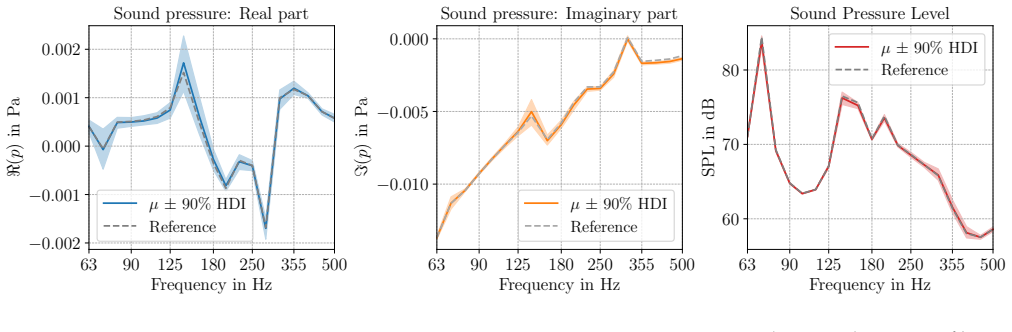
ArXiv preprint / 12 September 2025 7 63 90 125 180 250 355 500 Frequency in Hz −0.002 −0.001 0.000 0.001 0.002 ℜ(p) in Pa Sound pressure: Real part µ ± 90% HDI Reference 63 90 125 180 250 355 500 Frequency in Hz −0.010 −0.005 0.000 ℑ(p) in Pa Sound pressure: Imaginary part µ ± 90% HDI Reference 63 90 125 180 250 355 500 Frequency in Hz 60 70 80SPL in dB S...
work page 2025
-
[8]
The HDI is defined as the nar- rowest interval containing 90% of the posterior proba- bility mass
The posterior meanµand the 90% highest density interval (HDI) are shown, with the real part in blue, the imaginary part in orange, and the ref- erence values in gray. The HDI is defined as the nar- rowest interval containing 90% of the posterior proba- bility mass. In contrast to the standard deviation, the HDI provides a more informative uncertainty meas...
work page 2025
-
[9]
To prevent overly homogeneous bound- ary conditions, which would not reflect realistic acoustic environments, the remaining wallsZ 1,Z 2, andZ 4 are kept identical to the synthetic configuration described earlier. This mixed setup combines measured and syn- ArXiv preprint / 12 September 2025 9 thetic impedances, ensuring both realism and sufficient variab...
work page 2025
-
[10]
MAC of the posterior predictive sound pressure fields using synthetic (green) and measured (red) reference surface impedances, shown as mean values with 90% HDIs. of the MAC, evaluated over all PPC samples as a func- tion of frequency, for both synthetic (green) and mea- sured (red) reference impedances. In the synthetic case, the MAC remains nearly equal...
work page 2025
-
[11]
Geometric model of the car cabin with surface impedance regions highlighted in different colors. Dark gray areas denote sound-hard surfaces, while the loudspeaker mem- brane used for excitation is shown in pink. ArXiv preprint / 12 September 2025 11 here for brevity, indicate that an optimal configuration is achieved withN pos = 28 observation points, sub...
work page 2025
-
[12]
A review of finite element methods for room acoustics,
MAC with meanµand 90% HDIs for the posterior predictive sound pressure fields of the car cabin model across the frequency range. over all PPC samples. Across the considered frequency range, the MAC remains consistently high with values above 0.985, indicating excellent agreement between the predicted and reference sound pressure fields. A slight degradati...
work page doi:10.1121/10 2025
-
[13]
63C. Durkan, A. Bekasov, I. Murray, and G. Papamakarios, “Neu- ral spline flows,” inAdvances in Neural Information Processing Systems, Curran Associates Inc. (2019), Vol
work page 2019
-
[14]
64A. Tejero-Cantero, J. Boelts, M. Deistler, J.-M. Lueckmann, C. Durkan, P. Gon¸ calves, D. Greenberg, and J. Macke, “sbi: A toolkit for simulation-based inference,” Journal of Open Source Software5(52), 2505 (2020) doi:10.21105/joss.02505. ArXiv preprint / 12 September 2025 15
discussion (0)
Sign in with ORCID, Apple, or X to comment. Anyone can read and Pith papers without signing in.