DeepMET: Improving missing transverse momentum estimation with a deep neural network
Pith reviewed 2026-05-18 16:12 UTC · model grok-4.3
The pith
DeepMET uses a neural network to weight particles and improve missing transverse momentum resolution by 10-30%
A machine-rendered reading of the paper's core claim, the machinery that carries it, and where it could break.
Core claim
The paper claims that a deep neural network can be trained to produce weights for each reconstructed particle, allowing the missing transverse momentum to be computed as the negative sum of the weighted particle momenta. This yields an estimator that improves resolution by 10-30% compared to other methods in use by CMS, with benefits across diverse final states and enhanced resilience to pile-up.
What carries the argument
DeepMET, a deep neural network that outputs weights for reconstructed particles to enable a weighted negative sum for pTmiss estimation
Load-bearing premise
Monte Carlo simulations accurately reproduce the detector response, particle identification, and pile-up conditions in real LHC data.
What would settle it
Measuring the pTmiss resolution in real collision data and finding no significant improvement over traditional methods would falsify the performance claims.
Figures




read the original abstract
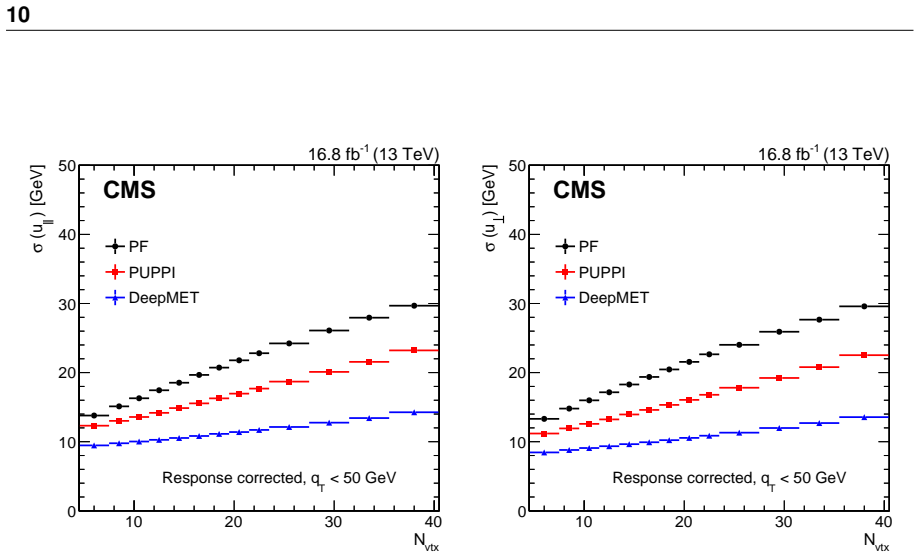
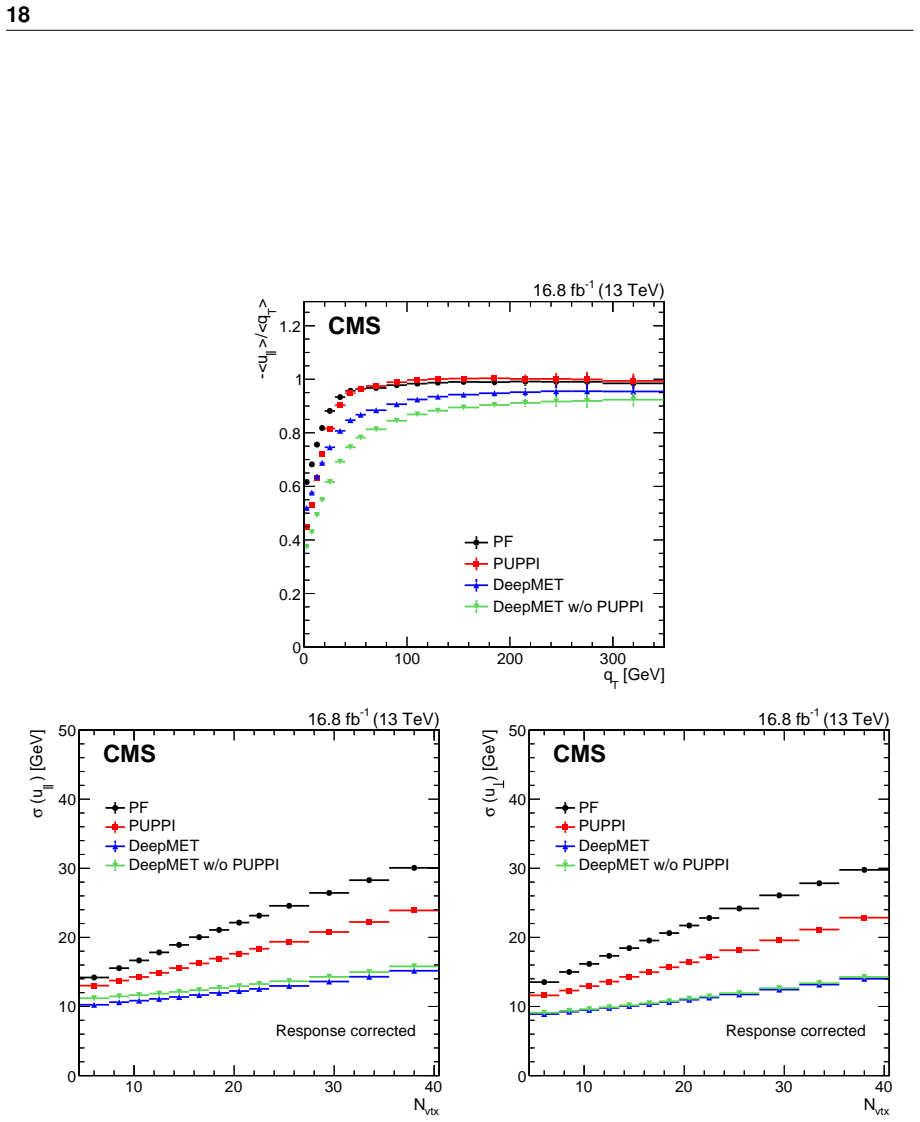
At hadron colliders, the net transverse momentum of particles that do not interact with the detector (missing transverse momentum, $\vec{p}_\mathrm{T}^\text{miss}$) is a crucial observable in many analyses. In the standard model, $\vec{p}_\mathrm{T}^\text{miss}$ originates from neutrinos. Many beyond-the-standard-model particles, such as dark matter candidates, are also expected to leave the experimental apparatus undetected. This paper presents a novel $\vec{p}_\mathrm{T}^\text{miss}$ estimator, DeepMET, which is based on deep neural networks that were developed by the CMS Collaboration at the LHC. The DeepMET algorithm produces a weight for each reconstructed particle based on its properties. The estimator is based on the negative vector sum of the weighted transverse momenta of all reconstructed particles in an event. Compared with other estimators currently employed by CMS, DeepMET improves the $\vec{p}_\mathrm{T}^\text{miss}$ resolution by 10$-$30%, shows improvement for a wide range of final states, is easier to train, and is more resilient against the effects of additional proton-proton interactions accompanying the collision of interest.
Editorial analysis
A structured set of objections, weighed in public.
Referee Report
Summary. The manuscript presents DeepMET, a deep neural network developed by CMS to estimate missing transverse momentum (p_T^miss) at the LHC. The algorithm assigns a learned weight to each reconstructed particle based on its properties and defines the estimator as the negative vector sum of the weighted transverse momenta. Using Monte Carlo simulations with generator-level invisible momentum as the training target, the paper reports that DeepMET improves p_T^miss resolution by 10-30% relative to existing CMS estimators, performs better across a range of final states, is easier to train, and shows greater resilience to pile-up.
Significance. If the reported resolution gains and pile-up resilience translate from simulation to collision data, DeepMET would represent a practical and deployable improvement for a core experimental observable used in many SM and BSM analyses. The per-particle weighting approach is a straightforward extension of existing techniques and could be adopted relatively quickly by the collaboration.
major comments (2)
- [Abstract] Abstract and results sections: The central claim of a 10-30% resolution improvement is presented without quantitative details on the exact resolution metric (e.g., RMS, 68% containment, or sigma of the response), the precise baseline estimators being compared, or the composition of the training/validation samples. This information is load-bearing for evaluating whether the numerical gains are robust or depend on particular event topologies.
- [Results] Results and validation sections: No data-MC closure test or performance comparison in data control regions with known true p_T^miss (such as Z→μμ or γ+jet events) is described. Because the network is trained exclusively on simulated events, the translation of the claimed gains to real collision data rests on the untested assumption that MC modeling of detector response, particle ID efficiencies, and pile-up is sufficiently accurate; this is a load-bearing point for the paper's applicability claim.
minor comments (2)
- [Abstract] The abstract states that DeepMET 'is easier to train' without specifying the training procedure, loss function, or hyperparameter choices relative to prior CMS MET estimators; a brief comparison table would improve clarity.
- [Methods] Notation for the weighted sum estimator should be defined explicitly with an equation number in the methods section to avoid ambiguity with standard p_T^miss definitions.
Simulated Author's Rebuttal
We thank the referee for the careful reading and constructive comments on our manuscript describing DeepMET. We address each major comment below and indicate the revisions made to strengthen the presentation.
read point-by-point responses
-
Referee: [Abstract] Abstract and results sections: The central claim of a 10-30% resolution improvement is presented without quantitative details on the exact resolution metric (e.g., RMS, 68% containment, or sigma of the response), the precise baseline estimators being compared, or the composition of the training/validation samples. This information is load-bearing for evaluating whether the numerical gains are robust or depend on particular event topologies.
Authors: We agree that explicit quantitative details strengthen the central claim. In the revised manuscript we have expanded both the abstract and the results section to specify that resolution is quantified via the RMS of the p_T^miss response distribution, that the baselines are the standard CMS particle-flow and PUPPI estimators, and that the training and validation samples comprise simulated ttbar, Z+jets, and W+jets events generated with a range of pile-up conditions. A new table now reports the per-final-state improvements. revision: yes
-
Referee: [Results] Results and validation sections: No data-MC closure test or performance comparison in data control regions with known true p_T^miss (such as Z→μμ or γ+jet events) is described. Because the network is trained exclusively on simulated events, the translation of the claimed gains to real collision data rests on the untested assumption that MC modeling of detector response, particle ID efficiencies, and pile-up is sufficiently accurate; this is a load-bearing point for the paper's applicability claim.
Authors: We acknowledge that direct validation in data control regions would provide additional confidence for deployment. The present work focuses on Monte Carlo studies in which the training target is generator-level invisible momentum, allowing controlled evaluation of resolution and pile-up resilience. We have added an explicit discussion of the modeling assumptions and a forward-looking statement that data-MC comparisons in Z→μμ and γ+jet regions are planned for a follow-up analysis. The simulation results remain a necessary first step for algorithm development. revision: partial
Circularity Check
No circularity: DeepMET resolution gains are measured against generator-level truth on held-out MC samples
full rationale
The paper trains a DNN to assign per-particle weights whose negative vector sum approximates missing transverse momentum, using generator-level invisible momentum as the explicit training target on simulated events. Resolution improvements (10-30%) are then quantified by direct comparison of the resulting estimator to the same generator-level truth on independent simulated samples. This is a standard supervised learning workflow with external benchmark; the reported metrics do not reduce to a fitted parameter renamed as a prediction, nor to any self-referential definition or self-citation chain. The derivation chain is therefore self-contained against the MC truth benchmark and receives the default non-circularity finding.
Axiom & Free-Parameter Ledger
free parameters (1)
- Neural network weights and biases
axioms (1)
- domain assumption Monte Carlo simulations accurately model real detector response, particle reconstruction, and pile-up conditions
Lean theorems connected to this paper
-
IndisputableMonolith/Cost/FunctionalEquation.leanwashburn_uniqueness_aczel unclear?
unclearRelation between the paper passage and the cited Recognition theorem.
The DEEPMET algorithm produces a weight for each reconstructed particle based on its properties. The estimator is based on the negative vector sum of the weighted transverse momenta of all reconstructed particles in an event.
-
IndisputableMonolith/Foundation/ArithmeticFromLogic.leanLogicNat embedding and J-cost orbit unclear?
unclearRelation between the paper passage and the cited Recognition theorem.
The DNN architecture... embedding layers... dense layers... outputs w_i, b_i,x, b_i,y... p_miss_x = −∑(w_i p_i,x + b_i,x)
What do these tags mean?
- matches
- The paper's claim is directly supported by a theorem in the formal canon.
- supports
- The theorem supports part of the paper's argument, but the paper may add assumptions or extra steps.
- extends
- The paper goes beyond the formal theorem; the theorem is a base layer rather than the whole result.
- uses
- The paper appears to rely on the theorem as machinery.
- contradicts
- The paper's claim conflicts with a theorem or certificate in the canon.
- unclear
- Pith found a possible connection, but the passage is too broad, indirect, or ambiguous to say the theorem truly supports the claim.
Forward citations
Cited by 1 Pith paper
-
Uncovering Hidden Systematics in Neural Network Models for High Energy Physics
Neural networks for HEP tasks can be fooled at significant rates by subtle perturbations inside uncertainty envelopes, revealing hidden systematics not captured by conventional methods.
Reference graph
Works this paper leans on
-
[1]
The CMS experiment at the CERN LHC
CMS Collaboration, “The CMS experiment at the CERN LHC”,JINST3(2008) S08004, doi:10.1088/1748-0221/3/08/S08004
-
[2]
The ATLAS Experiment at the CERN Large Hadron Collider
ATLAS Collaboration, “The ATLAS experiment at the CERN Large Hadron Collider”, JINST3(2008) S08003,doi:10.1088/1748-0221/3/08/S08003
-
[3]
Pileup mitigation at CMS in 13 TeV data
CMS Collaboration, “Pileup mitigation at CMS in 13 TeV data”,JINST15(2020) P09018, doi:10.1088/1748-0221/15/09/P09018,arXiv:2003.00503
-
[4]
Pileup Per Particle Identification
D. Bertolini, P . Harris, M. Low, and N. Tran, “Pileup per particle identification”,JHEP10 (2014) 059,doi:10.1007/JHEP10(2014)059,arXiv:1407.6013
work page internal anchor Pith review Pith/arXiv arXiv doi:10.1007/jhep10(2014)059 2014
-
[5]
Pileup-per-particle identification: optimisation for Run 2 Legacy and beyond
CMS Collaboration, “Pileup-per-particle identification: optimisation for Run 2 Legacy and beyond”, CMS Detector Performance Summary CMS-DP-2021-001, 2021. References 21
work page 2021
-
[6]
Performance of the CMS missing transverse energy reconstruction in pp data at sqrt(s) = 8 TeV
CMS Collaboration, “Performance of the CMS missing transverse momentum reconstruction in pp data at √s= 8 TeV”,JINST10(2015) P02006, doi:10.1088/1748-0221/10/02/P02006,arXiv:1411.0511
work page internal anchor Pith review Pith/arXiv arXiv doi:10.1088/1748-0221/10/02/p02006 2015
-
[7]
Evidence for the 125 GeV Higgs boson decaying to a pair of tau leptons
CMS Collaboration, “Evidence for the 125 GeV Higgs boson decaying to a pair ofτ leptons”,JHEP05(2014) 104,doi:10.1007/JHEP05(2014)104,arXiv:1401.5041
work page internal anchor Pith review Pith/arXiv arXiv doi:10.1007/jhep05(2014)104 2014
-
[8]
HEPData record for this analysis
“HEPData record for this analysis”, 2025.doi:10.17182/hepdata.159179
-
[9]
Performance of the CMS Level-1 trigger in proton-proton collisions at √s = 13 TeV
CMS Collaboration, “Performance of the CMS Level-1 trigger in proton-proton collisions at √s=13 TeV”,JINST15(2020) P10017, doi:10.1088/1748-0221/15/10/P10017,arXiv:2006.10165
-
[10]
CMS Collaboration, “The CMS trigger system”,JINST12(2017) P01020, doi:10.1088/1748-0221/12/01/P01020,arXiv:1609.02366
work page internal anchor Pith review Pith/arXiv arXiv doi:10.1088/1748-0221/12/01/p01020 2017
-
[11]
Performance of the CMS high-level trigger during LHC Run 2
CMS Collaboration, “Performance of the CMS high-level trigger during LHC Run 2”, JINST19(2024) P11021,doi:10.1088/1748-0221/19/11/P11021, arXiv:2410.17038
-
[12]
Description and performance of track and primary-vertex reconstruction with the CMS tracker
CMS Collaboration, “Description and performance of track and primary-vertex reconstruction with the CMS tracker”,JINST9(2014) P10009, doi:10.1088/1748-0221/9/10/P10009,arXiv:1405.6569
work page internal anchor Pith review Pith/arXiv arXiv doi:10.1088/1748-0221/9/10/p10009 2014
-
[13]
Technical proposal for the Phase-II upgrade of the Compact Muon Solenoid
CMS Collaboration, “Technical proposal for the Phase-II upgrade of the Compact Muon Solenoid”, CMS Technical Proposal CERN-LHCC-2015-010, CMS-TDR-15-02, 2015
work page 2015
-
[14]
Particle-flow reconstruction and global event description with the CMS detector
CMS Collaboration, “Particle-flow reconstruction and global event description with the CMS detector”,JINST12(2017) P10003,doi:10.1088/1748-0221/12/10/P10003, arXiv:1706.04965
work page internal anchor Pith review Pith/arXiv arXiv doi:10.1088/1748-0221/12/10/p10003 2017
-
[15]
CMS Collaboration, “Performance of the CMS muon detector and muon reconstruction with proton-proton collisions at √s=13 TeV”,JINST13(2018) P06015, doi:10.1088/1748-0221/13/06/P06015,arXiv:1804.04528
work page internal anchor Pith review Pith/arXiv arXiv doi:10.1088/1748-0221/13/06/p06015 2018
-
[16]
The anti-k_t jet clustering algorithm
M. Cacciari, G. P . Salam, and G. Soyez, “The anti-kT jet clustering algorithm”,JHEP04 (2008) 063,doi:10.1088/1126-6708/2008/04/063,arXiv:0802.1189
work page internal anchor Pith review Pith/arXiv arXiv doi:10.1088/1126-6708/2008/04/063 2008
-
[17]
M. Cacciari, G. P . Salam, and G. Soyez, “FastJet user manual”,Eur. Phys. J. C72(2012) 1896,doi:10.1140/epjc/s10052-012-1896-2,arXiv:1111.6097
work page internal anchor Pith review Pith/arXiv arXiv doi:10.1140/epjc/s10052-012-1896-2 2012
-
[18]
Jet energy scale and resolution in the CMS experiment in pp collisions at 8 TeV
CMS Collaboration, “Jet energy scale and resolution in the CMS experiment in pp collisions at 8 TeV”,JINST12(2017) P02014, doi:10.1088/1748-0221/12/02/P02014,arXiv:1607.03663
work page internal anchor Pith review Pith/arXiv arXiv doi:10.1088/1748-0221/12/02/p02014 2017
-
[19]
CMS Collaboration, “Performance of missing transverse momentum reconstruction in proton-proton collisions at √s=13 TeV using the CMS detector”,JINST14(2019) P07004,doi:10.1088/1748-0221/14/07/P07004,arXiv:1903.06078
work page internal anchor Pith review Pith/arXiv arXiv doi:10.1088/1748-0221/14/07/p07004 2019
-
[20]
Precision luminosity measurement in proton-proton collisions at√s = 13 TeV in 2015 and 2016 at CMS
CMS Collaboration, “Precision luminosity measurement in proton-proton collisions at√s=13 TeV in 2015 and 2016 at CMS”,Eur. Phys. J. C81(2021) 800, doi:10.1140/epjc/s10052-021-09538-2,arXiv:2104.01927
-
[21]
J. Alwall et al., “The automated computation of tree-level and next-to-leading order differential cross sections, and their matching to parton shower simulations”,JHEP07 (2014) 079,doi:10.1007/JHEP07(2014)079,arXiv:1405.0301. 22
work page internal anchor Pith review Pith/arXiv arXiv doi:10.1007/jhep07(2014)079 2014
-
[22]
A New Method for Combining NLO QCD with Shower Monte Carlo Algorithms
P . Nason, “A new method for combining NLO QCD with shower Monte Carlo algorithms”,JHEP11(2004) 040,doi:10.1088/1126-6708/2004/11/040, arXiv:hep-ph/0409146
work page internal anchor Pith review Pith/arXiv arXiv doi:10.1088/1126-6708/2004/11/040 2004
-
[23]
Matching NLO QCD computations with Parton Shower simulations: the POWHEG method
S. Frixione, P . Nason, and C. Oleari, “Matching NLO QCD computations with parton shower simulations: the POWHEG method”,JHEP11(2007) 070, doi:10.1088/1126-6708/2007/11/070,arXiv:0709.2092
work page internal anchor Pith review Pith/arXiv arXiv doi:10.1088/1126-6708/2007/11/070 2007
-
[24]
NLO vector-boson production matched with shower in POWHEG
S. Alioli, P . Nason, C. Oleari, and E. Re, “NLO vector-boson production matched with shower in POWHEG”,JHEP07(2008) 060, doi:10.1088/1126-6708/2008/07/060,arXiv:0805.4802
work page internal anchor Pith review Pith/arXiv arXiv doi:10.1088/1126-6708/2008/07/060 2008
-
[25]
A general framework for implementing NLO calculations in shower Monte Carlo programs: the POWHEG BOX
S. Alioli, P . Nason, C. Oleari, and E. Re, “A general framework for implementing NLO calculations in shower Monte Carlo programs: the POWHEG BOX”,JHEP06(2010) 043, doi:10.1007/JHEP06(2010)043,arXiv:1002.2581
work page internal anchor Pith review Pith/arXiv arXiv doi:10.1007/jhep06(2010)043 2010
-
[26]
T. Sj ¨ostrand et al., “An introduction to PYTHIA 8.2”,Comput. Phys. Commun.191(2015) 159,doi:10.1016/j.cpc.2015.01.024,arXiv:1410.3012
work page internal anchor Pith review Pith/arXiv arXiv doi:10.1016/j.cpc.2015.01.024 2015
-
[27]
Tuning PYTHIA 8.1: the Monash 2013 Tune
P . Skands, S. Carrazza, and J. Rojo, “Tuning PYTHIA 8.1: the Monash 2013 tune”,Eur. Phys. J. C74(2014) 3024,doi:10.1140/epjc/s10052-014-3024-y, arXiv:1404.5630
work page internal anchor Pith review Pith/arXiv arXiv doi:10.1140/epjc/s10052-014-3024-y 2013
-
[28]
Extraction and validation of a new set of CMS PYTHIA8 tunes from underlying-event measurements
CMS Collaboration, “Extraction and validation of a new set of CMSPYTHIA8 tunes from underlying-event measurements”,Eur. Phys. J. C80(2020) 4, doi:10.1140/epjc/s10052-019-7499-4,arXiv:1903.12179
-
[29]
Parton distributions from high-precision collider data
NNPDF Collaboration, “Parton distributions from high-precision collider data”,Eur. Phys. J. C77(2017) 663,doi:10.1140/epjc/s10052-017-5199-5, arXiv:1706.00428
work page internal anchor Pith review Pith/arXiv arXiv doi:10.1140/epjc/s10052-017-5199-5 2017
-
[30]
Simplified Models for a First Characterization of New Physics at the LHC
J. Alwall, P . Schuster, and N. Toro, “Simplified models for a first characterization of new physics at the LHC”,Phys. Rev. D79(2009) 075020, doi:10.1103/PhysRevD.79.075020,arXiv:0810.3921
work page internal anchor Pith review Pith/arXiv arXiv doi:10.1103/physrevd.79.075020 2009
-
[31]
Simplified Models for LHC New Physics Searches
LHC New Physics Working Group, “Simplified models for LHC new physics searches”, J. Phys. G39(2012) 105005,doi:10.1088/0954-3899/39/10/105005, arXiv:1105.2838
work page internal anchor Pith review Pith/arXiv arXiv doi:10.1088/0954-3899/39/10/105005 2012
-
[32]
CMS Collaboration, “Search for supersymmetry in proton-proton collisions at 13 TeV in final states with jets and missing transverse momentum”,JHEP10(2019) 244, doi:10.1007/JHEP10(2019)244,arXiv:1908.04722
-
[33]
CMS Collaboration, “Search for electroweak production of charginos and neutralinos at√s=13 TeV in final states containing hadronic decays of WW, WZ, or WH and missing transverse momentum”,Phys. Lett. B842(2023) 137460, doi:10.1016/j.physletb.2022.137460,arXiv:2205.09597
-
[34]
GEANT4 Collaboration, “GEANT4—a simulation toolkit”,Nucl. Instrum. Meth. A506 (2003) 250,doi:10.1016/S0168-9002(03)01368-8
-
[35]
Batch Normalization: Accelerating Deep Network Training by Reducing Internal Covariate Shift
S. Ioffe and C. Szegedy, “Batch normalization: accelerating deep network training by reducing internal covariate shift”, 2015.arXiv:1502.03167
work page internal anchor Pith review Pith/arXiv arXiv 2015
-
[36]
Chollet et al., “Keras”.https://keras.io, 2015
F. Chollet et al., “Keras”.https://keras.io, 2015. References 23
work page 2015
-
[37]
TensorFlow: A system for large-scale machine learning
M. Abadi et al., “TensorFlow: A system for large-scale machine learning”, 2016. arXiv:1605.08695
work page internal anchor Pith review Pith/arXiv arXiv 2016
-
[38]
Decoupled Weight Decay Regularization
I. Loshchilov and F. Hutter, “Decoupled weight decay regularization”, 2017. arXiv:1711.05101
work page internal anchor Pith review Pith/arXiv arXiv 2017
-
[39]
CMS Collaboration, “Measurement of the transverse momentum spectra of weak vector bosons produced in proton-proton collisions at √s=8 TeV”,JHEP02(2017) 096, doi:10.1007/JHEP02(2017)096,arXiv:1606.05864
work page internal anchor Pith review Pith/arXiv arXiv doi:10.1007/jhep02(2017)096 2017
-
[40]
High-precision measurement of the W boson mass with the CMS experiment
CMS Collaboration, “High-precision measurement of the W boson mass with the CMS experiment at the LHC”, 2024.arXiv:2412.13872. Submitted toNature
work page internal anchor Pith review Pith/arXiv arXiv 2024
-
[41]
CMS physics: Technical design report volume 1: Detector performance and software
CMS Collaboration, “CMS physics: Technical design report volume 1: Detector performance and software”, CMS Technical Design Report CERN-LHCC-2006-001, CMS-TDR-8-1, 2006
work page 2006
-
[42]
CMS Collaboration, “CMSSW on Github”. Accessed: 2023-11-08. http://cms-sw.github.io/
work page 2023
-
[43]
Portable acceleration of CMS computing workflows with coprocessors as a service
CMS Collaboration, “Portable acceleration of CMS computing workflows with coprocessors as a service”,Comput. Softw. Big Sci.8(2024) 17, doi:10.1007/s41781-024-00124-1,arXiv:2402.15366. 24 25 A The CMS Collaboration Yerevan Physics Institute, Yerevan, Armenia A. Hayrapetyan, V . Makarenko , A. Tumasyan1 Institut f ¨ ur Hochenergiephysik, Vienna, Austria W....
discussion (0)
Sign in with ORCID, Apple, or X to comment. Anyone can read and Pith papers without signing in.