AutiHero: Engaging Parents in Creating Personalized, Multi-path Social Narratives for Autistic Children
Pith reviewed 2026-05-18 15:02 UTC · model grok-4.3
The pith
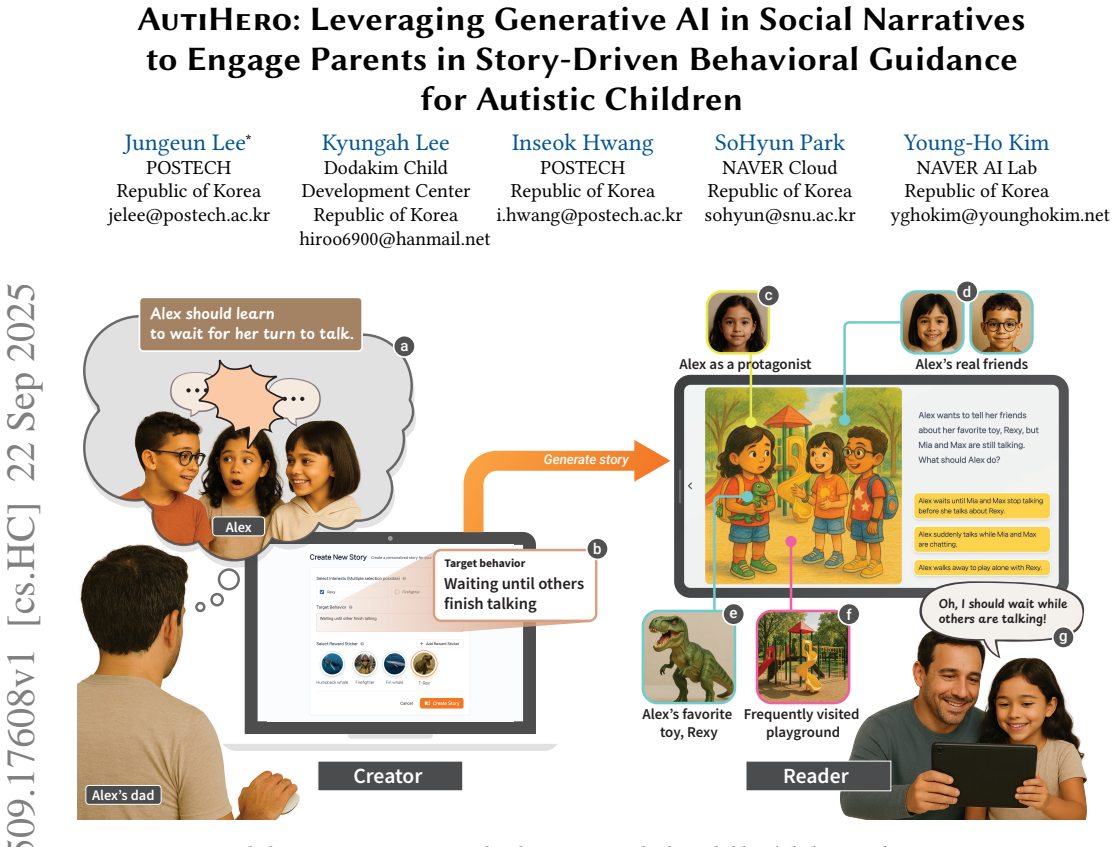
AutiHero uses generative AI to let parents create personalized multi-path social narratives that help autistic children explore behavioral choices and consequences.
A machine-rendered reading of the paper's core claim, the machinery that carries it, and where it could break.
Core claim
AutiHero is a generative AI-based social narrative system that supports parents to create personalized, multi-path stories targeting specific behaviors of their autistic children. It enables exploration of behavioral choices and causal consequences together in reading. In a two-week deployment with 16 autistic child-parent dyads, parents actively created, adapted, and read stories, showing increased confidence in everyday behavioral guidance. The work contributes real-world-contextualized text+image content creation approaches using GenAI for sensitive contexts.
What carries the argument
The AutiHero system, which harnesses generative AI to produce personalized text and image content for multi-path social narratives that branch based on behavioral choices.
Load-bearing premise
That self-reported increases in parental confidence from a short two-week study with 16 families reliably indicate lasting benefits without objective data on children's actual behavior.
What would settle it
A follow-up study measuring children's specific behavioral improvements or sustained parental confidence over several months with control groups showing no difference.
Figures


read the original abstract
Social narratives help autistic children understand and navigate social situations through stories. To ensure effective practice, however, they often require significant time and effort from parents in customizing the narrative materials and delivering repeated instructions on them. We present AutiHero, a generative AI (GenAI)-based social narrative system, which supports parents to create personalized, multi-path stories targeting specific behavior of their autistic children, while enabling them to explore behavioral choices and causal consequences together in reading. A two-week deployment study with 16 autistic child-parent dyads showed that parents actively created, adapted, and read stories with their children, with increased confidence in everyday behavioral guidance. Our work contributes real-world-contextualized text+image content creation approaches harnessing GenAI, ensuring user-aligned application in sensitive contexts involving autistic children and their parents.
Editorial analysis
A structured set of objections, weighed in public.
Referee Report
Summary. The paper introduces AutiHero, a generative AI system that enables parents to create personalized, multi-path social narratives targeting specific behaviors of their autistic children, allowing joint exploration of choices and consequences during reading. It reports results from a two-week deployment study with 16 autistic child-parent dyads, in which parents actively created, adapted, and read stories, accompanied by self-reported increases in confidence for everyday behavioral guidance. The work positions this as a contribution to user-aligned GenAI applications in sensitive autism-support contexts.
Significance. If the reported benefits hold under more rigorous evaluation, the multi-path narrative design and GenAI-assisted personalization could meaningfully lower barriers for parents creating social stories. The system concept for real-world, text+image content creation in this domain is a clear strength and aligns with needs in HCI and special education. However, the current evidence is too preliminary to support strong claims about effectiveness or generalizability.
major comments (1)
- [Evaluation / Deployment Study] The deployment study (described in the Evaluation section) reports positive parental engagement and increased confidence after two weeks but provides no details on outcome measures, pre/post assessment instruments, statistical tests, control conditions, or any objective behavioral data collected from the children. Without these, the data cannot distinguish system effects from novelty, repeated engagement, or reporting bias, undermining the central claim that AutiHero produces benefits in behavioral guidance.
minor comments (2)
- [Abstract] The abstract states positive study outcomes without any reference to study limitations, sample size, or duration; adding a brief qualifier would improve balance and reader expectations.
- [System Design] Notation for story paths and behavioral branches could be clarified with a small diagram or explicit definition early in the System Design section to aid readers unfamiliar with multi-path narratives.
Simulated Author's Rebuttal
We thank the referee for their constructive feedback and for recognizing the potential of the multi-path narrative approach in sensitive autism-support contexts. We address the major comment on the evaluation study below.
read point-by-point responses
-
Referee: [Evaluation / Deployment Study] The deployment study (described in the Evaluation section) reports positive parental engagement and increased confidence after two weeks but provides no details on outcome measures, pre/post assessment instruments, statistical tests, control conditions, or any objective behavioral data collected from the children. Without these, the data cannot distinguish system effects from novelty, repeated engagement, or reporting bias, undermining the central claim that AutiHero produces benefits in behavioral guidance.
Authors: We agree that the current reporting lacks sufficient detail on the evaluation methods. The two-week study was designed as an exploratory deployment to examine real-world parental engagement and perceived utility rather than as a controlled efficacy trial. Data were gathered via system usage logs (tracking story creation, adaptation, and reading frequency) and post-study semi-structured interviews in which parents described changes in their confidence for behavioral guidance. No standardized pre/post instruments, statistical tests, control conditions, or objective child behavioral observations were included, as the priority was ecological validity and minimizing burden on families. We will revise the Evaluation section to explicitly describe the interview protocol, provide example questions used to assess confidence, add a limitations subsection discussing self-report bias and the absence of controls, and adjust language to frame the confidence increases as parent-reported perceptions within an exploratory study. These changes will improve transparency while preserving the study's focus. revision: yes
Circularity Check
No circularity: empirical deployment study stands on observed usage and self-reports
full rationale
The paper describes a GenAI system for multi-path social narratives and reports results from a two-week deployment with 16 child-parent dyads. Central claims rest on parents actively creating/adapting stories and self-reported confidence gains. No equations, fitted parameters renamed as predictions, self-citation load-bearing for uniqueness theorems, or definitional loops appear. The study is presented as independent evidence rather than a tautology presupposing its own outcome.
Axiom & Free-Parameter Ledger
axioms (1)
- domain assumption Parents can accurately self-report increases in their confidence for guiding child behavior after short-term tool use.
invented entities (1)
-
AutiHero system
no independent evidence
Lean theorems connected to this paper
-
IndisputableMonolith/Foundation/RealityFromDistinction.leanreality_from_one_distinction unclear?
unclearRelation between the paper passage and the cited Recognition theorem.
two-week deployment study with 16 autistic child-parent dyads showed that parents actively created, adapted, and read stories with their children, with increased confidence in everyday behavioral guidance
-
IndisputableMonolith/Cost/FunctionalEquation.leanwashburn_uniqueness_aczel unclear?
unclearRelation between the paper passage and the cited Recognition theorem.
generative AI-based social narrative system... multi-path stories targeting specific behavior
What do these tags mean?
- matches
- The paper's claim is directly supported by a theorem in the formal canon.
- supports
- The theorem supports part of the paper's argument, but the paper may add assumptions or extra steps.
- extends
- The paper goes beyond the formal theorem; the theorem is a base layer rather than the whole result.
- uses
- The paper appears to rely on the theorem as machinery.
- contradicts
- The paper's claim conflicts with a theorem or certificate in the canon.
- unclear
- Pith found a possible connection, but the passage is too broad, indirect, or ambiguous to say the theorem truly supports the claim.
Forward citations
Cited by 1 Pith paper
-
StoryEcho: A Generative Child-as-Actor Storytelling System for Picky-Eating Intervention
A child-as-actor generative storytelling system updated by real-world food behavior increases preschoolers' willingness to try low-preference foods and reduces parental feeding pressure in a field study with 11 families.
Reference graph
Works this paper leans on
-
[1]
2025. Social Story Creator. Retrieved Jul. 04, 2025 from https://www. socialstorycreator.app/
work page 2025
-
[2]
Faihan Alotaibi, Yota Dimitriadi, and Anthony E Kemp. 2016. Perceptions of teachers using social stories for children with autism at special schools in Saudi Arabia.Journal of education and Practice7, 11 (2016), 85–97
work page 2016
-
[3]
Michael Argyle, Veronica Salter, Hilary Nicholson, Marylin Williams, and Philip Burgess. 1970. The communication of inferior and superior attitudes by verbal and non-verbal signals.British journal of social and clinical psychology9, 3 (1970), 222–231
work page 1970
-
[4]
Tony Attwood. 2003. Understanding and managing circumscribed interests. Learning and behavior problems in Asperger syndrome126 (2003), 147
work page 2003
-
[5]
Simon Baron-Cohen, Alan M Leslie, and Uta Frith. 1985. Does the autistic child have a “theory of mind”?Cognition21, 1 (1985), 37–46
work page 1985
-
[6]
Leasha M Barry and Suzanne B Burlew. 2004. Using social stories to teach choice and play skills to children with autism.Focus on Autism and Other Developmental Disabilities19, 1 (2004), 45–51
work page 2004
-
[7]
Rongqi Bei, Yajie Liu, Yihe Wang, Yuxuan Huang, Ming Li, Yuhang Zhao, and Xin Tong. 2024. StarRescue: the Design and Evaluation of A Turn-Taking Col- laborative Game for Facilitating Autistic Children’s Social Skills. InProceedings of the 2024 CHI Conference on Human Factors in Computing Systems. 1–19
work page 2024
-
[8]
Scott Bellini and Jennifer Akullian. 2007. A meta-analysis of video modeling and video self-modeling interventions for children and adolescents with autism spectrum disorders.Exceptional children73, 3 (2007), 264–287
work page 2007
-
[9]
Brian A. Boyd. 2002. Examining the Relationship BetWeen Stress and Lack of Social Support in Mothers of Children With Autism. Focus on Autism and Other Developmental Disabilities17, 4 (2002), 208–215. arXiv:https://doi.org/10.1177/10883576020170040301 doi:10.1177/ 10883576020170040301
-
[10]
Virginia Braun and Victoria Clarke. 2006. Using thematic analysis in psychology. Qualitative research in psychology3, 2 (2006), 77–101
work page 2006
-
[11]
Lauren Brookman-Frazee, Aubyn Stahmer, Mary J Baker-Ericzén, and Katherine Tsai. 2006. Parenting interventions for children with autism spectrum and disruptive behavior disorders: Opportunities for cross-fertilization.Clinical child and family psychology review9, 3 (2006), 181–200
work page 2006
-
[12]
Mike D Brownell. 2002. Musically adapted social stories to modify behaviors in students with autism: Four case studies.Journal of music therapy39, 2 (2002), 117–144
work page 2002
-
[13]
Yvonne Bruinsma, Robert L Koegel, and Lynn Kern Koegel. 2004. Joint attention and children with autism: A review of the literature.Mental retardation and developmental disabilities research reviews10, 3 (2004), 169–175
work page 2004
-
[14]
Björn Callenmark, Lars Kjellin, Louise Rönnqvist, and Sven Bölte. 2014. Explicit versus implicit social cognition testing in autism spectrum disorder.Autism18, 6 (2014), 684–693
work page 2014
-
[15]
Louis John Camilleri, Katie Maras, and Mark Brosnan. 2024. Supporting autistic communities through parent-led and child/young person-led digital social story Jungeun Lee, Kyungah Lee, Inseok Hwang, SoHyun Park, and Young-Ho Kim interventions: an exploratory study.Frontiers in Digital Health6 (2024), 1355795
work page 2024
-
[16]
Xiang Cao, Siân E Lindley, John Helmes, and Abigail Sellen. 2010. Telling the whole story: anticipation, inspiration and reputation in a field deployment of TellTable. InProceedings of the 2010 ACM conference on Computer supported cooperative work. 251–260
work page 2010
-
[17]
Yancheng Cao, Yangyang He, Yonglin Chen, Menghan Chen, Shanhe You, Yulin Qiu, Min Liu, Chuan Luo, Chen Zheng, Xin Tong, et al. 2025. Designing LLM- simulated Immersive Spaces to Enhance Autistic Children’s Social Affordances Understanding in Traffic Settings. InProceedings of the 30th International Con- ference on Intelligent User Interfaces. 519–537
work page 2025
-
[18]
Marjorie H Charlop-Christy, Loc Le, and Kurt A Freeman. 2000. A comparison of video modeling with in vivo modeling for teaching children with autism. Journal of autism and developmental disorders30, 6 (2000), 537–552
work page 2000
-
[19]
Dasom Choi, SoHyun Park, Kyungah Lee, Hwajung Hong, and Young-Ho Kim
-
[20]
InProceedings of the 2025 CHI Conference on Human Factors in Computing Systems
AACessTalk: Fostering Communication between Minimally Verbal Autis- tic Children and Parents with Contextual Guidance and Card Recommendation. InProceedings of the 2025 CHI Conference on Human Factors in Computing Systems. 1–25
work page 2025
-
[21]
Dominique H Como, Margaret Goodfellow, Delaney Hudak, and Sharon A Cermak. 2024. A scoping review: social stories supporting behavior change for individuals with autism.Journal of Occupational Therapy, Schools, & Early Intervention17, 1 (2024), 154–175
work page 2024
-
[22]
Christan Grygas Coogle, Siddiq Ahmed, Mohammed Abdulaziz Aljaffal, Manal Yousef Alsheef, and Hamad Ali Hamdi. 2018. Social narrative strategies to support children with autism spectrum disorder.Early Childhood Education Journal46, 4 (2018), 445–450
work page 2018
-
[23]
Monica Delano and Martha E Snell. 2006. The effects of social stories on the social engagement of children with autism.Journal of positive behavior interventions8, 1 (2006), 29–42
work page 2006
-
[24]
Monica E Delano. 2007. Video modeling interventions for individuals with autism.Remedial and Special Education28, 1 (2007), 33–42
work page 2007
- [25]
-
[26]
Shijian Deng, Erin E Kosloski, Siddhi Patel, Zeke A Barnett, Yiyang Nan, Alexan- der Kaplan, Sisira Aarukapalli, William T Doan, Matthew Wang, Harsh Singh, et al. 2024. Hear me, see me, understand me: Audio-visual autism behavior recognition.IEEE Transactions on Multimedia(2024)
work page 2024
-
[27]
Linda J. Eason, Martha J. White, and Crighton Newsom. 1982. Generalized reduction of self-stimulatory behavior: An effect of teaching appropriate play to autistic children.Analysis and Intervention in Developmental Disabilities2, 2 (1982), 157–169. doi:10.1016/0270-4684(82)90016-7 Special Issue: Educational Interventions and Analyses
-
[28]
Kelly AM Edwards, Elizabeth LW McKenney, Nick Niekra, Stephen DA Hupp, and Gregory E Everett. 2021. Personalization of social narratives for students with Autism Spectrum Disorder: Brief experimental analysis.Research in Autism Spectrum Disorders89 (2021), 101877
work page 2021
-
[29]
LLC. Ella Software. 2025. Ella. Retrieved Jul. 04, 2025 from https://www.ella. kids/
work page 2025
-
[30]
FastAPI. 2025. FastAPI framework, high performance, easy to learn, fast to code, ready for production. Retrieved Sep 1, 2025 from https://fastapi.tiangolo.com/
work page 2025
-
[31]
Yi Feng, Mingyang Song, Jiaqi Wang, Zhuang Chen, Guanqun Bi, Minlie Huang, Liping Jing, and Jian Yu. 2025. SS-GEN: A Social Story Generation Framework with Large Language Models. InProceedings of the AAAI Conference on Artificial Intelligence, Vol. 39. 1300–1308
work page 2025
-
[32]
Rudolph Flesch. 1948. A new readability yardstick.Journal of applied psychology 32, 3 (1948), 221
work page 1948
-
[33]
Sean Follmer, Rafael Ballagas, Hayes Raffle, Mirjana Spasojevic, and Hiroshi Ishii
-
[34]
InProceedings of the ACM 2012 conference on Computer supported cooperative work
People in books: using a FlashCam to become part of an interactive book for connected reading. InProceedings of the ACM 2012 conference on Computer supported cooperative work. 685–694
work page 2012
-
[35]
Leilani Forby, Nicola C Anderson, Joey T Cheng, Tom Foulsham, Bradley Karstadt, Jessica Dawson, Farid Pazhoohi, and Alan Kingstone. 2023. Read- ing the room: Autistic traits, gaze behaviour, and the ability to infer social relationships.Plos one18, 3 (2023), e0282310
work page 2023
-
[36]
2003.Autism: Explaining the enigma
Uta Frith. 2003.Autism: Explaining the enigma. Blackwell publishing
work page 2003
-
[37]
Isser Troy Gagan, Maria Angela Mikaela Matias, Ivy Tan, Christianne Marie Vinco, and Ethel Ong. 2023. Preparing children with Level 1 ASD for social interactions through storytelling with Amy: An exploratory study. InExtended Abstracts of the 2023 CHI Conference on Human Factors in Computing Systems. 1–7
work page 2023
-
[38]
Elisa Gagnon. 2001.Power cards: Using special interests to motivate children and youth with Asperger syndrome and autism. AAPC Publishing
work page 2001
-
[39]
Roopa Gandhi, Jennifer Jackson, and Chaitanya P Puranik. 2024. A comparative evaluation of video modeling and social stories for improving oral hygiene in children with autism spectrum disorder: A pilot study.Special Care in Dentistry 44, 3 (2024), 797–803
work page 2024
-
[40]
Carol Gray. 1994.Comic strip conversations: Illustrated interactions that teach conversation skills to students with autism and related disorders. Future Horizons
work page 1994
-
[41]
2000.The new social story book
Carol Gray. 2000.The new social story book. Future Horizons
work page 2000
-
[42]
Carol A Gray and Joy D Garand. 1993. Social stories: Improving responses of students with autism with accurate social information.Focus on autistic behavior8, 1 (1993), 1–10
work page 1993
-
[43]
The PostgreSQL Global Development Group. 2025. PostgreSQL: The World’s Most Advanced Open Source Relational Database. Retrieved Sep 1, 2025 from https://www.postgresql.org/
work page 2025
-
[44]
Kerry CM Gunn and Jonathan T Delafield-Butt. 2016. Teaching children with autism spectrum disorder with restricted interests: A review of evidence for best practice.Review of Educational Research86, 2 (2016), 408–430
work page 2016
-
[45]
Lauren Hale, Lawrence M Berger, Monique K LeBourgeois, and Jeanne Brooks- Gunn. 2011. A longitudinal study of preschoolers’ language-based bedtime routines, sleep duration, and well-being.Journal of Family Psychology25, 3 (2011), 423
work page 2011
-
[46]
Francesca GE Happé. 1997. Central coherence and theory of mind in autism: Reading homographs in context.British journal of developmental psychology15, 1 (1997), 1–12
work page 1997
-
[47]
Linda Quirk Hodgdon. 1995. Solving social-behavioral problems through the use of visually supported communication.Teaching children with autism: Strategies to enhance communication and socialization(1995), 265–286
work page 1995
-
[48]
Suzannah Iadarola, José Pérez-Ramos, Tristram Smith, and Ann Dozier. 2019. Understanding stress in parents of children with autism spectrum disorder: A focus on under-represented families.International journal of developmental disabilities65, 1 (2019), 20–30
work page 2019
-
[49]
Mega Iswari, Elsa Efrina, Arisul Mahdi, et al. 2019. Developing Social Skills of Autistic Children through Role Play. In1st Non Formal Education International Conference (NFEIC 2018). Atlantis Press, 64–68
work page 2019
-
[50]
Heike Jacob, Benjamin Kreifelts, Carolin Brück, Michael Erb, Franziska Hösl, and Dirk Wildgruber. 2012. Cerebral integration of verbal and nonverbal emotional cues: impact of individual nonverbal dominance.NeuroImage61, 3 (2012), 738–747
work page 2012
-
[51]
Tjeerd Jellema, Jeannette Lorteije, Sophie van Rijn, Mascha van t’Wout, Edward de Haan, Herman van Engeland, and Chantal Kemner. 2009. Involuntary inter- pretation of social cues is compromised in autism spectrum disorders.Autism Research2, 4 (2009), 192–204
work page 2009
-
[52]
Therese Jolliffe and Simon Baron-Cohen. 1999. A test of central coherence theory: linguistic processing in high-functioning adults with autism or Asperger syndrome: is local coherence impaired?Cognition71, 2 (1999), 149–185
work page 1999
-
[53]
Steven K Kapp, Robyn Steward, Laura Crane, Daisy Elliott, Chris Elphick, Elizabeth Pellicano, and Ginny Russell. 2019. ‘People should be allowed to do what they like’: Autistic adults’ views and experiences of stimming.Autism 23, 7 (2019), 1782–1792. arXiv:https://doi.org/10.1177/1362361319829628 doi:10. 1177/1362361319829628 PMID: 30818970
-
[54]
Steven K Kapp, Robyn Steward, Laura Crane, Daisy Elliott, Chris Elphick, Elizabeth Pellicano, and Ginny Russell. 2019. ‘People should be allowed to do what they like’: Autistic adults’ views and experiences of stimming.Autism23, 7 (2019), 1782–1792
work page 2019
-
[55]
Alicia Ann Karwal. 2007. Use of social stories for students with autism spectrum disorders. (2007)
work page 2007
-
[56]
Katharine Keeling, Brenda Smith Myles, Elisa Gagnon, and Richard L Simpson
-
[57]
Using the power card strategy to teach sportsmanship skills to a child with autism.Focus on Autism and Other Developmental Disabilities18, 2 (2003), 105–111
work page 2003
-
[58]
Cara M Keifer, Amori Yee Mikami, James P Morris, Erin J Libsack, and Matthew D Lerner. 2020. Prediction of social behavior in autism spectrum disorders: Explicit versus implicit social cognition.Autism24, 7 (2020), 1758– 1772
work page 2020
-
[59]
Lorcan Kenny, Caroline Hattersley, Bonnie Molins, Carole Buckley, Carol Povey, and Elizabeth Pellicano. 2016. Which terms should be used to describe autism? Perspectives from the UK autism community.Autism20, 4 (2016), 442–462. arXiv:https://doi.org/10.1177/1362361315588200 doi:10.1177/1362361315588200 PMID: 26134030
-
[60]
Muhammad Usman Khalid, Hina Fazil, and Maria Shoaib Qureshi. 2023. Devel- opment of Social Skills by Using Simulation Method for Children with Autism Spectrum Disorder.Journal of Development and Social Sciences4, 3 (2023), 459–478
work page 2023
-
[61]
So Hyun Kim, Audrey Thurm, Stacy Shumway, and Catherine Lord. 2013. Mul- tisite study of new autism diagnostic interview-revised (ADI-R) algorithms for toddlers and young preschoolers.Journal of autism and developmental disorders 43, 7 (2013), 1527–1538
work page 2013
-
[62]
Natalia Kucirkova. 2019. Children’s agency by design: Design parameters for personalization in story-making apps.International Journal of Child-Computer Interaction21 (2019), 112–120
work page 2019
-
[63]
Natalia Kucirkova, Merideth Gattis, Thomas P Spargo, Beatriz Seisdedos de Vega, and Rosie Flewitt. 2021. An empirical investigation of parent-child shared reading of digital personalized books.International Journal of Educational AutiHero: Leveraging Generative AI in Social Narratives to Engage Parents in Story-Driven Behavioral Guidance for Autistic Chil...
work page 2021
-
[64]
Natalia Kucirkova, David Messer, and Kieron Sheehy. 2014. Reading person- alized books with preschool children enhances their word acquisition.First Language34, 3 (2014), 227–243
work page 2014
-
[65]
Natalia Kucirkova, David Messer, and Denise Whitelock. 2013. Parents reading with their toddlers: The role of personalization in book engagement.Journal of Early Childhood Literacy13, 4 (2013), 445–470
work page 2013
- [66]
-
[67]
Elizabeth Larson. 2006. Caregiving and autism: How does children’s propensity for routinization influence participation in family activities?OTJR: Occupation, participation and health26, 2 (2006), 69–79
work page 2006
-
[68]
Justin B Leaf, Julia L Ferguson, Joseph H Cihon, Christine M Milne, Ronald Leaf, and John McEachin. 2020. A critical review of social narratives.Journal of Developmental and Physical Disabilities32, 2 (2020), 241–256
work page 2020
-
[69]
Jungeun Lee, Suwon Yoon, Kyoosik Lee, Eunae Jeong, Jae-Eun Cho, Wonjeong Park, Dongsun Yim, and Inseok Hwang. 2024. Open Sesame? Open Salami! Personalizing Vocabulary Assessment-Intervention for Children via Pervasive Profiling and Bespoke Storybook Generation. InProceedings of the 2024 CHI Conference on Human Factors in Computing Systems. 1–32
work page 2024
-
[70]
Susan R Leekam, Beatriz Lopez, and Chris Moore. 2000. Attention and joint attention in preschool children with autism.Developmental psychology36, 2 (2000), 261
work page 2000
-
[71]
Susan R Leekam, Margot R Prior, and Mirko Uljarevic. 2011. Restricted and repetitive behaviors in autism spectrum disorders: a review of research in the last decade.Psychological bulletin137, 4 (2011), 562
work page 2011
-
[72]
F¯ei Li, Mingyu Xu, Danping Wu, Yun Tang, Lingli Zhang, Xin Liu, Li Zhou, Fei Li, and Liping Jiang. 2022. From child social impairment to parenting stress in mothers of children with ASD: The role of parental self-efficacy and social support.Frontiers in Psychiatry13 (2022), 1005748
work page 2022
-
[73]
Peggy A Lorimer, Richard L Simpson, Brenda Smith Myles, and Jennifer B Ganz
-
[74]
The use of social stories as a preventative behavioral intervention in a home setting with a child with autism.Journal of positive behavior interventions 4, 1 (2002), 53–60
work page 2002
-
[75]
Alonna Marcus and David A Wilder. 2009. A comparison of peer video modeling and self video modeling to teach textual responses in children with autism. Journal of applied behavior analysis42, 2 (2009), 335–341
work page 2009
-
[76]
Goldie A McQuaid, Kevin A Pelphrey, Susan Y Bookheimer, Mirella Dapretto, Sara J Webb, Raphael A Bernier, James C McPartland, John D Van Horn, and Gregory L Wallace. 2021. The gap between IQ and adaptive functioning in autism spectrum disorder: Disentangling diagnostic and sex differences.Autism 25, 6 (2021), 1565–1579. arXiv:https://doi.org/10.1177/13623...
-
[77]
G Mesibov and Victoria Shea. 2008. Structured teaching and environmental supports.Learners on the autism spectrum: Preparing highly qualified educators (2008), 114–137
work page 2008
-
[78]
Meta. 2025. React Native - Learn Once, Write Everywhere. Retrieved Sep 1, 2025 from https://reactnative.dev/
work page 2025
-
[79]
Meta. 2025. React: The library for web and native user interfaces. Retrieved Sep 1, 2025 from https://react.dev
work page 2025
-
[80]
Microsoft. 2025. TypeScript. Retrieved Sep 1, 2025 from https://www. typescriptlang.org
work page 2025
discussion (0)
Sign in with ORCID, Apple, or X to comment. Anyone can read and Pith papers without signing in.