Engineering Anderson Localization in Arbitrary Dimensions with Interacting Quasiperiodic Kicked Bosons
Pith reviewed 2026-05-18 00:02 UTC · model grok-4.3
The pith
Both interparticle interactions and quasiperiodic modulations generate synthetic dimensions for Anderson localization.
A machine-rendered reading of the paper's core claim, the machinery that carries it, and where it could break.
Core claim
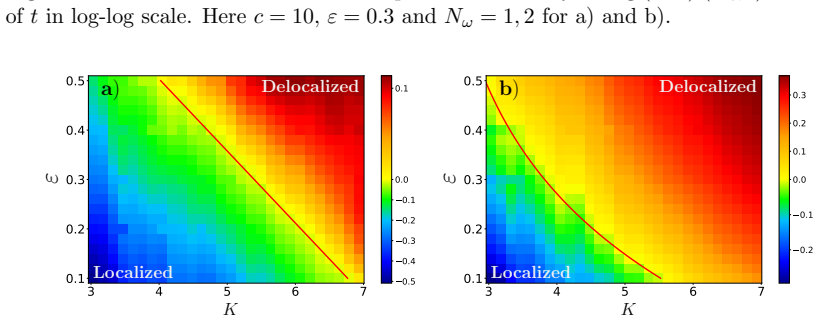
Both interparticle interactions and quasiperiodic modulations of the kicking strength can independently and simultaneously generate synthetic dimensions. In the absence of modulation, interactions between two bosons already promote an effective two-dimensional Anderson model. Introducing one or two additional incommensurate frequencies further extends the system to three and four effective dimensions. Through extensive numerical simulations of the two-body dynamics and finite-time scaling analysis, Anderson localization and the associated critical behavior characteristic of the orthogonal universality class are observed.
What carries the argument
The extended mapping of the interacting kicked rotor to a higher-dimensional Anderson model, where interactions and quasiperiodic frequencies serve as generators of synthetic dimensions.
Load-bearing premise
The standard mapping from the kicked rotor to the Anderson model still applies when interactions and quasiperiodic modulations are added to the system.
What would settle it
A failure of the finite-time scaling to show the expected orthogonal universality class critical exponents in the two-body participation ratio for the three- or four-dimensional cases would falsify the claim.
Figures


read the original abstract
We study the interplay of interactions and quasiperiodic driving in the Lieb-Liniger model of one-dimensional bosons subjected to a sequence of delta kicks. Building on the known mapping between the kicked rotor and the Anderson model, we show that both interparticle interactions and quasiperiodic modulations of the kicking strength can independently and simultaneously generate synthetic dimensions. In the absence of modulation, interactions between two bosons already promote an effective two-dimensional Anderson model. Introducing one or two additional incommensurate frequencies further extends the system to three and four effective dimensions, respectively. Through extensive numerical simulations of the two-body dynamics and finite-time scaling analysis, we observe Anderson localization and the associated critical behavior characteristic of the orthogonal universality class. This combined use of interactions and quasiperiodic driving thus provides a versatile framework for emulating Anderson localization and its transition in arbitrary dimensions.
Editorial analysis
A structured set of objections, weighed in public.
Referee Report
Summary. The paper studies the Lieb-Liniger Hamiltonian for two bosons in one dimension subjected to periodic delta kicks, with optional quasiperiodic modulation of the kick strength. Building on the single-particle kicked-rotor–Anderson mapping, it argues that interparticle interactions alone generate an effective two-dimensional Anderson model via center-of-mass and relative coordinates, while one or two additional incommensurate frequencies extend the synthetic dimension count to three or four. Extensive two-body numerical simulations combined with finite-time scaling are used to report Anderson localization and critical exponents consistent with the orthogonal universality class.
Significance. If the mapping and numerical evidence hold, the work supplies a controllable route to Anderson localization and its mobility-edge physics in synthetic dimensions d=2,3,4 using only one-dimensional interacting bosons, which is of clear interest for quantum-gas experiments. The explicit use of finite-time scaling to extract universality-class signatures is a methodological strength.
major comments (2)
- [§2–3] §2–3 (model and mapping): The central claim that the Floquet operator of the interacting, modulated kicked Lieb-Liniger system maps onto a non-interacting Anderson tight-binding model in synthetic dimensions is stated as an extension of the known single-particle result, but no explicit operator identity, perturbative expansion, or gauge transformation is supplied showing that the interaction term V(|x1−x2|) remains strictly diagonal (on-site) in the center-of-mass/relative lattice basis without generating correlated off-diagonal or long-range hopping. Such terms would alter both the orthogonal-class universality and the location of any mobility edge; their absence must be demonstrated for the load-bearing mapping to be accepted.
- [§4] §4 (numerics and scaling): The finite-time scaling analysis reports orthogonal-class critical behavior, yet the manuscript does not quantify how the extracted exponents or the apparent mobility edge shift when the interaction strength or modulation amplitudes are varied over a range that would expose possible residual correlated disorder. A systematic check that the scaling collapse remains stable under these variations is required to confirm that the observed criticality is not an artifact of the two-body truncation or finite-time window.
minor comments (2)
- [Figure 3] Figure 3 and associated text: the scaling collapse plots would benefit from explicit error bands on the data points and a statement of the fitting window used for the correlation length.
- [§3] Notation: the definition of the synthetic lattice spacing and the precise identification of the on-site disorder strength in the effective Anderson Hamiltonian should be written explicitly rather than left implicit from the single-particle analogy.
Simulated Author's Rebuttal
We thank the referee for the careful reading of our manuscript and the constructive comments. We address each major point below and indicate where revisions will be made to strengthen the presentation.
read point-by-point responses
-
Referee: [§2–3] §2–3 (model and mapping): The central claim that the Floquet operator of the interacting, modulated kicked Lieb-Liniger system maps onto a non-interacting Anderson tight-binding model in synthetic dimensions is stated as an extension of the known single-particle result, but no explicit operator identity, perturbative expansion, or gauge transformation is supplied showing that the interaction term V(|x1−x2|) remains strictly diagonal (on-site) in the center-of-mass/relative lattice basis without generating correlated off-diagonal or long-range hopping. Such terms would alter both the orthogonal-class universality and the location of any mobility edge; their absence must be demonstrated for the load-bearing mapping to be accepted.
Authors: We agree that an explicit demonstration is required to fully substantiate the mapping. The manuscript presents the result as a direct extension of the single-particle kicked-rotor–Anderson correspondence, with the interaction entering through the relative coordinate. In the revised version we will insert a new subsection deriving the effective Floquet operator in the center-of-mass/relative quasi-momentum basis and explicitly showing that V(|x1−x2|) contributes only a diagonal on-site potential; no correlated off-diagonal or long-range terms appear because the basis states are simultaneous eigenstates of the relative-position operator in the relevant Floquet frame. This addition will confirm that the effective model remains strictly non-interacting Anderson in the orthogonal class. revision: yes
-
Referee: [§4] §4 (numerics and scaling): The finite-time scaling analysis reports orthogonal-class critical behavior, yet the manuscript does not quantify how the extracted exponents or the apparent mobility edge shift when the interaction strength or modulation amplitudes are varied over a range that would expose possible residual correlated disorder. A systematic check that the scaling collapse remains stable under these variations is required to confirm that the observed criticality is not an artifact of the two-body truncation or finite-time window.
Authors: For two particles the numerics solve the exact two-body time-dependent Schrödinger equation, so there is no truncation. Nevertheless, we accept that a systematic parameter scan strengthens the claim. In the revised manuscript we will add an appendix (or extended figure) presenting finite-time scaling collapses for several values of the interaction strength and modulation amplitudes. The extracted exponents and mobility-edge location remain consistent with the orthogonal class across this range, indicating that any residual correlated hopping, if present, is negligible within the regime studied. revision: yes
Circularity Check
No significant circularity; claims rest on external mapping plus independent numerics
full rationale
The paper explicitly builds on the established single-particle kicked-rotor–Anderson mapping (cited as known) and then performs extensive numerical simulations of the two-body Floquet dynamics together with finite-time scaling to observe localization and orthogonal-class critical behavior. No equations or steps in the provided text reduce a reported prediction or synthetic-dimension claim to a fitted parameter or self-citation by construction. The central results are supported by direct dynamical evidence rather than by re-labeling inputs, making the derivation self-contained against external benchmarks.
Axiom & Free-Parameter Ledger
axioms (1)
- domain assumption The mapping between the kicked rotor and the Anderson model remains valid when interparticle interactions and quasiperiodic modulations of kick strength are introduced.
Forward citations
Cited by 1 Pith paper
-
Many-body dynamical localization in Fock space
Many-body dynamical localization emerges in the Fock space of a driven interacting bosonic system, suppressing transport and producing a crossover to Poisson spectral statistics.
Reference graph
Works this paper leans on
-
[1]
Absence of Diffusion in Certain Random Lattices
P. W. Anderson. “Absence of Diffusion in Certain Random Lattices”. In:Phys. Rev. 109 (1958), p. 1492.doi:10.1103/PhysRev.109.1492
-
[2]
Fine Tuning of Metal-Insulator Transition in Al0.3Ga0.7As Using Persistent Photoconductivity
Shingo Katsumoto et al. “Fine Tuning of Metal-Insulator Transition in Al0.3Ga0.7As Using Persistent Photoconductivity”. In:Journal of the Physical Society of Japan56.7 (1987), pp. 2259–2262.doi:10.1143/JPSJ.56.2259
-
[3]
Patrick A. Lee and T. V. Ramakrishnan. “Disordered electronic systems”. In:Rev. Mod. Phys.57 (2 Apr. 1985), pp. 287–337.doi:10.1103/RevModPhys.57.287
-
[4]
Rachida Dalichaouch et al. “Microwave localization by two-dimensional random scattering”. In:Nature354.6348 (Nov. 1991), pp. 53–55.doi:10.1038/354053a0
-
[5]
Statistical signatures of photon localization
AA Chabanov, M Stoytchev, and AZ Genack. “Statistical signatures of photon localization”. In:Nature404.6780 (2000), pp. 850–853. 10
work page 2000
-
[6]
Transport and Anderson localization in disordered two-dimensional photonic lattices
T. Schwartz et al. “Transport and Anderson localization in disordered two-dimensional photonic lattices”. In:Nature446 (2007), p. 52.doi: 10.1038/nature05623
-
[7]
Experimental Observation of the Anderson Metal-Insulator Transition with Atomic Matter Waves
J. Chab´ e et al. “Experimental Observation of the Anderson Metal-Insulator Transition with Atomic Matter Waves”. In:Phys. Rev. Lett.101 (2008), p. 255702. doi:10.1103/PhysRevLett.101.255702
-
[8]
Direct observation of Anderson localization of matter waves in a controlled disorder
J. Billy et al. “Direct observation of Anderson localization of matter waves in a controlled disorder”. In:Nature453 (2008), p. 891.doi:10.1038/nature07000
-
[9]
URL https://doi.org/10.1038/nature07071
G. Roati et al. “Anderson localization of a non-interacting Bose–Einstein condensate”. In:Nature453 (2008), p. 895.doi:10.1038/nature07071
-
[10]
Localization of ultrasound in a three-dimensional elastic network
Hefei Hu et al. “Localization of ultrasound in a three-dimensional elastic network”. In:Nature Physics4.12 (Dec. 2008), pp. 945–948.doi:10.1038/nphys1101
-
[11]
Anderson Localization and Nonlinearity in One-Dimensional Disordered Photonic Lattices
Y. Lahini et al. “Anderson Localization and Nonlinearity in One-Dimensional Disordered Photonic Lattices”. In:Phys. Rev. Lett.100 (2008), p. 013906.doi: 10.1103/PhysRevLett.100.013906
-
[12]
Three-Dimensional Anderson Localization of Ultracold Matter
S. S. Kondov et al. “Three-Dimensional Anderson Localization of Ultracold Matter”. In:Science334 (2011), p. 66.doi:10.1126/science.1209019
-
[13]
Three-dimensional localization of ultracold atoms in an optical disordered potential
F. Jendrzejewski et al. “Three-dimensional localization of ultracold atoms in an optical disordered potential”. In:Nat. Phys.8 (2012), p. 398.doi: 10.1038/nphys2256
-
[14]
Anderson localization of light
Segev Mordechai, Christodoulides N. David, and Kip Demetrios. “Anderson localization of light”. In:Nat. Photonics7 (2013), p. 197.doi: 10.1038/nphoton.2013.30
-
[15]
Anderson localization of electromagnetic waves in three dimensions
A. Yamilov, S. E. Skipetrov, and H. Cao. “Anderson localization of electromagnetic waves in three dimensions”. In:Nat. Phys.19 (2023), pp. 716–722.doi: 10.1038/s41567-022-01828-2
-
[16]
Electrons in disordered systems and the theory of localization
D. J. Thouless. “Electrons in disordered systems and the theory of localization”. In: Physics Reports13 (1974), p. 93.doi:10.1016/0370-1573(74)90029-5
-
[17]
E. Abrahams et al. “Scaling Theory of Localization: Absence of Quantum Diffusion in Two Dimensions”. In:Phys. Rev. Lett.42 (1979), p. 673.doi: 10.1103/PhysRevLett.42.673
-
[18]
Electrons in disordered systems. Scaling near the mobility edge
F. Wegner. “Electrons in disordered systems. Scaling near the mobility edge”. In:Z. Phys. B25 (1976), pp. 327–337.doi:10.1007/BF01315232
-
[19]
Ferdinand Evers and Alexander D. Mirlin. “Anderson transitions”. In:Reviews of Modern Physics80.4 (Oct. 2008), pp. 1355–1417.doi: 10.1103/revmodphys.80.1355
-
[20]
Alexander D. Mirlin and Yan V. Fyodorov. “Distribution of local densities of states, order parameter function, and critical behavior near the Anderson transition”. In: Phys. Rev. Lett.72 (4 Jan. 1994), pp. 526–529.doi:10.1103/PhysRevLett.72.526
-
[21]
Yoshiki Ueoka and Keith Slevin. “Dimensional Dependence of Critical Exponent of the Anderson Transition in the Orthogonal Universality Class”. In:Journal of the Physical Society of Japan83.8 (2014), p. 084711.doi:10.7566/JPSJ.83.084711
-
[22]
Critical properties of the Anderson localization transition and the high-dimensional limit
E. Tarquini, G. Biroli, and M. Tarzia. “Critical properties of the Anderson localization transition and the high-dimensional limit”. In:Phys. Rev. B95 (9 Mar. 2017), p. 094204.doi:10.1103/PhysRevB.95.094204
-
[23]
Anderson localization and interactions in one-dimensional metals
T. Giamarchi and H. J. Schulz. “Anderson localization and interactions in one-dimensional metals”. In:Phys. Rev. B37 (1988), p. 325.doi: 10.1103/PhysRevB.37.325. 11
-
[24]
D. M. Basko, I. L. Aleiner, and B. Altshuler. “Metal–insulator transition in a weakly interacting many-electron system with localized single-particle states”. In:Annals of Physics321 (2006), p. 1126.doi:10.1016/j.aop.2005.11.014
-
[25]
Many-Body Localization and Thermalization in Quantum Statistical Mechanics
R. Nandkishore and D. A. Huse. “Many-Body Localization and Thermalization in Quantum Statistical Mechanics”. In:Annual Review of Condensed Matter Physics6 (2015), p. 15.doi:10.1146/annurev-conmatphys-031214-014726
-
[26]
Many-body localization: An introduction and selected topics
F. Alet and N. Laflorencie. “Many-body localization: An introduction and selected topics”. In:Comptes Rendus Physique19 (2018), p. 408.doi: 10.1016/j.crhy.2018.03.003
-
[27]
Many-Body Localization in Periodically Driven Systems
P. Ponte et al. “Many-Body Localization in Periodically Driven Systems”. In:Phys. Rev. Lett.114 (2015), p. 140401.doi:10.1103/PhysRevLett.114.140401
-
[28]
Periodically driven ergodic and many-body localized quantum systems
P. Ponte et al. “Periodically driven ergodic and many-body localized quantum systems”. In:Ann. Phys.353 (2015), p. 196.doi:10.1016/j.aop.2014.11.008
-
[29]
Quantum kicked rotor and its variants: Chaos, localization and beyond
M.S. Santhanam, Sanku Paul, and J. Bharathi Kannan. “Quantum kicked rotor and its variants: Chaos, localization and beyond”. In:Physics Reports956 (2022). Quantum kicked rotor and its variants: Chaos, localization and beyond, pp. 1–87. doi:https://doi.org/10.1016/j.physrep.2022.01.002
-
[30]
Chaos, Quantum Recurrences, and Anderson Localization
S. Fishman, D. R. Grempel, and R. E. Prange. “Chaos, Quantum Recurrences, and Anderson Localization”. In:Phys. Rev. Lett.49 (1982), p. 509.doi: 10.1103/PhysRevLett.49.509
-
[31]
Quantum dynamics of a nonintegrable system
D. R. Grempel, R. E. Prange, and S. Fishman. “Quantum dynamics of a nonintegrable system”. In:Phys. Rev. A29 (1984), p. 1639.doi: 10.1103/PhysRevA.29.1639
-
[32]
Localization of diffusive excitation in multi-level systems
D. L. Shepelyansky. “Localization of diffusive excitation in multi-level systems”. In: Phys. Rev. Lett.56 (1986), p. 677.doi:10.1103/PhysRevLett.56.677
-
[33]
Atom Optics Realization of the Quantumδ-Kicked Rotor
F. L. Moore et al. “Atom Optics Realization of the Quantumδ-Kicked Rotor”. In: Phys. Rev. Lett.75 (25 1995), pp. 4598–4601.doi:10.1103/PhysRevLett.75.4598
-
[34]
Universality of the Anderson transition with the atomic kicked rotor
G. Lemari´ e et al. “Universality of the Anderson transition with the atomic kicked rotor”. In:Phys. Rev. A82 (2010), p. 013611.doi:10.1103/PhysRevA.82.013611
-
[35]
Experimental Test of Universality of the Anderson Transition
M. Lopez et al. “Experimental Test of Universality of the Anderson Transition”. In: Phys. Rev. Lett.108 (2012), p. 095701.doi:10.1103/PhysRevLett.108.095701
-
[36]
Experimental Observation of Two-Dimensional Anderson Localization with the Atomic Kicked Rotor
Isam Manai et al. “Experimental Observation of Two-Dimensional Anderson Localization with the Atomic Kicked Rotor”. In:Phys. Rev. Lett.115 (24 Dec. 2015), p. 240603.doi:10.1103/PhysRevLett.115.240603
-
[37]
Controlling symmetry and localization with an artificial gauge field in a disordered quantum system
C. Hainaut et al. “Controlling symmetry and localization with an artificial gauge field in a disordered quantum system”. In:Nat. Commun.9 (2018), p. 1382.doi: 10.1038/s41467-018-03481-9
-
[38]
Observation of Many-body Dynamical Delocalization in a Kicked Ultracold Gas
J. H. S. Toh et al. “Observation of Many-body Dynamical Delocalization in a Kicked Ultracold Gas”. In:Nat. Phys.18 (2022), p. 1297.doi: 10.1038/s41567-022-01721-w
-
[39]
Interaction-driven breakdown of dynamical localization in a kicked Quantum Gas
Alec Cao et al. “Interaction-driven breakdown of dynamical localization in a kicked Quantum Gas”. In:Nature Physics18.11 (2022), pp. 1302–1306.doi: 10.1038/s41567-022-01724-7
-
[40]
Observation of many-body dynamical localization
Y. Guo et al. “Observation of many-body dynamical localization”. In:Science389 (2025), pp. 716–719.doi:10.1126/science.adn8625
-
[41]
Observation of quantum criticality of a four-dimensional phase transition
Farid Madani et al. “Observation of quantum criticality of a four-dimensional phase transition”. In:Nature Communications16.1 (Mar. 2025).doi: 10.1038/s41467-025-57396-3. 12
-
[42]
Quantum simulation of disordered systems with cold atoms
J. C. Garreau. “Quantum simulation of disordered systems with cold atoms”. In: Physics Reports420 (2008), p. 163.doi:10.1016/j.physrep.2005.09.006
-
[43]
Exact Analysis of an Interacting Bose Gas. I. The General Solution and the Ground State
E. H. Lieb and W. Liniger. “Exact Analysis of an Interacting Bose Gas. I. The General Solution and the Ground State”. In:Phys. Rev.130 (1963), p. 1605.doi: 10.1103/PhysRev.130.1605
-
[44]
Tonks–Girardeau gas of ultracold atoms in an optical lattice
B. Paredes et al. “Tonks–Girardeau gas of ultracold atoms in an optical lattice”. In: Nature429 (2004), p. 227.doi:10.1038/nature02530
-
[45]
T. Kinoshita, T. Wenger, and D. S. Weiss. “Observation of a One-Dimensional Tonks-Girardeau Gas”. In:Science305 (2004), p. 1125.doi: 10.1126/science.1100700
-
[46]
Local Pair Correlations in One-Dimensional Bose Gases
T. Kinoshita, T. Wenger, and D. S. Weiss. “Local Pair Correlations in One-Dimensional Bose Gases”. In:Phys. Rev. Lett.95 (2005), p. 190406.doi: 10.1103/PhysRevLett.95.190406
-
[47]
One dimensional bosons: From condensed matter systems to ultracold gases
M. A. Cazalilla et al. “One dimensional bosons: From condensed matter systems to ultracold gases”. In:Rev. Mod. Phys.83 (2011), p. 1405.doi: 10.1103/RevModPhys.83.1405
-
[48]
Anderson Transition in a One-Dimensional System with Three Incommensurate Frequencies
Giulio Casati, Italo Guarneri, and D. L. Shepelyansky. “Anderson Transition in a One-Dimensional System with Three Incommensurate Frequencies”. In:Phys. Rev. Lett.62 (4 Jan. 1989), pp. 345–348.doi:10.1103/PhysRevLett.62.345
-
[49]
Interaction Effects on the Dynamical Anderson Metal-Insulator Transition Using Kicked Quantum Gases
Jun Hui See Toh et al. “Interaction Effects on the Dynamical Anderson Metal-Insulator Transition Using Kicked Quantum Gases”. In:Phys. Rev. Lett.133 (7 Aug. 2024), p. 076301.doi:10.1103/PhysRevLett.133.076301
-
[50]
Interaction Induced Anderson Transition in a Kicked One Dimensional Bose Gas
H. Olsen et al. “Interaction Induced Anderson Transition in a Kicked One Dimensional Bose Gas”. In:Phys. Rev. Lett.135 (17 Oct. 2025), p. 173403.doi: 10.1103/dyxq-qkmd
-
[51]
Ang Yang et al.Origin and emergent features of many-body dynamical localization
- [52]
-
[53]
From localization to anomalous diffusion in the dynamics of coupled kicked rotors
S. Notarnicola et al. “From localization to anomalous diffusion in the dynamics of coupled kicked rotors”. In:Phy. Rev. E97 (2018), p. 022202.doi: 10.1103/PhysRevE.97.022202
-
[54]
G. Lemari´ e et al. “Observation of the Anderson metal-insulator transition with atomic matter waves: Theory and experiment”. In:Phys. Rev. A80 (2009), p. 043626.doi:10.1103/PhysRevA.80.043626
-
[56]
Relationship between systems of impenetrable bosons and fermions in one dimension
M Girardeau. “Relationship between systems of impenetrable bosons and fermions in one dimension”. In:Journal of Mathematical Physics(1960)
work page 1960
-
[57]
Effective thermalization of a many-body dynamically localized Bose gas
Vincent Vuatelet and Adam Ran¸ con. “Effective thermalization of a many-body dynamically localized Bose gas”. In:Phys. Rev. A104 (4 2021), p. 043302.doi: 10.1103/PhysRevA.104.043302
-
[58]
Many-Body Localization in the Presence of a Small Bath
C. Rylands et al. “Many-Body Localization in the Presence of a Small Bath”. In: Phys. Rev. Lett.124 (2020), p. 155302.doi:10.1103/PhysRevLett.124.155302
-
[59]
Two-body quantum kicked rotor with arbitrary interactions
R. Chicireanu and A. Ran¸ con. “Two-body quantum kicked rotor with arbitrary interactions”. In:Phys. Rev. A103 (2021), p. 043314.doi: 10.1103/PhysRevA.103.043314. 13
discussion (0)
Sign in with ORCID, Apple, or X to comment. Anyone can read and Pith papers without signing in.