Two variants of the friendship paradox: The condition for inequality between them
Pith reviewed 2026-05-18 00:36 UTC · model grok-4.3
The pith
The difference between the two formulations of the friendship paradox equals the degree-degree covariance divided by the mean degree.
A machine-rendered reading of the paper's core claim, the machinery that carries it, and where it could break.
Core claim
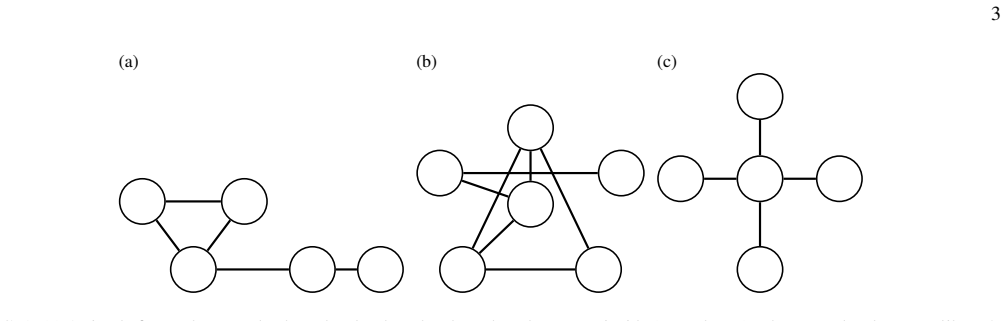
The alter-based mean exceeds the ego-based mean exactly when the degree-degree covariance is positive, equals it when the covariance is zero, and falls below it when the covariance is negative. The paper proves this identity by direct expansion of the two averaging procedures and demonstrates the three cases with explicit network examples. It further shows that the covariance form expands identically into the moment expression involving the indicated powers of the degree distribution, confirming that the two representations describe the same structural dependence.
What carries the argument
The degree-degree covariance normalized by the mean degree, which supplies the exact difference between the alter-based and ego-based friendship-paradox averages and encodes the network's mixing pattern.
If this is right
- Positive degree-degree covariance produces an assortative network in which the alter-based mean is larger than the ego-based mean.
- Negative covariance produces a disassortative network in which the alter-based mean is smaller than the ego-based mean.
- Zero covariance yields neutral mixing and equality of the two means.
- The covariance identity is equivalent to the four-moment expression, so both descriptions must hold simultaneously in any qualifying network.
Where Pith is reading between the lines
- The formula supplies a direct route to infer network assortativity from friendship-paradox statistics alone without enumerating all edges.
- The same covariance relation may extend to directed or weighted networks once the appropriate edge-direction or weight terms are inserted into the averaging procedures.
- Empirical tests on large-scale social graphs could quantify how often real networks realize each of the three covariance regimes.
Load-bearing premise
The network is undirected and possesses a well-defined finite mean degree together with a finite degree-degree covariance.
What would settle it
Measure the alter-based and ego-based averages on an empirical undirected social network, compute the degree-degree covariance and mean degree from the same data, and test whether the observed difference between the two averages equals the covariance divided by the mean degree.
Figures
read the original abstract
The friendship paradox -- the observation that, on average, one's friends have more friends than oneself -- admits two common formulations depending on whether averaging is performed over edges or over nodes. These two definitions, the "alter-based" and "ego-based" means, are often treated as distinct but related quantities. This paper establishes their exact analytical relationship, showing that the difference between them is governed by the degree-degree covariance normalized by the mean degree. Explicit examples demonstrate the three possible cases of positive, zero, and negative covariance, corresponding respectively to assortative, neutral, and disassortative mixing patterns. The derivation further connects the covariance form to the moment-based expression introduced by Kumar, Krackhardt, and Feld [Proc. Natl. Acad. Sci. 121, e2306412121 (2024)], which involves the (-1)st, 1st, 2nd, and 3rd moments of the degree distribution. The two formulations are shown to be equivalent, as they should be: the moment-based representation expands the same structural dependence that the covariance form expresses in its most compact and interpretable form. The analysis thus unifies node-level and moment-level perspectives on the friendship paradox, offering both a pedagogically transparent derivation and a direct bridge to recent theoretical developments.
Editorial analysis
A structured set of objections, weighed in public.
Referee Report
Summary. The manuscript derives the exact analytical relationship between the alter-based and ego-based means in the friendship paradox for undirected networks. It shows that the difference between these quantities is governed by the degree-degree covariance normalized by the mean degree, with explicit cases for positive, zero, and negative covariance corresponding to assortative, neutral, and disassortative mixing. The derivation equates the covariance form to the four-moment expression (-1st, 1st, 2nd, and 3rd moments) from Kumar, Krackhardt, and Feld (2024), demonstrating they are identical by expansion of the covariance sum over edges.
Significance. If the central derivation holds, the work provides a compact, interpretable unification of node-level and moment-level views on the friendship paradox. It offers a pedagogically transparent analytical derivation without post-hoc fitting, explicitly connects to an independent 2024 result by different authors, and supplies concrete examples for the three mixing regimes. The equivalence is shown as an identity, strengthening the structural understanding of degree correlations in networks.
minor comments (2)
- Abstract: the title emphasizes 'the condition for inequality between them,' yet the abstract focuses on the difference; a single sentence clarifying the sign of the normalized covariance as the inequality condition would improve alignment.
- The requirements of finite mean degree and finite degree-degree covariance are stated as necessary for the expressions; while automatically satisfied in any finite graph, a brief remark in the derivation section on this point would preempt reader questions about applicability to infinite or pathological networks.
Simulated Author's Rebuttal
We thank the referee for their careful reading of the manuscript and for the positive assessment. We are pleased that the central derivation equating the alter-based and ego-based means via degree-degree covariance (normalized by mean degree) was recognized, along with its equivalence to the four-moment expression and the explicit treatment of assortative, neutral, and disassortative regimes.
Circularity Check
No significant circularity
full rationale
The paper derives the exact relationship between alter-based and ego-based friendship paradox means directly from the standard definitions of averaging over edges versus nodes in an undirected graph. The difference equals the normalized degree-degree covariance as an algebraic identity obtained by expanding the relevant sums, which holds for any finite graph meeting the finite-moment conditions. Equivalence to the moment-based form from Kumar et al. (2024) follows by direct expansion of the covariance expression, with no remainder or additional fitting. The cited 2024 result is by independent authors and supplies external verification rather than a self-citation chain. No step reduces to self-definition, a fitted input renamed as prediction, or uniqueness imported from the present authors' prior work; the analysis remains self-contained on ordinary network definitions.
Axiom & Free-Parameter Ledger
axioms (1)
- domain assumption The network is undirected with finite mean degree and finite degree-degree covariance.
Lean theorems connected to this paper
-
IndisputableMonolith/Cost/FunctionalEquation.leanwashburn_uniqueness_aczel unclear?
unclearRelation between the paper passage and the cited Recognition theorem.
the difference between them is governed by the degree-degree covariance normalized by the mean degree
What do these tags mean?
- matches
- The paper's claim is directly supported by a theorem in the formal canon.
- supports
- The theorem supports part of the paper's argument, but the paper may add assumptions or extra steps.
- extends
- The paper goes beyond the formal theorem; the theorem is a base layer rather than the whole result.
- uses
- The paper appears to rely on the theorem as machinery.
- contradicts
- The paper's claim conflicts with a theorem or certificate in the canon.
- unclear
- Pith found a possible connection, but the passage is too broad, indirect, or ambiguous to say the theorem truly supports the claim.
Forward citations
Cited by 1 Pith paper
-
Friendship-paradox paradox: Do most people's friends really have more friends than they do?
The friendship paradox on averages does not constrain the fraction of nodes whose degree is below their neighbors' mean or median, allowing independent behaviors shown via examples and empirical networks.
Reference graph
Works this paper leans on
-
[1]
S. L. Feld, Why your friends have more friends than you do, Am. J. Sociol.96, 1464 (1991)
work page 1991
-
[2]
S. H. Lee, Friendship-paradox paradox: Do most people’s friends really have more friends than they do? e-print arXiv:2511.13957
work page internal anchor Pith review Pith/arXiv arXiv
-
[3]
E. Lee, S. Lee, Y .-H. Eom, P. Holme, and H.-H. Jo, Impact of perception models on friendship paradox and opinion formation, Phys. Rev. E99, 052302 (2019)
work page 2019
- [4]
-
[5]
X.-Z. Wu, A. G. Percus, and K. Lerman, Neighbor-neighbor cor- relations explain measurement bias in networks, Sci. Rep.7, 5576 (2017)
work page 2017
-
[6]
K. Lerman, X. Yan, and X.-Z. Wu, The “majority illusion” in social networks, PLOS ONE11, e0147617 (2016)
work page 2016
- [7]
-
[8]
M. E. J. Newman, Assortative mixing in networks, Phys. Rev. Lett.89, 208701 (2002)
work page 2002
discussion (0)
Sign in with ORCID, Apple, or X to comment. Anyone can read and Pith papers without signing in.