Friendship-paradox paradox: Do most people's friends really have more friends than they do?
Pith reviewed 2026-05-17 20:24 UTC · model grok-4.3
The pith
The classical friendship paradox does not force most nodes to have neighbors with more friends on average or in a median sense.
A machine-rendered reading of the paper's core claim, the machinery that carries it, and where it could break.
Core claim
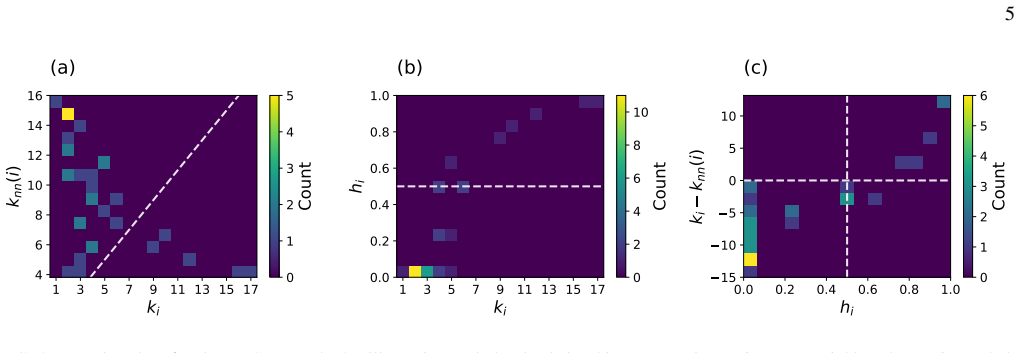
The classical friendship paradox asserts only that the network-wide average degree of neighbors is higher than the average degree of nodes. This mean-based inequality places no necessary constraint on the fraction of nodes that individually have lower degree than the mean of their neighbors, nor on the fraction of nodes that are dominated when neighbor degrees are compared via medians. Quadrant patterns in the scatter of each node's degree against its neighbors' mean degree, together with skewness in the distribution of neighbor degrees, independently set the sign and size of each majority fraction.
What carries the argument
Quadrant patterns in the joint distribution of a node's degree and the mean degree of its neighbors, together with left- or right-skewed distributions of neighbor degrees.
If this is right
- The global fraction measuring how many nodes are locally out-ranked by their neighbors' average can be low even when the network mean inequality holds.
- The local median-based fraction can take the opposite sign from the global fraction in the same network.
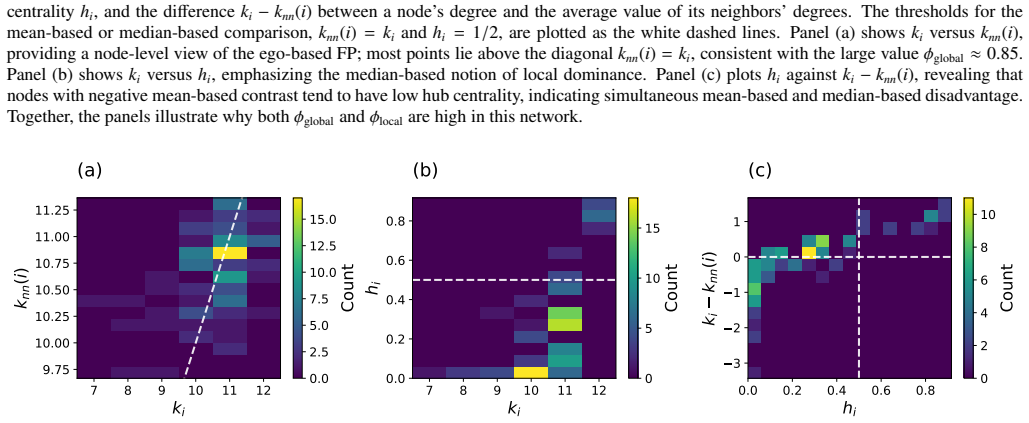
- Left-skewed neighbor degree distributions can make median comparisons favor the node while the mean comparison still favors the neighbors.
- Right-skewed neighbor degree distributions can produce the reverse mismatch between mean and median conclusions.
Where Pith is reading between the lines
- Social perception studies could test whether people report feeling less popular than their friends more often in networks with strong right skew than in balanced ones.
- Sampling methods that pick a random node and then a random friend may systematically over- or under-estimate local majorities depending on which fraction dominates.
- Interventions aimed at reducing perceived status gaps could target networks where the global and local fractions diverge sharply.
Load-bearing premise
That the observed quadrant occupancy and skewness patterns in node-neighbor degree pairs are enough to fix the independent values of the two fractions without further global network constraints.
What would settle it
A single network in which the classical average friendship paradox holds yet the global fraction of nodes with degree below their neighbors' mean is forced above 0.5 or the local median fraction is forced to match the average inequality exactly.
Figures
read the original abstract
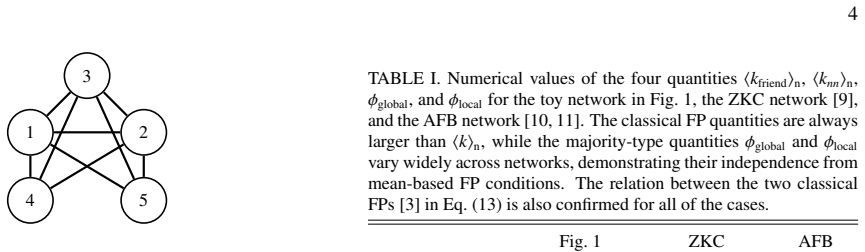
The classical friendship paradox asserts that, on average, an individual's neighbors have a higher degree than the individual. This statement concerns network-level means and does not describe how often a typical node is locally dominated by its neighbors. Motivated by this distinction, we develop a framework that separates mean-based friendship paradox inequalities from two majority-type quantities: a global fraction measuring how many nodes have a degree smaller than the mean degree of their neighbors, and a local fraction based on hub centrality that measures how many nodes are dominated in a median-based sense. We show that neither fraction is constrained by the classical friendship paradox and that they can behave independently of each other. A simple example and two empirical networks illustrate how quadrant patterns in the joint distribution of a node's degree and its neighbors' degree determine the signs and magnitudes of the two fractions, and how left- or right-skewed degree distributions of neighboring nodes can yield opposite conclusions for mean-based and median-based comparisons. The resulting framework offers a clearer distinction between population averages and local majority relations and provides a foundation for future analyses of local advantage, disadvantage, and perception asymmetry in complex networks.
Editorial analysis
A structured set of objections, weighed in public.
Referee Report
Summary. The paper distinguishes the classical mean-based friendship paradox (neighbors have higher average degree) from two majority-type quantities: a global fraction (nodes with degree smaller than the mean degree of their neighbors) and a local fraction (median-based domination by neighbors). It claims neither fraction is constrained by the classical paradox and that the two can vary independently of each other, with signs and magnitudes determined by quadrant patterns in the joint (node-degree, neighbor-degree) distribution and skew in neighbor-degree marginals. This is illustrated via a simple example plus two empirical networks.
Significance. If the independence result holds under network realizability constraints, the framework usefully separates population averages from local majority relations, offering a foundation for analyzing perception asymmetry and local advantage/disadvantage in networks. Credit is due for grounding the claims in both a constructed example and real data rather than purely theoretical constructions.
major comments (2)
- [Simple example] The central claim that the global and local fractions 'can behave independently' rests on quadrant occupancy and skew patterns in the joint distribution, but these local patterns do not automatically guarantee realizable networks. The neighbor-degree values assigned to a node must be consistent with the global degree sequence and edge set (via configuration-model or graphicality conditions), which can introduce dependencies that couple the two fractions. The simple example should explicitly verify that the reported independent signs/magnitudes are achievable without violating these constraints.
- [Framework / local fraction definition] The local fraction is described as 'median-based' and tied to 'hub centrality,' but the exact per-node definition (e.g., whether it compares a node's degree to the median of its neighbors' degrees, or vice versa) and any handling of even/odd neighbor counts are not fully specified in the provided description. This definition is load-bearing for the claim that the local fraction can take opposite sign from the mean-based global fraction.
minor comments (2)
- [Introduction] Define the global and local fractions with explicit mathematical notation at first use rather than relying on descriptive phrases.
- [Empirical networks] In the empirical section, report the network sizes, degree-sequence statistics, and any preprocessing steps (e.g., removal of isolates or self-loops) so that the quadrant counts and fraction values can be reproduced.
Simulated Author's Rebuttal
We thank the referee for the positive evaluation of the paper's significance and for the constructive major comments. We have revised the manuscript to address both points: we now explicitly verify the realizability of the simple example under graphicality and configuration-model constraints, and we have expanded the definition of the local fraction with precise per-node comparison rules and tie-handling conventions. These changes strengthen the independence claim without altering the core results.
read point-by-point responses
-
Referee: [Simple example] The central claim that the global and local fractions 'can behave independently' rests on quadrant occupancy and skew patterns in the joint distribution, but these local patterns do not automatically guarantee realizable networks. The neighbor-degree values assigned to a node must be consistent with the global degree sequence and edge set (via configuration-model or graphicality conditions), which can introduce dependencies that couple the two fractions. The simple example should explicitly verify that the reported independent signs/magnitudes are achievable without violating these constraints.
Authors: We agree that realizability must be verified explicitly rather than assumed from the joint-distribution patterns alone. The simple example is a small, hand-constructed graph whose degree sequence satisfies the handshaking lemma and is graphical; the neighbor-degree assignments are realized by the explicit edge set. In the revised manuscript we have added a short appendix paragraph that recomputes the global and local fractions directly from the adjacency list, confirms consistency with the configuration model, and shows that the reported opposite signs remain achievable. The two empirical networks supply further evidence that the independence is observed in large, naturally realizable structures. revision: yes
-
Referee: [Framework / local fraction definition] The local fraction is described as 'median-based' and tied to 'hub centrality,' but the exact per-node definition (e.g., whether it compares a node's degree to the median of its neighbors' degrees, or vice versa) and any handling of even/odd neighbor counts are not fully specified in the provided description. This definition is load-bearing for the claim that the local fraction can take opposite sign from the mean-based global fraction.
Authors: We accept that the per-node definition requires additional precision. The revised manuscript now states explicitly that, for each node i, the local indicator is 1 if deg(i) < median{deg(j) : j adjacent to i}. When the number of neighbors is even, the median is taken as the lower of the two central values (a conservative choice that does not inflate the local fraction). This convention is applied uniformly in both the simple example and the empirical networks, and the opposite-sign behavior between the mean-based global fraction and the median-based local fraction continues to hold under the clarified rule. revision: yes
Circularity Check
No circularity: new fractions defined directly from degree distributions and demonstrated via examples
full rationale
The paper defines the global fraction (nodes with degree smaller than mean neighbor degree) and local median-based fraction directly from the joint (node degree, neighbor-degree) distribution and its marginals. Independence from the classical mean friendship paradox is shown by constructing explicit quadrant occupancy patterns and skew examples, plus two empirical networks, without any parameter fitting, self-referential equations, or load-bearing self-citations. The derivation chain consists of straightforward counting from network properties and does not reduce any claimed result to its own inputs by construction. Global consistency constraints are acknowledged as a separate realizability question but do not affect the definitional or illustrative steps here.
Axiom & Free-Parameter Ledger
axioms (1)
- domain assumption Networks are undirected and simple (no self-loops or multiple edges)
invented entities (2)
-
global fraction
no independent evidence
-
local fraction
no independent evidence
Lean theorems connected to this paper
-
IndisputableMonolith/Foundation/Cost/FunctionalEquation.leanwashburn_uniqueness_aczel unclear?
unclearRelation between the paper passage and the cited Recognition theorem.
define ϕglobal = 1/N ∑ 1{ki < knn(i)} ... ϕlocal = 1/N ∑ 1{hi < 1/2} ... quadrant patterns in the joint distribution of a node’s degree and its neighbors’ degree
-
IndisputableMonolith/Foundation/RealityFromDistinction.leanreality_from_one_distinction unclear?
unclearRelation between the paper passage and the cited Recognition theorem.
neither fraction is constrained by the classical friendship paradox and that they can behave independently
What do these tags mean?
- matches
- The paper's claim is directly supported by a theorem in the formal canon.
- supports
- The theorem supports part of the paper's argument, but the paper may add assumptions or extra steps.
- extends
- The paper goes beyond the formal theorem; the theorem is a base layer rather than the whole result.
- uses
- The paper appears to rely on the theorem as machinery.
- contradicts
- The paper's claim conflicts with a theorem or certificate in the canon.
- unclear
- Pith found a possible connection, but the passage is too broad, indirect, or ambiguous to say the theorem truly supports the claim.
Forward citations
Cited by 1 Pith paper
-
Two variants of the friendship paradox: The condition for inequality between them
The difference between alter-based and ego-based friendship paradox means equals the degree-degree covariance normalized by the mean degree.
Reference graph
Works this paper leans on
-
[1]
S. L. Feld, Why your friends have more friends than you do, Am. J. Sociol.96, 1464 (1991)
work page 1991
- [2]
-
[3]
S. H. Lee, Two variants of the friendship paradox: The condi- tion for inequality between them, e-print arXiv:2511.06176
work page internal anchor Pith review Pith/arXiv arXiv
-
[4]
W. Jeong and U. Yu, Critical phenomena and strategy ordering with a hub-centrality approach in the aspiration-based coordi- nation game, Chaos31, 093114 (2021)
work page 2021
-
[5]
E. Lee, S. Lee, Y .-H. Eom, P. Holme, and H.-H. Jo, Impact of perception models on friendship paradox and opinion forma- tion, Phys. Rev. E99, 052302 (2019)
work page 2019
- [6]
-
[7]
X.-Z. Wu, A. G. Percus, and K. Lerman, Neighbor-neighbor correlations explain measurement bias in networks, Sci. Rep. 7, 5576 (2017)
work page 2017
-
[8]
K. Lerman, X. Yan, and X.-Z. Wu, The “majority illusion” in social networks, PLOS ONE11, e0147617 (2016)
work page 2016
-
[9]
W. W. Zachary, An information flow model for conflict and fis- sion in small groups, J. Anthropol. Res.33, 452 (1977)
work page 1977
-
[10]
M. Girvan and M. E. J. Newman, Community structure in social and biological networks, Proc. Natl. Acad. Sci. USA99, 7821 (2002)
work page 2002
- [11]
-
[12]
M. E. J. Newman, Assortative mixing in networks, Phys. Rev. Lett.89, 208701 (2002)
work page 2002
-
[13]
S. Fortunato and M. E. J. Newman, 20 years of network com- munity detection, Nat. Phys.18, 848 (2022)
work page 2022
-
[14]
P. Rombach, M. A. Porter, J. H. Fowler, and P. J. Mucha, Core- periphery structure in networks (revisited), SIAM Rev.59, 619 (2017)
work page 2017
-
[15]
V . Colizza, A. Flammini, M. A. Serrano, and A. Vespignani, Detecting rich-club ordering in complex networks, Nat. Phys. 2, 110 (2006)
work page 2006
- [16]
discussion (0)
Sign in with ORCID, Apple, or X to comment. Anyone can read and Pith papers without signing in.