Ordinary lattice defects as probes of topology
Pith reviewed 2026-05-17 21:58 UTC · model grok-4.3
The pith
Ordinary lattice defects such as vacancies can detect non-trivial topology in electronic bands by hosting mid-gap bound states.
A machine-rendered reading of the paper's core claim, the machinery that carries it, and where it could break.
Core claim
Ordinary lattice defects, although geometrically trivial, induce mid-gap bound states that serve as universal probes of the non-trivial topology of electronic Bloch bands; any local change in the topological environment within an otherwise normal insulator is marked by these states, which remain robust against weak random impurities.
What carries the argument
Mid-gap bound states localized near ordinary point defects, which appear selectively in topologically non-trivial regions of a minimal square-lattice Hamiltonian for Chern insulators.
If this is right
- Ordinary defects become diagnostic tools for topology in crystals of any symmetry and dimension.
- The same mechanism raises the possibility of localizing Majorana modes near ordinary defects inside topological superconductors.
- Defect-engineered topological devices become feasible without requiring specially engineered dislocations or disclinations.
- Spectroscopic signatures of these bound states can be used to map spatial variations in band topology.
Where Pith is reading between the lines
- Real-material searches could focus on vacancies in known Chern or Z2 insulators to look for the predicted mid-gap modes.
- The approach might extend to three-dimensional topological insulators where surface defects could be easier to introduce than bulk dislocations.
- Acoustic or photonic metamaterial platforms offer a controllable testbed for scaling the effect to larger defect arrays.
Load-bearing premise
The mid-gap bound states arise specifically from the non-trivial topology of the Bloch bands rather than from details of the defect potential or lattice symmetry.
What would settle it
Absence of mid-gap states near identical ordinary defects placed in a topologically trivial insulator with the same lattice symmetry and defect strength.
Figures




read the original abstract
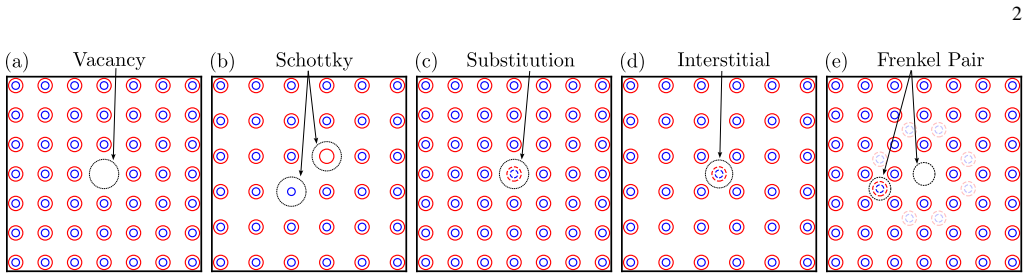
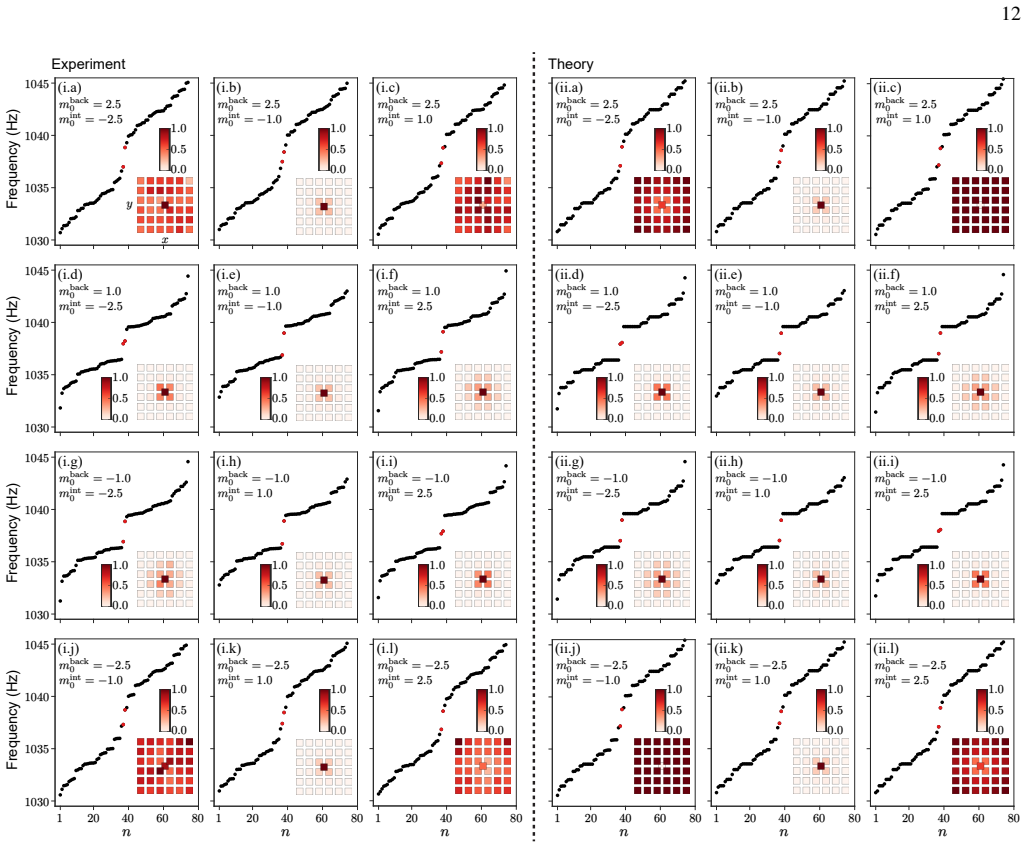
In addition to topological lattice defects such as dislocations and disclinations, crystals are also accompanied by unavoidable ordinary defects, devoid of any non-trivial geometry or topology, among which vacancies, Schottky defects, substitutions, interstitials, and Frenkel pairs are the most common. In this work, we demonstrate that these ubiquitous ordinary lattice defects, although geometrically trivial, can nonetheless serve as universal probes of the non-trivial topology of electronic Bloch bands, and any change in the local topological environment in an otherwise normal insulator in terms of mid-gap bound states in their vicinity. We theoretically establish these generic findings by implementing a minimal model Hamiltonian describing time-reversal symmetry breaking topological and normal insulators on a square lattice, fostering such point defects. The defect-bound mid-gap modes are also shown to be robust against sufficiently weak random point-like charge impurities. Furthermore, we showcase experimental observation of such bound states by embedding ordinary crystal defects in two-dimensional acoustic Chern lattices, where precision-controlled hopping amplitudes are implemented via active meta-atoms and Green's-function-based spectroscopy is used to reconstruct spectra and eigenstates. Our combined theory-experiment study establishes ordinary lattice defects as probes of topology that should be germane in crystals of any symmetry and dimension, raising the possibility of arresting localized Majorana modes near such defects in the bulk of topological superconductors and to emulate ordinary-defect-engineered topological devices.
Editorial analysis
A structured set of objections, weighed in public.
Referee Report
Summary. The manuscript claims that ordinary lattice defects (vacancies, substitutions, interstitials) can serve as universal probes of non-trivial Bloch band topology via the appearance of mid-gap bound states, even though the defects themselves carry no geometric or topological charge. This is supported theoretically by a minimal square-lattice Hamiltonian that realizes both time-reversal-symmetry-breaking Chern insulators and trivial insulators, with the defect implemented as a local on-site potential or site removal; the bound states are shown to be robust against weak random impurities. The claim is further tested experimentally in a 2D acoustic Chern lattice realized with active meta-atoms, where Green's-function-based spectroscopy reconstructs the local spectra and eigenstates around embedded defects.
Significance. If the central claim is confirmed, the result supplies a practical, geometry-independent diagnostic for band topology that applies to crystals of any symmetry and dimension and does not require specially engineered defects such as dislocations. The work explicitly credits the parameter-free minimal model, the direct numerical diagonalization of defect states, and the controllable acoustic platform with active meta-atoms and Green's-function spectroscopy. These elements together raise the possibility of using ordinary defects to localize Majorana modes in topological superconductors.
major comments (1)
- [§3] §3 (Minimal Model and Defect Implementation): the manuscript presents the same local defect potential in both the topological (non-zero Chern number) and trivial phases, yet does not report an explicit side-by-side comparison in which the defect strength is held fixed while the topological mass term is continuously tuned through zero. Without this controlled comparison it remains possible that a sufficiently deep potential well binds a mid-gap state irrespective of the Chern number, weakening the causal attribution to band topology.
minor comments (2)
- [Figure 3] Figure 3 and associated text: the acoustic-lattice spectra would be clearer if the simulated and measured local density of states were overlaid on the same energy axis with explicit markers for the mid-gap resonance.
- [§4] The robustness statement in the abstract and §4 is limited to 'sufficiently weak' impurities; a quantitative bound on impurity strength relative to the gap size would strengthen the claim.
Simulated Author's Rebuttal
We thank the referee for their careful reading of our manuscript and for the constructive major comment. We address the point raised in §3 below and will strengthen the presentation accordingly in the revised version.
read point-by-point responses
-
Referee: §3 (Minimal Model and Defect Implementation): the manuscript presents the same local defect potential in both the topological (non-zero Chern number) and trivial phases, yet does not report an explicit side-by-side comparison in which the defect strength is held fixed while the topological mass term is continuously tuned through zero. Without this controlled comparison it remains possible that a sufficiently deep potential well binds a mid-gap state irrespective of the Chern number, weakening the causal attribution to band topology.
Authors: We appreciate the referee highlighting the value of a more controlled parameter sweep. The current manuscript already compares the local spectra around identical defect potentials (on-site potential or site removal) in the Chern-insulator phase (C = 1) and the trivial phase (C = 0). To directly address the concern that a deep potential well might bind a mid-gap state independently of topology, we will add a new panel (or supplementary figure) in the revised manuscript that holds the defect strength fixed while continuously tuning the topological mass term through the critical point. This will explicitly show the bound-state energy entering the gap only on the non-trivial side of the transition, thereby reinforcing the causal link to band topology. We agree this addition improves the clarity of the argument. revision: yes
Circularity Check
No circularity: derivation proceeds from explicit model to computed states
full rationale
The paper defines a minimal square-lattice Hamiltonian capable of realizing both topological and trivial phases, then directly computes the spectrum and eigenstates in the presence of ordinary point defects (vacancies or on-site potentials). Mid-gap bound states emerge as an output of this calculation rather than being presupposed by the defect definition or by any fitted parameter. No load-bearing step reduces to a self-citation chain, an ansatz smuggled from prior work, or a renaming of a known empirical pattern; the experimental acoustic-lattice realization is likewise an independent verification. The derivation chain therefore remains self-contained against external benchmarks.
Axiom & Free-Parameter Ledger
Forward citations
Cited by 1 Pith paper
-
Observation of ring states in a delicate topological insulator
Ring states around impurities act as a spectroscopic probe for delicate topological insulators in a phononic metamaterial and persist after multicellularity is removed by a weakly hybridizing orbital.
Reference graph
Works this paper leans on
-
[1]
P. M. Chaikin and T. C. Lubensky, Principles of Condensed Matter Physics (Cambridge University Press, Cambridge, UK, 2000)
work page 2000
-
[2]
Kleinert,Gauge Fields in Condensed Matter (V ol
H. Kleinert,Gauge Fields in Condensed Matter (V ol. II), (World Scientific, Singapore, 1989)
work page 1989
-
[3]
Y . Ran, Y . Zhang, and A. Vishwanath, One-dimensional topo- logically protected modes in topological insulators with lattice dislocations, Nat. Phys.5, 298 (2009)
work page 2009
-
[4]
J. C. Y . Teo and C. L. Kane, Topological defects and gap- less modes in insulators and superconductors, Phys. Rev. B82, 115120 (2010)
work page 2010
-
[5]
V . Juriˇci´c, A. Mesaros, R.-J. Slager, and J. Zaanen, Universal Probes of Two-Dimensional Topological Insulators: Disloca- tion andπFlux, Phys. Rev. Lett.108, 106403 (2012)
work page 2012
-
[6]
D. Asahi and N. Nagaosa, Topological indices, defects, and Majorana fermions in chiral superconductors, Phys. Rev. B86, 100504(R) (2012)
work page 2012
- [7]
-
[8]
T. L. Hughes, H. Yao, and X.-L. Qi, Majorana zero modes in dislocations of Sr2RuO4, Phys. Rev. B90, 235123 (2014)
work page 2014
- [9]
-
[10]
R. Queiroz, I. C. Fulga, N. Avraham, H. Beidenkopf, and J. Cano, Partial Lattice Defects in Higher-Order Topological In- sulators, Phys. Rev. Lett.123, 266802 (2019)
work page 2019
- [11]
- [12]
-
[13]
A. Panigrahi, R. Moessner, and B. Roy, Non-Hermitian dislo- cation modes: Stability and melting across exceptional points, Phys. Rev. B106, L041302 (2022)
work page 2022
-
[14]
F. Schindler and A. Prem, Dislocation non-Hermitian skin ef- fect, Phys. Rev. B104, L161106 (2021)
work page 2021
-
[15]
G. Naselli, V . K¨onye, S. K. Das, G. G. N. Angilella, A. Isaeva, J. van den Brink, and C. Fulga, Nontrivial gapless electronic states at the stacking faults of weak topological insulators, Phys. Rev. B106, 094105 (2022)
work page 2022
-
[16]
S. K. Das and B. Roy, Dynamic melting and condensation of topological dislocation modes, Phys. Rev. B108, 144304 (2023)
work page 2023
-
[17]
A. K. Nayak, J. Reiner, R. Queiroz, H. Fu, C. Shekhar, B. Yan, C. Felser, N. Avraham, and H. Beidenkopf, Resolving the topo- logical classification of bismuth with topological defects, Sci. Adv.5, eaax6996 (2019)
work page 2019
-
[18]
H. Hamasaki, Y . Tokumoto, and K. Edagawa, Dislocation con- duction in Bi-Sb topological insulators, Appl. Phys. Lett.110, 092105 (2017)
work page 2017
-
[19]
Z-K. Lin, Y . Wu, B. Jiang, Y . Liu, S-Q. Wu, F. Li, and J-H. Jiang, Topological Wannier cycles induced by sub-unit-cell ar- tificial gauge flux in a sonic crystal, Nat. Mater.21, 430 (2022)
work page 2022
-
[20]
S. K. Das and B. Roy, Hybrid symmetry class topological insu- lators, SciPost Phys.18, 209 (2025)
work page 2025
- [21]
-
[22]
W. Wu, Q. Zhang, L. Qi, K. Zhang, S. Tong, C. Qiu, Observa- tion of Dislocation Non-Hermitian Skin Effect in a Torus-like Acoustic Metamaterial, Adv. Mater.2025, e14101 (2025)
work page 2025
-
[23]
J. C. Y . Teo and T. L. Hughes, Existence of Majorana-Fermion Bound States on Disclinations and the Classification of Topo- logical Crystalline Superconductors in Two Dimensions, Phys. Rev. Lett.111, 047006 (2013)
work page 2013
-
[24]
W. A. Benalcazar, J. C. Y . Teo, and T. L. Hughes, Classification of two-dimensional topological crystalline superconductors and Majorana bound states at disclinations, Phys. Rev. B89, 224503 (2014)
work page 2014
-
[25]
C. W. Peterson, T. Li, W. Jiang, T. L. Hughes, and G. Bahl, Trapped fractional charges at bulk defects in topological insu- lators, Nature (London)589, 376 (2021)
work page 2021
-
[26]
Y . Liu, S. Leung, F.-F. Li, Z.-K. Lin, X. Tao, Y . Poo, and J.- H. Jiang, Bulk–disclination correspondence in topological crys- talline insulators, Nature (London)589, 381 (2021)
work page 2021
-
[27]
R. Banerjee, S. Mandal, Y . Y . Terh, S. Lin, G.-G. Liu, B. Zhang, and Y . D. Chong, Topological Disclination States and Charge Fractionalization in a Non-Hermitian Lattice, Phys. Rev. Lett. 133, 233804 (2024)
work page 2024
- [28]
-
[29]
D. J. Salib, V . Juri ˇci´c, and B. Roy, Emergent metallicity at the grain boundaries of higher-order topological insulators, Sci. Rep.13, 15308 (2023)
work page 2023
-
[30]
M. Amundsen and V . Juri ˇci´c, Grain-boundary topological su- perconductor, Commun. Phys.6, 232 (2023)
work page 2023
-
[31]
D. J. Salib and B. Roy, Dispersive nodal fermions along grain boundaries in Floquet topological crystals, Sci. Rep.15, 1918 (2025)
work page 1918
-
[32]
H. W. Kim, S-H. Kang, H-J. Kim, K. Chae, S. Cho, W. Ko, S. H. Kang, H. Yang, S. W. Kim, S. Park, S. W. Hwang, Y-K. Kwon, Y-W. Son, Symmetry Dictated Grain Boundary State in a Two-Dimensional Topological Insulator, Nano Lett.20, 5837 (2020)
work page 2020
- [33]
-
[34]
D. J. Thouless, M. Kohmoto, M. P. Nightingale, and M. den Nijs, Quantized Hall Conductance in a Two-Dimensional Peri- odic Potential, Phys. Rev. Lett.49, 405 (1982)
work page 1982
-
[35]
F. D. M. Haldane, Model for a Quantum Hall Effect without Landau Levels: Condensed-Matter Realization of the “Parity Anomaly”, Phys. Rev. Lett.61, 2015 (1988)
work page 2015
-
[36]
S. K. Das, S. Manna, and B. Roy, Topologically distinct atomic insulators, Phys. Rev. B108, L041301 (2023)
work page 2023
-
[37]
T. A. Loring and M. B. Hastings, Disordered topological insu- lators viaC ∗-algebras, Europhys. Lett.92, 67004 (2010)
work page 2010
-
[38]
A. Agarwala and V . B. Shenoy, Topological Insulators in Amor- phous Systems, Phys. Rev. Lett.118, 236402 (2017)
work page 2017
-
[39]
D. J. Salib, A. J. Mains, and B. Roy, Topological insulators on fractal lattices: A general principle of construction, Phys. Rev. B110, L241302 (2024). 17
work page 2024
-
[40]
W-Y . Shan, J. Lu, H-Z. Lu, and S-Q. Shen, Vacancy-induced bound states in topological insulators, Phys. Rev. B84, 035307 (2011)
work page 2011
-
[41]
D. A. Lovey, G. Usaj, L. E. F. Foa Torres, and C. A. Balseiro, Floquet bound states around defects and adatoms in graphene, Phys. Rev. B93, 245434 (2016)
work page 2016
-
[42]
F. de Juan, A. R ¨uegg, and D-H. Lee, Bulk-defect correspon- dence in particle-hole symmetric insulators and semimetals, Phys. Rev. B89, 161117(R) (2014)
work page 2014
-
[43]
J. He, Y-X. Zhu, Y-J. Wu, L-F. Liu, Y . Liang, and S-P. Kou, Zero modes around vacancies in topological insulators and topologi- cal superconductors on the honeycomb lattice with particle-hole symmetry, Phys. Rev. B87, 075126 (2013)
work page 2013
- [44]
- [45]
-
[46]
A. Altland and M. R. Zirnbauer, Nonstandard symmetry classes in mesoscopic normal-superconducting hybrid structures, Phys. Rev. B55, 1142 (1997)
work page 1997
-
[47]
Kitaev, Periodic table for topological insulators and super- conductors, AIP Conf
A. Kitaev, Periodic table for topological insulators and super- conductors, AIP Conf. Proc.1134, 22 (2009)
work page 2009
-
[48]
S. Ryu, A. P. Schnyder, A. Furusaki, and A. W. W. Ludwig, Topological insulators and superconductors: tenfold way and dimensional hierarchy, New J. Phys.12, 065010 (2010)
work page 2010
-
[49]
M. Z. Hasan and C. L. Kane, Colloquium: Topological insula- tors, Rev. Mod. Phys.82, 3045 (2010)
work page 2010
-
[50]
X.-L. Qi and S.-C. Zhang, Topological insulators and supercon- ductors, Rev. Mod. Phys.83, 1057 (2011)
work page 2011
-
[51]
C.-K. Chiu, J. C. Y . Teo, A. P. Schnyder, and S. Ryu, Classifica- tion of topological quantum matter with symmetries, Rev. Mod. Phys.88, 035005 (2016)
work page 2016
-
[52]
A. Y . Kitaev, Fault-tolerant quantum computation by anyons, Ann. Phys. (NY)303, 2 (2003)
work page 2003
- [53]
- [54]
-
[55]
M-C. Liang, Y-D. Wei, L. Zhang, X-J. Wang, H. Zhang, W-W. Wang, W. Qi, X-J. Liu, and X. Zhang, Realization of Qi-Wu- Zhang model in spin-orbit-coupled ultra-cold fermions, Phys. Rev. Res.5, L012006 (2023)
work page 2023
-
[56]
C. H. Lee, S. Imhof, C. Berger, F. Bayer, J. Brehm, L. W. Molenkamp, T. Kiessling, and R. Thomale, Topolectrical Cir- cuits, Commun. Phys.1, 39 (2018)
work page 2018
-
[57]
T. Hofmann, T. Helbig, C. H. Lee, M. Greiter, and R. Thomale, Chiral V oltage Propagation and Calibration in a Topolectrical Chern Circuit, Phys. Rev. Lett.122, 247702 (2019)
work page 2019
-
[58]
J.-K. Dong, V . Juriˇci´c, and B. Roy, Topolectric circuits: Theory and construction, Phys. Rev. Res.3, 023056 (2021)
work page 2021
-
[59]
F. D. M. Haldane and S. Raghu , Possible Realization of Di- rectional Optical Waveguides in Photonic Crystals with Broken Time-Reversal Symmetry, Phys. Rev. Lett.100, 013904 (2008)
work page 2008
-
[60]
L. Lu, J. D. Joannopoulos, and M. Solja ˇci´c, Topological pho- tonics, Nature Photon8, 821 (2014)
work page 2014
- [61]
-
[62]
R. S ¨usstrunk and S. D. Huber, Observation of phononic helical edge states in a mechanical topological insulator, Science349, 47 (2015)
work page 2015
-
[63]
Z. Yang, F. Gao, X. Shi, X. Lin, Z. Gao, Y . Chong, and B. Zhang, Topological Acoustics, Phys. Rev. Lett.114, 114301 (2015)
work page 2015
-
[64]
C. He, X. Ni, H. Ge, X.-C. Sun, Y .-B. Chen, M.-H. Lu, X.-P. Liu, and Y .-F. Chen, Acoustic topological insulator and robust one-way sound transport, Nat. Phys.12, 1124 (2016)
work page 2016
discussion (0)
Sign in with ORCID, Apple, or X to comment. Anyone can read and Pith papers without signing in.