Ergotropy Dynamics in a Dissipative Graphene Quantum Battery
Pith reviewed 2026-05-22 11:33 UTC · model grok-4.3
The pith
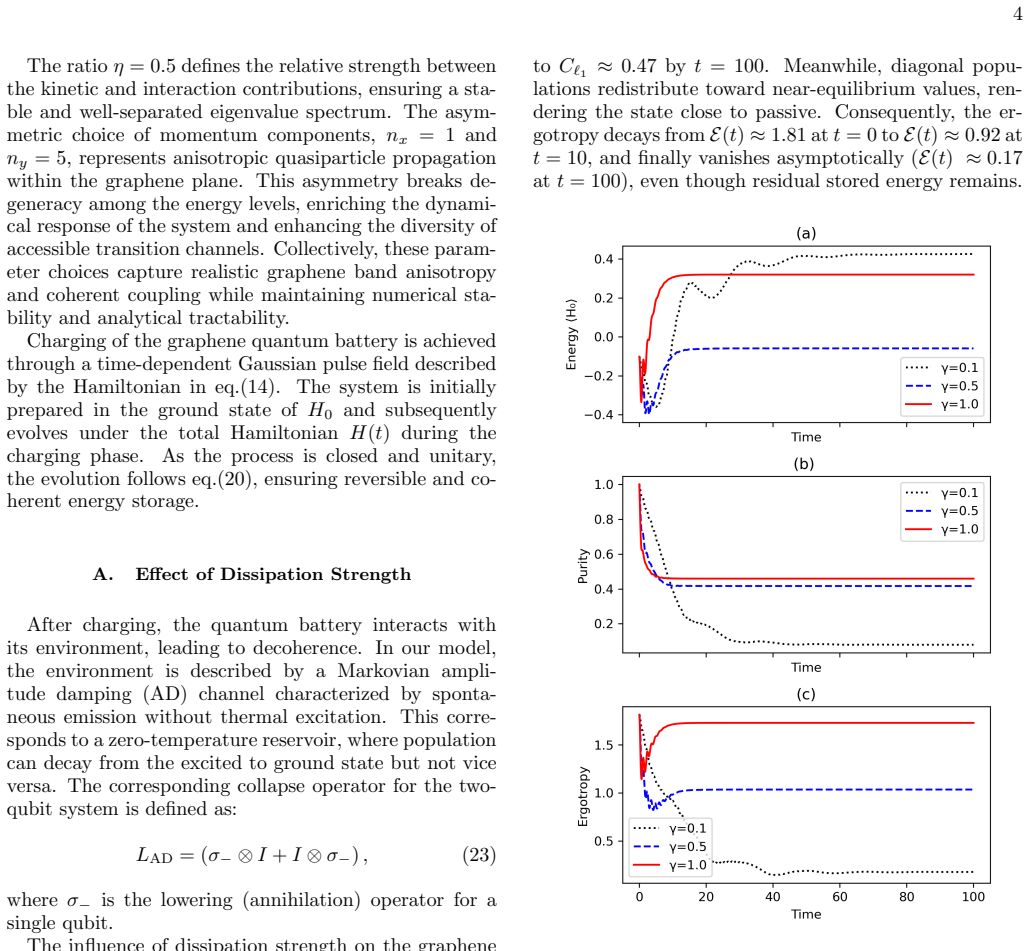
Amplitude damping stabilizes finite ergotropy in graphene quantum batteries while pure dephasing eliminates work extraction.
A machine-rendered reading of the paper's core claim, the machinery that carries it, and where it could break.
Core claim
In a graphene-based quantum battery represented by a four-level spin-valley system charged via a Gaussian pulse, amplitude damping stabilizes non-passive steady states with finite ergotropy, pure dephasing suppresses coherence and eliminates work extraction, and non-Markovian reservoirs slow ergotropy loss while enabling partial recovery through information backflow.
What carries the argument
The four-level spin-valley system whose ergotropy is computed from master-equation solutions under amplitude damping, dephasing, and non-Markovian channels after Gaussian-pulse charging.
If this is right
- Amplitude damping preserves extractable work in steady states despite overall energy loss.
- Pure dephasing removes all possibility of work extraction by eliminating coherence.
- Non-Markovian memory effects allow partial ergotropy recovery after initial decay.
- Coherence must be protected to maintain long-time battery performance.
- Reservoir memory can be leveraged to improve sustained work extraction.
Where Pith is reading between the lines
- Device designs could deliberately include controlled amplitude damping to retain usable ergotropy.
- The same memory-assisted recovery might appear in other two-dimensional material batteries.
- Experiments distinguishing Markovian from non-Markovian regimes would test the predicted partial recovery.
- Avoiding dephasing may matter more than eliminating all dissipation for practical ergotropy retention.
Load-bearing premise
The graphene quantum battery behaves exactly as a four-level spin-valley system whose evolution under the chosen dissipative master equations matches the physical system.
What would settle it
An experiment on a fabricated graphene device showing whether steady-state ergotropy stays positive under amplitude damping or drops to zero under pure dephasing.
Figures


read the original abstract
We investigate ergotropy dynamics in a graphene-based quantum battery modeled as a four-level spin--valley system under different dissipative environments. The battery is charged via a Gaussian pulse and subsequently evolves under amplitude damping, dephasing, and both Markovian and non-Markovian reservoirs. We find that amplitude damping, while inducing energy loss, can stabilize non-passive steady states with finite ergotropy, whereas pure dephasing suppresses coherence and eliminates work extraction. On the other hand, non-Markovian memory slows ergotropy loss and enables partial recovery through information backflow. These results identify coherence and reservoir memory as essential resources for enhancing the long-time performance of graphene quantum batteries.
Editorial analysis
A structured set of objections, weighed in public.
Referee Report
Summary. The manuscript models a graphene quantum battery as a four-level spin-valley system charged by a Gaussian pulse and evolved under amplitude-damping, pure-dephasing, and both Markovian and non-Markovian master equations. It reports that amplitude damping stabilizes non-passive steady states possessing finite ergotropy, pure dephasing eliminates extractable work by destroying coherence, and non-Markovian memory slows ergotropy decay while permitting partial revival through information backflow.
Significance. If the effective four-level description and chosen dissipators are valid, the results identify coherence and reservoir memory as key resources for sustaining long-time ergotropy in a material-specific quantum battery. The numerical distinction between Markovian loss and non-Markovian recovery is cleanly demonstrated and could guide engineering of 2D-material energy-storage devices.
major comments (3)
- [Model] Model section: the four-level spin-valley truncation is introduced without quantitative bounds on its validity relative to the Dirac-cone bandwidth or the spectral width of the charging pulse; if intervalley scattering or higher bands become relevant, the reported steady-state ergotropy values would change.
- [Dissipative dynamics] Dissipative dynamics section: the amplitude-damping and dephasing channels are implemented via phenomenological Lindblad operators and a memory kernel; no derivation from a microscopic electron-phonon or electron-impurity Hamiltonian for graphene is supplied, so the central claim that amplitude damping stabilizes finite ergotropy rests on an unverified effective model.
- [Results] Results section: the non-Markovian revival is shown for a specific memory kernel, but no comparison is made to realistic graphene correlation functions or intervalley scattering rates; without such anchoring the partial-recovery prediction remains model-dependent.
minor comments (2)
- [Abstract] The abstract states qualitative findings but omits the explicit form of the master equations or the numerical values of the damping rates and memory time; adding one representative equation and a table of parameters would improve readability.
- [Figures] Figure captions for the ergotropy time traces should explicitly state the initial state, pulse parameters, and whether the plotted quantity is the instantaneous or time-averaged ergotropy.
Simulated Author's Rebuttal
We thank the referee for the careful reading of our manuscript and the constructive comments. We appreciate the positive assessment of the potential implications for 2D-material quantum batteries. We address each major comment below and indicate the revisions we will make.
read point-by-point responses
-
Referee: Model section: the four-level spin-valley truncation is introduced without quantitative bounds on its validity relative to the Dirac-cone bandwidth or the spectral width of the charging pulse; if intervalley scattering or higher bands become relevant, the reported steady-state ergotropy values would change.
Authors: We agree that explicit quantitative bounds would strengthen the presentation. In the revised manuscript we will add a paragraph in the Model section that compares the Dirac-cone bandwidth, the spectral width of the Gaussian pulse, and typical intervalley scattering rates, together with the regime of validity of the four-level truncation. revision: yes
-
Referee: Dissipative dynamics section: the amplitude-damping and dephasing channels are implemented via phenomenological Lindblad operators and a memory kernel; no derivation from a microscopic electron-phonon or electron-impurity Hamiltonian for graphene is supplied, so the central claim that amplitude damping stabilizes finite ergotropy rests on an unverified effective model.
Authors: The referee is correct that the dissipators are phenomenological. A microscopic derivation from a specific electron-phonon Hamiltonian lies outside the scope of the present work, which focuses on ergotropy dynamics within an effective model. We will revise the Dissipative dynamics section to state this limitation explicitly, motivate the choice of channels on physical grounds, and emphasize that the reported stabilization of finite ergotropy holds within the adopted effective description. revision: partial
-
Referee: Results section: the non-Markovian revival is shown for a specific memory kernel, but no comparison is made to realistic graphene correlation functions or intervalley scattering rates; without such anchoring the partial-recovery prediction remains model-dependent.
Authors: We acknowledge that the memory kernel is chosen for illustration. In the revised Results section we will add a short discussion relating the adopted memory timescale to typical phonon correlation times reported for graphene and will note the model-dependent character of the quantitative revival amplitude. revision: yes
- A complete microscopic derivation of the Lindblad operators from a microscopic electron-phonon or impurity Hamiltonian for graphene cannot be supplied within the present manuscript.
Circularity Check
No circularity: results follow from direct numerical integration of standard master equations on an assumed model.
full rationale
The paper defines a four-level spin-valley model for the graphene battery, applies standard Lindblad and non-Markovian master equations for amplitude damping and dephasing, charges it with a Gaussian pulse, and numerically evolves the ergotropy. All headline findings (stabilization of finite ergotropy under amplitude damping, suppression under dephasing, partial recovery via non-Markovian backflow) are direct outputs of these integrations. No parameters are fitted to the reported steady-state ergotropy values, no self-citations supply load-bearing uniqueness theorems, and no ansatz or renaming reduces the central claims to the inputs by construction. The derivation is therefore self-contained within the phenomenological model.
Axiom & Free-Parameter Ledger
Lean theorems connected to this paper
-
IndisputableMonolith/Cost/FunctionalEquation.leanwashburn_uniqueness_aczel unclear?
unclearRelation between the paper passage and the cited Recognition theorem.
We investigate ergotropy dynamics in a graphene-based quantum battery modeled as a four-level spin–valley system under different dissipative environments... amplitude damping... pure dephasing... non-Markovian memory
-
IndisputableMonolith/Foundation/RealityFromDistinction.leanreality_from_one_distinction unclear?
unclearRelation between the paper passage and the cited Recognition theorem.
The battery is charged via a Gaussian pulse and subsequently evolves under amplitude damping, dephasing, and both Markovian and non-Markovian reservoirs.
What do these tags mean?
- matches
- The paper's claim is directly supported by a theorem in the formal canon.
- supports
- The theorem supports part of the paper's argument, but the paper may add assumptions or extra steps.
- extends
- The paper goes beyond the formal theorem; the theorem is a base layer rather than the whole result.
- uses
- The paper appears to rely on the theorem as machinery.
- contradicts
- The paper's claim conflicts with a theorem or certificate in the canon.
- unclear
- Pith found a possible connection, but the passage is too broad, indirect, or ambiguous to say the theorem truly supports the claim.
Forward citations
Cited by 1 Pith paper
-
Ergotropy and Work Extraction in Quantum Heat Engines via Quantum Channels
Multilevel quantum systems in GAD-channel heat engines exhibit enhanced work extraction and decoherence robustness compared to qubits.
Reference graph
Works this paper leans on
-
[1]
Electric field effect in atomically thin carbon films.science, 306(5696):666–669, 2004
Kostya S Novoselov, Andre K Geim, Sergei V Morozov, De-eng Jiang, Yanshui Zhang, Sergey V Dubonos, Irina V Grigorieva, and Alexandr A Firsov. Electric field effect in atomically thin carbon films.science, 306(5696):666–669, 2004
work page 2004
-
[2]
Gordon W Semenoff. Condensed-matter simulation of a three-dimensional anomaly.Physical Review Letters, 53(26):2449, 1984
work page 1984
-
[3]
DP DiVincenzo and EJ Mele. Self-consistent effective- mass theory for intralayer screening in graphite interca- lation compounds.Physical Review B, 29(4):1685, 1984
work page 1984
-
[4]
Critical behavior of disordered degen- erate semiconductors
Eduardo Fradkin. Critical behavior of disordered degen- erate semiconductors. ii. spectrum and transport proper- ties in mean-field theory.Physical review B, 33(5):3263, 1986
work page 1986
-
[5]
F Duncan M Haldane. Model for a quantum hall ef- fect without landau levels: Condensed-matter realiza- tion of the” parity anomaly”.Physical review letters, 61(18):2015, 1988
work page 2015
-
[6]
Two-dimensional gas of massless dirac fermions in graphene.nature, 438(7065):197–200, 2005
Kostya S Novoselov, Andre K Geim, Sergei Vladimirovich Morozov, Dingde Jiang, Michail I Katsnelson, Irina V Grigorieva, Sergey V Dubonos, and Alexandr A Firsov. Two-dimensional gas of massless dirac fermions in graphene.nature, 438(7065):197–200, 2005
work page 2005
-
[7]
Dynamics of heisenberg xyz two-spin quantum battery
Disha Verma, VS Indrajith, and R Sankaranarayanan. Dynamics of heisenberg xyz two-spin quantum battery. Physica A: Statistical Mechanics and its Applications, 9 659:130352, 2025
work page 2025
-
[8]
Spin-chain model of a many- body quantum battery.Physical Review A, 97(2):022106, 2018
Thao P Le, Jesper Levinsen, Kavan Modi, Meera M Parish, and Felix A Pollock. Spin-chain model of a many- body quantum battery.Physical Review A, 97(2):022106, 2018
work page 2018
-
[9]
Cavity heisenberg-spin-chain quantum battery.Physical Review A, 106(3):032212, 2022
Fu-Quan Dou, Hang Zhou, and Jian-An Sun. Cavity heisenberg-spin-chain quantum battery.Physical Review A, 106(3):032212, 2022
work page 2022
-
[10]
Off-resonant dicke quantum battery: Charging by virtual photons.Batteries, 9(4):197, 2023
Giulia Gemme, Gian Marcello Andolina, Francesco Maria Dimitri Pellegrino, Maura Sassetti, and Dario Fer- raro. Off-resonant dicke quantum battery: Charging by virtual photons.Batteries, 9(4):197, 2023
work page 2023
-
[11]
Frustrating quantum batteries.PRX Quantum, 5(3):030319, 2024
Alberto Giuseppe Catalano, Salvatore Marco Giampaolo, Oliver Morsch, Vittorio Giovannetti, and Fabio Fran- chini. Frustrating quantum batteries.PRX Quantum, 5(3):030319, 2024
work page 2024
-
[12]
James Q Quach, Kirsty E McGhee, Lucia Ganzer, Do- minic M Rouse, Brendon W Lovett, Erik M Gauger, Jonathan Keeling, Giulio Cerullo, David G Lidzey, and Tersilla Virgili. Superabsorption in an organic micro- cavity: Toward a quantum battery.Science advances, 8(2):eabk3160, 2022
work page 2022
-
[13]
I Maillette de Buy Wenniger, SE Thomas, M Maffei, SC Wein, M Pont, N Belabas, S Prasad, A Harouri, A Lemaˆ ıtre, I Sagnes, et al. Experimental analysis of energy transfers between a quantum emitter and light fields.Physical Review Letters, 131(26):260401, 2023
work page 2023
-
[14]
Jitendra Joshi and TS Mahesh. Experimental investiga- tion of a quantum battery using star-topology nmr spin systems.Physical Review A, 106(4):042601, 2022
work page 2022
-
[15]
James Q Quach and William J Munro. Using dark states to charge and stabilize open quantum batteries.Physical Review Applied, 14(2):024092, 2020
work page 2020
-
[16]
Junjie Liu, Dvira Segal, and Gabriel Hanna. Loss-free ex- citonic quantum battery.The Journal of Physical Chem- istry C, 123(30):18303–18314, 2019
work page 2019
-
[17]
Col- loquium: quantum batteries.Reviews of Modern Physics, 96(3):031001, 2024
Francesco Campaioli, Stefano Gherardini, James Q Quach, Marco Polini, and Gian Marcello Andolina. Col- loquium: quantum batteries.Reviews of Modern Physics, 96(3):031001, 2024
work page 2024
-
[18]
Marius Eich, Frantiˇ sek Herman, Riccardo Pisoni, Hiske Overweg, Annika Kurzmann, Yongjin Lee, Peter Rick- haus, Kenji Watanabe, Takashi Taniguchi, Manfred Sigrist, et al. Spin and valley states in gate-defined bilayer graphene quantum dots.Physical Review X, 8(3):031023, 2018
work page 2018
-
[19]
CH Yang, A Rossi, R Ruskov, NS Lai, FA Mohiyaddin, S Lee, C Tahan, Gerhard Klimeck, A Morello, and AS Dzurak. Spin-valley lifetimes in a silicon quantum dot with tunable valley splitting.Nature communica- tions, 4(1):2069, 2013
work page 2069
-
[20]
Specular andreev reflection in graphene.Physical review letters, 97(6):067007, 2006
CWJ Beenakker. Specular andreev reflection in graphene.Physical review letters, 97(6):067007, 2006
work page 2006
-
[21]
The valley hall effect in mos2 tran- sistors.Science, 344(6191):1489–1492, 2014
Kin Fai Mak, Kathryn L McGill, Jiwoong Park, and Paul L McEuen. The valley hall effect in mos2 tran- sistors.Science, 344(6191):1489–1492, 2014
work page 2014
-
[22]
Thermodynamics in the quantum regime.Fundamental Theories of Physics, 195(1), 2018
Felix Binder, Luis A Correa, Christian Gogolin, Janet Anders, and Gerardo Adesso. Thermodynamics in the quantum regime.Fundamental Theories of Physics, 195(1), 2018
work page 2018
-
[23]
Work extraction from a controlled quan- tum emitter.Journal of Physics: Photonics, 7(2):025023, 2025
Kavalambramalil George Paulson, Hanna Terletska, and Herbert F Fotso. Work extraction from a controlled quan- tum emitter.Journal of Physics: Photonics, 7(2):025023, 2025
work page 2025
-
[24]
Dissipative charging of a quantum battery
Felipe Barra. Dissipative charging of a quantum battery. Physical review letters, 122(21):210601, 2019
work page 2019
-
[25]
Quan- tum entanglement in a graphene sheet.J
Zhan-Ning Hu, Kee-Su Park, and Kyung-Soo Yi. Quan- tum entanglement in a graphene sheet.J. Korean Phys. Soci, 54:921, 2009
work page 2009
-
[26]
Dario Ferraro, Michele Campisi, Gian Marcello Andolina, Vittorio Pellegrini, and Marco Polini. High-power collec- tive charging of a solid-state quantum battery.Physical review letters, 120(11):117702, 2018
work page 2018
-
[27]
Enhancing the charging power of quantum batteries.Physical review letters, 118(15):150601, 2017
Francesco Campaioli, Felix A Pollock, Felix C Binder, Lucas C´ eleri, John Goold, Sai Vinjanampathy, and Ka- van Modi. Enhancing the charging power of quantum batteries.Physical review letters, 118(15):150601, 2017
work page 2017
-
[28]
VS Indrajith, R Muthuganesan, and R Sankara- narayanan. Fidelity-based purity and coherence for quan- tum states.International Journal of Quantum Informa- tion, 20(06):2250016, 2022
work page 2022
-
[29]
Maximal work extraction from finite quantum systems.Europhysics Letters, 67(4):565, 2004
Armen E Allahverdyan, Roger Balian, and Th M Nieuwenhuizen. Maximal work extraction from finite quantum systems.Europhysics Letters, 67(4):565, 2004
work page 2004
-
[30]
Gianluca Francica, John Goold, Francesco Plastina, and Mauro Paternostro. Daemonic ergotropy: Enhanced work extraction from quantum correlations.npj Quan- tum Information, 3(1):12, 2017
work page 2017
-
[31]
Heinz-Peter Breuer and Francesco Petruccione.The the- ory of open quantum systems. OUP Oxford, 2002
work page 2002
-
[32]
A short introduction to the lindblad master equation.Aip advances, 10(2), 2020
Daniel Manzano. A short introduction to the lindblad master equation.Aip advances, 10(2), 2020
work page 2020
-
[33]
Cambridge university press, 2010
Michael A Nielsen and Isaac L Chuang.Quantum compu- tation and quantum information. Cambridge university press, 2010
work page 2010
-
[34]
Quantifying coherence.Physical review letters, 113(14):140401, 2014
Tillmann Baumgratz, Marcus Cramer, and Martin B Plenio. Quantifying coherence.Physical review letters, 113(14):140401, 2014
work page 2014
-
[35]
Ergotropy from coherences in an open quantum system.Physical Review E, 102(4):042111, 2020
Barı¸ s C ¸ akmak. Ergotropy from coherences in an open quantum system.Physical Review E, 102(4):042111, 2020
work page 2020
-
[36]
Fast charging of a quantum battery assisted by noise.Physical Review A, 104(3):032207, 2021
Srijon Ghosh, Titas Chanda, Shiladitya Mal, and Aditi Sen. Fast charging of a quantum battery assisted by noise.Physical Review A, 104(3):032207, 2021
work page 2021
-
[37]
Springer Science & Business Media, 2004
Crispin Gardiner and Peter Zoller.Quantum noise: a handbook of Markovian and non-Markovian quantum stochastic methods with applications to quantum optics. Springer Science & Business Media, 2004
work page 2004
-
[38]
Maximilian Schlosshauer.Decoherence and the quantum- to-classical transition. Springer, 2007
work page 2007
-
[39]
Qubit dynamics of ergotropy and environment-induced work.Physical Review A, 109(5):052219, 2024
JMZ Choquehuanca, PAC Obando, FM de Paula, and MS Sarandy. Qubit dynamics of ergotropy and environment-induced work.Physical Review A, 109(5):052219, 2024
work page 2024
-
[40]
Precision and work fluc- tuations in gaussian battery charging.Quantum, 2:61, 2018
Nicolai Friis and Marcus Huber. Precision and work fluc- tuations in gaussian battery charging.Quantum, 2:61, 2018
work page 2018
discussion (0)
Sign in with ORCID, Apple, or X to comment. Anyone can read and Pith papers without signing in.