REVIEW 4 major objections 4 minor 2 cited by
The HHG spectrum for any quantum state of light in free space reduces to a Husimi-weighted average of semiclassical calculations, with corrections below one part in ten thousand.
Reviewed by Pith at T0; open to challenge. T0 means a machine referee read the full paper against a public rubric. the ladder, T0–T4 →
T0 review · deepseek-v4-flash
2026-08-03 18:06 UTC pith:4Q5U6SFE
load-bearing objection Solid single-mode temporal-mode generalization of Gorlach et al., but the abstract overclaims both the multi-mode and many-atom results that are not in the body. the 4 major comments →
High-harmonic generation driven by temporal-mode quantum states of light
The pith
A machine-rendered reading of the paper's core claim, the machinery that carries it, and where it could break.
Core claim
Using a temporal-mode expansion of the quantized field, the authors show that the HHG spectrum produced by a driving field in a single temporal mode is, up to a correction factor C_l(alpha_m), obtained by averaging semiclassical spectra over the Husimi distribution Q(alpha). In the diagonal approximation where the two coherent-state amplitudes in the positive-P representation are set equal, the spectrum reduces exactly to the earlier single-mode formula. For the large photon numbers needed for free-space HHG, the correction factor deviates from unity by less than 10^-4 across the entire harmonic spectrum, confirming that any quantum state of light in free space yields a spectrum indistinguis
What carries the argument
The central object is the correction factor C_l(alpha_m), which multiplies the Husimi-averaged semiclassical spectrum and measures deviations from the diagonal approximation alpha ≈ beta ≈ alpha_m. Its near-unity value at HHG intensities is what makes the Husimi-averaging prescription quantitatively accurate. The temporal-mode basis—wavepackets localized in time and space—replaces the non-normalizable single plane-wave mode and provides a proper normalization through an effective pulse volume V_eff.
Load-bearing premise
The derivation assumes the driving field is contained in a single temporal mode, with all other modes in vacuum, and that the atom's back-action factorizes as a product of coherent states; if real multi-mode quantum pulses or incoherent back-action introduce corrections, the Husimi-average prescription could miss genuine quantum effects.
What would settle it
Compute the correction factor C_l(alpha_m) for a bright squeezed vacuum distributed over several temporal modes with realistic experimental parameters; if it deviates from unity by more than about 10^-4 at 10^14 W/cm^2, the no-quantum-effects claim fails. Alternatively, measure the harmonic yield from a few-photon (about 10 photons) driving field in a sub-wavelength cavity and compare with the Husimi-averaged semiclassical prediction; a systematic deviation beyond experimental error would falsify the claim.
If this is right
- The HHG spectrum for any free-space quantum light pulse can be computed by averaging classical simulations over the Husimi distribution, avoiding full quantum-optical simulations.
- Enhanced cutoffs and yields observed with bright squeezed vacuum or thermal light are classical statistical effects of broad intensity distributions, not quantum advantages.
- The near-unity correction factor means that convolving the Husimi function with a unit-width Gaussian does not alter the spectrum, so the fine details of the quantum state are irrelevant at HHG intensities.
- In nanophotonic environments with mode volumes near 1 nm^3, few-photon driving could break the diagonal approximation and reveal genuine quantum effects.
- The framework resolves the normalization mismatch between infinite plane-wave analytics and finite-pulse numerics, making it directly comparable to experimental pulse shapes.
Where Pith is reading between the lines
- The same diagonal-approximation argument likely extends to other intense nonlinear-optical processes (such as above-threshold ionization or multiphoton absorption) whenever photon numbers are large; computing the analogous correction factors for those observables would test this.
- The paper explicitly assumes a single temporal driving mode, so its 'any quantum state' statement does not yet cover multi-mode quantum light; a straightforward multi-mode extension could either confirm or overturn the conclusion for realistic bright-squeezed-vacuum sources.
- Because the Husimi distribution is always positive and real, using it as the averaging weight may hide phase-sensitive nonclassical features; averaging over the Wigner function (which can be negative) might expose quantum effects even at large photon numbers, though the diagonal approximation would need re-examination.
- The near-unity correction factor at HHG intensities directs the search for quantum strong-field signatures toward few-photon, sub-wavelength confined regimes, with picocavity experiments as the immediate testbed.
Editorial analysis
A structured set of objections, weighed in public.
Referee Report
Summary. This paper develops a temporal-mode QED framework for high-harmonic generation (HHG) driven by quantum light, replacing the infinite plane-wave mode used in earlier work with a normalizable wave-packet mode. Starting from the positive-P representation of the field, the authors derive a Husimi-distribution-averaged semiclassical formula for the HHG spectrum and identify a correction factor C_l(α_m) that measures deviations from the diagonal approximation α≈β≈α_m. They argue that C_l is state-independent and evaluate it numerically for a 1D soft-Coulomb model atom driven by a flat-top 25-cycle 800 nm pulse, finding deviations below 10^-4 at 10^14 W/cm^2. They compute spectra for coherent, Fock, thermal, and bright-squeezed-vacuum states and conclude that any observed enhancement is a statistical intensity-distribution effect, not a genuine quantum effect. They also suggest nanophotonic few-photon regimes as candidate platforms for observable quantum signatures. The abstract additionally claims applicability to arbitrary multi-mode states and a many-atom unitarity result, which do not appear in the body.
Significance. If correct, the paper's main result would close a conceptual gap in previous single-plane-wave treatments and would substantially strengthen the no-quantum-advantage claim for free-space HHG: it gives a normalizable-mode derivation, a state-independent correction factor, and a quantitative estimate of the regime in which the diagonal/semiclassical averaging is accurate. The analytical derivation of C_l is a genuine formal contribution, and the explicit spectra for coherent/Fock/thermal/BSV inputs make the classical-statistical interpretation transparent. The comparison with Ref. [15] is careful, and the resolution of the plane-wave normalization issue in Appendix C is useful. The main limitations are that the proof covers only one populated temporal mode, the numerical verification is a single model-and-pulse example, and the advertised many-atom analysis is absent. These do not invalidate the single-mode result but do restrict the domain of the abstract's blanket claim.
major comments (4)
- [Sec. II.A; Abstract] The central claim in the Abstract ('any quantum state of light in free space', 'arbitrary multi-mode states') is not what is derived. Section II.A restricts the initial field to a single populated temporal mode p: Eq. (8) leaves all modes ν≠p in vacuum, and the positive-P expansion in Eq. (7) is for one mode. The correction factor C_l(α_m) in Eqs. (27)-(28) is a single-mode object. The sentence 'the formalism can be straightforwardly extended to multiple modes' is an assertion, not a proof. A multi-mode state with total photon number N spread over M modes has per-mode amplitudes |α_{m,p}|^2 ~ N/M; for large M these can be order unity while the total intensity is still HHG-scale. The argument that δα/α_m ~ 10^-5 then fails. Since real BSV sources are intrinsically multi-mode, the advertised generalization is load-bearing. Either provide the multi-mode version of C_l and show it remains ne
- [Abstract; Secs. II–III] The abstract announces results for the many-atom regime: the correction factor is said to be derived 'both for the response of a single atom and in the many-atom regime', and the text states that the mean-field coherent-state approximation 'does not preserve probabilities, although unitarity is restored by in the diagonal approximation'. I could not find any many-atom derivation or probability-conservation analysis in the body. Sections II and III treat one atom; Eqs. (1)–(36) contain no many-atom Hamiltonian or collective operators. The unitarity claim is therefore unsupported as written. This should be either added as a real derivation or removed from the abstract.
- [Sec. III, Eq. (36), Figs. 2–3] The numerical evidence for C_l≈1 is a single point in parameter space. The correction factor is evaluated for one 1D soft-Coulomb model atom (Eq. (36)), one pulse shape (Eq. (33)), one peak intensity I=10^14 W/cm^2, and one value α_m=sqrt(I_HHG/I_1p). Figs. 2 and 3 vary δα and harmonic frequency but not α_m, pulse duration/envelope, or atomic potential. Because the abstract claims 'any quantum state of light' and the conclusion says 'typical of HHG experiments', a universal statement needs either an analytic bound on C_l in terms of |α_m| or a systematic scan over parameters. As it stands, the 10^-4 figure is an illustration for one model, not a proof of universality.
- [Sec. II.B, Eq. (12)] The factorization |ψ_α(t)⟩ = |ϕ_α(t)⟩ ⊗ ∏_ℓ |γ_α_ℓ⟩ is stated as a mean-field approximation 'using the same assumptions and approximations as Refs. [2,9]', with the justification that incoherent contributions are negligible when spontaneous emission is not important. This is load-bearing: if incoherent or fluctuating field components contribute to the harmonic emission, the Husimi-average formula does not follow. The manuscript does not quantify the error or identify a regime where the approximation fails (e.g., near ionization thresholds or for very short pulses). I would like a clear statement of the validity conditions of Eq. (12) and, ideally, a numerical test that retains fluctuations beyond the coherent-state factorization.
minor comments (4)
- [Eq. (22)] There is a typo in the Gaussian prefactor: 'e^{-|α-β2|/4}' should read 'e^{-|α-β|^2/4}'. Please check the surrounding algebra for consistent notation.
- [Abstract] Grammar issues: 'Our results confirms' should be 'Our results confirm'; 'restored by in the diagonal approximation' should be 'restored in the diagonal approximation'.
- [Fig. 3] The colorbar label 'δα' is dimensionless, but it would help to state in the caption explicitly that α_m is fixed at the value corresponding to 10^14 W/cm^2 and that the plot is for the single flat-top pulse of Eq. (33).
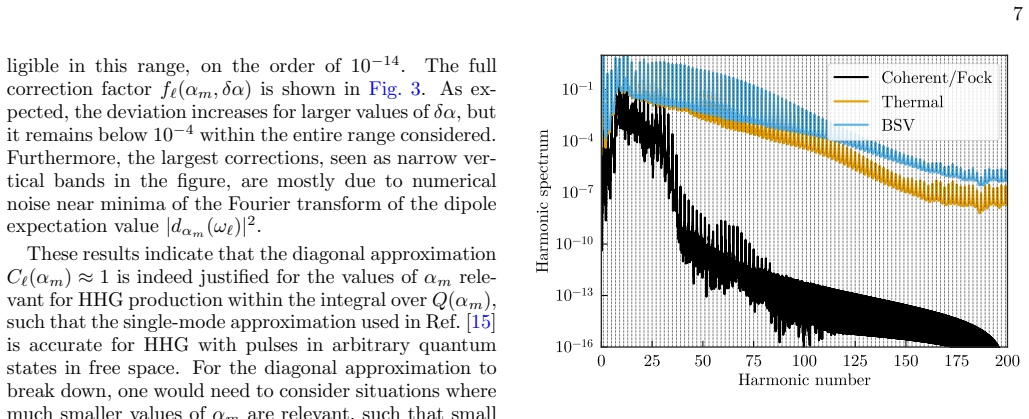
- [Sec. III, Fig. 4] The statement that the coherent and Fock spectra are 'indistinguishable' is qualitative; since this supports the argument that narrow Husimi distributions wash out state-dependent effects, a quantitative measure (e.g., relative difference integrated over harmonics) would be more convincing.
Circularity Check
No significant circularity: the Husimi-average reduction is explicitly derived and the correction factor is numerically computed, not fitted or imported as a load-bearing self-citation.
full rationale
The paper's central claim is reached by an explicit derivation rather than by defining the output in terms of the input. Equations (7)-(26) rewrite the evolution using the positive-P representation, introduce the diagonal approximation alpha approximately beta approximately alpha_m, and reduce the spectrum to a Husimi-weighted average of semiclassical calculations. The correction factor C_l(alpha_m) is defined in Eqs. (27)-(28) and evaluated numerically in Sec. III; its near-unity value is a computed result (Fig. 3), not a fitted parameter or a renamed input. The mean-field factorization in Eq. (12) is explicitly identified as an approximation justified by external Refs. [2,9]; it is a stated assumption, not a conclusion imported as evidence. The paper explicitly limits the derivation to a single temporal mode (Sec. II.A) and notes only that multimode extension is 'straightforward', which is a scope gap relative to the abstract's 'any quantum state' phrasing; this is overclaiming or omitted proof, not circularity. The abstract's many-atom unitarity statement is absent from the body, which is missing support but again not circular. There is no invented uniqueness theorem, and the only self-citation (Ref. [22]) is for the standard QED Hamiltonian. The numerical evaluation of the correction factor solves the semiclassical Schrodinger equation for different classical amplitudes and compares with the diagonal value; it does not use the target no-quantum-effects conclusion as an input. Thus no step reduces by construction to its own input.
Axiom & Free-Parameter Ledger
free parameters (1)
- soft-core parameter a =
0.8160 r_B
axioms (7)
- domain assumption Non-relativistic QED with dipole (long-wavelength) approximation and Power-Zienau-Woolley picture (Eq. 1)
- domain assumption The driving field occupies a single temporal mode b_p; all other modes are vacuum (Sec. II.A)
- standard math Positive-P representation exists for the field density matrix (Sec. II.B, Eq. 7)
- domain assumption Mean-field factorization of the full state into atomic state times product of coherent field states (Eq. 12)
- domain assumption c_l ≈ 0 for high-harmonic modes (Sec. II.C)
- domain assumption Large photon number |α_m| >> 1 for HHG-relevant amplitudes (Sec. III)
- domain assumption Numerical correction factor evaluation uses a 1D model atom with soft Coulomb potential (Sec. III)
read the original abstract
We develop a theoretical framework for high-harmonic generation (HHG) driven by quantum states of light based on a temporal-mode expansion of the electromagnetic field. This approach extends previous single plane-wave mode treatments to realistic pulse configurations and arbitrary multi-mode states of light, resolving conceptual inconsistencies arising from non-normalizable infinite plane waves and establishing consistency between analytical and numerical methods. We derive a correction factor that quantifies deviations from the diagonal approximation (in which the yield becomes a statistical average over classical-field simulations) both for the response of a single atom and in the many-atom regime. Our results confirms that the HHG spectrum for atoms driven by any quantum state of light in free space is accurately described by averaging semi-classical calculations over the Husimi distribution, with no observable genuine quantum effects in the spectrum. We also demonstrate that in the many-atom regime, the mean-field coherent-state approximation underlying this treatment does not preserve probabilities, although unitarity is restored by in the diagonal approximation. The absence of genuine quantum effects in the HHG yield is attributed to the large photon numbers ($\sim 10^{11}$) required to reach HHG intensities in free space, which render quantum fluctuations negligible. We discuss nanophotonic environments with ultrasmall mode volumes as potential platforms where few-photon strong-field processes could exhibit genuine quantum signatures.
Figures


Forward citations
Cited by 2 Pith papers
-
Reconciliation of effective Hamiltonians for intense light-matter interaction
QD-RSPT reconciles effective Hamiltonians for intense light-matter interaction by making eigenvectors non-orthogonal to account for asymmetric couplings, matching Floquet calculations better than standard methods.
-
Limitations of an approximative phase-space description in strong-field quantum optics
Under no dipole correlations, the APP approximation of a nonclassical driving field is an incoherent mixture of coherent states, so it cannot produce sub-Poissonian statistics or squeezing in HHG light.
Reference graph
Works this paper leans on
-
[1]
I. A. Gonoskov, N. Tsatrafyllis, I. K. Kominis, and P. Tzallas, Quantum optical signatures in strong-field laser physics: Infrared photon counting in high-order- harmonic generation, Sci. Rep.6, 32821 (2016)
2016
-
[2]
Gorlach, O
A. Gorlach, O. Neufeld, N. Rivera, O. Cohen, and I. Kaminer, The quantum-optical nature of high har- monic generation, Nature Communications11, 4598 (2020)
2020
-
[3]
Gombk¨ ot˝ o, P
´A. Gombk¨ ot˝ o, P. F¨ oldi, and S. Varr´ o, Quantum-optical description of photon statistics and cross correlations in high-order harmonic generation, Phys. Rev. A104, 033703 (2021)
2021
-
[4]
M. E. Tzur, M. Birk, A. Gorlach, M. Kr¨ uger, I. Kaminer, and O. Cohen, Photon-statistics force in ultrafast elec- tron dynamics, Nat. Photonics17, 501 (2023)
2023
-
[5]
Stammer, J
P. Stammer, J. Rivera-Dean, A. Maxwell, T. Lamprou, A. Ord´ o˜ nez, M. F. Ciappina, P. Tzallas, and M. Lewen- stein, Quantum Electrodynamics of Intense Laser-Matter Interactions: A Tool for Quantum State Engineering, PRX Quantum4, 010201 (2023)
2023
-
[6]
Gonoskov, R
I. Gonoskov, R. Sondenheimer, C. H¨ unecke, D. Kar- tashov, U. Peschel, and S. Gr¨ afe, Nonclassical light gen- eration and control from laser-driven semiconductor in- traband excitations, Phys. Rev. B109, 125110 (2024)
2024
-
[7]
S. Yi, N. D. Klimkin, G. G. Brown, O. Smirnova, S. Patchkovskii, I. Babushkin, and M. Ivanov, Genera- tion of Massively Entangled Bright States of Light during Harmonic Generation in Resonant Media, Phys. Rev. X 15, 011023 (2025)
2025
-
[8]
Tsatrafyllis, I
N. Tsatrafyllis, I. K. Kominis, I. A. Gonoskov, and P. Tzallas, High-order harmonics measured by the photon statistics of the infrared driving-field exiting the atomic medium, Nat. Commun.8, 15170 (2017)
2017
-
[9]
Lewenstein, M
M. Lewenstein, M. F. Ciappina, E. Pisanty, J. Rivera- Dean, P. Stammer, Th. Lamprou, and P. Tzallas, Gen- eration of optical Schr¨ odinger cat states in intense laser– matter interactions, Nature Physics17, 1104 (2021)
2021
-
[10]
Theidel, V
D. Theidel, V. Cotte, R. Sondenheimer, V. Shiriaeva, M. Froidevaux, V. Severin, A. Merdji-Larue, P. Mosel, S. Fr¨ ohlich, K.-A. Weber, U. Morgner, M. Kovacev, J. Biegert, and H. Merdji, Evidence of the Quantum Op- tical Nature of High-Harmonic Generation, PRX Quan- tum5, 040319 (2024)
2024
-
[11]
Theidel, V
D. Theidel, V. Cotte, P. Heinzel, H. Griguer, M. Weis, R. Sondenheimer, and H. Merdji, Observation of a dis- placed squeezed state in high-harmonic generation, Phys. 11 Rev. Res.7, 033223 (2025)
2025
-
[12]
Iskhakov, M
T. Iskhakov, M. V. Chekhova, and G. Leuchs, Gener- ation and Direct Detection of Broadband Mesoscopic Polarization-Squeezed Vacuum, Phys. Rev. Lett.102, 183602 (2009)
2009
-
[13]
K. Yu. Spasibko, T. Sh. Iskhakov, and M. V. Chekhova, Spectral properties of high-gain parametric down- conversion, Opt. Expr.20, 7507 (2012)
2012
-
[14]
Chekhova, G
M. Chekhova, G. Leuchs, and M. ˙Zukowski, Bright squeezed vacuum: Entanglement of macroscopic light beams, Opt. Commun.337, 27 (2015)
2015
-
[15]
Gorlach, M
A. Gorlach, M. E. Tzur, M. Birk, M. Kr¨ uger, N. Rivera, O. Cohen, and I. Kaminer, High-harmonic generation driven by quantum light, Nature Physics19, 1689 (2023)
2023
-
[16]
Rasputnyi, Z
A. Rasputnyi, Z. Chen, M. Birk, O. Cohen, I. Kaminer, M. Kr¨ uger, D. Seletskiy, M. Chekhova, and F. Tani, High- harmonic generation by a bright squeezed vacuum, Nat. Phys.20, 1960 (2024)
1960
-
[17]
H. Liu, H. Zhang, X. Wang, and J. Yuan, Atomic Double Ionization with Quantum Light, Phys. Rev. Lett.134, 123202 (2025)
2025
-
[18]
Mouloudakis and P
G. Mouloudakis and P. Lambropoulos, Revisiting photon-statistics effects on multiphoton ionization, Phys. Rev. A97, 053413 (2018)
2018
-
[19]
Mouloudakis and P
G. Mouloudakis and P. Lambropoulos, Revisiting photon-statistics effects on multiphoton ionization. II. Connection to realistic systems, Phys. Rev. A99, 063419 (2019)
2019
-
[20]
Lemieux, S
S. Lemieux, S. A. Jalil, D. N. Purschke, N. Boroumand, T. J. Hammond, D. Villeneuve, A. Naumov, T. Brabec, and G. Vampa, Photon bunching in high-harmonic emis- sion controlled by quantum light, Nat. Photonics19, 767 (2025)
2025
-
[21]
M. E. Tzur, C. Mor, N. Yaffe, M. Birk, A. Rasputnyi, O. Kneller, I. Nisim, I. Kaminer, M. Kr¨ uger, N. Du- dovich, and O. Cohen, Measuring and controlling the birth of quantum attosecond pulses, arXiv:2502.09427 [physics] (2025)
Pith/arXiv arXiv 2025
-
[22]
Feist, A
J. Feist, A. I. Fern´ andez-Dom ´ ınguez, and F. J. Garc ´ ıa- Vidal, Macroscopic QED for quantum nanophotonics: emitter-centered modes as a minimal basis for multiemit- ter problems, Nanophotonics10, 477 (2021)
2021
-
[23]
S. Y. Buhmann,Dispersion Forces I, Springer Tracts in Modern Physics, Vol. 247 (Springer Berlin Heidelberg, Berlin, Heidelberg, 2012)
2012
-
[24]
Brecht, D
B. Brecht, D. V. Reddy, C. Silberhorn, and M. G. Raymer, Photon Temporal Modes: A Complete Frame- work for Quantum Information Science, Phys. Rev. X5, 041017 (2015)
2015
-
[25]
P. D. Drummond and C. W. Gardiner, Generalised P- representations in quantum optics, Journal of Physics A: Mathematical and General13, 2353 (1980)
1980
-
[26]
W. Li, Q. Zhou, P. Zhang, and X.-W. Chen, Bright Opti- cal Eigenmode of 1 nm 3 Mode Volume, Phys. Rev. Lett. 126, 257401 (2021)
2021
-
[27]
T. Wu, W. Yan, and P. Lalanne, Bright Plasmons with Cubic Nanometer Mode Volumes through Mode Hy- bridization, ACS Photonics8, 307 (2021)
2021
-
[28]
M. Kim, F. De Oliveira, and P. Knight, Properties of squeezed number states and squeezed thermal states, Physical Review A40, 2494 (1989)
1989
-
[29]
K. Blow, R. Loudon, S. J. Phoenix, and T. Shepherd, Continuum fields in quantum optics, Physical Review A 42, 4102 (1990)
1990
discussion (0)
Sign in with ORCID, Apple, or X to comment. Anyone can read and Pith papers without signing in.