Neutral Barium in Solid Neon: Optical Spectroscopy and First Excited State Lifetime
Pith reviewed 2026-05-16 22:51 UTC · model grok-4.3
The pith
Neutral barium atoms in solid neon show a 0.39-second lifetime for the 5d6s 3D1 state.
A machine-rendered reading of the paper's core claim, the machinery that carries it, and where it could break.
Core claim
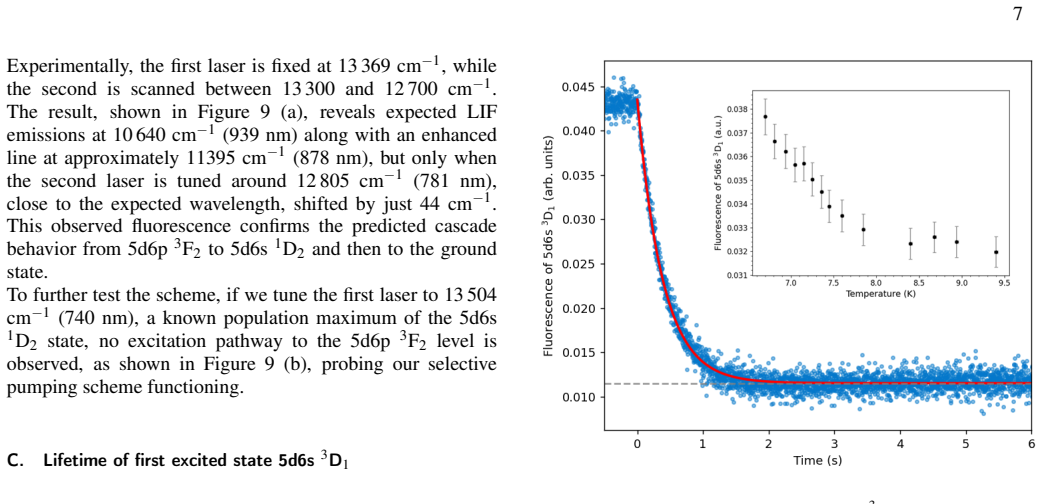
The authors establish that neutral barium atoms isolated in solid neon at 6.8 K exhibit matrix-shifted energy levels, inhomogeneous linewidths, and multiple fluorescence cascades. Their central new result is the first lifetime measurement of the 5d6s 3D1 state, which yields 0.39 ± 0.02 s under the reported conditions and is expected to lengthen by roughly 10 percent when the crystal is cooled to 2 K.
What carries the argument
Matrix isolation spectroscopy in a neon cryogenic crystal, which isolates individual barium atoms and permits direct observation of their emission spectra and excited-state decay under controlled temperature and laser excitation.
If this is right
- Matrix-induced shifts and linewidths quantify how the neon host perturbs barium energy levels relative to vacuum values.
- Multiple radiative pathways and matrix-induced relaxation channels operate within the 5d6s and 6s6p manifolds.
- The 0.39 s lifetime supplies a concrete baseline that grows by approximately 10 percent at 2 K.
- Neutral barium atoms constitute a documented potential background source in neon matrices intended for barium monofluoride electron-EDM experiments.
Where Pith is reading between the lines
- Lifetime data in other noble-gas hosts could reveal systematic host-dependent quenching rates.
- The same isolation technique may be applied to heavier atoms whose long-lived states are relevant to precision measurements.
- Explicit subtraction of barium impurity signals could tighten systematic budgets in planned BaF matrix EDM searches.
Load-bearing premise
The observed fluorescence originates exclusively from the identified barium manifolds without meaningful overlap from unidentified relaxation channels or residual impurities.
What would settle it
A repeat measurement that finds a lifetime differing by more than the stated uncertainty or that reveals additional emission lines not assignable to the listed barium transitions under the same excitation wavelengths would undermine the state attribution.
Figures



read the original abstract
Matrix isolation spectroscopy enables probing atomic properties in controlled cryogenic environments. We present a spectroscopic study on neutral barium atoms embedded in a neon cryogenic crystal at 6.8 K, extending previous investigations performed in other noble gas hosts. The visible and near-infrared emission spectra were recorded under two different laser excitation schemes. First, 10-ns laser pulses at 355 nm were used to directly excite high-lying energy levels of barium, enabling the observation of fluorescence cascades. Second, a tunable continuous-wave laser operating between 700 nm and 900 nm allowed us to determine the matrix-induced shifts of barium energy levels relative to their vacuum values, as well as the inhomogeneous linewidths of the observed transitions and to perform lifetime measurements. Our results confirm multiple radiative pathways and matrix-induced relaxation channels affecting the 5d6s and 6s6p barium manifolds. Furthermore, we present the first lifetime measurement of the barium 5d6s 3D1 state in a neon crystal, yielding 0.39 \pm 0.02 s, with a predicted increase of about 10% at 2 K. The study of fluorescence and spectroscopic properties of barium isolated in neon represents an important step toward future searches for the electron electric dipole moment using barium monofluoride in neon matrices, where neutral barium atoms may act as unavoidable impurities and potential sources of background and systematic limitations.
Editorial analysis
A structured set of objections, weighed in public.
Referee Report
Summary. The manuscript reports a spectroscopic study of neutral barium atoms embedded in a solid neon matrix at 6.8 K. Using 10-ns 355 nm pulsed laser excitation to observe fluorescence cascades and a tunable CW laser (700-900 nm) to measure matrix-induced energy shifts, inhomogeneous linewidths, and lifetimes, the authors confirm multiple radiative pathways and matrix-induced relaxation channels in the 5d6s and 6s6p manifolds. The central result is the first reported lifetime of the 5d6s 3D1 state in neon, measured as 0.39 ± 0.02 s with a predicted ~10% increase at 2 K, motivated by background considerations for future BaF eEDM searches in neon matrices.
Significance. If the lifetime measurement is shown to be free of contamination, the result provides new data on matrix effects for a metastable state of barium and supports characterization of potential impurities in matrix-based precision measurements. The confirmation of multiple relaxation channels adds to the understanding of atomic dynamics in cryogenic noble-gas hosts.
major comments (1)
- [Lifetime measurement section] Lifetime measurement (abstract and corresponding experimental section): The reported 0.39 ± 0.02 s value for the 5d6s 3D1 state is obtained from time-resolved fluorescence under CW excitation. The abstract explicitly states that multiple matrix-induced relaxation channels affect the 5d6s and 6s6p manifolds, yet no quantitative analysis, decay-curve decomposition, or spectral overlap check is described to demonstrate that the monitored band receives negligible population or depopulation from other channels or residual impurities on the ~0.4 s timescale. This isolation is load-bearing for equating the fitted time constant to the intrinsic 3D1 lifetime.
minor comments (2)
- [Experimental methods] The two excitation schemes are described in the abstract but would benefit from a dedicated methods subsection with explicit pulse energies, laser powers, and detection wavelengths to allow reproduction.
- [Results] Notation for the 5d6s 3D1 state and manifold labels is consistent but should be cross-referenced to a level diagram or table of observed transitions for clarity.
Simulated Author's Rebuttal
We thank the referee for their careful reading of our manuscript and for identifying this important point about the lifetime measurement. We address the comment below and will strengthen the presentation in revision.
read point-by-point responses
-
Referee: [Lifetime measurement section] Lifetime measurement (abstract and corresponding experimental section): The reported 0.39 ± 0.02 s value for the 5d6s 3D1 state is obtained from time-resolved fluorescence under CW excitation. The abstract explicitly states that multiple matrix-induced relaxation channels affect the 5d6s and 6s6p manifolds, yet no quantitative analysis, decay-curve decomposition, or spectral overlap check is described to demonstrate that the monitored band receives negligible population or depopulation from other channels or residual impurities on the ~0.4 s timescale. This isolation is load-bearing for equating the fitted time constant to the intrinsic 3D1 lifetime.
Authors: We agree that explicit demonstration of isolation is necessary. The CW laser was tuned to the specific matrix-shifted absorption line of the 5d6s 3D1 state, and fluorescence was monitored in a narrow emission band that is spectrally separated from the other observed transitions in the 5d6s and 6s6p manifolds. The recorded decay curves are single-exponential to within the noise level over the full 0.4 s window, with no detectable fast or slow components. In the revised manuscript we will add (i) a quantitative description of the spectral selectivity and filter bandwidths, (ii) the results of single- versus multi-exponential fits with residuals, and (iii) an upper-limit estimate on possible impurity or cascade contributions based on the absence of other lines in the excitation spectrum. These additions will make the isolation argument explicit. revision: yes
Circularity Check
No circularity: direct experimental lifetime extraction from fluorescence decay
full rationale
The paper's core results consist of measured emission spectra, matrix shifts, linewidths, and a lifetime value extracted by fitting time-resolved fluorescence signals under specific laser excitation. No derivation chain reduces any reported quantity to a fitted parameter by construction, nor does any central claim rely on a self-citation that itself assumes the target result. The 0.39 s lifetime is obtained from observed decay curves, and the 10% temperature extrapolation is presented as a separate estimate rather than a load-bearing step that closes on itself. The work is therefore self-contained against external benchmarks with no evident circular steps.
Axiom & Free-Parameter Ledger
axioms (1)
- domain assumption Atoms are isolated in the neon matrix with negligible atom-atom interactions
Reference graph
Works this paper leans on
-
[1]
In this paper, we extend the approach conducted in previously cited works, proving the first successful growth of good quality Ba doped neon crystals at temperatures ranging from 6.8 to 9 K. Among the hosts previously studied, neon is a promising matrix for MIT, as it can offer good optical transparency and reduced perturbation of embedded species, as pro...
work page internal anchor Pith review Pith/arXiv arXiv 2025
-
[2]
Departments of Excellence grant 2023–2027—Quantum Frontiers
A similar investigation for Ba and BaF will be crucial to establish parahydrogen as a next-generation host for matrix-isolated spectroscopy and precision measurements of fundamental properties. ACKNOWLEDGMENTS We express our sincere gratitude to A. C. Vutha for contributing to insightful discussions that greatly contributed to this work. We also thank E. ...
work page 2023
-
[3]
Environmentally isolated molecules for quantum computation,
pp. 317–340. 2J. D. Weinstein and D. DeMille, “Environmentally isolated molecules for quantum computation,” Physical Review Letters94, 040501 (2005). 3D. Patterson and J. M. Doyle, “Bright, guided molecular beam with hydrodynamic enhancement,” Journal of Chemical Physics126, 154307 (2007). 4E. L. Raab, M. Prentiss, A. Cable, S. Chu, and D. E. Pritchard, “...
discussion (0)
Sign in with ORCID, Apple, or X to comment. Anyone can read and Pith papers without signing in.