Recognition: 1 theorem link
· Lean TheoremOn the Diversity of Pulsar's Frequency-Dependent Circular Polarization
Pith reviewed 2026-05-16 20:52 UTC · model grok-4.3
The pith
Wave mode coupling in the limiting polarization region reproduces the diversity of frequency-dependent circular polarization in pulsar single pulses.
A machine-rendered reading of the paper's core claim, the machinery that carries it, and where it could break.
Core claim
Assuming circular polarization arises solely from wave mode coupling, the authors solve the coupling equations numerically and perform Bayesian analysis on FAST observations. For the three selected pulsars this yields posterior constraints of multiplicity approximately 10^0 to 10^2 and Lorentz factor approximately 10^0.5 to 10^2. These values imply that the plasma flow producing the coherent radio emission accounts for only a very small fraction of the pulsar's spin-down energy loss.
What carries the argument
Numerical solution of the wave mode coupling equations in the limiting polarization region, which converts the polarization state of outward-propagating waves according to local plasma parameters.
If this is right
- Circular polarization spectra with differing frequency evolution are reproduced by the mode-coupling model.
- Multiplicity is constrained to roughly 1 to 100 for the three chosen pulsars.
- Lorentz factor is constrained to roughly 3 to 100 for the same pulsars.
- The emitting plasma carries only a tiny fraction of the total spin-down power.
Where Pith is reading between the lines
- Polarization spectra could serve as a direct diagnostic of magnetospheric plasma density and velocity without requiring assumptions about high particle energies.
- Low multiplicity values suggest that coherent emission arises in relatively sparse flows, which may conflict with models that invoke dense pair plasmas.
- Applying the same fitting procedure to a larger sample of pulsars with varying periods and magnetic fields would test whether the low-multiplicity regime is general.
Load-bearing premise
That observed circular polarization is generated entirely by wave mode coupling during propagation and receives no contribution from the emission mechanism at its source.
What would settle it
Single-pulse circular polarization spectra whose frequency dependence cannot be matched by any combination of multiplicity and Lorentz factor when the coupling equations are integrated outward from the emission region.
Figures




read the original abstract
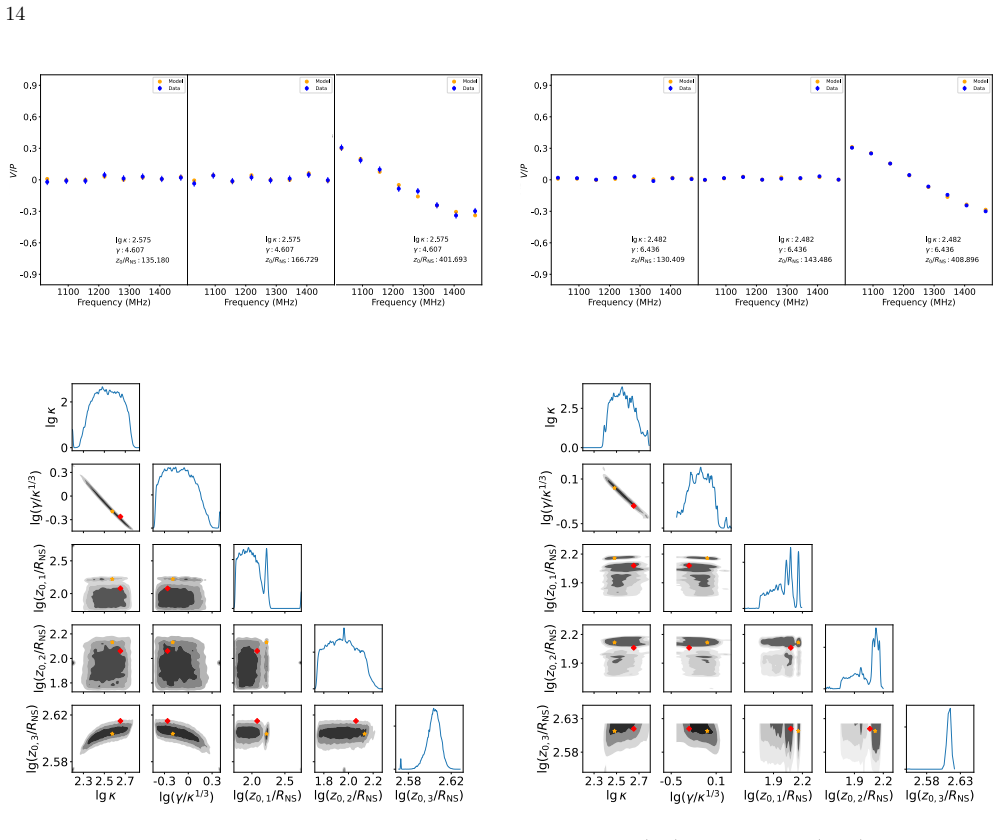
The nature of coherent radio emission is still challenging even after more than half a century of pulsar discovery, but it is generally a consensus that single-pulse observations are essential for probing the magnetospheric dynamics, especially with the largest single-dish telescope FAST (Five-hundred-meter Aperture Spherical radio Telescope). This paper aims to explain the observed diversity of single pulse circular polarization, and to constrain the multiplicity and Lorentz factor of pulsar magnetospheric plasma, with the mode coupling model in the limiting polarization region. Assuming that circular polarization comes only from wave mode coupling, we apply a Bayesian analysis to the FAST observed single pulse circular polarization spectra, involving numerical solving of wave mode coupling equations, and analyze the posterior probability distribution functions of the parameters. Although the model fails to quantitatively fit most circular polarization spectra, circular polarization of different frequency evolution is reproduced. For three chosen pulsars, the Bayesian analysis constrains the multiplicity to be approximately $10^{0}\sim10^{2}$, and the Lorentz factor to be approximately $10^{0.5}\sim10^{2}$. Pulsar circular polarization could be induced by wave mode coupling. The plasma flow responsible for coherent radio emission carries only a very small fraction of the pulsar spin-down energy loss.
Editorial analysis
A structured set of objections, weighed in public.
Referee Report
Summary. The paper claims that the diversity of frequency-dependent circular polarization in pulsar single pulses can be explained by wave mode coupling in the limiting polarization region. Using numerical solutions of the mode-coupling equations combined with Bayesian inference on FAST single-pulse spectra for three selected pulsars, the authors constrain the plasma multiplicity to approximately 10^0–10^2 and the Lorentz factor to approximately 10^{0.5}–10^2, concluding that the emitting plasma carries only a small fraction of the spin-down luminosity and that mode coupling induces the observed circular polarization.
Significance. If the parameter constraints can be shown to be robust, the work would supply useful empirical bounds on magnetospheric plasma properties and lend support to wave-mode coupling as a mechanism for circular polarization diversity. The emphasis on single-pulse spectroscopy with FAST is a positive aspect that could help probe emission physics.
major comments (3)
- [Abstract] Abstract: The explicit statement that the model 'fails to quantitatively fit most circular polarization spectra' while still reporting Bayesian-derived constraints on multiplicity and Lorentz factor creates a direct tension; a forward model with poor quantitative agreement typically yields flat or prior-dominated posteriors, undermining the reliability of the reported parameter ranges.
- [Bayesian analysis] Bayesian analysis section: The constraints (multiplicity ~10^0–10^2, Lorentz factor ~10^{0.5}–10^2) are obtained by direct fitting of the wave-mode-coupling model to the observed spectra; given the acknowledged quantitative mismatch, it is unclear whether these values are data-driven or largely reflect prior choices.
- [Discussion] Discussion: The claim that the plasma flow carries only a very small fraction of the pulsar spin-down energy loss rests on the low fitted multiplicity and Lorentz factor; an explicit calculation of the implied energy fraction together with comparison to independent estimates would be needed to support this conclusion.
minor comments (3)
- The selection criteria for the three pulsars and the specific frequency bands analyzed should be stated more explicitly.
- [Methods] Clarify the precise form of the likelihood function and any assumptions about spectral noise in the Bayesian fitting procedure.
- [Model description] A few equations describing the numerical integration of the mode-coupling equations would benefit from additional explanatory text on boundary conditions and convergence checks.
Simulated Author's Rebuttal
We thank the referee for the constructive comments on our manuscript. We have revised the paper to address the concerns, clarifying the abstract, expanding the Bayesian analysis with posterior diagnostics, and adding explicit energy calculations in the discussion. Our responses to each major comment are provided below.
read point-by-point responses
-
Referee: [Abstract] The explicit statement that the model 'fails to quantitatively fit most circular polarization spectra' while still reporting Bayesian-derived constraints on multiplicity and Lorentz factor creates a direct tension; a forward model with poor quantitative agreement typically yields flat or prior-dominated posteriors, undermining the reliability of the reported parameter ranges.
Authors: We acknowledge the noted tension in the original abstract wording. The model is intended to reproduce the qualitative diversity of frequency evolutions (e.g., sign changes and peak locations) rather than exact quantitative spectra, due to simplifications in the limiting polarization region treatment. We have revised the abstract to explicitly distinguish between qualitative reproduction of trends and quantitative fitting. We have also added posterior plots and prior-sensitivity tests in the Bayesian section to demonstrate that the reported ranges (multiplicity 10^0–10^2, Lorentz factor 10^{0.5}–10^2) are data-driven. revision: yes
-
Referee: [Bayesian analysis] The constraints (multiplicity ~10^0–10^2, Lorentz factor ~10^{0.5}–10^2) are obtained by direct fitting of the wave-mode-coupling model to the observed spectra; given the acknowledged quantitative mismatch, it is unclear whether these values are data-driven or largely reflect prior choices.
Authors: To clarify this point, the revised manuscript now includes the full prior and posterior distributions (new Figure). The posteriors show distinct peaks within the quoted ranges, separated from the flat prior boundaries, indicating that the likelihood from matching the observed frequency-dependent circular polarization patterns drives the constraints. While absolute quantitative fits are imperfect, the model likelihood still favors these parameter values for capturing the spectral evolution trends across the selected pulses. revision: yes
-
Referee: [Discussion] The claim that the plasma flow carries only a very small fraction of the pulsar spin-down energy loss rests on the low fitted multiplicity and Lorentz factor; an explicit calculation of the implied energy fraction together with comparison to independent estimates would be needed to support this conclusion.
Authors: We agree an explicit calculation strengthens the claim. The revised Discussion now derives the plasma energy flux from the constrained multiplicity (∼1–100) and Lorentz factor (∼3–100), yielding an energy fraction of order 10^{-3}–10^{-1} relative to the spin-down luminosity for the three pulsars. This is compared to independent estimates from pair-cascade models and radio efficiency measurements in the literature, confirming consistency with a small fraction carried by the emitting plasma. revision: yes
Circularity Check
No significant circularity; constraints are standard Bayesian fits to external data
full rationale
The paper assumes wave-mode coupling produces the observed circular polarization and numerically solves the governing equations while performing Bayesian inference on multiplicity and Lorentz factor using FAST single-pulse spectra. The reported posterior ranges (multiplicity ~10^0-10^2, Lorentz factor ~10^{0.5}-10^2) are direct outputs of fitting the forward model to independent observational data for three selected pulsars. No equation or claim reduces a 'prediction' or first-principles result to an input by construction, no self-citation supplies a load-bearing uniqueness theorem, and no ansatz is smuggled via prior work. The derivation chain is therefore a conventional parameter-estimation exercise whose numerical values are data-driven rather than tautological.
Axiom & Free-Parameter Ledger
free parameters (2)
- multiplicity =
10^0 to 10^2
- Lorentz factor =
10^{0.5} to 10^2
axioms (2)
- domain assumption Circular polarization comes only from wave mode coupling in the limiting polarization region
- domain assumption Wave propagation obeys the standard mode-coupling equations for relativistic plasma
Lean theorems connected to this paper
-
IndisputableMonolith/Foundation/RealityFromDistinction.leanreality_from_one_distinction unclear?
unclearRelation between the paper passage and the cited Recognition theorem.
We use the mode coupling model in the limiting polarization region... numerical solving of wave mode coupling equations... Bayesian analysis constrains the multiplicity... Lorentz factor
What do these tags mean?
- matches
- The paper's claim is directly supported by a theorem in the formal canon.
- supports
- The theorem supports part of the paper's argument, but the paper may add assumptions or extra steps.
- extends
- The paper goes beyond the formal theorem; the theorem is a base layer rather than the whole result.
- uses
- The paper appears to rely on the theorem as machinery.
- contradicts
- The paper's claim conflicts with a theorem or certificate in the canon.
- unclear
- Pith found a possible connection, but the passage is too broad, indirect, or ambiguous to say the theorem truly supports the claim.
Forward citations
Cited by 1 Pith paper
-
To understand the radiative processes of pulsars and fast radio bursts with the FAST
FAST telescope observations are providing pivotal insights into the radiative processes of pulsars and fast radio bursts.
Reference graph
Works this paper leans on
-
[1]
, " * write output.state after.block = add.period write newline
ENTRY address archivePrefix author booktitle chapter doi edition editor eprint howpublished institution journal key month number organization pages publisher school series title misctitle type volume year version url label extra.label sort.label short.list INTEGERS output.state before.all mid.sentence after.sentence after.block FUNCTION init.state.consts ...
-
[2]
" write newline "" before.all 'output.state := FUNCTION format.url url empty "" new.block "" url * "" * if FUNCTION format.eprint eprint empty "" archivePrefix empty "" archivePrefix "arXiv" = new.block " " eprint * " " * new.block " " eprint * " " * if if if FUNCTION format.doi doi empty "" " " doi * " " * if FUNCTION format.pid doi empty eprint empty ur...
-
[3]
bl"dYc ̰@`Y^ <a8lx Ǵg F B <a)Y#ͪ & 6az, P, 6y=0Z=A 7 qx +0Þ H/U+c_
thebibliography [1] 20pt to REFERENCES 6pt =0pt \@twocolumntrue 12pt -12pt 10pt plus 3pt =0pt =0pt =1pt plus 1pt =0pt =0pt -12pt =13pt plus 1pt =20pt =13pt plus 1pt \@M =10000 =-1.0em =0pt =0pt 0pt =0pt =1.0em @enumiv\@empty 10000 10000 `\.\@m \@noitemerr \@latex@warning Empty `thebibliography' environment \@ifnextchar \@reference \@latexerr Missing key o...
work page 2017
-
[4]
U., Albert , A., Alfaro , R., et al
Abeysekara , A. U., Albert , A., Alfaro , R., et al. 2017, title Extended gamma-ray sources around pulsars constrain the origin of the positron flux at Earth , Science, 358, 911, 10.1126/science.aan4880
-
[5]
Andrianov , A. S., & Beskin , V. S. 2010, title Limiting polarization effect a key link in investigating the mean profiles of radio pulsars , Astronomy Letters, 36, 248, 10.1134/S1063773710040031
-
[6]
Arons , J., & Barnard , J. J. 1986, title Wave Propagation in Pulsar Magnetospheres: Dispersion Relations and Normal Modes of Plasmas in Superstrong Magnetic Fields , , 302, 120, 10.1086/163978
-
[7]
Arons , J., & Scharlemann , E. T. 1979, title Pair formation above pulsar polar caps: structure of the low altitude acceleration zone. , , 231, 854, 10.1086/157250
-
[8]
Barnard , J. J. 1986, title Probing the Magnetic Field of Radio Pulsars: A Reexamination of Polarization Position Angle Swings , , 303, 280, 10.1086/164073
-
[9]
Ben \'a c ek , J., Jessner , A., Pohl , M., Rievajov \'a , T., & Oswald , L. S. 2025, On the origin of radio polarization in pulsar polar caps , 10.48550/arXiv.2503.17249
-
[10]
Beskin , V. S. 2018, title Radio pulsars: already fifty years! , Physics Uspekhi, 61, 353, 10.3367/UFNe.2017.10.038216
-
[11]
Beskin , V. S., Gurevich , A. V., & Istomin , I. N. 1988, title Theory of the Radio Emission of Pulsars , , 146, 205, 10.1007/BF00637577
-
[12]
Beskin , V. S., Gurevich , A. V., & Istomin , Y. N. 1993, Physics of the Pulsar Magnetosphere (Cambridge University Press)
work page 1993
-
[13]
B., Scranton , R., M \'e nard , B., et al
Beskin , V. S., & Philippov , A. A. 2012, title On the mean profiles of radio pulsars - I. Theory of propagation effects , , 425, 814, 10.1111/j.1365-2966.2012.20988.x
-
[14]
B \^ rzan , L., Pavlov , G. G., & Kargaltsev , O. 2016, title Chandra Observations of the Elusive Pulsar Wind Nebula around PSR B0656+14 , , 817, 129, 10.3847/0004-637X/817/2/129
-
[15]
Blaskiewicz , M., Cordes , J. M., & Wasserman , I. 1991, title A Relativistic Model of Pulsar Polarization , , 370, 643, 10.1086/169850
-
[16]
Budden , K. G. 1952, title The Theory of the Limiting Polarization of Radio Waves Reflected from the Ionosphere , Proceedings of the Royal Society of London Series A, 215, 215, 10.1098/rspa.1952.0207
-
[17]
Cao , S., Jiang , J., Dyks , J., et al. 2025, title Rapid Rotation of Polarization Orientations in PSR B1919+21's Single Pulses: Implications on Pulsar's Magnetospheric Dynamics , , 983, 43, 10.3847/1538-4357/adbe33
-
[18]
Cao , S., Jiang , J., Dyks , J., et al. 2024, title PSR B0943+10: Mode Switch, Polar Cap Geometry, and Orthogonally Polarized Radiation , , 973, 56, 10.3847/1538-4357/ad60c5
-
[19]
Cheng , A. F., & Ruderman , M. A. 1979, title A theory of subpulse polarization patterns from radio pulsars. , , 229, 348, 10.1086/156959
-
[20]
Daugherty , J. K., & Harding , A. K. 1982, title Electromagnetic cascades in pulsars. , , 252, 337, 10.1086/159561
-
[21]
de Jager , O. C. 2007, title Lower Limits on Pulsar Pair Production Multiplicities from H.E.S.S. Observations of Pulsar Wind Nebulae , , 658, 1177, 10.1086/511950
-
[22]
2017, title The origin of radio pulsar polarization , , 472, 4598, 10.1093/mnras/stx2101
Dyks , J. 2017, title The origin of radio pulsar polarization , , 472, 4598, 10.1093/mnras/stx2101
-
[23]
Everett , J. E., & Weisberg , J. M. 2001, title Emission Beam Geometry of Selected Pulsars Derived from Average Pulse Polarization Data , , 553, 341, 10.1086/320652
-
[24]
Foreman-Mackey , D., Hogg , D. W., Lang , D., & Goodman , J. 2013, title emcee: The MCMC Hammer , , 125, 306, 10.1086/670067
-
[25]
Galishnikova , A. K., Philippov , A. A., & Beskin , V. S. 2020, title Simulations of the radio polarization of a precessing pulsar PSR J1906+0746 , , 497, 2831, 10.1093/mnras/staa2070
-
[26]
Goldreich , P., & Julian , W. H. 1969, title Pulsar Electrodynamics , , 157, 869, 10.1086/150119
-
[27]
Gurevich , A. V., & Istomin , I. N. 1985, title Generation of electron-positron plasma in a pulsar's magnetosphere. , Zhurnal Eksperimentalnoi i Teoreticheskoi Fiziki, 89, 3
work page 1985
-
[28]
1998, MNRAS, 300, 146, doi: 10.1046/j.1365-8711.1998.01918.x
Han , J. L., Manchester , R. N., Xu , R. X., & Qiao , G. J. 1998, title Circular polarization in pulsar integrated profiles , , 300, 373, 10.1046/j.1365-8711.1998.01869.x
-
[29]
Hobbs , G. B., Edwards , R. T., & Manchester , R. N. 2006, title TEMPO2, a new pulsar-timing package - I. An overview , , 369, 655, 10.1111/j.1365-2966.2006.10302.x
-
[30]
W., van Straten , W., & Manchester , R
Hotan , A. W., van Straten , W., & Manchester , R. N. 2004, title PSRCHIVE and PSRFITS: An Open Approach to Radio Pulsar Data Storage and Analysis , , 21, 302, 10.1071/AS04022
-
[31]
Jiang , J. C., Xu , J. W., Niu , J. R., et al. 2024, title Ninety percent circular polarization detected in a repeating fast radio burst , National Science Review, 12, nwae293, 10.1093/nsr/nwae293
-
[32]
Johnston , S., Mitra , D., Keith , M. J., Oswald , L. S., & Karastergiou , A. 2024, title The Thousand-Pulsar-Array programme on MeerKAT ─ XIV. On the high linearly polarized pulsar signals , , 530, 4839, 10.1093/mnras/stae1175
-
[33]
Jones , T. W., & O'Dell , S. L. 1977, title Transfer of polarized radiation in self-absorbed synchrotron sources. I. Results for a homogeneous source. , , 214, 522, 10.1086/155278
-
[34]
2003, title Simultaneous single-pulse observations of radio pulsars
Karastergiou , A., Johnston , S., & Kramer , M. 2003, title Simultaneous single-pulse observations of radio pulsars. III. The behaviour of circular polarization , , 404, 325, 10.1051/0004-6361:20030433
-
[35]
Karastergiou , A., Johnston , S., & Manchester , R. N. 2005, title Polarization profiles of southern pulsars at 3.1 GHz , , 359, 481, 10.1111/j.1365-2966.2005.08909.x
-
[36]
Kazbegi , A. Z., Machabeli , G. Z., & Melikidze , G. I. 1991, title On the circular polarization in pulsar emission. , , 253, 377, 10.1093/mnras/253.3.377
-
[37]
Lorimer, D. R., & Kramer, M. 2012, Handbook of Pulsar Astronomy (Cambridge University Press)
work page 2012
-
[38]
Luo , R., Wang , B. J., Men , Y. P., et al. 2020, title Diverse polarization angle swings from a repeating fast radio burst source , , 586, 693, 10.1038/s41586-020-2827-2
-
[39]
Lyubarskii , Y. E., & Petrova , S. A. 1998, title On the Circular Polarization of Pulsar Radiation , , 262, 379, 10.1023/A:1001872805645
-
[40]
Malengier , B., Ki s on , P., Tocknell , J., et al. 2018, title ODES: a high level interface to ODE and DAE solvers , The Journal of Open Source Software, 3, 165, 10.21105/joss.00165
-
[41]
Manchester , R. N., Hobbs , G. B., Teoh , A., & Hobbs , M. 2005, title The Australia Telescope National Facility Pulsar Catalogue , , 129, 1993, 10.1086/428488
work page internal anchor Pith review doi:10.1086/428488 2005
-
[42]
Melrose , D. B., & Luo , Q. 2004, title Circular polarization in pulsar radio emission due to intrinsically relativistic effects , , 352, 915, 10.1111/j.1365-2966.2004.07986.x
-
[43]
Mitra , D., Melikidze , G. I., & Basu , R. 2023, title Evidence for coherent curvature radiation in PSR J1645-0317 with disordered distribution of polarization position angle , , 521, L34, 10.1093/mnrasl/slad022
-
[44]
Nelson , B., Ford , E. B., & Payne , M. J. 2014, title RUN DMC: An Efficient, Parallel Code for Analyzing Radial Velocity Observations Using N-body Integrations and Differential Evolution Markov Chain Monte Carlo , , 210, 11, 10.1088/0067-0049/210/1/11
-
[45]
S., Karastergiou , A., & Johnston , S
Oswald , L. S., Karastergiou , A., & Johnston , S. 2023, title Pulsar polarization: a partial-coherence model , , 525, 840, 10.1093/mnras/stad2271
-
[46]
Petrova , S. A. 2001, title On the origin of orthogonal polarization modes in pulsar radio emission , , 378, 883, 10.1051/0004-6361:20011297
-
[47]
Petrova , S. A. 2003, title Diagnostics of the plasma of pulsar magnetospheres based on polarization profiles of radio pulses , , 408, 1057, 10.1051/0004-6361:20031028
-
[48]
Petrova , S. A., & Lyubarskii , Y. E. 2000, title Propagation effects in pulsar magnetospheres , , 355, 1168
work page 2000
-
[49]
Qu , Y., & Zhang , B. 2025, title Magnetic Interactions in White Dwarf Binaries as Mechanism for Long-period Radio Transients , , 981, 34, 10.3847/1538-4357/adb1b5
-
[50]
Radhakrishnan , V., & Cooke , D. J. 1969, title Magnetic Poles and the Polarization Structure of Pulsar Radiation , , 3, 225
work page 1969
-
[51]
Ruderman , M. A., & Sutherland , P. G. 1975, title Theory of pulsars: polar gaps, sparks, and coherent microwave radiation. , , 196, 51, 10.1086/153393
-
[52]
Sazonov , V. N. 1969, title Generation and Transfer of Polarized Synchrotron Radiation. , , 13, 396
work page 1969
-
[53]
Sironi , L., Plotnikov , I., N \"a ttil \"a , J., & Beloborodov , A. M. 2021, title Coherent Electromagnetic Emission from Relativistic Magnetized Shocks , , 127, 035101, 10.1103/PhysRevLett.127.035101
-
[54]
Spencer , S. T., & Mitchell , A. M. W. 2025, title Deriving pulsar pair-production multiplicities from pulsar wind nebulae using H.E.S.S. and LHAASO observations , , 694, A324, 10.1051/0004-6361/202451276
-
[55]
Sun , S. N., Wang , N., Yan , W. M., & Wang , S. Q. 2025, title The Emission Geometry of Pulsars with Interpulses , , 983, 179, 10.3847/1538-4357/adc254
-
[56]
ter Braak, C. J. F., & Vrugt, J. A. 2008, title Differential Evolution Markov Chain with snooker updater and fewer chains , Stat. Comput., 18, 435, 10.1007/s11222-008-9104-9
-
[57]
Timokhin , A. N., & Harding , A. K. 2015, title On the Polar Cap Cascade Pair Multiplicity of Young Pulsars , , 810, 144, 10.1088/0004-637X/810/2/144
-
[58]
Timokhin , A. N., & Harding , A. K. 2019, title On the Maximum Pair Multiplicity of Pulsar Cascades , , 871, 12, 10.3847/1538-4357/aaf050
-
[59]
van Straten , W., & Bailes , M. 2011, title DSPSR: Digital Signal Processing Software for Pulsar Astronomy , , 28, 1, 10.1071/AS10021
-
[60]
N., Johnston , S., & Reynolds , J
van Straten , W., Manchester , R. N., Johnston , S., & Reynolds , J. E. 2010, title PSRCHIVE and PSRFITS: Definition of the Stokes Parameters and Instrumental Basis Conventions , , 27, 104, 10.1071/AS09084
-
[61]
Wang , C., Lai , D., & Han , J. 2010, title Polarization changes of pulsars due to wave propagation through magnetospheres , , 403, 569, 10.1111/j.1365-2966.2009.16074.x
-
[62]
Wang , P. F., Han , J. L., Xu , J., et al. 2023, title FAST Pulsar Database. I. Polarization Profiles of 682 Pulsars , Research in Astronomy and Astrophysics, 23, 104002, 10.1088/1674-4527/acea1f
-
[63]
Wang , W.-Y., Yang , Y.-P., Niu , C.-H., Xu , R., & Zhang , B. 2022, title Magnetospheric Curvature Radiation by Bunches as Emission Mechanism for Repeating Fast Radio Bursts , , 927, 105, 10.3847/1538-4357/ac4097
-
[64]
Xu , Z.-H., Wang , W.-Y., Cao , S.-S., & Xu , R.-X. 2025, title Pulsar Sparking: What if mountains on the surface? , arXiv e-prints, arXiv:2506.12305, 10.48550/arXiv.2506.12305
-
[65]
You , X.-P., & Han , J.-l. 2006, title Circular Polarization in Pulsar Integrated Profiles: Updates , , 6, 237, 10.1088/1009-9271/6/2/11
-
[66]
Yuan , M., Zhu , W., Kramer , M., et al. 2023, title High-altitude Magnetospheric Emissions from Two Pulsars , , 949, 115, 10.3847/1538-4357/accb9a
-
[67]
Zheleznyakov, V. V. 1996, Radiation in Astrophysical Plasmas (Kluwer Academic Publishers), 10.1007/978-94-009-0201-5
-
[68]
Zhong , Y., & Most , E. R. 2025, title Unraveling the emission mechanism powering long period radio transients from interacting white dwarf binaries via kinetic plasma simulations , arXiv e-prints, arXiv:2509.09057, 10.48550/arXiv.2509.09057
discussion (0)
Sign in with ORCID, Apple, or X to comment. Anyone can read and Pith papers without signing in.