Recognition: 2 theorem links
· Lean TheoremOn the Metric f(R) gravity Viability in Accounting for the Binned Supernovae Data
Pith reviewed 2026-05-16 20:29 UTC · model grok-4.3
The pith
An extra condition on the modified Friedmann equation restores consistent dynamics and finite positive scalar mass in metric f(R) gravity while fitting binned supernova data.
A machine-rendered reading of the paper's core claim, the machinery that carries it, and where it could break.
Core claim
The central claim is that the additional condition on the modified Friedmann equation has a precise dynamical origin, being necessary to restore a consistent Cauchy problem and to ensure a finite, positive scalar field mass in metric f(R) gravity models that account for the observed running of the Hubble parameter in binned supernova data.
What carries the argument
The additional condition imposed on the modified Friedmann equation, which enables a fully consistent reformulation of the scalar field dynamics in the general metric f(R) model.
If this is right
- The resulting models preserve agreement with the binned Supernova Ia data.
- The framework supplies a dynamical justification for the condition used in earlier late-time cosmological analyses.
- The scalar degree of freedom acquires a finite and positive mass.
- The effective running Hubble constant is reproduced by the low-redshift Taylor approximation.
Where Pith is reading between the lines
- Higher-redshift supernova samples could test whether the second-order Taylor expansion remains adequate or demands higher-order corrections in the effective function.
- Similar consistency conditions may be required in other scalar-tensor models to avoid unphysical masses when applied to cosmic expansion data.
- Precise measurements of the scalar mass from future surveys could provide an independent check on the viability of these f(R) descriptions.
Load-bearing premise
The binned Pantheon and Master samples genuinely indicate a running Hubble parameter that can be captured by a low-redshift Taylor expansion of an effective f(R) function without higher-order terms or selection effects altering the fit.
What would settle it
A calculation or observation showing that the scalar field mass remains negative or divergent in an f(R) model without the additional condition, or new binned supernova data that cannot be fit once the condition is enforced.
Figures




read the original abstract
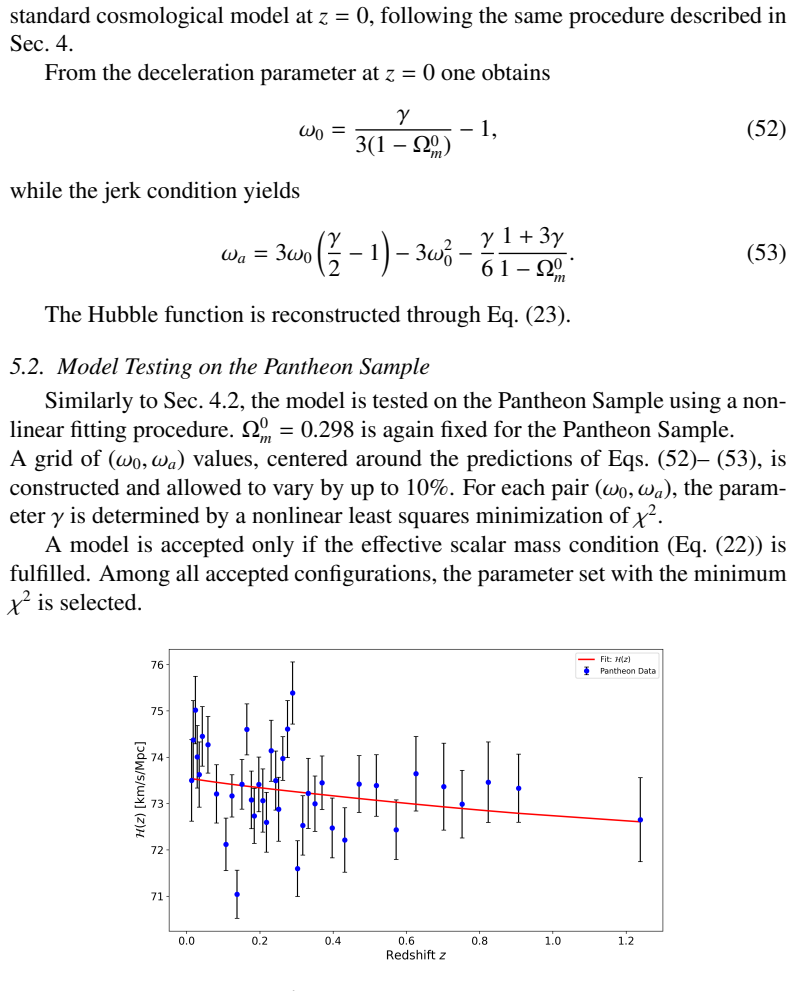
In this work, two models of metric $f(R)$ gravity in the Jordan frame are investigated as a dynamical description of the late-time cosmic expansion using binned Type Ia Supernovae data. The aim is to provide an explanation for the effective running of the Hubble constant observed in both the binned Pantheon Sample and the Master Sample. To this end, the effective running Hubble constant $\mathcal{H}(z)$ is defined as the ratio between the modified Hubble parameter and that of the $\Lambda$CDM, multiplied by $H_0$. $\mathcal{H}(z)$ serves as a diagnostic tool to capture deviations from the $\Lambda$CDM model. The first model used is a general representation of metric $f(R)$ gravity in which the gravitational Lagrangian is encoded in an effective redshift-dependent function that mimics the evolution of the Hubble parameter. This function can be approximated by a second-order Taylor expansion at low redshift due to the limited redshift range covered by the Supernovae data. While this general formulation yields a phenomenological fit compatible with that of the $\Lambda$CDM model for the binned Pantheon Sample, the model generically leads to the emergence of an unphysical mass of the scalar field. This issue originates from an implicit restriction imposed on the Cauchy problem for the scalar field. To address this limitation, following previous studies, an additional condition on the modified Friedmann equation is introduced, enabling a fully consistent reformulation of the dynamics. It is clarified that this additional condition has a precise dynamical origin, being necessary to restore a consistent Cauchy problem and to ensure a finite, positive scalar field mass. The resulting framework not only preserves the agreement with binned Supernova Ia data, but also provides a physical justification for the additional condition adopted in earlier analyses of late-time cosmological dynamics.
Editorial analysis
A structured set of objections, weighed in public.
Referee Report
Summary. The manuscript investigates two metric f(R) gravity models in the Jordan frame to explain the effective running of the Hubble constant observed in binned Type Ia Supernovae data from the Pantheon and Master samples. It defines an effective running Hubble parameter H(z) and approximates the gravitational Lagrangian with a second-order Taylor expansion at low redshift. While the general model fits the binned data similarly to LambdaCDM, it leads to unphysical scalar field masses; an additional condition on the modified Friedmann equation is introduced to restore a consistent Cauchy problem and ensure a finite positive scalar mass m^2 ~ 1/(3f''(R)), preserving the data agreement.
Significance. If the result holds, it provides a dynamical justification for the additional condition used in prior f(R) analyses, linking it to the well-posedness of the initial-value problem rather than ad hoc fitting. This strengthens the viability of metric f(R) for late-time cosmology by ensuring physical scalar degrees of freedom, though the reliance on binned data limits broader implications.
major comments (2)
- [Derivation of the additional condition] The section deriving the fixing condition: the claim that the additional condition on the modified Friedmann equation has a precise dynamical origin (restoring consistent Cauchy evolution and finite positive scalar mass) requires an explicit step-by-step derivation from the scalar field equation of motion to the mass expression m^2 ~ 1/(3f''(R)); without this, the link to the IVP remains asserted rather than demonstrated.
- [§4] §4 (data analysis): the compatibility of the Taylor-expanded f(R) with binned Pantheon/Master samples is shown via H(z) plots, but no reduced chi-squared, degrees of freedom, or test against simulated LambdaCDM binned data is reported; this is load-bearing because binning artifacts could mimic the running without genuine deviation, undermining the viability interpretation.
minor comments (2)
- [Abstract and §2] The definition of the effective running Hubble constant H(z) as a ratio multiplied by H0 should include an explicit equation number for clarity.
- [Throughout] Notation for the Taylor coefficients of the effective function should be standardized across text and equations to avoid ambiguity in the truncation.
Simulated Author's Rebuttal
We thank the referee for the careful reading of our manuscript and the constructive comments. We address each major comment point by point below. We agree that both points require strengthening and will revise the manuscript accordingly.
read point-by-point responses
-
Referee: [Derivation of the additional condition] The section deriving the fixing condition: the claim that the additional condition on the modified Friedmann equation has a precise dynamical origin (restoring consistent Cauchy evolution and finite positive scalar mass) requires an explicit step-by-step derivation from the scalar field equation of motion to the mass expression m^2 ~ 1/(3f''(R)); without this, the link to the IVP remains asserted rather than demonstrated.
Authors: We agree that the link to the initial-value problem should be demonstrated explicitly rather than asserted. In the revised manuscript we will insert a dedicated subsection deriving the scalar-field mass from the equation of motion. Starting from the trace of the metric field equations in the Jordan frame, we obtain the second-order equation for the scalar degree of freedom φ = f'(R). Linearizing around a background solution yields the effective mass m² = 1/(3f''(R)) (with the sign convention ensuring m² > 0 for stability). We then show that the additional condition imposed on the modified Friedmann equation is precisely the requirement that the coefficient of the highest derivative remains non-vanishing, thereby restoring a well-posed Cauchy problem and guaranteeing a finite positive mass. This derivation will be self-contained and will cite the relevant literature only for context. revision: yes
-
Referee: [§4] §4 (data analysis): the compatibility of the Taylor-expanded f(R) with binned Pantheon/Master samples is shown via H(z) plots, but no reduced chi-squared, degrees of freedom, or test against simulated LambdaCDM binned data is reported; this is load-bearing because binning artifacts could mimic the running without genuine deviation, undermining the viability interpretation.
Authors: We acknowledge that visual agreement in the H(z) plots is insufficient to rule out binning artifacts. In the revised §4 we will report the reduced χ² values and the number of degrees of freedom for both the f(R) and ΛCDM fits to the binned Pantheon and Master samples. In addition, we will generate mock binned supernova catalogs from a fiducial ΛCDM cosmology using the same redshift binning and error structure as the real data, and we will repeat the entire fitting procedure on these mocks. The resulting χ² distribution will be used to quantify the probability that the observed running arises from binning alone. These additions will be presented in a new table and accompanying text. revision: yes
Circularity Check
Derivation self-contained; additional condition from Cauchy consistency, not data fit
full rationale
The paper defines an effective redshift-dependent f(R) via a low-z Taylor expansion chosen to match binned SN Hubble evolution, then imposes an extra Friedmann condition to ensure a well-posed Cauchy problem and positive finite scalar mass m² ~ 1/(3f''(R)). This condition is justified by dynamical requirements (restoring consistent initial-value evolution) rather than by fitting the supernova data; the fit itself remains an independent phenomenological step. No equation reduces to its input by construction, no self-citation is load-bearing for the central viability claim, and the mass positivity follows from the imposed condition without tautological renaming of the data trend. The derivation is therefore self-contained against external benchmarks.
Axiom & Free-Parameter Ledger
free parameters (1)
- Taylor expansion coefficients
axioms (2)
- domain assumption Metric f(R) gravity in the Jordan frame admits an effective redshift-dependent Lagrangian function
- domain assumption Binned supernova data reflect a genuine effective running of the Hubble parameter
Lean theorems connected to this paper
-
IndisputableMonolith/Cost/FunctionalEquation.leanwashburn_uniqueness_aczel unclear?
unclearRelation between the paper passage and the cited Recognition theorem.
the additional condition on the modified Friedmann equation ... necessary to restore a consistent Cauchy problem and to ensure a finite, positive scalar field mass
-
IndisputableMonolith/Foundation/DimensionForcing.leanreality_from_one_distinction unclear?
unclearRelation between the paper passage and the cited Recognition theorem.
μ² = 1/3 (f_R / f_RR − R) > 0
What do these tags mean?
- matches
- The paper's claim is directly supported by a theorem in the formal canon.
- supports
- The theorem supports part of the paper's argument, but the paper may add assumptions or extra steps.
- extends
- The paper goes beyond the formal theorem; the theorem is a base layer rather than the whole result.
- uses
- The paper appears to rely on the theorem as machinery.
- contradicts
- The paper's claim conflicts with a theorem or certificate in the canon.
- unclear
- Pith found a possible connection, but the passage is too broad, indirect, or ambiguous to say the theorem truly supports the claim.
Forward citations
Cited by 3 Pith papers
-
On the Physical Nature of the Scalar Mode Mass in the Jordan frame of a Metric $f(R)$ gravity
The scalar mode mass in Jordan-frame metric f(R) gravity must exceed the Hubble scale by several orders of magnitude.
-
Revisiting the Matter Creation Process: Observational Constraints on Gravitationally Induced Dark Energy and the Hubble Tension
Gravitationally induced particle creation models fit cosmological data as well as ΛCDM and reduce the Hubble tension from 4.3σ to 2.4–3σ.
-
Mapping the redshift drift at various redshifts through cosmography
Cosmographic Taylor and Padé models fitted to Pantheon+SH0ES+GRB+DESI BAO data yield redshift drift predictions compatible with ΛCDM and ω0ω1CDM at 1-2σ, with mock drift data tightening q0 and j0 bounds.
Reference graph
Works this paper leans on
-
[1]
Gravitational Stability and Bulk Cosmology
doi:10.3847/1538-4357/ac8e04. Capozziello, S., Cardone, V .F., Elizalde, E., Nojiri, S., Odintsov, S.D., 2006. Observational constraints on dark energy with generalized equations of state. Physical Review D—Particles, Fields, Gravitation, and Cosmology 73, 043512. Capozziello, S., De Laurentis, M., 2011. Extended theories of gravity. Physics Reports 509, ...
work page internal anchor Pith review Pith/arXiv arXiv doi:10.3847/1538-4357/ac8e04 2006
-
[2]
arXiv preprint arXiv:2510.19931
Determining the hubble constant through cross-correlation of galaxies and gravitational waves. arXiv preprint arXiv:2510.19931 . Perlmutter, S., et al., 1999. Measurements ofωandλfrom 42 high-redshift su- pernovae. The Astrophysical Journal 517, 565–586. doi:10.1086/307221. Postnikov, S., Dainotti, M.G., Hernandez, X., Capozziello, S., 2014. Nonpara- metr...
work page internal anchor Pith review doi:10.1086/307221 1999
-
[3]
Silva, E., Sabogal, M.A., Scherer, M., Nunes, R.C., Di Valentino, E., Kumar, S.,
doi:10.3847/1538-4357/aab9bb. Silva, E., Sabogal, M.A., Scherer, M., Nunes, R.C., Di Valentino, E., Kumar, S.,
-
[4]
New constraints on interacting dark energy from desi dr2 bao observa- tions. Physical Review D 111, 123511. Sotiriou, T.P., Faraoni, V ., 2010. f(r) theories of gravity. Reviews of Modern Physics 82, 451–497. doi:10.1103/RevModPhys.82.451, arXiv:0805.1726. Su, P., Gong, Y ., Xiong, Q., Hu, D., Lin, H., Deng, F., Chen, X., 2025. Exploring joint observation...
work page internal anchor Pith review Pith/arXiv arXiv doi:10.1103/revmodphys.82.451 2010
-
[5]
arXiv preprint arXiv:2503.15659
A low-redshift preference for an interacting dark energy model. arXiv preprint arXiv:2503.15659 . Zhan, Y ., Wang, D., Yi, S.X., Wang, F.Y ., 2025. Precise hubble constant measure- ment from quasi-periodic eruptions as electromagnetic counterparts to extreme mass ratio inspirals. arXiv preprint arXiv:2506.14150 . 43
discussion (0)
Sign in with ORCID, Apple, or X to comment. Anyone can read and Pith papers without signing in.