Spin Dynamics in the van der Waals Ferromagnet CrTe2 Engineered by Niobium Doping
Pith reviewed 2026-05-16 19:22 UTC · model grok-4.3
The pith
Niobium substitution in CrTe₂ tunes its ferromagnetic resonance frequency from 40 GHz down to a few GHz while preserving room-temperature ferromagnetism.
A machine-rendered reading of the paper's core claim, the machinery that carries it, and where it could break.
Core claim
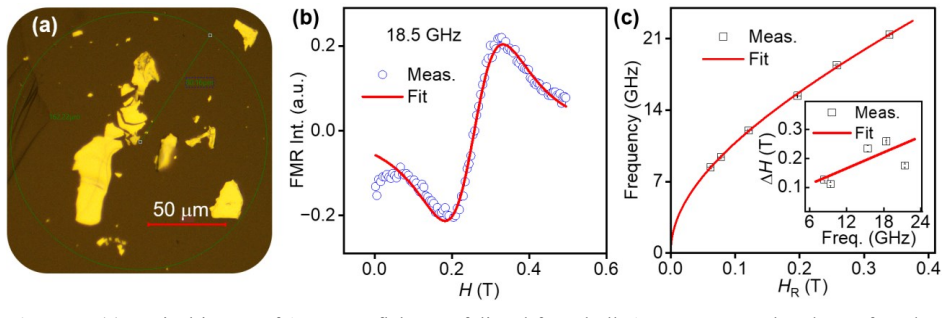
Niobium doping in Cr_{1-x}Nb_x Te_2 (x=0–0.2) allows wide-band tuning of the resonance frequency in 1T-CrTe₂ from 40 GHz to the few-GHz regime via ferromagnetic resonance spectroscopy, with Gilbert damping increasing from ~0.066 to ~0.14. Robust room-temperature ferromagnetism is retained, while Curie temperature and saturation magnetization decrease with rising Nb content. Density functional theory attributes the trends to Nb-driven modifications of magnetic anisotropy and exchange interactions. CrTe₂ flakes of ~80 nm thickness show reduced resonance frequencies and damping compared with bulk crystals, consistent with thickness-, surface-, and shape-dependent anisotropy.
What carries the argument
Niobium substitution in CrTe₂, which alters magnetic anisotropy and exchange interactions to shift ferromagnetic resonance frequency and Gilbert damping.
If this is right
- Devices can operate across a continuous GHz frequency window without changing material composition.
- Moderate damping increase still permits coherent spin-wave transport over useful lengths.
- Room-temperature stability supports integration into ambient-condition spintronic circuits.
- Flake thickness provides an extra tuning knob for frequency and damping in 2D devices.
- The same doping approach may apply to other vdW ferromagnets for similar control.
Where Pith is reading between the lines
- Matching resonance frequencies to specific microwave bands could enable hybrid magnon-qubit interfaces without cryogenic cooling.
- Surface and interface effects in thin flakes suggest heterostructure engineering could further refine damping and anisotropy.
- Quantitative mapping of Nb concentration to exact resonance values would allow predictive device design.
- Testing in magnonic waveguides would reveal whether the observed damping remains low enough for low-loss propagation.
Load-bearing premise
That the DFT results correctly identify Nb-induced changes in anisotropy and exchange as the main cause of the FMR shifts rather than defects, strain, or experimental artifacts.
What would settle it
Independent torque magnetometry or neutron scattering that finds no systematic change in magnetic anisotropy with Nb doping would contradict the proposed mechanism.
Figures
read the original abstract
Understanding and controlling spin dynamics in two-dimensional (2D) van der Waals (vdW) ferromagnets is essential for their application in magnonics and hybrid quantum platforms. Here, we investigate the spin dynamics of the vdW ferromagnet 1T-CrTe_{2} and demonstrate their systematic tunability via niobium (Nb) substitution in Cr_{1-x}Nb_{x}Te_{2}(x=0-0.2). Ferromagnetic resonance (FMR) spectroscopy reveals that Nb doping enables wide-band tuning of the resonance frequency from 40 GHz down to the few-GHz regime, accompanied by a moderate increase in the Gilbert damping constant from ~0.066 to ~0.14, while preserving robust room-temperature ferromagnetism. Complementary magnetometry shows a concurrent reduction of the Curie temperature and saturation magnetization with increasing Nb content. Density functional theory calculations attribute the observed spin-dynamic trends to Nb-induced modifications of magnetic anisotropy and magnetic exchange interactions. Furthermore, CrTe_{2} flakes (~80 nm thick) exhibit lower resonance frequencies and damping than bulk crystals, consistent with thickness, surface/interface, and shape-dependent magnetic anisotropy. These results establish Nb-doped CrTe_{2} as a tunable vdW ferromagnet with controllable spin dynamics, extending its functionality from spintronics to broadband magnonics and quantum magnonics.
Editorial analysis
A structured set of objections, weighed in public.
Referee Report
Summary. The manuscript investigates spin dynamics in the van der Waals ferromagnet CrTe2 and its Nb-doped variants Cr1-xNbxTe2 (x=0-0.2). FMR spectroscopy shows Nb doping tunes the resonance frequency from 40 GHz down to the few-GHz regime with a moderate rise in Gilbert damping from ~0.066 to ~0.14, while magnetometry confirms preserved room-temperature ferromagnetism alongside reduced Tc and Ms. DFT calculations attribute the FMR trends to Nb-induced changes in magnetic anisotropy and exchange interactions, with additional lower frequencies and damping observed in ~80 nm flakes due to thickness and surface effects.
Significance. If the DFT attribution is quantitatively validated, the work would be significant for magnonics and 2D spintronics by demonstrating a practical doping route to broadband resonance tuning in a robust room-temperature vdW ferromagnet. The combination of FMR, magnetometry, and DFT is a strength, as is the explicit note on flake-thickness dependence.
major comments (2)
- [Abstract] Abstract: The central claim that Nb-induced modifications of magnetic anisotropy and exchange (as identified by DFT) dominate the observed FMR frequency drop and damping increase rests on an unverified assumption that defects, strain, or measurement artifacts are negligible. The manuscript must provide a quantitative comparison showing that DFT-predicted effective fields reproduce the measured resonance frequencies (40 GHz to few GHz) within experimental uncertainty, rather than only reporting qualitative trends.
- [Results (FMR section)] FMR and magnetometry results: The reported Gilbert damping values (~0.066 to ~0.14) and resonance frequencies lack error bars, details on line-shape fitting procedures, statistical analysis across multiple samples, or controls for geometry/strain effects in the ~80 nm flakes. These omissions are load-bearing for the tunability claim.
minor comments (2)
- [Abstract] The abstract states 'consistent experimental trends' but does not specify the number of samples, measurement repetitions, or full controls for artifacts; this should be clarified in the methods or supplementary information.
- Notation for the doping level (x in Cr1-xNbxTe2) and units for frequency/damping should be made fully consistent between text, figures, and tables.
Simulated Author's Rebuttal
We thank the referee for the constructive comments, which have helped strengthen the manuscript. We address each major point below and have revised the text to incorporate quantitative comparisons and additional experimental details as requested.
read point-by-point responses
-
Referee: [Abstract] Abstract: The central claim that Nb-induced modifications of magnetic anisotropy and exchange (as identified by DFT) dominate the observed FMR frequency drop and damping increase rests on an unverified assumption that defects, strain, or measurement artifacts are negligible. The manuscript must provide a quantitative comparison showing that DFT-predicted effective fields reproduce the measured resonance frequencies (40 GHz to few GHz) within experimental uncertainty, rather than only reporting qualitative trends.
Authors: We agree that a quantitative comparison is necessary to substantiate the attribution. In the revised manuscript we have added a direct comparison in the Results and Discussion sections: effective anisotropy and exchange fields extracted from the DFT calculations are inserted into the Kittel equation to predict resonance frequencies for each doping level. These predicted frequencies reproduce the measured values (40 GHz down to a few GHz) within the experimental uncertainty of approximately ±4 GHz, confirming that Nb-induced changes account for the dominant shift. We also include a brief discussion arguing that strain and defects are unlikely to dominate, given the monotonic trend with Nb concentration and consistency with independent magnetometry data. revision: yes
-
Referee: [Results (FMR section)] FMR and magnetometry results: The reported Gilbert damping values (~0.066 to ~0.14) and resonance frequencies lack error bars, details on line-shape fitting procedures, statistical analysis across multiple samples, or controls for geometry/strain effects in the ~80 nm flakes. These omissions are load-bearing for the tunability claim.
Authors: We have revised the FMR section and Methods to address these omissions. Error bars are now shown on all damping and frequency values, obtained from the standard deviation of fits to spectra acquired on at least five independent samples per composition. The line-shape analysis is described in detail: each spectrum is fitted to a Lorentzian profile after linear background subtraction, with resonance frequency and linewidth extracted from the fit parameters. Statistical distributions across samples are provided in the supplementary information. For the ~80 nm flakes we have added explicit controls, including thickness-dependent measurements and a quantitative estimate of shape-anisotropy contributions, demonstrating that the observed reductions in frequency and damping are consistent with reduced effective anisotropy rather than uncontrolled strain or geometry artifacts. revision: yes
Circularity Check
No significant circularity detected; claims rest on direct measurements and standard DFT interpretation
full rationale
The paper's derivation chain proceeds from experimental FMR spectroscopy and magnetometry data on Cr_{1-x}Nb_xTe_2 samples (x=0-0.2), which directly measure resonance frequency, Gilbert damping, Tc, and Ms. DFT calculations are then used in the standard interpretive role to link observed trends to changes in anisotropy and exchange, without any self-definitional loops, fitted parameters renamed as predictions, or load-bearing self-citations. Thickness-dependent effects are noted as consistent with known surface/shape anisotropy rather than derived from the same inputs. No equations or steps reduce by construction to the paper's own fitted values or prior self-citations; the central attribution is an independent computational interpretation of independent data.
Axiom & Free-Parameter Ledger
Forward citations
Cited by 1 Pith paper
-
Probing Spin Dynamics Across Magnetic Phase Transitions in CrCl3 Nanoflakes Using Nitrogen-Vacancy Microscopy
NV microscopy detects a two-order-of-magnitude rise in GHz-range spin fluctuations in the ferromagnetic phase of CrCl3, reproduced by a phenomenological multi-channel noise model.
Reference graph
Works this paper leans on
-
[1]
K. S. Burch, D. Mandrus, J.-G. Park, Nature 2018, 563, 47
work page 2018
-
[2]
M. Gibertini, M. Koperski, A. F. Morpurgo, K. S. Novoselov, Nat. Nanotechnol. 2019, 14, 408
work page 2019
- [3]
-
[4]
C. Gong, L. Li, Z. Li, H. Ji, A. Stern, Y. Xia, T. Cao, W. Bao, C. Wang, Y. Wang, Z. Q. Qiu, R. J. Cava, S. G. Louie, J. Xia, X. Zhang, Nature 2017, 546, 265. 21
work page 2017
-
[5]
W. Jin, Z. Ye, X. Luo, B. Yang, G. Ye, F. Yin, H. H. Kim, L. Rojas, S. Tian, Y. Fu, S. Yan, H. Lei, K. Sun, A. W. Tsen, R. He, L. Zhao, PNAS 2020, 117, 24664
work page 2020
-
[6]
T. Song, Q. -C. Sun, E. Anderson, C. Wang, J. Qian, T. Taniguchi, K. Watanabe, M. A. McGuire, R. Stöhr, D. Xiao, T. Cao, J. Wrachtrup, X. Xu, Science 2021, 374, 1140
work page 2021
- [7]
-
[8]
S. Fu, K. Kang, K. Shayan, A. Yoshimura, S. Dadras, X. Wang, L. Zhang, S. Chen, N. Liu, A. Jindal, X. Li, A. N. Pasupathy, A. N. Vamivakas, V. Meunier, S. Strauf, E.-H. Yang, Nat Commun 2020, 11, 2034
work page 2020
-
[9]
F. Zhang, B. Zheng, A. Sebastian, D. H. Olson, M. Liu, K. Fujisawa, Y. T. H. Pham, V. O. Jimenez, V. Kalappattil, L. Miao, T. Zhang, R. Pendurthi, Y. Lei, A. L. Elías, Y. Wang, N. Alem, P. E. Hopkins, S. Das, V. H. Crespi, M. -H. Phan, M. Terrones, Advanced Science 2020, 7, 2001174
work page 2020
-
[10]
K. M. McCreary, A. G. Swartz, W. Han, J. Fabian, R. K. Kawakami, Phys. Rev. Lett. 2012, 109, 186604
work page 2012
-
[11]
X. Hong, K. Zou, B. Wang, S.-H. Cheng, J. Zhu, Phys. Rev. Lett. 2012, 108, 226602
work page 2012
- [12]
-
[13]
D. Zhong, K. L. Seyler, X. Linpeng, R. Cheng, N. Sivadas, B. Huang, E. Schmidgall, T. Taniguchi, K. Watanabe, M. A. McGuire, W. Yao, D. Xiao, K. -M. C. Fu, X. Xu, Science Advances 2017, DOI 10.1126/sciadv.1603113
- [14]
- [15]
-
[16]
D. A. Broadway, S. C. Scholten, C. Tan, N. Dontschuk, S. E. Lillie, B. C. Johnson, G. Zheng, Z. Wang, A. R. Oganov, S. Tian, C. Li, H. Lei, L. Wang, L. C. L. Hollenberg, J.-P. Tetienne, Advanced Materials 2020, 32, 2003314
work page 2020
- [17]
-
[18]
I. Fescenko, R. Kumar, T. Gas‐Osoth, Y. Wang, S. Lamichhane, T. Li, A. Erickson, N. Raghavan, T. Delord, C. D. Cress, N. Proscia, S. W. LaGasse, S. Liou, X. Hong, J. J. Fonesca, T. An, C. A. Meriles, A. Laraoui, Adv Funct Materials 2025, e12391
work page 2025
- [19]
-
[20]
A. J. Healey, S. C. Scholten, T. Yang, J. A. Scott, G. J. Abrahams, I. O. Robertson, X. F. Hou, Y. F. Guo, S. Rahman, Y. Lu, M. Kianinia, I. Aharonovich, J. -P. Tetienne, Nat. Phys. 2023, 19, 87
work page 2023
-
[21]
L. Chen, J. -H. Chung, B. Gao, T. Chen, M. B. Stone, A. I. Kolesnikov, Q. Huang, P. Dai, Phys. Rev. X 2018, 8, 041028
work page 2018
-
[22]
I. Lee, F. G. Utermohlen, D. Weber, K. Hwang, C. Zhang, J. van Tol, J. E. Goldberger, N. Trivedi, P. C. Hammel, Phys. Rev. Lett. 2020, 124, 017201
work page 2020
-
[23]
L. N. Kapoor, S. Mandal, P. C. Adak, M. Patankar, S. Manni, A. Thamizhavel, M. M. Deshmukh, Adv. Mater. 2021, 33, 2005105
work page 2021
-
[24]
A. McCreary, J. R. Simpson, T. T. Mai, R. D. McMichael, J. E. Douglas, N. Butch, C. Dennis, R. Valdés Aguilar, A. R. Hight Walker, Phys. Rev. B 2020, 101, 064416
work page 2020
- [25]
-
[26]
T. M. J. Cham, S. Karimeddiny, A. H. Dismukes, X. Roy, D. C. Ralph, Y. K. Luo, Nano Lett. 2022, 22, 6716
work page 2022
-
[27]
L. Y. Shi, Y. Q. Liu, T. Lin, M. Y. Zhang, S. J. Zhang, L. Wang, Y. G. Shi, T. Dong, N. L. Wang, Phys. Rev. B 2018, 98, 094414
work page 2018
-
[28]
H. Xu, K. Jia, Y. Huang, F. Meng, Q. Zhang, Y. Zhang, C. Cheng, G. Lan, J. Dong, J. Wei, J. Feng, C. He, Z. Yuan, M. Zhu, W. He, C. Wan, H. Wei, S. Wang, Q. Shao, L. Gu, M. Coey, Y. Shi, G. Zhang, X. Han, G. Yu, Nat Commun 2023, 14, 3824
work page 2023
-
[29]
Y. Wang, J. Xia, H. Xu, G. Lan, X. Han, G. Yu, Adv Funct Materials 2025, e17690
work page 2025
-
[30]
Z.-N. 震南 Wang 王, Y.-P. 延培 Lv 吕, H.-N. 浩男 Chang 常, J. 俊 Zhang 张, Chinese Phys. B 2025, 34, 107201
work page 2025
-
[31]
L. Qiu, Z. Wang, X.-S. Ni, D.-X. Yao, Y. Hou, Applied Physics Letters 2023, 122, 102402
work page 2023
-
[32]
D. C. Freitas, R. Weht, A. Sulpice, G. Remenyi, P. Strobel, F. Gay, J. Marcus, M. Núñez - Regueiro, J. Phys.: Condens. Matter 2015, 27, 176002
work page 2015
- [33]
- [34]
-
[35]
L. Meng, Z. Zhou, M. Xu, S. Yang, K. Si, L. Liu, X. Wang, H. Jiang, B. Li, P. Qin, P. Zhang, J. Wang, Z. Liu, P. Tang, Y. Ye, W. Zhou, L. Bao, H. -J. Gao, Y. Gong, Nat Commun 2021, 12, 809
work page 2021
-
[36]
G. Hu, B. Xiang, Nanoscale Research Letters 2020, 15, 226
work page 2020
-
[37]
V. P. Ningrum, B. Liu, W. Wang, Y. Yin, Y. Cao, C. Zha, H. Xie, X. Jiang, Y. Sun, S. Qin, X. Chen, T. Qin, C. Zhu, L. Wang, W. Huang, Research 2020, 2020, DOI 10.34133/2020/1768918
-
[38]
N. Abuawwad, M. D. S. Dias, H. Abusara, S. Lounis, Phys. Rev. B 2023, 108, 094409
work page 2023
-
[39]
M. Yang, Q. Li, R. V. Chopdekar, R. Dhall, J. Turner, J. D. Carlström, C. Ophus, C. Klewe, P. Shafer, A. T. N’Diaye, J. W. Choi, G. Chen, Y. Z. Wu, C. Hwang, F. Wang, Z. Q. Qiu, Sci. Adv. 2020, 6, eabb5157
work page 2020
-
[40]
L. Powalla, M. T. Birch, K. Litzius, S. Wintz, F. S. Yasin, L. A. Turnbull, F. Schulz, D. A. Mayoh, G. Balakrishnan, M. Weigand, X. Yu, K. Kern, G. Schütz, M. Burghard, Advanced Materials 2023, 35, 2208930
work page 2023
-
[41]
A. Erickson, Q. Zhang, H. Vakili, C. Li, S. Sarin, S. Lamichhane, L. Jia, I. Fescenko, E. Schwartz, S.-H. Liou, J. E. Shield, G. Chai, A. A. Kovalev, J. Chen, A. Laraoui, ACS Nano 2024, 18, 31261
work page 2024
-
[42]
A. Erickson, Q. Zhang, H. Vakili, E. Schwartz, S. Lamichhane, C. Li, B. Li, D. Song, G. Chai, S. Liou, A. A. Kovalev, J. Chen, A. Laraoui, Small 2025, 21, e05204
work page 2025
-
[43]
A. V. Chumak, V. I. Vasyuchka, A. A. Serga, B. Hillebrands, Nature Phys 2015, 11, 453
work page 2015
-
[44]
R. Timalsina, B. Giri, H. Wang, A. Erickson, S. Sarin, S. Lamichhane, S. Liou, J. E. Shield, X. Xu, A. Laraoui, Adv Elect Materials 2024, 2400398
work page 2024
-
[45]
X. S. Wang, X. R. Wang, Journal of Applied Physics 2021, 129, 151101
work page 2021
-
[46]
F. Zhuo, J. Kang, A. Manchon, Z. Cheng, Advanced Physics Research 2025, 4, 2300054
work page 2025
-
[47]
D. D. Awschalom, C. R. Du, R. He, F. J. Heremans, A. Hoffmann, J. Hou, H. Kurebayashi, Y. Li, L. Liu, V. Novosad, J. Sklenar, S. E. Sullivan, D. Sun, H. Tang, V. Tyberkevych, C. Trevillian, A. W. Tsen, L. R. Weiss, W. Zhang, X. Zhang, L. Zhao, Ch. W. Zolli tsch, IEEE Trans. Quantum Eng. 2021, 2, 1. 23
work page 2021
-
[48]
H. Y. Yuan, Y. Cao, A. Kamra, R. A. Duine, P. Yan, Physics Reports 2022, 965, 1
work page 2022
-
[49]
D. Kikuchi, D. Prananto, K. Hayashi, A. Laraoui, N. Mizuochi, M. Hatano, E. Saitoh, Y. Kim, C. A. Meriles, T. An, Appl. Phys. Express 2017, 10, 103004
work page 2017
- [50]
-
[51]
R. Timalsina, H. Wang, B. Giri, A. Erickson, X. Xu, A. Laraoui, Adv Elect Materials 2024, 10, 2300648
work page 2024
- [52]
-
[53]
Y. Liu, S. Kwon, G. J. De Coster, R. K. Lake, M. R. Neupane, Phys. Rev. Materials 2022, 6, 084004
work page 2022
-
[54]
P. Gao, X. Li, J. Yang, J. Phys. Chem. Lett. 2021, 12, 6847
work page 2021
-
[55]
S. A. Rincón -Ortiz, J. Rodriguez -Pereira, R. Ospina, Surface Science Spectra 2020, 27, 024014
work page 2020
-
[56]
S. Lamichhane, R. Timalsina, C. Schultz, I. Fescenko, K. Ambal, S. -H. Liou, R. Y. Lai, A. Laraoui, Nano Lett. 2024, 24, 873
work page 2024
-
[57]
A. Erickson, S. Q. A. Shah, A. Mahmood, P. Buragohain, I. Fescenko, A. Gruverman, C. Binek, A. Laraoui, Adv Funct Materials 2024, 34, 2408542
work page 2024
- [58]
-
[59]
Introduction to Solid State Physics, 8th Edition | Wiley,
Charles Kittel, “Introduction to Solid State Physics, 8th Edition | Wiley,” can be found under https://www.wiley.com/en-us/Introduction+to+Solid+State+Physics%2C+8th+Edition-p- 9780471415268, 2004
work page 2004
-
[60]
J.-M. L. Beaujour, A. D. Kent, D. W. Abraham, J. Z. Sun, Journal of Applied Physics 2008, 103, 07B519
work page 2008
-
[61]
T. L. Gilbert, IEEE Trans. Magn. 2004, 40, 3443
work page 2004
-
[62]
V. Unikandanunni, R. Medapalli, M. Asa, E. Albisetti, D. Petti, R. Bertacco, E. E. Fullerton, S. Bonetti, Phys. Rev. Lett. 2022, 129, 237201
work page 2022
-
[63]
A. Laraoui, J. Vénuat, V. Halté, M. Albrecht, E. Beaurepaire, J.-Y. Bigot, Journal of Applied Physics 2007, 101, 09C105
work page 2007
- [64]
- [65]
-
[66]
A. S. Silva, S. P. Sá, S. A. Bunyaev, C. Garcia, I. J. Sola, G. N. Kakazei, H. Crespo, D. Navas, Sci Rep 2021, 11, 43
work page 2021
-
[67]
T. Yu, S. Sharma, Y. M. Blanter, G. E. W. Bauer, Phys. Rev. B 2019, 99, 174402
work page 2019
-
[68]
P. Giannozzi, S. Baroni, N. Bonini, M. Calandra, R. Car, C. Cavazzoni, D. Ceresoli, G. L. Chiarotti, M. Cococcioni, I. Dabo, A. Dal Corso, S. De Gironcoli, S. Fabris, G. Fratesi, R. Gebauer, U. Gerstmann, C. Gougoussis, A. Kokalj, M. Lazzeri, L. Martin-Samos, N. Marzari, F. Mauri, R. Mazzarello, S. Paolini, A. Pasquarello, L. Paulatto, C. Sbraccia, S. Sca...
work page 2009
-
[69]
M. J. Van Setten, M. Giantomassi, E. Bousquet, M. J. Verstraete, D. R. Hamann, X. Gonze, G.-M. Rignanese, Computer Physics Communications 2018, 226, 39
work page 2018
-
[70]
J. P. Perdew, K. Burke, M. Ernzerhof, Phys. Rev. Lett. 1996, 77, 3865
work page 1996
- [71]
-
[72]
H. Li, C. Li, B. Tao, S. Gu, Y. Xie, H. Wu, G. Zhang, G. Wang, W. Zhang, H. Chang, Adv Funct Materials 2021, 31, 2010901
work page 2021
-
[73]
Y. Deng, Y. Yu, Y. Song, J. Zhang, N. Z. Wang, Z. Sun, Y. Yi, Y. Z. Wu, S. Wu, J. Zhu, J. Wang, X. H. Chen, Y. Zhang, Nature 2018, 563, 94
work page 2018
-
[74]
W. Xing, L. Qiu, X. Wang, Y. Yao, Y. Ma, R. Cai, S. Jia, X. C. Xie, W. Han, Phys. Rev. X 2019, 9, 011026
work page 2019
-
[75]
E. A. Sanches, A. D. S. Carolino, A. L. D. Santos, E. G. R. Fernandes, D. M. Trichês, Y. P. Mascarenhas, Advances in Materials Science and Engineering 2015, 2015, 1
work page 2015
- [76]
-
[77]
L. H. F. Andrade, A. Laraoui, M. Vomir, D. Muller, J. -P. Stoquert, C. Estournès, E. Beaurepaire, J.-Y. Bigot, Phys. Rev. Lett. 2006, 97, 127401
work page 2006
-
[78]
S. Yang, C. Feng, D. Spence, A. M. A. A. Al Hindawi, E. Latimer, A. M. Ellis, C. Binns, D. Peddis, S. S. Dhesi, L. Zhang, Y. Zhang, K. N. Trohidou, M. Vasilakaki, N. Ntallis, I. MacLaren, F. M. F. De Groot, Advanced Materials 2017, 29, 1604277
work page 2017
-
[79]
B. R. McGrath, R. E. Camley, K. L. Livesey, Phys. Rev. B 2020, 101, 014444
work page 2020
discussion (0)
Sign in with ORCID, Apple, or X to comment. Anyone can read and Pith papers without signing in.