Entanglement complexity of spanning pairs of lattice polygons
Pith reviewed 2026-05-16 13:44 UTC · model grok-4.3
The pith
All but exponentially few large spanning pairs of lattice polygons have entanglement complexity that grows at least linearly with size.
A machine-rendered reading of the paper's core claim, the machinery that carries it, and where it could break.
Core claim
Good measures of knot complexity extend via tangle products to good measures F of spanning-link complexity for k-component links. For any such F, all but exponentially few size-m 2SAPs satisfy that F grows at least linearly in m as m tends to infinity. Classical link invariants including bridge number and splitting number yield good measures under the given definition.
What carries the argument
The good measure F of spanning-link complexity, constructed from tangle products that combine knot components while preserving monotonicity under increasing knot complexity.
If this is right
- More complex prime knot factors on either component strictly raise the F value of the 2SAP.
- Any good measure of knot complexity automatically supplies a good measure of spanning-link complexity.
- Invariants such as bridge number and splitting number become good measures for 2SAPs.
- Certain two-component links appear as 2SAPs only when at least one component is forced into a non-minimal bridge-number embedding.
- Tube cross-section dimensions determine both the embeddable link types and the geometric constraints on their possible F values.
Where Pith is reading between the lines
- The linear lower bound on F supplies a concrete rate at which entanglement accumulates in confined two-ring polymer models beyond the mere fact of linking.
- Numerical sampling of 2SAPs for moderate m could test whether the exponential decay of low-F examples already appears at accessible sizes.
- The same tangle-product technique may apply directly to spanning links with three or more components once suitable lattice models are defined.
Load-bearing premise
The tangle-product construction that turns good knot measures into good spanning-link measures preserves the required increasing properties with respect to component knot complexity.
What would settle it
An explicit enumeration or Monte-Carlo sampling for successively larger m that finds a positive-density subset of 2SAPs whose F remains bounded by a fixed constant.
Figures


read the original abstract
We study the entanglement complexity of a system consisting of two simple-closed curves (self-avoiding polygons) that span a lattice tube, referred to as a 2SAP. 2SAPs are of interest as the first known model of confined ring polymers where the linking probability goes to 1 exponentially with the size of the system. Atapour et al proved this in 2010 by showing that all but exponentially few sufficiently large 2SAPs contain a pattern that guarantees the 2SAP is non-split, provided that the requisite pattern fits in the tube. This result was recently extended to all tubes sizes that admit non-trivial links. Here we develop and apply knot theory results to answer more general questions about the entanglement complexity of 2SAPs. We first extend the 1992 concept of a good measure of knot complexity to a good measure, $F$, of spanning-link complexity for $k$-component links. Using tangle products, we show, for example, that the more complex the prime knot decomposition of any component of a given link type, the greater its $F$-measure. We then prove that all but exponentially few size $m$ 2SAPs have $F$ complexity that grows at least linearly in $m$ as $m\to \infty$. We establish that good measures of knot complexity yield good measures of spanning-link complexity. We also establish conditions whereby more general link invariants can yield good measures. In particular, we establish that measures based on several classical invariants are good measures by our definition, eg bridge number or the splitting number. Finally, we consider how the tube dimensions affect which links are embeddable as 2SAPs as well as geometric restrictions on the entanglement complexity of the embeddings. For example, we establish that there are two-component links that occur as 2SAPs in a given tube size only when one of the components is forced into a non-minimal bridge number conformation.
Editorial analysis
A structured set of objections, weighed in public.
Referee Report
Summary. The paper extends the 1992 notion of a good measure of knot complexity to a good measure F of spanning-link complexity for k-component links, using tangle products to establish monotonicity under prime-factor insertion. It then proves that all but exponentially few size-m 2SAPs have F growing at least linearly in m as m→∞, building on Atapour et al.'s pattern-counting argument for non-split links. Additional results characterize which links embed as 2SAPs in a given tube and identify geometric restrictions (e.g., forced non-minimal bridge number).
Significance. If the linear-growth theorem is rigorous, the work supplies a quantitative, asymptotically linear measure of entanglement complexity for confined polymer models, strengthening the 2010 linking-probability result. The tangle-product framework and verification that classical invariants (bridge number, splitting number) are good measures provide reusable tools for link complexity under confinement.
major comments (2)
- [Tangle-product extension and main asymptotic theorem] The extension of good measures via tangle products (the step that converts knot-complexity monotonicity into link-complexity additivity) does not explicitly verify that multiple inserted patterns remain additively independent once embedded under the global spanning and self-avoidance constraints of the tube; geometric interactions such as shared arcs could produce sublinear total F, directly undermining the Θ(m) lower bound obtained from the pattern-counting argument.
- [Main theorem on linear growth of F] When the paper invokes Atapour et al. to guarantee Θ(m) pattern insertions with high probability, it assumes the chosen invariant (e.g., bridge number) remains strictly additive after each insertion inside the tube; no separate argument rules out forced cancellations or minimal-conformation constraints that would cap the cumulative contribution below linear.
minor comments (2)
- [Abstract] The abstract uses 'eg' instead of 'e.g.' and should list the specific invariants shown to be good measures rather than giving examples in passing.
- [Definitions section] Notation for the spanning-link measure F is introduced without an explicit comparison table to the original 1992 knot measure; a short table would clarify which axioms are preserved.
Simulated Author's Rebuttal
We thank the referee for their careful reading and insightful comments, which help clarify the presentation of our tangle-product framework and the asymptotic result. We respond point by point to the major comments below, indicating revisions that will strengthen the manuscript.
read point-by-point responses
-
Referee: [Tangle-product extension and main asymptotic theorem] The extension of good measures via tangle products (the step that converts knot-complexity monotonicity into link-complexity additivity) does not explicitly verify that multiple inserted patterns remain additively independent once embedded under the global spanning and self-avoidance constraints of the tube; geometric interactions such as shared arcs could produce sublinear total F, directly undermining the Θ(m) lower bound obtained from the pattern-counting argument.
Authors: The tangle-product construction concatenates patterns sequentially along the tube axis in disjoint lattice segments, so that the monotonicity property of F applies independently to each insertion. Self-avoidance and the fixed cross-section of the tube prevent arc-sharing interactions that would reduce the total measure. We acknowledge that an explicit independence argument would improve clarity. We will add a short lemma in the revised manuscript proving that multiple disjoint pattern insertions yield strictly additive contributions to F for any good measure under the 2SAP embedding constraints. revision: yes
-
Referee: [Main theorem on linear growth of F] When the paper invokes Atapour et al. to guarantee Θ(m) pattern insertions with high probability, it assumes the chosen invariant (e.g., bridge number) remains strictly additive after each insertion inside the tube; no separate argument rules out forced cancellations or minimal-conformation constraints that would cap the cumulative contribution below linear.
Authors: By definition, a good measure F increases monotonically with each prime-factor insertion via the tangle product and admits no cancellations. Atapour et al. supply the high-probability count of Θ(m) embeddable non-trivial patterns; our extension then directly yields the linear lower bound on F. Tube geometry is already incorporated in the pattern-selection step, which excludes conformations that would force a reduction in the invariant. We agree a brief clarifying remark would be helpful and will insert one (or a short proof for bridge number and splitting number) in the revision. revision: yes
Circularity Check
Derivation self-contained; no reduction to inputs by construction
full rationale
The paper defines a new extension F of good measures to spanning links via tangle-product constructions, proves monotonicity under prime insertions as a fresh result, and combines it with the external 2010 pattern-counting argument to obtain the linear lower bound on F for most 2SAPs. No equation or step equates the target asymptotic to a fitted parameter, self-definition, or unverified self-citation chain; the central claim rests on independent monotonicity and probability arguments that do not presuppose the linear growth.
Axiom & Free-Parameter Ledger
axioms (3)
- standard math The 1992 definition of good measures of knot complexity
- standard math Properties of tangle products in knot theory
- domain assumption Results from Atapour et al. (2010) on non-split 2SAPs
invented entities (1)
-
Good measure F of spanning-link complexity
no independent evidence
Forward citations
Cited by 1 Pith paper
-
A central limit theorem for the signatures of 2-bridge knots
A closed formula for the number of 2-bridge knots of crossing number c and signature σ is given, from which the signatures are shown to converge in distribution to a normal law as c tends to infinity.
Reference graph
Works this paper leans on
-
[1]
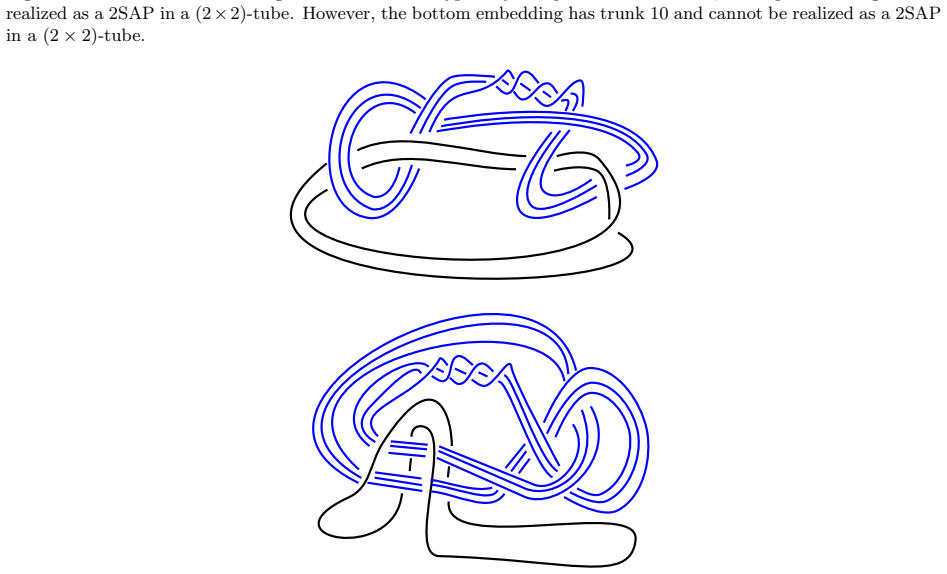
C. C. Adams.The knot book: an elementary introduction to the mathematical theory of knots. American Mathematical Soc., 2004. 22 Figure 18: Two morse embeddings of the same link type. By the proof of Theorem 7, the top embedding can be realized as a 2SAP in a (2×2)-tube. However, the bottom embedding has trunk 10 and cannot be realized as a 2SAP in a (2×2)...
work page 2004
-
[2]
The linking probability for 2-component links which span a lattice tube
M. Atapour, C. Soteros, C. Ernst, and S. Whittington. “The linking probability for 2-component links which span a lattice tube”. In:Journal of Knot Theory and Its Ramifications19.01 (2010), pp. 27–54
work page 2010
-
[3]
The linking probability for 2-component links which span a lattice tube
M. Atapour, C. E. Soteros, C. Ernst, and S. G. Whittington. “The linking probability for 2-component links which span a lattice tube”. In:J. Knot Theory Ramifications19.01 (2010), pp. 27–54.doi: 10.1142/s0218216510007760
-
[4]
Topological Entanglement Complexity of Systems of Polygons and Walks in Tubes
M. Atapour. “Topological Entanglement Complexity of Systems of Polygons and Walks in Tubes”. PhD thesis. Saskatoon, Canada: University of Saskatchewan, 2008
work page 2008
-
[5]
N. R. Beaton, J. W. Eng, and C. E. Soteros. “Knotting statistics for polygons in lattice tubes”. In: Journal of Physics A: Mathematical and Theoretical52.14 (2019), p. 144003.doi:10.1088/1751- 8121/ab0981
-
[6]
Characterising knotting properties of polymers in nanochannels
N. R. Beaton, J. W. Eng, K. Ishihara, K. Shimokawa, and C. E. Soteros. “Characterising knotting properties of polymers in nanochannels”. In:Soft matter14.28 (2018), pp. 5775–5785
work page 2018
-
[7]
Bridge number and tangle products
R. Blair. “Bridge number and tangle products”. In:Algebraic & Geometric Topology13.2 (2013), pp. 1125–1141
work page 2013
-
[8]
Bridge number and Conway products
R. C. Blair. “Bridge number and Conway products”. In:Algebraic & Geometric Topology10.2 (2010), pp. 789–823
work page 2010
-
[9]
P. R. Cromwell.Knots and links. Cambridge university press, 2004
work page 2004
-
[10]
Mathematical problems in the biological sciences
M. Delbruck. “Mathematical problems in the biological sciences”. In:Proc. Symp. Appl. Math.Vol. 14. 1962, p. 55
work page 1962
-
[11]
M. Eisermann. “Knot colouring polynomials”. In:Pacific Journal of Mathematics231.2 (2007), pp. 305– 336
work page 2007
-
[12]
Link statistics for pairs of polygons spanning a tube or nano-channel
J. Eng, P. Pongtanapaisan, R. Scharein, and C. Soteros. “Link statistics for pairs of polygons spanning a tube or nano-channel”. In:In preparation(2025)
work page 2025
-
[13]
A quick trip through knot theory
R. H. Fox. “A quick trip through knot theory”. In:Topology of 3-manifolds and related topics(1962), pp. 120–167
work page 1962
-
[14]
S. Friedl, M. Nagel, and M. Powell. “A specious unlinking strategy”. In:Periodica Mathematica Hun- garica69.2 (2014), pp. 207–210
work page 2014
-
[15]
H. L. Frisch and E. Wasserman. “Chemical topology”. In:Journal of the American Chemical Society 83.18 (1961), pp. 3789–3795
work page 1961
-
[16]
Bounds for the minimum step number of knots confined to slabs in the simple cubic lattice
K. Ishihara, R. Scharein, Y. Diao, J. Arsuaga, M. Vazquez, and K. Shimokawa. “Bounds for the minimum step number of knots confined to slabs in the simple cubic lattice”. In:Journal of Physics A: Mathematical and Theoretical45.6 (Jan. 2012), p. 065003.doi:10.1088/1751-8113/45/6/065003. url:https://doi.org/10.1088/1751-8113/45/6/065003
-
[17]
Bounds for minimum step number of knots confined to tubes in the simple cubic lattice
K. Ishihara, M. Pouokam, A. Suzuki, R. Scharein, M. Vazquez, J. Arsuaga, and K. Shimokawa. “Bounds for minimum step number of knots confined to tubes in the simple cubic lattice”. In:Journal of Physics A: Mathematical and Theoretical50.21 (2017), p. 215601
work page 2017
-
[18]
E. J. Janse van Rensburg and A. Rechnitzer. “Minimal knotted polygons in cubic lattices”. In:Journal of Statistical Mechanics: Theory and Experiment2011.09 (2011), P09008.doi:10.1088/1742-5468/ 2011/09/p09008
-
[19]
Geometric realisation of relation modules over asp herical groups
H. Kim. “Minimum lattice length of 2-bridge knots and links”. In:Topology and its Applications 371 (2025). Special issue dedicated to Iberoamerican and Pan Pacific International Conference on Topology and its Applications. Benem´ erita Universidad Aut´ onoma de Puebla, Ciudad de Puebla, M´ exico, September 2023., p. 109353.issn: 0166-8641.doi:https://doi....
-
[20]
A new bridge index for links with trivial knot components
Y. Kodani. “A new bridge index for links with trivial knot components”. In:Mathematical Proceedings of the Cambridge Philosophical Society. Vol. 154. 2. Cambridge University Press. 2013, pp. 279–286. 24
work page 2013
-
[21]
A pattern theorem for lattice clusters
N. Madras. “A pattern theorem for lattice clusters”. In:Annals of Combinatorics3.2 (1999), pp. 357– 384.doi:10.1007/BF01608793
-
[22]
J. W. Milnor.Morse theory. 51. Princeton university press, 1963
work page 1963
-
[23]
Random linking of lattice polygons
E. Orlandini, E. J. Van Rensburg, M. Tesi, and S. Whittington. “Random linking of lattice polygons”. In:Journal of Physics A: Mathematical and General27.2 (1994), p. 335
work page 1994
-
[24]
M. Ozawa. “Waist and trunk of knots”. In:Geometriae Dedicata149.1 (2010), pp. 85–94
work page 2010
-
[25]
N. Pippenger. “Knots in random walks”. In:Discrete Applied Mathematics25.3 (1989), pp. 273–278. doi:10.1016/0166-218x(89)90005-x
-
[26]
Bounds for the minimum step number of knots in the simple cubic lattice
R. Scharein, K. Ishihara, J. Arsuaga, Y. Diao, K. Shimokawa, and M. Vazquez. “Bounds for the minimum step number of knots in the simple cubic lattice”. In:Journal of Physics A: Mathematical and Theoretical42.47 (Nov. 2009), p. 475006.doi:10.1088/1751-8113/42/47/475006.url:https: //doi.org/10.1088/1751-8113/42/47/475006
work page doi:10.1088/1751-8113/42/47/475006.url:https: 2009
-
[27]
Knots in graphs in subsets ofZ 3
C. E. Soteros. “Knots in graphs in subsets ofZ 3”. In:Topology and Geometry in Polymer Science (Minneapolis, MN, 1996). Vol. 103. IMA Vol. Math. Appl. Springer, New York, 1998, pp. 101–133. doi:10.1007/978-1-4612-1712-1\_10
-
[28]
Entanglement complexity of graphs in Z3
C. E. Soteros, D. W. Sumners, and S. G. Whittington. “Entanglement complexity of graphs in Z3”. In:Mathematical Proceedings of the Cambridge Philosophical Society111.1 (1992), pp. 75–91.doi: 10.1017/s0305004100075174
-
[29]
J. M. Steele.Probability theory and combinatorial optimization. SIAM, 1997
work page 1997
-
[30]
Pore translocation of knotted DNA rings
A. Suma and C. Micheletti. “Pore translocation of knotted DNA rings”. In:Proceedings of the National Academy of Sciences114.15 (2017), E2991–E2997.issn: 0027-8424.doi:10.1073/pnas.1701321114
-
[31]
D. Sumners and S. Whittington. “Knots in self-avoiding walks”. In:Journal of Physics A: Mathematical and General21.7 (1988), p. 1689
work page 1988
-
[32]
Topological entanglement complexity of polymer chains in confined geometries
M. C. Tesi, E. J. Van Rensburg, E. Orlandini, and S. G. Whittington. “Topological entanglement complexity of polymer chains in confined geometries”. In:Topology and Geometry in Polymer Science (1998), pp. 135–157. Ryan Blair Department of Mathematics, California State University Long Beach, Long Beach, CA 90840, USA Email: ryan.blair@csulb.edu Puttipong P...
work page 1998
discussion (0)
Sign in with ORCID, Apple, or X to comment. Anyone can read and Pith papers without signing in.