REVIEW 2 major objections 4 minor 1 cited by
This paper shows that for monocular 2D-to-3D human pose lifting, rotation equivariance is best learned by simple data augmentation rather than by architecturally enforced equivariance, yielding lower error on rotated poses and lower computa
Reviewed by Pith at T0; open to challenge. T0 means a machine referee read the full paper against a public rubric. the ladder, T0–T4 →
T0 review · deepseek-v4-flash
2026-08-03 09:21 UTC pith:RLEMPSHA
load-bearing objection Useful empirical comparison and a practical augmentation recipe; the head-to-head with equivariant-by-design models is confounded by architecture and the rotated test reuses the augmentation distribution. the 2 major comments →
On the Role of Rotation Equivariance in Monocular 2D-to-3D Human Pose Lifting
The pith
A machine-rendered reading of the paper's core claim, the machinery that carries it, and where it could break.
Core claim
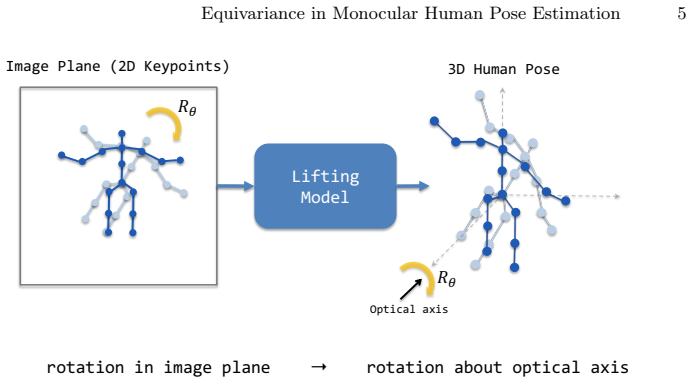
On rotated test sets, the empirical ordering of model families is vanilla+aug > hybrid+aug > fully equivariant > hybrid > vanilla. On rotated Human3.6M, a ResNet baseline trained with rotation augmentation reaches 64.3 mm mean per-joint position error, versus 76.4 mm for the best fully equivariant model, while taking roughly a tenth of the training time. Hybrid models, which make only the xy-outputs equivariant by design and learn depth invariance, sit between the two. The paper's geometric consistency condition — rotating the 2D input by R_theta must rotate the 3D output about the optical axis leaving depth invariant — is the symmetry that augmentation instills, and the paper reads the resu
What carries the argument
The load-bearing object is the geometric consistency condition of Eq. (3): a lifting model f is consistent if f(X R_theta^T) = f(X) diag(R_theta^T, 1), meaning an in-plane rotation of the 2D keypoints rotates the predicted 3D pose about the optical axis while leaving depth invariant. Instead of building this in as a hard architectural constraint, the paper instills it through joint rotation of input 2D poses and output xy-coordinates during training. This augmentation acts as the mechanism that transfers the symmetry into standard non-equivariant networks, and the comparison across vanilla, hybrid, and fully equivariant models — all matched to roughly 3.7–4.4M parameters — is what carries th
Load-bearing premise
The comparison rests on the assumption that the operative symmetry is in-plane rotation with depth invariant and that robustness is correctly measured by test rotations sampled from the same uniform distribution used for augmentation; if real deployments rotate poses differently, the reported gains may shrink or disappear.
What would settle it
Train a vanilla+aug model with rotation angles uniform over [0, 2π), then evaluate it on rotations drawn only from a narrow interval (say 85–95 degrees) or on perspective-distorted rotations about a non-optical axis; if its error rises to, or past, the level of a fully equivariant model, the claim that augmentation learns the correct equivariance fails.
If this is right
- Standard 2D-to-3D lifting models are not rotation-robust; benchmark protocols that include rotated test sets will expose failures that current original-pose evaluations miss.
- Rotation augmentation is a cheap, architecture-agnostic route to rotation robustness that transfers across datasets (Human3.6M to MPII-INF-3DHP) without fine-tuning.
- Fully equivariant architectures, while guaranteeing robustness by design, over-constrain the learned mapping and underperform on both original and rotated data.
- Hybrid designs that enforce xy-equivariance but learn depth invariance approximate the best trade-off, yet still trail plain augmented models.
- The most accurate models (vanilla+aug) are also the fastest to train and run, showing that robustness and efficiency do not trade off in this setting.
Where Pith is reading between the lines
- A sharper test would evaluate on rotations drawn from a distribution different from the augmentation distribution, e.g. a narrow band near 90 degrees or rotations about an off-optical-axis axis; the paper's own remark that the true mapping is only approximately equivariant suggests the gap may close or reverse there.
- The graded ordering suggests augmentation acts as a tunable regularizer: sweeping the rotation-angle range would likely trace a bias-variance curve, with too little augmentation leaving the model un-robust and too much degrading original-pose accuracy.
- The same joint input-output rotation recipe could transfer to other lifted 2D-to-3D tasks — object pose, face reconstruction, hand pose — wherever the output has an axis aligned with the image plane.
- The hybrid ablation, where feeding equivariant features into depth prediction yields no gain, hints that depth is best left unconstrained; an explicit model of how depth transforms under rotation could explain why learned invariance beats hard-wired invariance here.
Editorial analysis
A structured set of objections, weighed in public.
Referee Report
Summary. The paper studies rotation equivariance for 2D-to-3D human pose lifting. It defines a geometric-consistency condition (Eq. 3), then compares vanilla networks (ResNet, PoseFormer), fully equivariant transformers (VN-Transformer, GotenNet), and hybrid models, each with and without rotation augmentation. On Human3.6M and MPII-INF-3DHP, vanilla models degrade sharply on rotated inputs; random in-plane rotation augmentation recovers accuracy and yields the best rotated-test performance (e.g., ResNet+aug 64.3 mm vs. fully equivariant 76.4 mm), while also being faster. The authors conclude that rotation equivariance is most effectively learned by augmentation and that exact equivariance by design is overly restrictive.
Significance. If the main claim held, the paper would be a useful practical result: real-world robustness to in-plane rotations can be obtained by simple augmentation, avoiding special architectures. The authors report reproducible experiments with three seeds, standardized training details, clear tables, and a qualitative evaluation on SportsCap. The computational-efficiency comparison in Table 3 is also relevant. However, the evidence supporting the ranking against equivariant-by-design models is confounded, and the test-time rotation distribution is the same as the augmentation distribution, weakening the out-of-distribution message. The paper's conclusions are therefore stronger than the experiments currently support.
major comments (2)
- [Section 4.4, Table 1] The central claim that 'strictly imposing the equivariance constraint ... harms the task performance' is not supported by the comparisons. The fully equivariant models are 76.4±1.2 / 76.7±1.3 mm on original Human3.6M, while the vanilla ResNet is 62.9±0.2 mm, and the rotated-test gap (ResNet+aug 64.3 vs. VN-Transformer 76.4) is nearly identical to the unrotated-test gap. This shows the selected equivariant backbones are worse 2D-to-3D lifters, not that equivariance hurts. Moreover, Section 4.1 appends a fixed random per-joint z-coordinate to the inputs of these networks, an ad hoc embedding not used for the vanilla models. A controlled comparison with an equivariant version of the same ResNet backbone is required.
- [Section 4.3 (Data augmentation) and Section 4.2 (Rotated test)] Test-time rotations are sampled from the same uniform distribution used for augmentation, so the evaluated robustness is in-distribution for the +aug models. The paper trains the model to minimize error on exactly the rotations it is later tested on; the observed improvement therefore largely reflects fitting the augmentation distribution. Since Section 3 explicitly states that exact equivariance 'may be too restrictive' and the mapping is 'often only approximately rotation-equivariant' in practice, the robustness claim should be tested on other rotation regimes (e.g., narrow angle ranges, off-axis rotations, or combined with perspective distortion) or reported as a function of rotation angle. Without this, the ranking on Rotated sets is partly by construction.
minor comments (4)
- [Section 4.3] Please specify the exact test-rotation procedure: how many random angles per test sample, whether the same angles are used for all models, and whether the rotation is applied to the input and the target (or only the input). Currently 'in the same way' is vague and important for reproducibility.
- [Section 4.4, Table 3 caption] The caption 'The most accurate models (vanilla+aug) have both the shortest training and inference times' is imprecise: ResNet+aug is not the shortest training time overall (ResNet vanilla is 11s vs. 34s), and PoseFormer+aug is 48s. Suggest rephrasing to 'shortest among the accurate models' or similar.
- [Section 2.2, Eq. (1)] The notation in Eq. (1) is inconsistent: the input space is written as X ∈ X ⊆ R^n, but the functions considered take N×2 or N×3 matrices; also the left side uses f(X) while the right side uses f(Rx). Please clean up the notation.
- [Section 5 (Limitations)] The limitations paragraph is very brief and does not mention the same-distribution test set or the repurposed baselines. I recommend adding an explicit discussion of these threats to external validity.
Circularity Check
No significant circularity; external benchmarks anchor the comparison.
full rationale
The paper's central empirical claims are comparisons against external baselines (Martinez ResNet, PoseFormer, VN-Transformer, GotenNet) on standard benchmarks (Human3.6M, MPII-INF-3DHP) under a stated protocol. The augmentation procedure (Section 4.3) applies the same random rotation distribution to training and to the 'Rotated' test sets; this aligns training and evaluation distributions, but the rotated test split is still held out and the +aug models must generalize across subjects and continuous angles, so the result is not a fitted parameter renamed as a prediction. The conclusion that strict equivariance 'harms' performance is weaker than claimed because the fully equivariant baselines are substantially worse on unrotated data (a confound between architecture and equivariance), but this is a validity/correctness concern, not circularity. No load-bearing self-citation or construction by definition is present.
Axiom & Free-Parameter Ledger
free parameters (3)
- rotation augmentation distribution =
theta ~ U[0, 2*pi)
- random input z-coordinate for equivariant networks =
N-dimensional vector sampled once
- PoseFormer temporal depth reduction =
2
axioms (3)
- domain assumption The lifting function should satisfy the equivariance property in Eq. (3): in-plane rotation of input 2D keypoints corresponds to optical-axis rotation of output 3D pose with depth invariant.
- domain assumption Root-aligned and standardized coordinates: ground-truth 3D poses are root-aligned at the origin and input 2D poses are zero-mean/unit-std before rotation, so rotating about the origin corresponds to rotating the skeleton about its root.
- ad hoc to paper Appending a random constant third coordinate to 2D inputs is a valid embedding for measuring SO(2) equivariance of VN-Transformer and GotenNet.
read the original abstract
Estimating 3D from 2D is one of the central tasks in computer vision. In this work, we consider the monocular setting, i.e. single-view input, for 3D human pose estimation (HPE), where the goal is to predict a 3D point set of human skeletal joints from a single 2D image, typically via 2D keypoint detection followed by 2D-to-3D lifting. Despite their success, we find that current lifting models exhibit strong performance degradation under rotations. We address this by considering different approaches to incorporating rotation equivariance, including explicit equivariant architectures and standard models. Utilising common HPE benchmarks, we demonstrate that rotation equivariance can be effectively learned via rotation-based data augmentation applied jointly to input and output poses. This significantly improves robustness to rotations and, in this setting, outperforms methods that are fully equivariant by design, while maintaining a lower computational cost.
Figures



Forward citations
Cited by 1 Pith paper
-
Revisiting Euler-Angle Regression with Kolmogorov-Arnold Networks
Range-constrained Euler angles plus Kolmogorov-Arnold Networks outperform the standard MLP+6D pipeline on rotation regression for articulated systems.
Reference graph
Works this paper leans on
-
[1]
TMLR (2023)
Assaad, S., Downey, C., Al-Rfou, R., Nayakanti, N., Sapp, B.: Vn-transformer: Rotation-equivariant attention for vector neurons. TMLR (2023)
2023
-
[2]
In: ICLR (2025)
Aykent, S., Xia, T.: GotenNet: Rethinking Efficient 3D Equivariant Graph Neural Networks. In: ICLR (2025)
2025
-
[3]
IJCV (Aug 2021)
Chen, X., Pang, A., Yang, W., Ma, Y., Xu, L., Yu, J.: Sportscap: Monocular 3d humanmotion captureandfine-grainedunderstandinginchallengingsportsvideos. IJCV (Aug 2021)
2021
-
[4]
In: CVPR (2020)
Cheng, B., Xiao, B., Wang, J., Shi, H., Huang, T.S., Zhang, L.: Higherhrnet: Scale- aware representation learning for bottom-up human pose estimation. In: CVPR (2020)
2020
-
[5]
In: CVPR (2021)
Deng, C., Litany, O., Duan, Y., Poulenard, A., Tagliasacchi, A., Guibas, L.J.: Vector neurons: A general framework for SO(3)-equivariant networks. In: CVPR (2021)
2021
-
[6]
In: ICCV (2021)
Garau, N., Bisagno, N., Bródka, P., Conci, N.: DECA: Deep viewpoint-Equivariant human pose estimation using Capsule Autoencoders. In: ICCV (2021)
2021
-
[7]
Sensors (Basel, Switzerland)25(8), 2409 (2025)
Guo, Y., Gao, T., Dong, A., Jiang, X., Zhu, Z., Wang, F.: A survey of the state of the art in monocular 3d human pose estimation: Methods, benchmarks, and challenges. Sensors (Basel, Switzerland)25(8), 2409 (2025)
2025
-
[8]
NeurIPS (2023)
Howell, O., Klee, D., Biza, O., Zhao, L., Walters, R.: Equivariant Single View Pose Prediction via Induced and Restriction Representations. NeurIPS (2023)
2023
-
[9]
PAMI36(7), 1325–1339 (2014)
Ionescu, C., Papava, D., Olaru, V., Sminchisescu, C.: Human3.6m: Large scale datasets and predictive methods for 3d human sensing in natural environments. PAMI36(7), 1325–1339 (2014)
2014
-
[10]
Virtual Reality & Intelligent Hardware2(6), 471–500 (2020)
Ji, X., Fang, Q., Dong, J., Shuai, Q., Jiang, W., Zhou, X.: A survey on monocular 3d human pose estimation. Virtual Reality & Intelligent Hardware2(6), 471–500 (2020)
2020
-
[11]
In: CVPR (2020)
Li, S., Ke, L., Pratama, K., Tai, Y.W., Tang, C.K., Cheng, K.T.: Cascaded deep monocular 3d human pose estimation with evolutionary training data. In: CVPR (2020)
2020
-
[12]
ICLR (2024)
Liao, Y.L., Wood, B., Das, A., Smidt, T.: EquiformerV2: Improved Equivariant Transformer for Scaling to Higher-Degree Representations. ICLR (2024)
2024
-
[13]
In: ICCV (2017)
Martinez, J., Hossain, R., Romero, J., Little, J.J.: A simple yet effective baseline for 3d human pose estimation. In: ICCV (2017)
2017
-
[14]
In: 3DV (2017), http://gvv.mpi-inf.mpg.de/3dhp_dataset Equivariance in Monocular Human Pose Estimation 15
Mehta, D., Rhodin, H., Casas, D., Fua, P., Sotnychenko, O., Xu, W., Theobalt, C.: Monocular 3d human pose estimation in the wild using improved cnn supervision. In: 3DV (2017), http://gvv.mpi-inf.mpg.de/3dhp_dataset Equivariance in Monocular Human Pose Estimation 15
2017
-
[15]
In: ICCV (2019)
Moon, G., Chang, J.Y., Lee, K.M.: Camera distance-aware top-down approach for 3d multi-person pose estimation from a single rgb image. In: ICCV (2019)
2019
-
[16]
NeurIPS (2019)
Paszke, A., Gross, S., Massa, F., Lerer, A., Bradbury, J., Chanan, G., Killeen, T., Lin, Z., Gimelshein, N., Antiga, L., et al.: Pytorch: An imperative style, high- performance deep learning library. NeurIPS (2019)
2019
-
[17]
In: CVPR (2019)
Wandt, B., Rosenhahn, B.: Repnet: Weakly supervised training of an adversarial reprojection network for 3d human pose estimation. In: CVPR (2019)
2019
-
[18]
In: CVPR (2023)
Wang, J., Luvizon, D., Xu, W., Liu, L., Sarkar, K., Theobalt, C.: Scene-aware egocentric 3d human pose estimation. In: CVPR (2023)
2023
-
[19]
In: CVPR (2022)
Wang, Z., Nie, X., Qu, X., Chen, Y., Liu, S.: Distribution-aware single-stage models for multi-person 3d pose estimation. In: CVPR (2022)
2022
-
[20]
In: CVPR (2020)
Xu, J., Yu, Z., Ni, B., Yang, J., Yang, X., Zhang, W.: Deep kinematics analysis for monocular 3d human pose estimation. In: CVPR (2020)
2020
-
[21]
ICCV (2021)
Zheng, C., Zhu, S., Mendieta, M., Yang, T., Chen, C., Ding, Z.: 3d human pose estimation with spatial and temporal transformers. ICCV (2021)
2021
discussion (0)
Sign in with ORCID, Apple, or X to comment. Anyone can read and Pith papers without signing in.