REVIEW 5 major objections 5 minor 3 cited by
A model that turns 12-lead ECGs into realistic cine cardiac MRI videos, then uses those synthetic videos to improve disease classification and phenotype prediction, is shown to work on the UK Biobank and an external clinical cohort.
Reviewed by Pith at T0; open to challenge. T0 means a machine referee read the full paper against a public rubric. the ladder, T0–T4 →
T0 review · deepseek-v4-flash
2026-08-03 07:18 UTC pith:SVCLMLMC
load-bearing objection Serious, well-engineered ECG-to-CMR generation paper, but the downstream claim is not yet secured: no control isolates synthetic CMR value from plain training-set upsampling. the 5 major comments →
ECGFlowCMR: Pretraining with ECG-Generated Cine CMR Helps Cardiac Disease Classification and Phenotype Prediction
The pith
A machine-rendered reading of the paper's core claim, the machinery that carries it, and where it could break.
Core claim
The central claim is that ECG alone is a sufficient conditioning signal to generate anatomically plausible, temporally coherent cine CMR sequences, and that these synthesized sequences carry enough clinically relevant signal to improve downstream cardiac analysis when used as synthetic pretraining data. Specifically, the framework combines a masked autoencoder with a cardiac-phase prediction head to extract ECG features aligned to the CMR cycle, and a flow-matching network that maps a noise-perturbed population template toward a target CMR latent, conditional on those ECG features. On UK Biobank disease classification, the method improves accuracy and AUC over the strongest baseline by rough
What carries the argument
The load-bearing mechanism is the two-module pipeline. PA-MAE is a masked autoencoder trained with dual supervision—reconstructing masked ECG signals and predicting a sinusoidal cardiac-phase label (derived from R-peak detection)—to produce ECG features that are cycle-aligned to CMR. AMDF uses a 3D variational autoencoder to compress CMR videos into latents, computes a time-invariant population template, and trains a Diffusion Transformer to predict a velocity field that interpolates from the noisy template to the target latent, conditioned on the PA-MAE ECG features. At inference, explicit Euler integration of this learned velocity field yields a latent that is decoded into the synthetic ci
Load-bearing premise
The central assumption is that a 12-lead ECG encodes enough subject-specific information about cardiac anatomy and motion that conditioning on it yields clinically meaningful variation in generated CMRs, rather than collapsing toward the population-average template.
What would settle it
Train the generator on ECGs from two separate recordings of the same subject, then measure whether the two generated CMRs are more similar to each other than to those of different subjects. If the generated videos are no more identity-specific than random samples from the template distribution, the ECG conditioning is not carrying subject-specific anatomical information, and the observed downstream gains would instead be attributable to the generator's priors.
If this is right
- If ECG-generated CMR captures clinically meaningful subject-specific information, then existing large ECG biobanks could be converted into synthetic CMR datasets for pretraining without new MR acquisitions, substantially lowering the cost of building cardiac imaging models.
- Synthetic pretraining improves downstream classification and phenotype prediction on UK Biobank across all three disease cohorts, with accuracy/AUC gains growing from 100% to 300% mixing ratios.
- On the external ZJU-CM cohort, moderate synthetic mixing (300–400%) improves binary and four-class cardiomyopathy classification over a real-data-only MAE baseline, suggesting the augmentation transfers across distribution shifts.
- The near-chance Turing test result (average 51.4% accuracy, range 40–60%) indicates generated videos are perceptually indistinguishable from real cine CMR to expert cardiologists, making them usable for qualitative review tasks.
- The fast generation time (0.45 seconds per video) and low FID/FVD scores relative to baselines make the approach practical for large-scale augmentation pipelines.
Where Pith is reading between the lines
- The paper's success on the external cohort is consistent with the generation capturing disease-discriminative features from ECG, but an alternative explanation is that synthetic videos mainly inject class priors; a testable extension is to verify that generated CMRs from different ETIOLOGY groups (e.g., HCM vs DCM) show distinct, ECG-driven morphological differences rather than sharing a common te
- Because the anatomical anchor is a population average, atypical or severely remodeled cardiac morphologies may be pulled toward the template; an extension would evaluate generation fidelity stratified by ventricular volume or ejection fraction extremes.
- The Turing test assesses perceptual realism, not clinical fidelity; a stronger validation would measure whether downstream classifiers trained on generated CMRs generalize to real CMRs without synthetic mixing, isolating the information content of the generated videos.
- The observed degradation at 500% synthetic mixing suggests that the augmentation's benefit is bounded; a practical extension is to investigate adaptive mixing ratios based on domain-similarity metrics (e.g., FID gap between synthetic and real) rather than fixed percentages.
Editorial analysis
A structured set of objections, weighed in public.
Referee Report
Summary. The paper proposes ECGFlowCMR, a generative framework that synthesizes cine CMR sequences from 12-lead ECGs. It combines a Phase-Aware Masked Autoencoder (PA-MAE) for ECG representation learning and cycle alignment with an Anatomy-Motion Disentangled Flow (AMDF) that conditions a DiT-based flow-matching network on a population anatomical template plus ECG features. On UK Biobank, the authors report improved generation quality (LPIPS/FID/FVD) relative to several baselines, and improved downstream cardiac disease classification and phenotype prediction when synthetic CMRs are mixed into the training set. External validation is reported on a proprietary ZJU-CM cardiomyopathy cohort. The stated goal is to enable scalable pretraining for cardiac image analysis using cheap, widely available ECGs.
Significance. If the reported gains hold, the paper offers a practical route to augmenting scarce CMR data with ECG-conditioned synthetic cine sequences, and the PA-MAE + AMDF architecture is a plausible novel contribution to cross-modal medical video generation. Strengths include the patient-level split for downstream tasks, comparisons against several public baselines, public code, an ablation of the two main modules on generation quality, and a cardiologist Turing test. However, the downstream effect sizes are small, no significance tests are reported, the external validation selects mixing ratios on the test set, and the paper does not report whether the generative model was trained only on the UK Biobank training split. The most load-bearing gap is the absence of a control that isolates the generative step's contribution from ordinary training-set upsampling.
major comments (5)
- [§4.1 and Eq. (6)] The data split for the generative components is not stated. Section 4.1 defines a patient-level split for downstream evaluation, and Eq. (6) computes the anatomical template from 'all training CMR videos,' but the paper never says whether PA-MAE, the 3D-VAE, and the AMDF were trained only on the 29,490-subject training split. If any generative component sees UKB validation/test subjects, or if synthetic CMRs are generated from ECGs of test subjects and then mixed into the downstream training set, the reported gains could be inflated by leakage. Please state explicitly which subjects were used for training PA-MAE, the 3D-VAE, and the AMDF, and specify the subjects whose ECGs were used to generate synthetic CMRs.
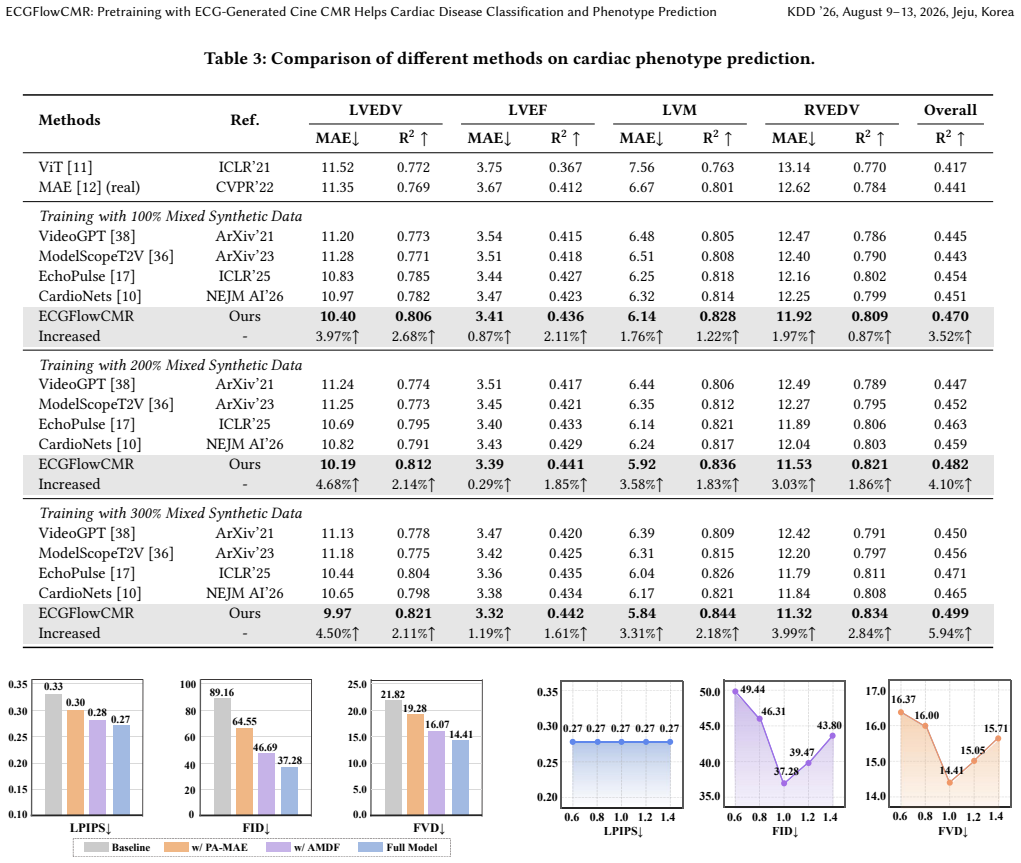
- [Tables 2–3] The downstream comparisons do not include a control in which the real training CMRs are repeated/upsampled to the same multiplicity as the 100%, 200%, and 300% synthetic-mixing settings. The 'MAE(real)' baseline is trained once on real data only. Under standard ERM, increasing the effective training-set size alone can improve performance, so the observed gains do not establish that ECG-generated CMR carries new subject-specific information. In addition, no significance tests are reported, and several cells show overlapping error bars; for example, UKB-CAD at 100% mix: ECGFlowCMR AUC 0.787±0.011 vs EchoPulse 0.778±0.035. Please add paired tests and either a real-repetition control or an explicit argument that the baselines already control for dataset size.
- [§4.6, Table 4] The external validation reports results for multiple mixing ratios and then highlights the best ratio for each task (e.g., peak binary AUC 0.848 at 400%, peak four-class AUC 0.853 at 300%). Because the optimal ratio is selected on the test set, the 'best' performance may reflect selection bias. Moreover, no significance test is given, and the best binary AUC (0.848±0.059) overlaps with MAE(real) (0.798±0.029). The claim that 'moderate synthetic supervision enhances discrimination' needs a validation-based or pre-specified mixing ratio and a paired significance test.
- [§4.4, Fig. 3] The ablation study evaluates only generation metrics (LPIPS, FID, FVD). Since the central claim is that ECGFlowCMR improves downstream cardiac classification and phenotype prediction, the same ablations should be reported for the downstream tasks. Without this, the reader cannot tell whether PA-MAE and AMDF contribute to the claimed application or only to image fidelity.
- [§3.2, Eq. (8)] The generation is conditioned on a population-level anatomical template plus noise, with ECG features as the sole subject-specific condition. Given the paper's own 'anatomical observability gap,' the experiments do not isolate whether ECG conditioning—rather than the template/prior—drives downstream gains. A control that generates synthetic CMRs with the same pipeline but with shuffled ECG conditioning (or with no ECG conditioning) would test this. This is load-bearing for the central claim of ECG-to-CMR pretraining.
minor comments (5)
- [Table 1] Typo 'geneartive' in the caption. The 'Increased' row uses upward arrows for LPIPS and inference time, which are lower-is-better metrics; consider 'Reduction' or clarify the direction.
- [References] Reference [10] (CardioNets) is cited as 'NEJM AI'26' in Table 1, but the reference list gives an arXiv preprint (arXiv:2411.13602). Please reconcile.
- [Table 3] The 'Overall R²' column reports no standard deviations or fold-wise variation, unlike Table 2. Add dispersion measures or a note on fold consistency.
- [Figure 4] The axis labels and value callouts in the FID/FVD subplots are hard to read at the current resolution; please enlarge.
- [§4.6] For the proprietary ZJU-CM dataset, please provide IRB approval, acquisition details, and demographic/clinical characteristics to support the external-validity claim.
Circularity Check
No significant circularity: downstream gains are evaluated on held-out real data and the generative training objectives are not defined in terms of the downstream labels.
full rationale
The central claim—that ECG-conditioned flow matching can synthesize cine CMR and that mixing these synthetic videos with real training data improves downstream classification and phenotype regression—is empirically tested against held-out real test data (UKB test split and external ZJU-CM) and against real-only baselines such as MAE(real) and ViT. The generative losses (Eq. 2, Eq. 4, Eq. 10) are self-supervised or supervised only by CMR latents and ECG phase, not by disease labels or phenotype targets; the α hyperparameter in Eq. 8 is tuned on FID/FVD, not on downstream task performance. CardioNets [10] is a co-author self-citation, but it is used only as prior-work feasibility evidence and as a comparison baseline, not as justification for ECGFlowCMR's design or results. The absence of a repeated-real-data control is an experimental-design limitation rather than a circular step, because no stated prediction is equal to its input by construction: no fitted parameter is renamed as a prediction, no uniqueness theorem or inherited ansatz is invoked to force the method, and the downstream evaluations are external to the generator's training objective. The Limitations section notes generalizability risks and clinical-use restrictions, but it does not assert any dependence of the method on its own conclusions. Accordingly, the derivation chain is self-contained and no circular step can be exhibited.
Axiom & Free-Parameter Ledger
free parameters (4)
- Noise scale α (Eq. 8) =
1.0
- PA-MAE masking ratio ρ =
0.5
- 3D-VAE spatial compression ratio =
8×
- ECG temporal downsampling rate =
8×
axioms (6)
- domain assumption ECG signals are correlated with cardiac structure and function sufficiently to condition individual CMR synthesis.
- domain assumption R-peak detection on Lead II yields reliable ground-truth cardiac phase labels.
- domain assumption The UKB segmentation model [3] accurately extracts cardiac regions from CMR.
- domain assumption The 3D-VAE latent representation preserves diagnostically relevant anatomy and motion.
- domain assumption The population-level anatomical template z_template (Eq. 6) is a valid structural prior for generating individual anatomies.
- standard math Linear interpolation between noise-perturbed template and target latent defines a valid flow-matching trajectory.
read the original abstract
Cardiac Magnetic Resonance (CMR) imaging provides a comprehensive assessment of cardiac structure and function but remains constrained by high acquisition costs and reliance on expert annotations, limiting the availability of large-scale labeled datasets. In contrast, electrocardiograms (ECGs) are inexpensive, widely accessible, and offer a promising modality for conditioning the generative synthesis of cine CMR. To this end, we propose ECGFlowCMR, a novel ECG-to-CMR generative framework that integrates a Phase-Aware Masked Autoencoder (PA-MAE) and an Anatomy-Motion Disentangled Flow (AMDF) to address two fundamental challenges: (1) the cross-modal temporal mismatch between multi-beat ECG recordings and single-cycle CMR sequences, and (2) the anatomical observability gap due to the limited structural information inherent in ECGs. Extensive experiments on the UK Biobank and a proprietary clinical dataset demonstrate that ECGFlowCMR can generate realistic cine CMR sequences from ECG inputs, enabling scalable pretraining and improving performance on downstream cardiac disease classification and phenotype prediction tasks.
Figures




Forward citations
Cited by 3 Pith papers
-
ImputeECG: Deep Learning Reconstruction of Complete 12-Lead Electrocardiograms from Incomplete Recordings for Cardiac Assessment
A mask-conditioned 1D Transformer autoencoder completes incomplete 12-lead 10-s ECGs, cutting missing-region MAE 42–52% and restoring multi-label diagnostic AUROC near complete-ECG levels on PTB-XL, CPSC2018, and a 43...
-
EchoBridge: Long-Tail-Aware ECG-Echocardiography Text Alignment for Echocardiography-Derived Cardiac Findings
EchoBridge’s shared–private ECG–echo-text alignment plus frequency-adaptive prototypes beats strong baselines on classifier-free and cross-center frozen probing, including several low-prevalence valvular findings.
-
Chain of Flow: ECG-Conditioned 4D Cardiac Cine Generation from Patient-Specific Anatomical Anchor
Chain of Flow generates a 4D cardiac cine sequence from one cardiac MRI anchor frame and the patient's ECG by learning ECG-conditioned deformation fields through flow matching.
Reference graph
Works this paper leans on
-
[1]
Salar Abbaspourazad, Oussama Elachqar, Andrew Miller, Saba Emrani, Udhyaku- mar Nallasamy, and Ian Shapiro. 2024. Large-scale Training of Foundation Models for Wearable Biosignals. InICLR
2024
-
[2]
Mohammad Babaeizadeh, Chelsea Finn, Dumitru Erhan, Roy H Campbell, and Sergey Levine. 2017. Stochastic variational video prediction.arXiv preprint arXiv:1710.11252(2017)
Pith/arXiv arXiv 2017
-
[3]
Wenjia Bai, Hideaki Suzuki, Jian Huang, Catherine Francis, Shuo Wang, Giacomo Tarroni, Florian Guitton, Nay Aung, Kenneth Fung, Steffen E Petersen, et al
-
[4]
Andreas Blattmann, Robin Rombach, Huan Ling, Tim Dockhorn, Seung Wook Kim, Sanja Fidler, and Karsten Kreis. 2023. Align your latents: High-resolution video synthesis with latent diffusion models. InProceedings of the IEEE/CVF conference on computer vision and pattern recognition. 22563–22575
2023
-
[5]
Christian Bluethgen, Pierre Chambon, Jean-Benoit Delbrouck, Rogier Van Der Sluijs, Małgorzata Połacin, Juan Manuel Zambrano Chaves, Tanishq Mathew Abraham, Shivanshu Purohit, Curtis P Langlotz, and Akshay S Chaudhari. 2025. A vision–language foundation model for the generation of realistic chest x-ray images.Nature Biomedical Engineering9, 4 (2025), 494–506
2025
-
[6]
Clare Bycroft, Colin Freeman, Desislava Petkova, Gavin Band, Lloyd T Elliott, Kevin Sharp, Allan Motyer, Damjan Vukcevic, Olivier Delaneau, Jared O’Connell, et al. 2018. The UK Biobank resource with deep phenotyping and genomic data. Nature562, 7726 (2018), 203–209
2018
-
[7]
Tingxiu Chen, Yilei Shi, Zixuan Zheng, Bingcong Yan, Jingliang Hu, Xiao Xiang Zhu, and Lichao Mou. 2024. Ultrasound image-to-video synthesis via latent dynamic diffusion models. InMICCAI. Springer, 764–774
2024
-
[8]
Swakshar Deb, Nian Wu, Frederick H Epstein, and Miaomiao Zhang. 2025. Unsu- pervised Cardiac Video Translation Via Motion Feature Guided Diffusion Model. InInternational Conference on Medical Image Computing and Computer-Assisted Intervention. Springer, 648–658
2025
-
[9]
Emily Denton and Rob Fergus. 2018. Stochastic video generation with a learned prior. InInternational conference on machine learning. PMLR, 1174–1183
2018
-
[10]
Zhengyao Ding, Ziyu Li, Yujian Hu, Youyao Xu, Chengchen Zhao, Yiheng Mao, Haitao Li, Zhikang Li, Qian Li, Jing Wang, et al. 2024. Translating Electrocardio- grams to Cardiac Magnetic Resonance Imaging Useful for Cardiac Assessment and Disease Screening: A Multi-Center Study AI for ECG to CMR Translation Study.arXiv preprint arXiv:2411.13602(2024)
arXiv 2024
-
[11]
Alexey Dosovitskiy. 2020. An image is worth 16x16 words: Transformers for image recognition at scale.arXiv preprint arXiv:2010.11929(2020)
Pith/arXiv arXiv 2020
-
[12]
Kaiming He, Xinlei Chen, Saining Xie, Yanghao Li, Piotr Dollár, and Ross Girshick
-
[13]
Yingqing He, Tianyu Yang, Yong Zhang, Ying Shan, and Qifeng Chen. 2022. Latent video diffusion models for high-fidelity long video generation.arXiv preprint arXiv:2211.13221(2022)
Pith/arXiv arXiv 2022
-
[14]
Martin Heusel, Hubert Ramsauer, Thomas Unterthiner, Bernhard Nessler, and Sepp Hochreiter. 2017. Gans trained by a two time-scale update rule converge to a local nash equilibrium
2017
-
[15]
Jonathan Ho, Tim Salimans, Alexey Gritsenko, William Chan, Mohammad Norouzi, and David J Fleet. 2022. Video diffusion models.Advances in neu- ral information processing systems35 (2022), 8633–8646
2022
-
[16]
Xuan Lei, Philip Schniter, and Rizwan Ahmad. 2025. A patch-based latent video diffusion model for cardiac cine (Cine-LDiff).Journal of Cardiovascular Magnetic Resonance27 (2025)
2025
-
[17]
Yiwei Li, Sekeun Kim, Zihao Wu, Hanqi Jiang, Yi Pan, Pengfei Jin, Sifan Song, Yucheng Shi, Xiaowei Yu, Tianze Yang, et al. 2025. ECHOPulse: ECG Controlled Echocardio-gram Video Generation. InICLR
2025
-
[18]
Ziyu Li, Yujian Hu, Zhengyao Ding, Yiheng Mao, Haitao Li, Fan Yi, Hongkun Zhang, and Zhengxing Huang. 2025. Phenotype-Guided Generative Model for High-Fidelity Cardiac MRI Synthesis: Advancing Pretraining and Clinical Appli- cations. InMICCAI. Springer, 484–494
2025
-
[19]
Cong Liu, Xiaohan Yuan, ZhiPeng Yu, and Yangang Wang. 2024. Texdc: Text- driven disease-aware 4d cardiac cine mri images generation. InProceedings of the Asian Conference on Computer Vision. 3005–3021
2024
-
[20]
Xingchao Liu, Chengyue Gong, et al. 2023. Flow Straight and Fast: Learning to Generate and Transfer Data with Rectified Flow. InICLR
2023
-
[21]
Xiaofeng Liu, Fangxu Xing, Zhangxing Bian, Tomas Arias-Vergara, Paula Andrea Pérez-Toro, Andreas Maier, Maureen Stone, Jiachen Zhuo, Jerry L Prince, and Jonghye Woo. 2024. Tagged-to-Cine MRI Sequence Synthesis via Light Spatial- Temporal Transformer. InInternational Conference on Medical Image Computing and Computer-Assisted Intervention. Springer, 701–711
2024
-
[22]
Michael Moor, Oishi Banerjee, Zahra Shakeri Hossein Abad, Harlan M Krumholz, Jure Leskovec, Eric J Topol, and Pranav Rajpurkar. 2023. Foundation models for generalist medical artificial intelligence.Nature616, 7956 (2023), 259–265
2023
-
[23]
William Peebles and Saining Xie. 2023. Scalable diffusion models with transform- ers. InICCV. 4195–4205
2023
-
[24]
Wei Peng, Ehsan Adeli, Tomas Bosschieter, Sang Hyun Park, Qingyu Zhao, and Kilian M Pohl. 2023. Generating realistic brain mris via a conditional diffusion probabilistic model. InMICCAI. Springer, 14–24
2023
-
[25]
Eva Prakash, Jeya Maria Jose Valanarasu, Zhihong Chen, Eduardo Pontes Reis, Andrew Johnston, Anuj Pareek, Christian Bluethgen, Sergios Gatidis, Cameron Olsen, Akshay S Chaudhari, et al. 2025. Evaluating and Improving the Effective- ness of Synthetic Chest X-Rays for Medical Image Analysis. InICCV. 4413–4421
2025
-
[26]
Adityanarayanan Radhakrishnan, Sam F Friedman, Shaan Khurshid, Kenney Ng, Puneet Batra, Steven A Lubitz, Anthony A Philippakis, and Caroline Uhler
-
[27]
Masaki Saito, Eiichi Matsumoto, and Shunta Saito. 2017. Temporal generative ad- versarial nets with singular value clipping. InProceedings of the IEEE international conference on computer vision. 2830–2839
2017
-
[28]
Uriel Singer, Adam Polyak, Thomas Hayes, Xi Yin, Jie An, Songyang Zhang, Qiyuan Hu, Harry Yang, Oron Ashual, Oran Gafni, et al. 2022. Make-a-video: Text-to-video generation without text-video data.arXiv preprint arXiv:2209.14792 (2022)
Pith/arXiv arXiv 2022
-
[29]
Petru-Daniel Tudosiu, Walter HL Pinaya, Pedro Ferreira Da Costa, Jessica Dafflon, Ashay Patel, Pedro Borges, Virginia Fernandez, Mark S Graham, Robert J Gray, Parashkev Nachev, et al . 2024. Realistic morphology-preserving generative modelling of the brain.Nature Machine Intelligence6, 7 (2024), 811–819
2024
-
[30]
Sergey Tulyakov, Ming-Yu Liu, Xiaodong Yang, and Jan Kautz. 2018. Mocogan: Decomposing motion and content for video generation. InProceedings of the IEEE conference on computer vision and pattern recognition. 1526–1535
2018
-
[31]
Thomas Unterthiner, Sjoerd Van Steenkiste, Karol Kurach, Raphaël Marinier, Marcin Michalski, and Sylvain Gelly. 2019. FVD: A new metric for video genera- tion. (2019)
2019
-
[32]
Aaron Van Den Oord, Oriol Vinyals, et al. 2017. Neural discrete representation learning.Advances in neural information processing systems30 (2017)
2017
-
[33]
Ruben Villegas, Mohammad Babaeizadeh, Pieter-Jan Kindermans, Hernan Moraldo, Han Zhang, Mohammad Taghi Saffar, Santiago Castro, Julius Kunze, and Dumitru Erhan. 2022. Phenaki: Variable length video generation from open domain textual description.arXiv preprint arXiv:2210.02399(2022)
Pith/arXiv arXiv 2022
-
[34]
Carl Vondrick, Hamed Pirsiavash, and Antonio Torralba. 2016. Generating videos with scene dynamics.Advances in neural information processing systems29 (2016)
2016
-
[35]
Milos Vukadinovic, Alan C Kwan, Debiao Li, and David Ouyang. 2023. GANcMRI: Cardiac magnetic resonance video generation and physiologic guidance using latent space prompting. InMachine Learning for Health (ML4H). PMLR, 594–606
2023
-
[36]
Jiuniu Wang, Hangjie Yuan, Dayou Chen, Yingya Zhang, Xiang Wang, and Shiwei Zhang. 2023. Modelscope text-to-video technical report.arXiv preprint arXiv:2308.06571(2023)
Pith/arXiv arXiv 2023
-
[37]
Yan-Ran Wang, Kai Yang, Yi Wen, Pengcheng Wang, Yuepeng Hu, Yongfan Lai, Yufeng Wang, Kankan Zhao, Siyi Tang, Angela Zhang, et al. 2024. Screening and diagnosis of cardiovascular disease using artificial intelligence-enabled cardiac magnetic resonance imaging.Nature Medicine30, 5 (2024), 1471–1480
2024
-
[38]
Wilson Yan, Yunzhi Zhang, Pieter Abbeel, and Aravind Srinivas. 2021. Videogpt: Video generation using vq-vae and transformers.arXiv preprint arXiv:2104.10157 (2021)
Pith/arXiv arXiv 2021
-
[39]
Arezoo Zakeri, Alireza Hokmabadi, Ning Bi, Isuru Wijesinghe, Michael G Nix, Steffen E Petersen, Alejandro F Frangi, Zeike A Taylor, and Ali Gooya. 2023. Drag- Net: Learning-based deformable registration for realistic cardiac MR sequence generation from a single frame.Medical Image Analysis83 (2023), 102678
2023
-
[40]
Oliver Zettinig, Tommaso Mansi, Dominik Neumann, Bogdan Georgescu, Saiki- ran Rapaka, Philipp Seegerer, Elham Kayvanpour, Farbod Sedaghat-Hamedani, Ali Amr, Jan Haas, et al. 2014. Data-driven estimation of cardiac electrical diffu- sivity from 12-lead ECG signals.Medical image analysis18, 8 (2014), 1361–1376
2014
-
[41]
Richard Zhang, Phillip Isola, Alexei A Efros, Eli Shechtman, and Oliver Wang
-
[2018]
The unreasonable effectiveness of deep features as a perceptual metric. In CVPR. 586–595. Received 20 February 2007; revised 12 March 2009; accepted 5 June 2009
2007
-
[2020]
A population-based phenome-wide association study of cardiac and aortic structure and function.Nature medicine26, 10 (2020), 1654–1662
2020
-
[2022]
Masked autoencoders are scalable vision learners. InCVPR. 16000–16009
-
[2023]
Cross-modal autoencoder framework learns holistic representations of cardiovascular state.Nature Communications14, 1 (2023), 2436
2023
discussion (0)
Sign in with ORCID, Apple, or X to comment. Anyone can read and Pith papers without signing in.