REVIEW 3 major objections 4 minor 1 cited by
By patching donor hairpin activations into ESMFold's trunk, this paper shows that protein folding in the model runs through two causally verifiable stages—early blocks write biochemical features into pairwise space, late blocks build the ge
Reviewed by Pith at T0; open to challenge. T0 means a machine referee read the full paper against a public rubric. the ladder, T0–T4 →
T0 review · deepseek-v4-flash
2026-08-03 04:02 UTC pith:NTUPU3ZY
load-bearing objection The ESMFold two-stage story is real and well-supported; the abstract's three-model convergence claim is not in the body and should be rewritten before publication. the 3 major comments →
Two Stages of Folding: Convergent Mechanisms in AI Protein Folding Trunks
The pith
A machine-rendered reading of the paper's core claim, the machinery that carries it, and where it could break.
Core claim
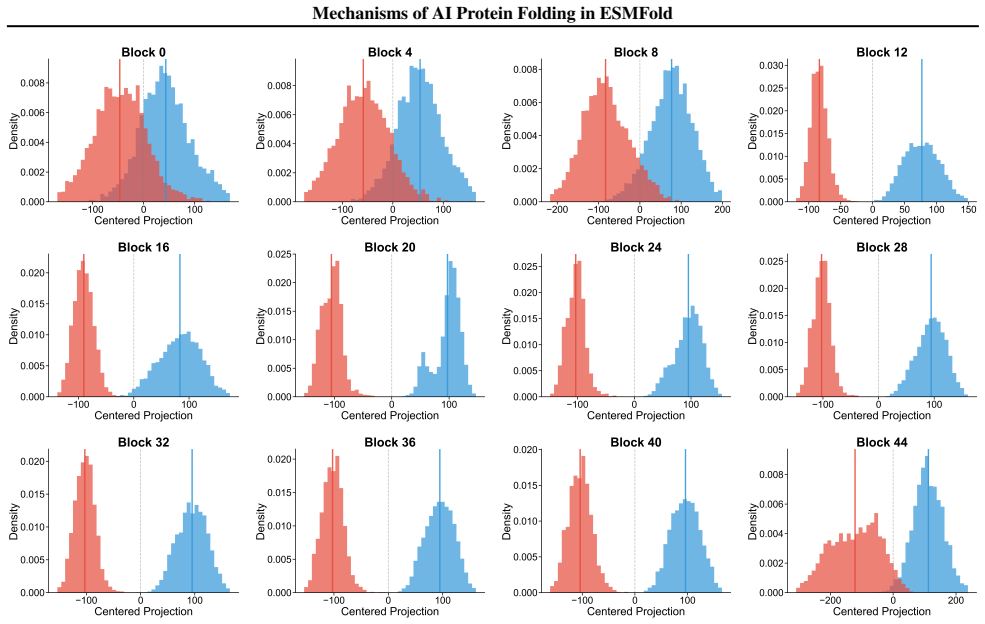
On the paper's own terms: ESMFold folds a beta hairpin in two causally separable stages. During early blocks (0–7), residue identity and biochemical features such as charge flow from the sequence representation into the pairwise representation through the seq2pair pathway; sequence patching is effective only there. During late blocks (roughly 25 onward), the pairwise representation accumulates distance and contact information, modulates sequence attention through the pair2seq bias, and directly controls the structure module; pairwise patching is effective only there. The causal interventions are charge steering, distance steering, attention redirection, and pairwise scaling. The abstract ext
What carries the argument
The central object is the pairwise representation z—an L×L tensor over residue pairs that the trunk refines block by block—together with its two communication pathways: seq2pair, which projects sequence features into z via elementwise products and differences, and pair2seq, which turns z into attention biases on the sequence. Activation patching at individual blocks localizes where each representation type carries folding-relevant information; linear probes and steering vectors expose that charge and distance are stored linearly; scaling interventions show z's magnitude acts as a global distance map consumed by the structure module.
Load-bearing premise
The results assume that activation patching is a valid counterfactual: that a donor hairpin's activations, transplanted into a target at one block, reveal what those representations normally cause, rather than being off-distribution artifacts—a risk the paper itself acknowledges in its low-confidence counterfactual structures, steric clashes, and chain breaks.
What would settle it
A concrete test: rerun the single-block patching experiments with donor activations replaced by random perturbations of the target activations matched for norm and covariance. If such perturbations induce hairpins at a comparable rate (roughly 40% for full patches, 20% for late-block pairwise patches), the donor-specific content is not doing the causal work and the two-stage localization collapses. A second check: find any donor–target pair where patching the pairwise representation alone before block 25, or the sequence representation alone after block 8, reliably folds a hairpin, breaking th
If this is right
- Folding decisions can be localized to specific trunk blocks: intervention windows differ sharply for sequence versus pairwise representations, so future analyses and edits can target the block range that actually carries a given decision.
- The pairwise representation is a manipulable distance map: scaling z proportionally expands or contracts the predicted structure, and steering a linear distance direction induces targeted cross-strand hydrogen bonds.
- Charge is encoded along a linear direction, and steering that direction toward electrostatic complementarity induces hairpin formation—demonstrating that a known biochemical prior can causally steer a learned folding model.
- The same two-stage pattern appears in reverse patching (helix into hairpin), suggesting the chemistry-then-geometry organization is a general property of the ESMFold trunk rather than a hairpin-specific artifact.
- If the cross-model convergence holds, pairwise states from different folding trunks can be linearly aligned and substituted, making mechanistic findings transferable across architectures.
Where Pith is reading between the lines
- If the same patching methods were applied to an MSA-based trunk, the stage boundary might shift because sequence information arrives through a different encoder; the paper's own appendix flags that transfer is untested, so the cross-model convergence should be read as a hypothesis as much as a result.
- Because scaling z alone controls global compactness, a practical design handle suggests itself: modulate the pairwise scale to tune protein compactness without changing sequence—though the paper does not test whether such structures are physically foldable.
- The near-zero probe selectivity for residue identity suggests seq2pair's early write-in is architectural (products and differences of identity embeddings) rather than a deeply learned strategy; if so, stage 1's timing may be a structural consequence of the trunk design, not an emergent learned strategy.
Editorial analysis
A structured set of objections, weighed in public.
Referee Report
Summary. This paper studies the folding trunk of ESMFold by transplanting activations from a beta-hairpin donor into an alpha-helical target and measuring whether a hairpin is formed. On the basis of single-block patching, the authors identify two regimes: sequence patches are effective in blocks 0–7 and pairwise patches in blocks ~25–35. They then trace stage 1 to the seq2pair pathway, show that a linear 'charge direction' exists and that steering it induces cross-strand H-bonds, and trace stage 2 to pairwise distance/contact information: linear probes decode Cα distances from z, steering z along probe gradients induces H-bond formation, the pair2seq bias carries contact information, and scaling z scales output geometry. The main body is limited to ESMFold, with code and data availability. The paper as a whole, however, contains an early abstract/title claiming convergence across ESMFold, OpenFold, and Boltz-1 and functional interchangeability, which is not supported by any experiment in the body.
Significance. The ESMFold-specific contribution is significant and generally well-executed: it is one of the first direct mechanistic analyses of a folding trunk, and it uses externally grounded physical metrics (DSSP, N–O H-bonds, Cα distances) rather than only model-internal correlations. The paper includes multiple converging controls — reverse patching, seq2pair/pair2seq ablations, Rg filtering, same-charge steering, and z-scaling — and ships code/data. If the ESMFold claims are correct, they provide a useful map of where and when folding decisions are made in this architecture. The broader 'convergent mechanisms across architectures' claim would be a significant generalization, but the body contains no OpenFold or Boltz-1 experiments and the appendix explicitly disclaims transfer.
major comments (3)
- [Abstract; §1; §7; App. A] The title and the first abstract claim a shared two-stage structure across ESMFold, OpenFold, and Boltz-1 and linearly interchangeable representations. Every experiment in the body (§§3–5 and appendices) is run on ESMFold only; there are no OpenFold or Boltz-1 experiments and no cross-model alignment or substitution. Appendix A explicitly states 'the computational stages we observe may not directly transfer to other architectures.' This is a load-bearing scope mismatch, not a presentational detail: a reader of the title/abstract would attribute to the paper a claim the manuscript itself disclaims. The title and abstract must be changed to the ESMFold-specific claim (as in the full-text abstract) unless the authors provide cross-architecture evidence.
- [§3; App. A] The block-localization result (Fig. 1), the seq2pair necessity claim (Fig. 7b), and the attention-redirection result (Fig. 11) all rely on activation patching as a counterfactual. Appendix A concedes that the resulting structures have low pLDDT, that inverse folding fails to recover viable sequences, and that interventions can create steric clashes or chain breaks. These facts support an alternative interpretation in which early/late patches act as off-distribution artifacts rather than revealing the normal causal role of the representations. The authors should report pLDDT/clash rates for the patched outputs and add an explicit control (e.g., patching random or noise activations of comparable norm) or qualify the causal conclusions in the main text. The current sentence in App. A is a serious limitation that is not integrated into the main text's causal language.
- [Fig. 1; §3] The two-regime separation rests on single-block patching success rates of roughly 40% (sequence, early) and 20% (pairwise, late). No confidence intervals, error bars, or significance tests are reported for these rates, and the thresholds (blocks 0–7 and 25+) are read off the curves. Please provide per-block CIs or bootstrap intervals and a quantitative test of the regime boundary, to confirm that the separation is robust rather than a consequence of smoothing or arbitrary thresholds.
minor comments (4)
- [Abstract; §1] The abstract refers to Boltz-1 while the introduction refers to Boltz-2; please make the model references consistent.
- [§7] The phrase 'first to analyze the computational mechanisms of the folding trunk' is stronger than needed given prior behavioral and probing analyses of AlphaFold-family models; suggest softening.
- [§5.1] The linear distance-probe result (R² ≈ 0.9) would benefit from a control task (e.g., predicting sequence separation) and reported confidence intervals, since z is initialized with positional embeddings that correlate with sequence separation.
- [§4.2; §5.1] The steering strengths α = 3σ (charge) and α = 20σ (distance) are presented without sensitivity analysis; please report the range of α over which the effects hold or add a brief robustness discussion.
Circularity Check
No significant circularity: the causal interventions are evaluated against external PDB/DSSP outcomes, and fitted probes/vectors are not used to define the target findings.
full rationale
The paper's derivation chain is empirical throughout. The two-stage localization (Fig. 1) comes from single-block activation patching with success measured by DSSP secondary-structure assignment against PDB-derived donor/target structures. The charge mechanism uses a difference-of-means vector fitted on 200 independent helical proteins (Eq. 5); the causal steering (Eq. 6) is evaluated by backbone N-O H-bond criteria (<3.5 Å) on separate target proteins, and the same-charge control provides a sign test. The distance mechanism trains linear probes on held-out proteins (400 train/200 test) against PDB Cα distances; steering uses the probe gradient, and success is measured by H-bond formation, not by the probe's training objective. The z-scaling result directly measures output geometry under representation scaling. None of these steps fits the target finding into the instrument used to produce it. The only concerns—the abstract's three-model convergence claim and Appendix A's admission that stages 'may not directly transfer to other architectures'—are about generalization support, not circularity. No load-bearing self-citation or uniqueness import appears. Score 0.
Axiom & Free-Parameter Ledger
free parameters (6)
- Charge steering strength α = 3σ =
3σ, with σ the std of residue projections onto v_charge
- Distance steering strength α = 20σ =
20σ, with σ the std of pair projections onto the probe direction ŵ
- Charge direction v_charge (DoM vector) =
Difference of mean representations of K,R,H vs D,E over 200 α-helical proteins
- Distance probe parameters (per-block w, b) =
Linear ridge probes trained on 400 proteins against Cα distances; R²≈0.9 by late blocks
- Compaction filter threshold (Rg < 0.9× baseline) =
0.9
- Steering window sizes =
15 blocks (charge steering, seq2pair ablation); 10 blocks (distance steering)
axioms (6)
- domain assumption Patching donor activations into a target forward pass yields outputs that reveal the causal role of the patched representation (counterfactual validity on or near the model's manifold).
- domain assumption Disabling recycling does not change the folding mechanism for the studied proteins.
- standard math DSSP secondary-structure assignment on predicted structures is a valid detector of induced hairpins and helix content.
- domain assumption The difference-of-means 'charge direction' is causally specific to residue charge rather than to correlated physico-chemical properties.
- domain assumption Linear decodability of Cα distance from z (R²≈0.9) licenses the conclusion that the structure module reads geometry out of z.
- domain assumption The curated all-α targets and ~80k extracted hairpins are representative of the folding behaviors being localized.
read the original abstract
How do protein structure prediction models fold proteins? We investigate this question through causal interventions on the folding trunks of ESMFold, OpenFold, and Boltz-1. Across all three models, we find a shared two-stage computational structure. In the first stage, early blocks initialize pairwise biochemical signals: features like charge propagate from sequence into pairwise representations through architecture-specific pathways. In the second stage, late blocks develop pairwise spatial features: distance and contact information accumulate in the pairwise representation. We verify these mechanisms causally by showing that steering charge and distance features induces predictable structural changes. Furthermore, these representations are functionally interchangeable: pairwise states can be linearly aligned and substituted across models. Together, these results suggest that folding trunks with different architectures, inputs, and training procedures converge on a shared representational organization for mapping sequence chemistry into spatial geometry.
Figures




Forward citations
Cited by 1 Pith paper
-
Design-CP: Context Parallelism for Design of Protein Nanoparticles
Context-parallel inference for RFdiffusion 3 enables end-to-end all-atom design of large symmetric protein nanoparticles on multi-GPU hardware without retraining.
Reference graph
Works this paper leans on
-
[1]
Secondary structure assignment: We run DSSP (Hekkelman et al., 2025) on the predicted structure to identifyβ-strand regions (DSSP codes E or B)
2025
-
[2]
Geiger, A., Ibeling, D., Zur, A., Chaudhary, M., Chauhan, S., Huang, J., Arora, A., Wu, Z., Goodman, N., Potts, C., et al
URL https://openreview.net/forum? id=zjGwoJaVPS. Geiger, A., Ibeling, D., Zur, A., Chaudhary, M., Chauhan, S., Huang, J., Arora, A., Wu, Z., Goodman, N., Potts, C., et al. Causal abstraction: A theoretical foundation for mechanistic interpretability.Journal of Machine Learning Research, 26(83):1–64, 2025. Glusker, J. P., Lewis, M., and Rossi, M.Crystal st...
2025
-
[3]
Loop length: The connecting loop must be 0–5 residues
-
[4]
URL https://www.biorxiv.org/content/ early/2025/04/17/2025.04.11.648460
doi: 10.1101/2025.04.11.648460. URL https://www.biorxiv.org/content/ early/2025/04/17/2025.04.11.648460. Hewitt, J. and Liang, P. Designing and interpreting probes with control tasks.arXiv preprint arXiv:1909.03368, 2019. Jumper, J., Evans, R., Pritzel, A., Green, T., Figurnov, D., Ronneberger, O., Tunyasuvunakool, K., Bates, R., Zidek, A., Potapenko, A.,...
Pith/arXiv arXiv 2025
-
[6]
ISSN 0891-2017. doi: 10.1162/COLI.a.572. URL https://doi.org/10.1162/COLI.a.572. Munoz, V ., Henry, E. R., Hofrichter, J., and Eaton, W. A. A statistical mechanical model for β-hairpin kinetics.Pro- ceedings of the National Academy of Sciences, 95(11): 5872–5879, 1998. Murakami, T., Hashidate, Y ., and Matsunaga, Y . Mechanis- tic interpretability of fine...
Pith/arXiv arXiv 2017
-
[10]
Strand length: Each strand must contain at least 2 residues
-
[12]
mainly α
Adjacency: The two strands must be sequential in the primary sequence (no intervening strands). C. Experiment Datasets Alpha-helical target dataset (patching targets).For acti- vation patching experiments, we curated a separate set of 95 all-α proteins from the PDB spanning diverse structural families (globins, helix bundles, helix–turn–helix proteins, co...
2019
-
[41]
URL https: //doi.org/10.1093/bioadv/vbae187
doi: 10.1093/bioadv/vbae187. URL https: //doi.org/10.1093/bioadv/vbae187. Hekkelman, M. L., Álvarez Salmoral, D., Perrakis, A., and Joosten, R. P. Dssp 4: Fair annota- tion of protein secondary structure.bioRxiv,
-
[48]
findings-acl.48/
URL https://aclanthology.org/2022. findings-acl.48/. Vig, J., Gehrmann, S., Belinkov, Y ., Qian, S., Nevo, D., Singer, Y ., and Shieber, S. Investigating gender bias in language models using causal mediation analysis. In Larochelle, H., Ranzato, M., Had- sell, R., Balcan, M., and Lin, H. (eds.),Advances in Neural Information Processing Systems, vol- ume 3...
2022
-
[2020]
cc/paper_files/paper/2020/file/ 92650b2e92217715fe312e6fa7b90d82-Paper
URL https://proceedings.neurips. cc/paper_files/paper/2020/file/ 92650b2e92217715fe312e6fa7b90d82-Paper. pdf. Wang, N., Nalmpantis, C., Fang, C., Niki, P., Bis- sell, M., Kathail, P., Hazra, D., Karailiev, A., Pearce, M., Ganbat, J.-O., Jain, A., Giacomoni, L., Balsam, D., Wan, J., and Solanki, R. Using interpretabil- ity to identify a novel class of Alzh...
2020
-
[2021]
doi: 10.1038/s41586-021-03819-2. Kabsch, W. and Sander, C. Dictionary of protein secondary structure: pattern recognition of hydrogen-bonded and geometrical features.Biopolymers, 22:2577–2637, 1983. doi: 10.1002/bip.360221211. Koga, N., Tatsumi Koga, R., Liu, G., Xiao, R., Acton, T. B., Montelione, G. T., and Baker, D. Principles for designing ideal prote...
Pith/arXiv arXiv 1983
-
[2025]
Ahdritz, G., Bouatta, N., Floristean, C., Kadyan, S., Xia, Q., Gerecke, W., O’Donnell, T
URL https://openreview.net/forum? id=zdOGBRQEbz. Ahdritz, G., Bouatta, N., Floristean, C., Kadyan, S., Xia, Q., Gerecke, W., O’Donnell, T. J., Berenberg, D., Fisk, I., Zanichelli, N., Zhang, B., Nowaczynski, A., Wang, B., Stepniewska-Dziubinska, M. M., Zhang, S., Ojew- ole, A., Guney, M. E., Biderman, S., Watkins, A. M., Ra, S., Lorenzo, P. R., Nivon, L.,...
2024
discussion (0)
Sign in with ORCID, Apple, or X to comment. Anyone can read and Pith papers without signing in.