Dimensional crossover in surface growth on rectangular substrates
Pith reviewed 2026-05-10 17:58 UTC · model grok-4.3
The pith
Rectangular substrates induce a crossover from two- to one-dimensional scaling in interface growth across multiple universality classes.
A machine-rendered reading of the paper's core claim, the machinery that carries it, and where it could break.
Core claim
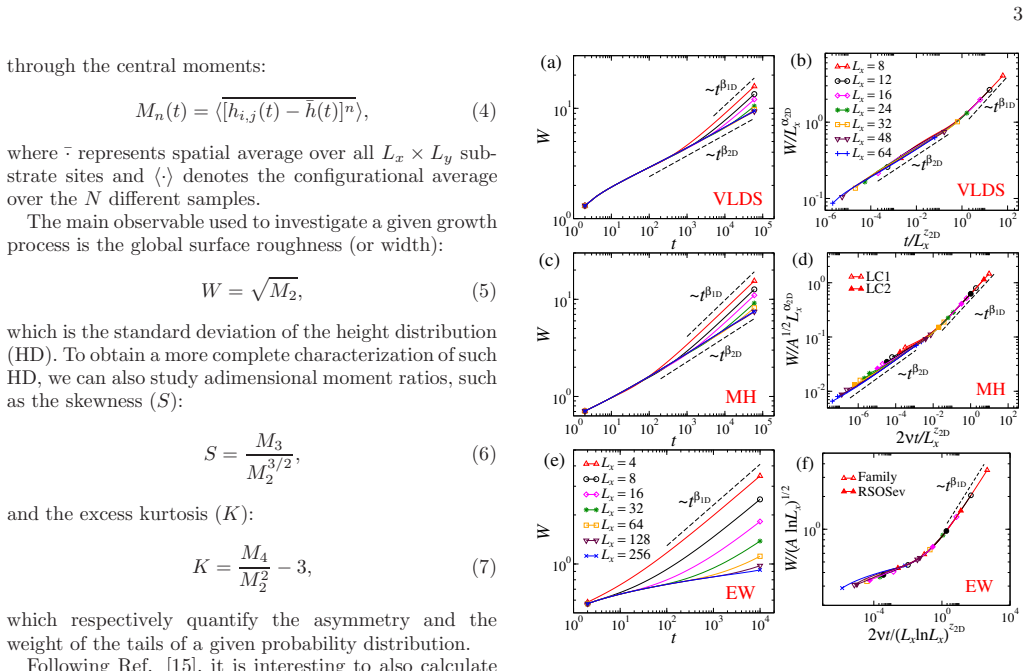
For sufficiently large aspect ratio R = Ly/Lx, the roughness W scales as t to the power beta_2D for t much less than tc and as t to the power beta_1D for t much greater than tc, with tc approximately equal to Lx to the power z_2D. The VLDS height distribution crosses from its two-dimensional to its one-dimensional form at the same time. In the steady state both roughness and VLDS height distribution interpolate between the two- and one-dimensional limits as R increases. When Lx equals Ly to the power delta and delta exceeds z_1D over z_2D, the temporal crossover vanishes and the saturation roughness scales as Ly to the power Lambda equal to (1 minus delta) times alpha_1D plus delta times the
What carries the argument
The aspect ratio R = Ly/Lx of the rectangular substrate, which sets the crossover time tc between the two-dimensional and one-dimensional scaling regimes.
If this is right
- Roughness versus time splits into two distinct power-law segments separated by tc proportional to Lx^z_2D.
- VLDS height distributions transition from their two-dimensional to one-dimensional forms across the same crossover.
- Steady-state roughness and distributions interpolate continuously between two- and one-dimensional limits with increasing R.
- When Lx = Ly^delta with delta larger than z_1D/z_2D the temporal crossover disappears and saturation roughness acquires the mixed exponent Lambda.
Where Pith is reading between the lines
- Experimental thin-film deposition on rectangular substrates with controllable aspect ratio could be used to observe the predicted crossover in roughness or height statistics.
- The special ratio delta* = z_1D/z_2D offers a geometric knob that eliminates the time-dependent crossover and replaces it with a non-universal saturation scaling.
- The same geometric mechanism may govern other nonequilibrium growth processes whenever the substrate has a pronounced rectangular anisotropy.
Load-bearing premise
The simulated system sizes and run times are large enough to isolate the early two-dimensional regime, the crossover, and the late one-dimensional regime without residual finite-size effects.
What would settle it
A simulation or experiment on a rectangle with very large Ly/Lx that shows either a single unchanging power-law regime in roughness versus time or a crossover time that fails to scale as Lx to the power z_2D.
Figures


read the original abstract
In a recent work [Phys. Rev. E 109, L042102 (2024)], interesting dimensional crossovers [from two- to one-dimensional (2D to 1D) scaling] were found in the growth of Kardar-Parisi-Zhang (KPZ) interfaces on rectangular substrates, with lateral sizes $L_y > L_x$. Here, we extend this study to other universality classes for interface growth -- specifically, the Edwards-Wilkinson (EW), the Mullins-Herring (MH), and the Villain-Lai Das Sarma (VLDS) classes. From extensive simulations, we demonstrate that, in all systems with sufficiently large aspect ratio $\mathcal{R}=L_y/L_x$, the roughness $W$ scales with time $t$ in the growth regime as $W \sim t^{\beta_{\text{2D}}}$ for $t \ll t_c$ and $W \sim t^{\beta_{\text{1D}}}$ for $t \gg t_c$, where $t_c \sim L_x^{z_{2\text{D}}}$ in most cases. For the VLDS class, this crossover is also observed in the height distribution (HD), which approaches its characteristic probability density function for the 2D case at short times ($t \ll t_c$) and then crosses over to the asymptotic 1D HD. Dimensional crossovers are also found in the steady state regime, both in the roughness scaling as well as in the VLDS HD, which interpolate between the 2D and 1D ones as $\mathcal{R}$ increases. The particular case $L_x = L_y^{\delta}$, with $0 < \delta < 1$, is also discussed in detail and reveals interesting features of the investigated systems. For instance, there exist a `special' exponent $\delta^* = z_{1\text{D}}/z_{2\text{D}}$ such that the temporal crossover cannot be observed for $\delta > \delta^*$. Moreover, this leads the saturation roughness to display a nonuniversal scaling: $W_s \sim L_y^{\Lambda}$, with $\Lambda = (1-\delta) \alpha_{1\text{D}} + \delta \alpha_{2\text{D}}$.
Editorial analysis
A structured set of objections, weighed in public.
Referee Report
Summary. The manuscript extends prior work on dimensional crossovers in KPZ interface growth to the EW, MH, and VLDS universality classes on rectangular substrates with large aspect ratio R = Ly/Lx. Using extensive simulations, it reports that the roughness W(t) crosses over from the 2D growth exponent β_2D at early times (t ≪ t_c) to the 1D exponent β_1D at late times (t ≫ t_c), with t_c ∼ L_x^{z_2D} in most cases. Analogous crossovers appear in the steady-state roughness and, for VLDS, in the height distribution (HD). The special geometry L_x = L_y^δ is analyzed in detail, revealing a critical δ* = z_1D/z_2D above which the temporal crossover disappears and the saturation roughness follows the nonuniversal form W_s ∼ L_y^Λ with Λ = (1−δ)α_1D + δ α_2D.
Significance. If the numerical evidence for clean regime separation holds, the work establishes that dimensional crossover is generic across linear and nonlinear interface growth classes, with the crossover time controlled by the 2D dynamic exponent. The identification of δ* and the resulting nonuniversal saturation scaling provides a concrete, testable prediction that could motivate analytic treatments of anisotropic geometries. The VLDS HD crossover adds a higher-order statistic that strengthens the claim beyond roughness alone.
major comments (2)
- [Simulation methods and results for EW/MH/VLDS roughness] The central claim requires that, for sufficiently large R, the time series W(t) exhibits extended, unambiguous power-law plateaus in the 2D and 1D regimes separated by a sharp crossover at t_c. Because computational cost scales with L_x × L_y and t_c grows with L_x, the accessible dynamic range may be too narrow to produce clean asymptotics without residual 2D-like fluctuations or saturation effects from finite Ly. The manuscript must supply effective-exponent plots, correlation-length data, or direct measurements of ξ(t)/L_x in both regimes to demonstrate that the reported β values and t_c scaling are not contaminated by crossover transients.
- [VLDS height-distribution analysis] For the VLDS height-distribution crossover, the claim that the PDF approaches the characteristic 2D form at t ≪ t_c and the 1D form at t ≫ t_c additionally requires adequate sampling of the distribution tails in both regimes. The paper should report the number of independent realizations, the binning procedure, and the system sizes used for the HD histograms, together with error estimates on the tail probabilities, to confirm that the observed crossover is statistically robust rather than an artifact of undersampling rare large-height events.
minor comments (2)
- [Abstract and introduction] The abstract states that t_c ∼ L_x^{z_2D} 'in most cases'; the main text should explicitly list the exceptions, quantify the deviations, and explain their origin (e.g., logarithmic corrections or marginal dimensions).
- [Notation and figures] Notation for the aspect ratio is introduced as script R but appears inconsistently in some figure captions and equations; uniform usage throughout would improve readability.
Simulated Author's Rebuttal
We thank the referee for the positive evaluation of our manuscript and for the constructive comments, which will help strengthen the presentation of our results. We address each major comment below.
read point-by-point responses
-
Referee: [Simulation methods and results for EW/MH/VLDS roughness] The central claim requires that, for sufficiently large R, the time series W(t) exhibits extended, unambiguous power-law plateaus in the 2D and 1D regimes separated by a sharp crossover at t_c. Because computational cost scales with L_x × L_y and t_c grows with L_x, the accessible dynamic range may be too narrow to produce clean asymptotics without residual 2D-like fluctuations or saturation effects from finite Ly. The manuscript must supply effective-exponent plots, correlation-length data, or direct measurements of ξ(t)/L_x in both regimes to demonstrate that the reported β values and t_c scaling are not contaminated by crossover transients.
Authors: We agree that additional diagnostics would strengthen the evidence for clean regime separation. Although the original simulations already display clear power-law regimes and crossover scaling consistent with t_c ∼ L_x^{z_2D} across multiple system sizes, we will add effective-exponent plots β_eff(t) together with correlation-length data ξ(t)/L_x in the revised manuscript. These will explicitly confirm extended plateaus at the expected β_2D and β_1D values and the absence of significant transient contamination in the reported windows. revision: yes
-
Referee: [VLDS height-distribution analysis] For the VLDS height-distribution crossover, the claim that the PDF approaches the characteristic 2D form at t ≪ t_c and the 1D form at t ≫ t_c additionally requires adequate sampling of the distribution tails in both regimes. The paper should report the number of independent realizations, the binning procedure, and the system sizes used for the HD histograms, together with error estimates on the tail probabilities, to confirm that the observed crossover is statistically robust rather than an artifact of undersampling rare large-height events.
Authors: We concur that these methodological details are necessary to establish statistical robustness. In the revised version we will add an appendix (or expanded methods section) reporting the number of independent realizations (typically several hundred for smaller systems), the histogram binning procedure, the system sizes employed for the HD analysis, and error estimates on the tail probabilities obtained from bootstrap resampling. This will confirm that the observed 2D-to-1D crossover in the VLDS height distribution is not affected by undersampling. revision: yes
Circularity Check
No circularity: claims rest on independent simulations compared to literature exponents
full rationale
The paper's central results are direct numerical measurements of roughness scaling and height distributions in EW, MH, and VLDS models on rectangular lattices. These are compared to independently established 1D and 2D exponents from prior literature. The single citation to a recent KPZ study supplies context for the extension but does not justify or define any of the new claims; those claims are obtained from fresh simulations whose outputs are not forced by the cited work. No analytical derivation, ansatz, uniqueness theorem, or fitted parameter is present that reduces to a self-definition or to the same data.
Axiom & Free-Parameter Ledger
axioms (2)
- domain assumption The Edwards-Wilkinson, Mullins-Herring, and Villain-Lai-Das Sarma equations govern the interface evolution in their respective universality classes.
- standard math The 1D and 2D roughness exponents β, α, z for each class are known from prior analytic or numerical work and can be used as benchmarks.
Lean theorems connected to this paper
-
IndisputableMonolith/Foundation/AlexanderDuality.leanalexander_duality_circle_linking unclear?
unclearRelation between the paper passage and the cited Recognition theorem.
From extensive simulations, we demonstrate that, in all systems with sufficiently large aspect ratio R=Ly/Lx, the roughness W scales with time t in the growth regime as W ∼ t^β_{2D} for t ≪ t_c and W ∼ t^β_{1D} for t ≫ t_c, where t_c ∼ L_x^{z_{2D}}
What do these tags mean?
- matches
- The paper's claim is directly supported by a theorem in the formal canon.
- supports
- The theorem supports part of the paper's argument, but the paper may add assumptions or extra steps.
- extends
- The paper goes beyond the formal theorem; the theorem is a base layer rather than the whole result.
- uses
- The paper appears to rely on the theorem as machinery.
- contradicts
- The paper's claim conflicts with a theorem or certificate in the canon.
- unclear
- Pith found a possible connection, but the passage is too broad, indirect, or ambiguous to say the theorem truly supports the claim.
Reference graph
Works this paper leans on
-
[1]
—, in heat conduction on rectangular domains [4], Bose-Einstein condensates [5], quantum phase transitions [6], confined solids [7] and so on. Moreover, experimental examples include ultra-thin magnetic films [8], polymer coatings [9], layered superconductors [10], thermal [11] and quantum transport [12], bosonic gases of trapped ul- tracold atoms [13] or p...
work page internal anchor Pith review Pith/arXiv arXiv 2026
-
[2]
also apply for these other classes. The only exception is the EW class, where W displays logarithmic behav- iors in 2D; and the appropriate scaling relations for this case are devised here. The crossover in the HDs is also discussed for these classes, in both the growth and satu- ration regimes. We investigate also the interesting situ- ation where Lx = L...
work page 2048
-
[3]
D. J. Amit and V. Martin- Mayor, “Crossover phenomena,” in Field Theory, the Renormalization Group, and Critical Phen omena, 3rd ed. (2005) pp. 342–363
work page 2005
-
[4]
T. Graim and D. P. Landau, Phys. Rev. B 24, 5156 (1981); I. Hatta and R. Abe, J. Magn. Magn. Mater. 31, 1097 (1983); A. Yamagata, Physica A 214, 445 (1995); K. W. Lee, J. Korean Phys. Soc. 40, L398 (2002); M. G. Gonzalez, E. A. Ghioldi, C. J. Gazza, L. O. Manuel, and A. E. Trumper, Phys. Rev. B 96, 174423 (2017)
work page 1981
-
[5]
Binder, Thin Solid Films 20, 367 (1974); W
K. Binder, Thin Solid Films 20, 367 (1974); W. Janke and K. Nather, Nucl. Phys. B 30, 834 (1993); Y. Laosiritaworn, J. Poulter, and J. B. Staunton, Phys. Rev. B 70, 104413 (2004); P. V. Prudnikov, V. V. Prudnikov, M. A. Menshikova, and N. I. Piskunova, J. Magn. Magn. Mater. 387, 77 (2015); I. S. Popov, A. P. Popova, and P. V. Prud- nikov, J. Phys: Conf. S...
work page 1974
-
[6]
L. Yang, P. Grassberger, and B. Hu, Phys. Rev. E 74, 062101 (2006); P. Grassberger and L. Yang, arXiv: , 0204247 (2002); K. Hattori and M. Sambonchiku, Phys. Rev. E 102, 012121 (2020)
work page 2006
- [7]
- [8]
-
[9]
Y. Wang, J. Wang, G. Yao, Z. Fan, E. Granato, M. Kosterlitz, T. Ala-Nissila, R. Car, and J. Sun, PNAS 122, e2502980122 (2025)
work page 2025
- [10]
-
[11]
L. Sung, A. Karim, J. F. Douglas, and C. C. Han, Phys. Rev. Lett. 76, 4368 (1996)
work page 1996
-
[12]
S. T. Ruggiero, T. W. Barbee, and M. R. Beasley, Phys. Rev. Lett. 45, 1299 (1980); S. Uji, C. Ter- akura, T. Terashima, Y. Okano, and R. Kato, Phys. Rev. B 64, 214517 (2001)
work page 1980
-
[13]
S. Ghosh, W. Bao, D. L. Nika, S. Sub- rina, E. P. Pokatilov, C. N. Lau, and A. A. Balandin, Nature Mater. 9, 555 (2010); N. Sakhavand and R. Shahsavari, ACS Appl. Mater. Interfaces 7, 18312 (2015); L. Dong, Q. Xi, D. Chen, J. Guo, T. Nakayama, Y. Li, Z. Liang, J. Zhou, X. Xu, and B. Li, Natl. Sci. Rev. 5, 500 (2018)
work page 2010
-
[14]
P. Gehring, K. Vaklinova, A. Hoyer, H. M. Benia, V. Skakalova, G. Argentero, F. Eder, J. C. Meyer, M. Burghard, and K. Kern, Sci. Rep. 5, 11691 (2015)
work page 2015
-
[15]
A. Vogler, R. Labouvie, G. Barontini, S. Eggert, V. Guar - rera, and H. Ott, Phys. Rev. Lett. 113, 215301 (2014); G. Biagioni, N. Antolini, A. A. na, M. Modugno, A. Fioretti, C. Gabbanini, L. Tanzi, and G. Mod- ugno, Phys. Rev. X 12, 021019 (2022); R. Shah, T. J. Barrett, A. Colcelli, F. Orucevi´ c, A. Trombettoni, and P. Kr¨ uger, Phys. Rev. Lett. 130, 1...
work page 2014
-
[16]
K. K. Umesh, J. Schulz, J. Schmitt, M. Weitz, G. von Freymann, and F. Vewinger, Nature Phys. 20, 1810 (2024)
work page 2024
-
[17]
I. S. S. Carrasco and T. J. Oliveira, Phys. Rev. E 109, L042102 (2024)
work page 2024
- [18]
-
[19]
C.-Y. Chi, C.-C. Chang, S. Hu, T.-W. Yeh, S. B. Cronin, and P. D. Dapkus, Nano Lett. 13, 2506 (2013); H. Schmid, M. Borg, K. Moselund, L. Gignac, C. M. Breslin, J. Bruley, D. Cutaia, and H. Riel, Appl. Phys. Lett. 106, 233101 (2015); G. Murillo, I. Rodr ´ ıguez-Ruiz, and J. Esteve, Cryst. Growth Des. 16, 5059 (2016); J. Winnerl, M. Kraut, S. Artmeier, and...
work page 2013
-
[20]
X. Yuan, D. Pan, Y. Zhou, X. Zhang, K. Peng, B. Zhao, M. Deng, J. He, H. H. Tan, and C. Ja- gadish, Appl. Phys. Rev. 8, 021302 (2021); B. Wang, Y. Zeng, Y. Song, Y. Wang, L. Liang, L. Qin, J. Zhang, P. Jia, Y. Lei, C. Qiu, Y. Ning, and L. Wang, Crystals 12, 1011 (2022)
work page 2021
-
[21]
S. F. Edwards and D. R. Wilkinson, Proc. R. Soc. Lon- don, Ser. A 381, 17 (1982)
work page 1982
-
[22]
W. W. Mullins, J. Appl. Phys. 28, 333 (1957); C. Her- ring, in Phys. Powder Metall. , edited by W. E. Kingston (McGraw-Hill, New York, USA, 1951)
work page 1957
-
[23]
J. Villain, J. Phys. I 1, 19 (1991); Z.-W. Lai and S. Das Sarma, Phys. Rev. Lett. 66, 2348 (1991)
work page 1991
-
[24]
J. M. Kim and J. M. Kosterlitz, Phys. Rev. Lett. 62, 2289 (1989)
work page 1989
-
[25]
B. A. Mello, A. S. Chaves, and F. A. Oliveira, Phys. Rev. E. 63, 041113 (2001)
work page 2001
-
[26]
T. J. Oliveira, K. Dechoum, J. A. Redinz, and F. D. A. A. Reis, Phys. Rev. E 74, 011604 (2006)
work page 2006
- [27]
-
[28]
J. M. Kim and S. Das Sarma, Phys. Rev. Lett. 72, 2903 (1994)
work page 1994
- [29]
-
[30]
Y. Kim, D. K. Park, and J. M. Kim, J. Phys. A: Math. Gen. 27, L533 (1994)
work page 1994
-
[31]
A.-L. Barabasi and H. E. Stanley, Fractal Concepts in Surface Growth (Cambridge University Press, Cam- bridge, England, 1995)
work page 1995
- [32]
-
[33]
H. K. Janssen, Phys. Rev. Lett. 78, 1082 (1997). 10
work page 1997
-
[34]
I. S. S. Carrasco and T. J. Oliveira, Phys. Rev. E 94, 050801(R) (2016)
work page 2016
-
[35]
I. S. S. Carrasco and T. J. Oliveira, Phys. Rev. E 99, 032140 (2019)
work page 2019
-
[36]
[33] and the ν values reported there for LC1 and LC2 models are exchanged
There is a typo in Table III of Ref. [33] and the ν values reported there for LC1 and LC2 models are exchanged
-
[37]
F. D. A. Aar˜ ao Reis, Phys. Rev. E 70, 031607 (2004)
work page 2004
-
[38]
T. J. Oliveira and F. D. A. Aar˜ ao Reis, Phys. Rev. E 76, 61601 (2007)
work page 2007
-
[39]
T. J. Oliveira, Phys. Rev. E 106, L062103 (2022)
work page 2022
discussion (0)
Sign in with ORCID, Apple, or X to comment. Anyone can read and Pith papers without signing in.