Recognition: unknown
Lightweight LLM Agent Memory with Small Language Models
Pith reviewed 2026-05-10 17:17 UTC · model grok-4.3
The pith
LightMem uses small language models to manage agent memory by separating online retrieval from offline consolidation.
A machine-rendered reading of the paper's core claim, the machinery that carries it, and where it could break.
Core claim
LightMem modularizes memory retrieval, writing, and long-term consolidation using small language models, separating online processing from offline consolidation to enable efficient memory invocation under bounded compute, with consistent gains in accuracy and efficiency across model scales.
What carries the argument
LightMem's two-stage online retrieval (vector-based coarse retrieval followed by semantic consistency re-ranking with SLMs) and offline abstraction into long-term memory, organized in STM, MTM, and LTM layers with user identifiers for multi-user support.
Load-bearing premise
Small language models can reliably perform semantic consistency re-ranking and memory abstraction tasks at accuracy levels sufficient to maintain cross-turn consistency without large-model oversight.
What would settle it
A controlled test on a new long-horizon benchmark in which replacing the SLM re-ranking stage with pure vector retrieval removes the reported F1 gain or pushes end-to-end latency above large-model baselines would falsify the claimed efficiency-accuracy trade-off.
Figures


read the original abstract
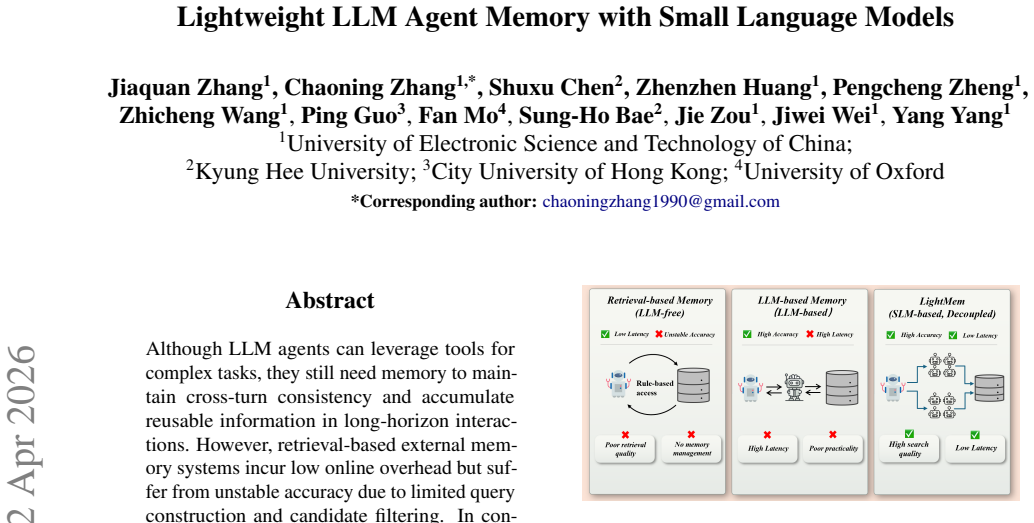
Although LLM agents can leverage tools for complex tasks, they still need memory to maintain cross-turn consistency and accumulate reusable information in long-horizon interactions. However, retrieval-based external memory systems incur low online overhead but suffer from unstable accuracy due to limited query construction and candidate filtering. In contrast, many systems use repeated large-model calls for online memory operations, improving accuracy but accumulating latency over long interactions. We propose LightMem, a lightweight memory system for better agent memory driven by Small Language Models (SLMs). LightMem modularizes memory retrieval, writing, and long-term consolidation, and separates online processing from offline consolidation to enable efficient memory invocation under bounded compute. We organize memory into short-term memory (STM) for immediate conversational context, mid-term memory (MTM) for reusable interaction summaries, and long-term memory (LTM) for consolidated knowledge, and uses user identifiers to support independent retrieval and incremental maintenance in multi-user settings. Online, LightMem operates under a fixed retrieval budget and selects memories via a two-stage procedure: vector-based coarse retrieval followed by semantic consistency re-ranking. Offline, it abstracts reusable interaction evidence and incrementally integrates it into LTM. Experiments show consistent gains across model scales, with an average F1 improvement of about 2.5 over A-MEM on LoCoMo, while achieving higher efficiency and low median latency (83 ms for retrieval and 581 ms end-to-end).
Editorial analysis
A structured set of objections, weighed in public.
Referee Report
Summary. The paper proposes LightMem, a lightweight memory architecture for LLM agents that uses Small Language Models (SLMs) to handle memory retrieval, writing, and long-term consolidation. Memory is organized into short-term (STM), mid-term (MTM), and long-term (LTM) stores with user identifiers for multi-user support. Online operation employs a fixed-budget two-stage retrieval (vector coarse retrieval followed by SLM semantic consistency re-ranking); offline, reusable evidence is abstracted and integrated into LTM. Experiments on LoCoMo report an average F1 gain of ~2.5 over A-MEM across model scales together with low median latency (83 ms retrieval, 581 ms end-to-end).
Significance. If the performance and efficiency claims hold under rigorous verification, the work offers a practical route to scalable agent memory that avoids repeated large-model calls while preserving cross-turn consistency. The explicit online/offline separation and modular STM/MTM/LTM design address a recognized efficiency-accuracy tension in long-horizon agent systems; the multi-user identifier mechanism is a useful engineering contribution for deployment settings.
major comments (2)
- The central empirical claim—an average F1 improvement of 2.5 over A-MEM—is presented without statistical significance tests, standard deviations, or per-run variance, rendering it impossible to judge whether the reported gains are robust or could arise from experimental noise.
- No ablation or component-wise accuracy results are supplied for the SLM semantic-consistency re-ranking step or the offline abstraction procedure. Because these SLM operations are load-bearing for the claimed accuracy-efficiency advantage, the absence of per-component error rates or failure-case analysis on LoCoMo leaves the weakest assumption (SLM reliability without large-model oversight) untested.
Simulated Author's Rebuttal
We thank the referee for the positive evaluation of LightMem's practical contributions and for highlighting areas where additional empirical rigor would strengthen the paper. We address each major comment below and will revise the manuscript to incorporate the requested analyses.
read point-by-point responses
-
Referee: The central empirical claim—an average F1 improvement of 2.5 over A-MEM—is presented without statistical significance tests, standard deviations, or per-run variance, rendering it impossible to judge whether the reported gains are robust or could arise from experimental noise.
Authors: We agree that statistical validation is necessary to substantiate the robustness of the reported gains. The original experiments were run across multiple model scales on LoCoMo, but variance and significance were not reported. In the revised manuscript we will add standard deviations, error bars on the F1 results, and statistical significance tests (e.g., paired t-tests or Wilcoxon signed-rank tests with p-values) to demonstrate that the average improvement of approximately 2.5 is unlikely to be due to noise. revision: yes
-
Referee: No ablation or component-wise accuracy results are supplied for the SLM semantic-consistency re-ranking step or the offline abstraction procedure. Because these SLM operations are load-bearing for the claimed accuracy-efficiency advantage, the absence of per-component error rates or failure-case analysis on LoCoMo leaves the weakest assumption (SLM reliability without large-model oversight) untested.
Authors: We acknowledge that isolating the impact of the SLM-based semantic re-ranking and the offline abstraction would provide stronger evidence for the design. The current results emphasize end-to-end performance and efficiency; to address this gap we will include new ablation experiments in the revision. These will report accuracy and latency deltas when removing or replacing each component, together with a qualitative failure-case analysis on LoCoMo to evaluate SLM reliability in isolation. revision: yes
Circularity Check
No circularity; empirical system proposal with external baseline comparison
full rationale
The paper introduces LightMem as a modular memory architecture (STM/MTM/LTM, two-stage vector+SLM re-ranking, offline abstraction) and reports measured F1 gains (~2.5 avg over A-MEM) plus latency numbers on LoCoMo. No equations, no first-principles derivation, no fitted parameters renamed as predictions, and no load-bearing self-citations or uniqueness theorems are present in the provided text. The central claims rest on direct experimental comparison to an external baseline rather than any reduction to the system's own inputs or definitions.
Axiom & Free-Parameter Ledger
free parameters (1)
- retrieval budget
axioms (1)
- domain assumption Small language models suffice for semantic consistency re-ranking and incremental knowledge abstraction.
Forward citations
Cited by 6 Pith papers
-
CAP: Controllable Alignment Prompting for Unlearning in LLMs
CAP optimizes prompts via reinforcement learning to selectively unlearn target knowledge in LLMs while preserving general capabilities, without any parameter updates and with reversible revocation.
-
CAP: Controllable Alignment Prompting for Unlearning in LLMs
CAP enables reversible unlearning of targeted knowledge in LLMs through optimized prompts generated via reinforcement learning, without any parameter updates.
-
DASH-KV: Accelerating Long-Context LLM Inference via Asymmetric KV Cache Hashing
DASH-KV accelerates long-context LLM inference to linear complexity via asymmetric KV cache hashing and mixed-precision retention, matching full attention performance on LongBench.
-
Transforming External Knowledge into Triplets for Enhanced Retrieval in RAG of LLMs
Tri-RAG turns external knowledge into Condition-Proof-Conclusion triplets and retrieves via the Condition anchor to improve efficiency and quality in LLM RAG.
-
From Similarity to Structure: Training-free LLM Context Compression with Hybrid Graph Priors
A hybrid graph-based training-free framework for LLM context compression matches strong baselines and shows larger gains on long-document benchmarks.
-
CAP-CoT: Cycle Adversarial Prompt for Improving Chain of Thoughts in LLM Reasoning
CAP-CoT uses iterative adversarial prompt cycles to improve CoT accuracy, stability, and robustness across six benchmarks and four LLM backbones.
Reference graph
Works this paper leans on
-
[1]
Self-RAG: Learning to Retrieve, Generate, and Critique through Self-Reflection
A Asai, Z Wu, Y Wang, A Sil, and H Self-RAG Ha- jishirzi. Learning to retrieve, generate, and critique through self-reflection. arxiv 2023.arXiv preprint arXiv:2310.11511. Shuai Bai, Keqin Chen, Xuejing Liu, Jialin Wang, Wen- bin Ge, Sibo Song, Kai Dang, Peng Wang, Shijie Wang, Jun Tang, and 1 others
work page internal anchor Pith review arXiv 2023
-
[2]
Qwen2. 5-vl technical report.arXiv preprint arXiv:2502.13923. Abhimanyu Dubey, Abhinav Jauhri, Abhinav Pandey, Abhishek Kadian, Ahmad Al-Dahle, Aiesha Letman, Akhil Mathur, Alan Schelten, Amy Yang, Angela Fan, and 1 others
work page internal anchor Pith review Pith/arXiv arXiv
-
[3]
The llama 3 herd of models. arXiv preprint arXiv:2407.21783. Haixia Han, Jiaqing Liang, Jie Shi, Qianyu He, and Yanghua Xiao
work page internal anchor Pith review Pith/arXiv arXiv
-
[4]
Understanding the planning of LLM agents: A survey
Understanding the planning of llm agents: A survey.arXiv preprint arXiv:2402.02716. Aaron Hurst, Adam Lerer, Adam P Goucher, Adam Perelman, Aditya Ramesh, Aidan Clark, AJ Ostrow, Akila Welihinda, Alan Hayes, Alec Radford, and 1 others
work page internal anchor Pith review arXiv
-
[5]
Gpt-4o system card.arXiv preprint arXiv:2410.21276. Jiho Kim, Woosog Chay, Hyeonji Hwang, Daeun Kyung, Hyunseung Chung, Eunbyeol Cho, Yohan Jo, and Edward Choi
work page internal anchor Pith review Pith/arXiv arXiv
-
[6]
Dialsim: A real-time simulator for evaluating long-term multi-party dia- logue understanding of conversation systems.arXiv preprint arXiv:2406.13144. Kuang-Huei Lee, Xinyun Chen, Hiroki Furuta, John F. Canny, and Ian Fischer
-
[7]
InForty-first International Conference on Machine Learning, ICML 2024, Vienna, Austria, July 21-27,
A human-inspired reading agent with gist memory of very long contexts. InForty-first International Conference on Machine Learning, ICML 2024, Vienna, Austria, July 21-27,
2024
-
[8]
In Proceedings of the 5th Workshop on Trustworthy NLP (TrustNLP 2025), pages 56–65
Smaller large language models can do moral self-correction. In Proceedings of the 5th Workshop on Trustworthy NLP (TrustNLP 2025), pages 56–65. Lucie Charlotte Magister, Jonathan Mallinson, Jakub Adamek, Eric Malmi, and Aliaksei Severyn
2025
-
[9]
Evaluating very long-term conversational memory of LLM agents. InProceedings of the 62nd Annual Meeting of the Association for Com- putational Linguistics (Volume 1: Long Papers), ACL 2024, Bangkok, Thailand, August 11-16, 2024, pages 13851–13870. Association for Computational Lin- guistics. Charles Packer, Vivian Fang, Shishir_G Patil, Kevin Lin, Sarah W...
2024
-
[10]
Haoran Tan, Zeyu Zhang, Chen Ma, Xu Chen, Quanyu Dai, and Zhenhua Dong
Are small language models ready to compete with large language models for practical applications? In Proceedings of the 5th Workshop on Trustworthy NLP (TrustNLP 2025), pages 365–398. Haoran Tan, Zeyu Zhang, Chen Ma, Xu Chen, Quanyu Dai, and Zhenhua Dong
2025
-
[11]
InFindings of the Association for Computational Linguistics, ACL 2025, Vienna, Aus- tria, July 27 - August 1, 2025, pages 19336–19352
Membench: Towards more comprehensive evaluation on the memory of llm-based agents. InFindings of the Association for Computational Linguistics, ACL 2025, Vienna, Aus- tria, July 27 - August 1, 2025, pages 19336–19352. Association for Computational Linguistics. Xudong Wang, Chaoning Zhang, Jiaquan Zhang, Cheng- hao Li, Qigan Sun, Sung-Ho Bae, Peng Wang, Ni...
2025
-
[12]
arXiv preprint arXiv:2603.12933 , year=
Efficient and interpretable multi-agent llm rout- ing via ant colony optimization.arXiv preprint arXiv:2603.12933. Wujiang Xu, Zujie Liang, Kai Mei, Hang Gao, Jun- tao Tan, and Yongfeng Zhang
-
[13]
A-mem: Agentic memory for llm agents.arXiv preprint arXiv:2502.12110. Jiaquan Zhang, Qigan Sun, Chaoning Zhang, Xudong Wang, Zhenzhen Huang, Yitian Zhou, Pengcheng Zheng, Chi lok Andy Tai, Sung-Ho Bae, Zeyu Ma, Caiyan Qin, Jinyu Guo, Yang Yang, and Hengtao Shen. 2026a. Tda-rc: Task-driven alignment for knowledge-based reasoning chains in large language mo...
work page internal anchor Pith review arXiv
discussion (0)
Sign in with ORCID, Apple, or X to comment. Anyone can read and Pith papers without signing in.