Recognition: unknown
Effective strings and particles interacting in 3D: the Ising model
Pith reviewed 2026-05-10 16:46 UTC · model grok-4.3
The pith
A fluctuating domain wall in three dimensions interacts with the lightest bulk mode through a single renormalized coupling that sets several observables.
A machine-rendered reading of the paper's core claim, the machinery that carries it, and where it could break.
Core claim
An effective interaction between the fluctuating domain wall and the lightest bulk massive mode remains controlled when bulk exchange is nearly on-shell and parallel momentum is small; in this regime several observables, including the large-Lz correction to the wall free energy and the large transverse tail of two-point functions, are governed by one renormalized dimensionless coupling.
What carries the argument
The effective interaction between the wall and the lightest bulk massive mode, governed by a renormalized dimensionless coupling.
If this is right
- The large-Lz correction to the wall free energy is fixed by the renormalized coupling.
- The large transverse tail of two-point functions in the presence of the wall is fixed by the same coupling.
- Universal kinematic signatures such as rough-wall broadening and nearby Gaussian behavior appear independently of other operator details.
- One-point functions and two-point functions in the nearby regime retain non-universal dependence on the bulk spectrum.
Where Pith is reading between the lines
- The same effective description may be tested in other three-dimensional lattice models that support domain walls.
- The framework could be extended to compute higher-point functions once the coupling is fixed by the two-point data.
- Lattice artifacts in the simulations could be reduced by studying larger volumes to isolate the universal regime more cleanly.
Load-bearing premise
The effective interaction description stays controlled when bulk exchange is nearly on-shell and momentum along the wall remains small.
What would settle it
Monte Carlo measurements on the three-dimensional Ising model with anti-periodic boundaries that fail to exhibit the predicted rough-wall broadening or the nearby Gaussian shape of two-point functions would falsify the claim.
Figures
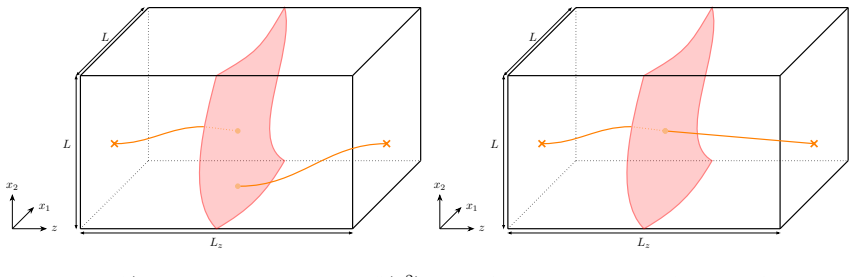

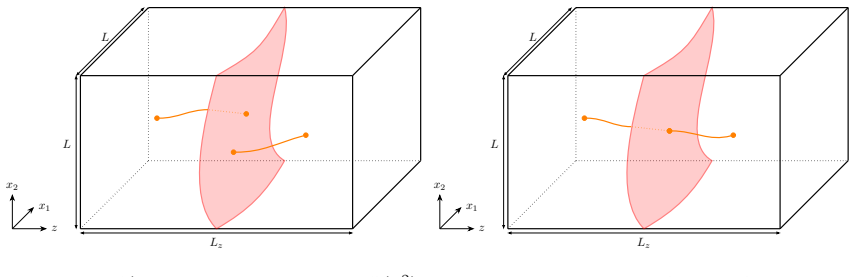


read the original abstract
We study how a fluctuating domain wall in three dimensions modifies bulk observables in a gapped phase. We introduce an effective interaction between the wall and the lightest bulk massive mode, and identify the regime in which this description is controlled: nearly on-shell bulk exchange with small momentum along the wall. In this regime, several observables are controlled by a renormalized dimensionless coupling $\lambda$, including the large-$L_z$ correction to the wall free energy and the large-$|x_\perp|$ tail of two-point functions in the presence of the wall. Other observables, such as one-point functions and two-point functions in the nearby-regime, retain non-universal dependence on operator data and on the bulk spectral density. We test the universal kinematic consequences of wall fluctuations, and find good agreement with the predicted rough-wall broadening and nearby Gaussian behavior in Monte Carlo simulations of the 3D Ising model with anti-periodic boundary conditions.
Editorial analysis
A structured set of objections, weighed in public.
Referee Report
Summary. The manuscript introduces an effective interaction between a fluctuating domain wall and the lightest bulk massive mode in the gapped phase of the 3D Ising model. It identifies a controlled regime of nearly on-shell bulk exchange with small momentum parallel to the wall, in which several observables—including the large-Lz correction to the wall free energy and the large-|x_⊥| tail of two-point functions—are governed by a single renormalized dimensionless coupling λ. Other observables retain non-universal dependence on operator data. Monte Carlo simulations of the 3D Ising model with anti-periodic boundary conditions are used to test the universal kinematic consequences, reporting good agreement with predicted rough-wall broadening and nearby Gaussian behavior.
Significance. If the effective description holds in the claimed regime, the work provides a simplified framework for universal kinematic features of wall-bulk interactions in 3D gapped systems, reducing dependence on full spectral data to a single coupling λ for selected observables. The Monte Carlo agreement for rough-wall broadening and Gaussian behavior is a concrete strength that directly supports the kinematic predictions.
major comments (2)
- [§4] §4 (Monte Carlo tests): The agreement is reported only for rough-wall broadening and nearby Gaussian behavior, but the central claim requires explicit confirmation that the simulated volumes and correlation lengths place the system inside the nearly on-shell, small-momentum regime; without quantitative checks (e.g., ξ/L ratios or off-shell suppression estimates), the universality independent of other operator data remains unverified and load-bearing for the effective-interaction description.
- [§2] Introduction and §2 (effective interaction): λ is introduced as a renormalized coupling whose value is fixed by matching or data, yet the manuscript does not show an independent determination of λ prior to predicting the large-Lz free-energy correction and |x_⊥| tails; this creates a circularity risk for the claim that these observables are controlled solely by λ once the kinematic regime is entered.
minor comments (2)
- [Abstract] Abstract: Define the notation L_z and x_⊥ at first use to improve accessibility for readers outside the immediate subfield.
- The manuscript would benefit from a short table contrasting universal vs. non-universal observables in the effective regime.
Simulated Author's Rebuttal
We thank the referee for the careful reading and constructive comments on our manuscript. The points raised help clarify the verification of the effective regime and the role of the coupling λ. We address each major comment below and have revised the manuscript to incorporate additional checks and clarifications.
read point-by-point responses
-
Referee: [§4] §4 (Monte Carlo tests): The agreement is reported only for rough-wall broadening and nearby Gaussian behavior, but the central claim requires explicit confirmation that the simulated volumes and correlation lengths place the system inside the nearly on-shell, small-momentum regime; without quantitative checks (e.g., ξ/L ratios or off-shell suppression estimates), the universality independent of other operator data remains unverified and load-bearing for the effective-interaction description.
Authors: We agree that explicit quantitative checks would strengthen the confirmation that the simulations are in the nearly on-shell regime. In the revised manuscript, we will add estimates of the bulk correlation length ξ (extracted from two-point functions), the ratios ξ/L for the simulated volumes, and a discussion of the parallel momentum scales relative to the mass gap to demonstrate off-shell suppression. The reported agreement with rough-wall broadening and Gaussian behavior is consistent with entry into this regime, but these additions will make the verification of the kinematic universality more rigorous and explicit. revision: yes
-
Referee: [§2] Introduction and §2 (effective interaction): λ is introduced as a renormalized coupling whose value is fixed by matching or data, yet the manuscript does not show an independent determination of λ prior to predicting the large-Lz free-energy correction and |x_⊥| tails; this creates a circularity risk for the claim that these observables are controlled solely by λ once the kinematic regime is entered.
Authors: The Monte Carlo tests focus on the universal kinematic consequences of the wall fluctuations in the nearly on-shell, small-momentum regime, including rough-wall broadening and nearby Gaussian behavior. These predictions follow from the kinematics and are independent of the specific value of λ as well as other operator data. The coupling λ governs the amplitude of effects in observables such as the large-Lz free-energy correction and distant |x_⊥| tails. We will revise the text to clarify that λ can be fixed independently by matching to one observable (for example, fitting the amplitude of the free-energy correction) and then used to predict others, thereby removing any potential circularity. The current tests validate the regime itself without requiring a predetermined numerical value for λ. revision: partial
Circularity Check
No significant circularity detected
full rationale
The paper introduces an effective interaction between the domain wall and bulk massive mode, identifies a kinematic regime (nearly on-shell exchange, small wall-parallel momentum), and derives that certain observables become controlled by a single renormalized coupling λ. These consequences are then confronted with independent Monte Carlo data on the 3D Ising model, showing agreement on rough-wall broadening and nearby Gaussian behavior. No quoted equation or step reduces by construction to a fit, self-definition, or load-bearing self-citation; the effective description supplies new, externally testable content rather than renaming or recycling its inputs.
Axiom & Free-Parameter Ledger
free parameters (1)
- λ
axioms (1)
- domain assumption The system resides in a gapped phase with a well-defined lightest bulk massive mode.
invented entities (1)
-
effective interaction between fluctuating wall and lightest bulk mode
no independent evidence
Forward citations
Cited by 1 Pith paper
-
Protected operators in non-local defect CFTs from AdS
Defect-induced symmetry breaking viewed from the AdS bulk enforces protected displacement and tilt operators in non-local boundary CFTs via Ward identities.
Reference graph
Works this paper leans on
-
[1]
Z. Komargodski and S. Zhong, Baryon junction and string interactions, Phys. Rev. D110 (2024) 056018 [2405.12005]
-
[2]
M. Caselle, N. Magnoli, D. Panfalone and L. Verzichelli, The mass of the baryon junction: a lattice computation in 2 + 1 dimensions, JHEP12(2025) 019 [2508.00608]
-
[3]
Nambu, Strings, Monopoles and Gauge Fields, Phys
Y. Nambu, Strings, Monopoles and Gauge Fields, Phys. Rev. D10(1974) 4262
1974
-
[4]
Luscher, Symmetry Breaking Aspects of the Roughening Transition in Gauge Theories, Nucl
M. Luscher, Symmetry Breaking Aspects of the Roughening Transition in Gauge Theories, Nucl. Phys. B180(1981) 317
1981
-
[5]
Polchinski and A
J. Polchinski and A. Strominger, Effective string theory, Phys. Rev. Lett.67(1991) 1681
1991
-
[6]
M. Caselle, F. Gliozzi and S. Vinti, Finite size effects in the interface of 3-D Ising model, Phys. Lett. B302(1993) 74 [hep-lat/9212013]
-
[7]
M. Caselle, F. Gliozzi, S. Vinti, R. Fiore, M. Hasenbusch and K. Pinn, Rough interfaces beyond the Gaussian approximation, Nucl. Phys. B Proc. Suppl.42(1995) 755 [hep-lat/9411042]
-
[8]
The partition function of interfaces from the Nambu-Goto effective string theory
M. Billo, M. Caselle and L. Ferro, The Partition function of interfaces from the Nambu-Goto effective string theory, JHEP02(2006) 070 [hep-th/0601191]
work page Pith review arXiv 2006
-
[9]
M. Caselle, M. Hasenbusch and M. Panero, The Interface free energy: Comparison of accurate Monte Carlo results for the 3D Ising model with effective interface models, JHEP 09(2007) 117 [0707.0055]. – 23 –
-
[10]
Effective String Theory Revisited
S. Dubovsky, R. Flauger and V. Gorbenko, Effective String Theory Revisited, JHEP09 (2012) 044 [1203.1054]
work page Pith review arXiv 2012
-
[11]
The Effective Theory of Long Strings
O. Aharony and Z. Komargodski, The Effective Theory of Long Strings, JHEP05(2013) 118 [1302.6257]
work page Pith review arXiv 2013
-
[12]
Evidence for a new particle on the worldsheet of the QCD flux tube
S. Dubovsky, R. Flauger and V. Gorbenko, Evidence from Lattice Data for a New Particle on the Worldsheet of the QCD Flux Tube, Phys. Rev. Lett.111(2013) 062006 [1301.2325]
work page Pith review arXiv 2013
-
[13]
Towards a Theory of the QCD String
S. Dubovsky and V. Gorbenko, Towards a Theory of the QCD String, JHEP02(2016) 022 [1511.01908]
work page Pith review arXiv 2016
-
[14]
Flux Tube Spectra from Approximate Integrability at Low Energies
S. Dubovsky, R. Flauger and V. Gorbenko, Flux Tube Spectra from Approximate Integrability at Low Energies, J. Exp. Theor. Phys.120(2015) 399 [1404.0037]
work page Pith review arXiv 2015
-
[15]
P. Conkey and S. Dubovsky, Four Loop Scattering in the Nambu-Goto Theory, JHEP05 (2016) 071 [1603.00719]
-
[16]
E. Beratto, M. Bill` o and M. Caselle,T ¯Tdeformation of the compactified boson and its interpretation in lattice gauge theory, Phys. Rev. D102(2020) 014504 [1912.08654]
-
[17]
A. Athenodorou and M. Teper, SU(N) gauge theories in 3+1 dimensions: glueball spectrum, string tensions and topology, JHEP12(2021) 082 [2106.00364]
-
[18]
O. Aharony, N. Barel and T. Sheaffer, Effective strings in QED 3, JHEP03(2025) 143 [2412.01313]
-
[19]
Effective string theory on a torus: the 3d Ising domain wall,
D. Lima, J.M.V.P. Lopes, J. Matos and J. Penedones, Effective string theory on a torus: the 3d Ising domain wall,2510.15206
-
[20]
Luscher, Volume Dependence of the Energy Spectrum in Massive Quantum Field Theories
M. Luscher, Volume Dependence of the Energy Spectrum in Massive Quantum Field Theories. 1. Stable Particle States, Commun. Math. Phys.104(1986) 177
1986
-
[21]
J. Polchinski, String theory. Vol. 1: An introduction to the bosonic string, Cambridge Monographs on Mathematical Physics, Cambridge University Press (12, 2007), 10.1017/CBO9780511816079
-
[22]
M. Muller and G. Munster, Profile and width of rough interfaces, J. Statist. Phys.118 (2005) 669 [cond-mat/0405673]
- [23]
-
[24]
M. Hasenbusch, S. Meyer and M. Putz, The Roughening transition of the 3-D Ising interface: A Monte Carlo study, J. Statist. Phys.85(1996) 383 [hep-lat/9601011]
-
[25]
Mon, D.P
K.K. Mon, D.P. Landau and D. Stauffer, Interface roughening in the three-dimensional ising model, Phys. Rev. B42(1990) 545
1990
-
[26]
Berg and T
B.A. Berg and T. Neuhaus, Multicanonical algorithms for first order phase transitions, Phys. Lett. B267(1991) 249
1991
-
[27]
Lee, A New Monte Carlo algorithm: Entropic sampling, Phys
J. Lee, A New Monte Carlo algorithm: Entropic sampling, Phys. Rev. Lett.71(1993) 211
1993
-
[28]
F. Wang and D.P. Landau, Efficient, Multiple-Range Random Walk Algorithm to Calculate the Density of States, Phys. Rev. Lett.86(2001) 2050 [cond-mat/0011174]
-
[29]
Trebst, D.A
S. Trebst, D.A. Huse and M. Troyer, Optimizing the ensemble for equilibration in broad-histogram monte carlo simulations, Phys. Rev. E70(2004) 046701. – 24 –
2004
-
[30]
Viana Lopes, M.D
J. Viana Lopes, M.D. Costa, J.M.B. Lopes dos Santos and R. Toral, Optimized multicanonical simulations: A proposal based on classical fluctuation theory, Phys. Rev. E 74(2006) 046702
2006
-
[31]
Do Dark Matter Axions Form a Condensate with Long-Range Correlation?,
A.H. Guth, M.P. Hertzberg and C. Prescod-Weinstein, Do Dark Matter Axions Form a Condensate with Long-Range Correlation?, Phys. Rev. D92(2015) 103513 [1412.5930]
-
[32]
M. Caselle, E. Cellini, A. Nada, D. Panfalone and L. Verzichelli, Intrinsic Width of the Flux Tube as a tool to explore confining mechanisms in Lattice Gauge Theories,2601.19520
-
[33]
L. Verzichelli, M. Caselle, E. Cellini, A. Nada and D. Panfalone, Intrinsic Width of the flux tube in 2+1 dimensional Yang-Mills theories, in 42th International Symposium on Lattice Field Theory, 3, 2026 [2603.05323]
-
[34]
Luscher, G
M. Luscher, G. Munster and P. Weisz, How Thick Are Chromoelectric Flux Tubes?, Nucl. Phys. B180(1981) 1
1981
-
[35]
M. Caselle, F. Gliozzi, U. Magnea and S. Vinti, Width of long color flux tubes in lattice gauge systems, Nucl. Phys. B460(1996) 397 [hep-lat/9510019]
-
[36]
M. Reehorst, Rigorous bounds on irrelevant operators in the 3d Ising model CFT, JHEP09 (2022) 177 [2111.12093]. – 25 –
discussion (0)
Sign in with ORCID, Apple, or X to comment. Anyone can read and Pith papers without signing in.