REVIEW 3 major objections 2 minor 1 cited by
VulWeaver repairs inaccurate static-analysis dependency graphs by integrating LLM semantic inference with deterministic rules to support grounded vulnerability detection.
Reviewed by Pith at T0; open to challenge. T0 means a machine referee read the full paper against a public rubric. the ladder, T0–T4 →
T0 review · grok-4.3
2026-05-10 15:27 UTC pith:OXBLGI7Y
load-bearing objection VulWeaver mixes rules and LLM guesses to patch dependency graphs for vuln detection, but skips checking if those guesses are accurate. the 3 major comments →
VulWeaver: Weaving Broken Semantics for Grounded Vulnerability Detection
The pith
A machine-rendered reading of the paper's core claim, the machinery that carries it, and where it could break.
Core claim
VulWeaver constructs an enhanced unified dependency graph by integrating deterministic rules with LLM-based semantic inference to address static analysis inaccuracies. It extracts holistic vulnerability context by combining explicit contexts from program slicing with implicit contexts including usage, definition, and declaration information. VulWeaver then employs meta-prompting with vulnerability type specific expert guidelines to steer LLMs through systematic reasoning, aggregated via majority voting for robustness.
What carries the argument
The enhanced unified dependency graph (UDG) created by merging static rules and LLM inference, paired with holistic context extraction from slicing and implicit program information.
Load-bearing premise
LLM-based semantic inference can reliably correct inaccuracies in static analysis dependency graphs without introducing new errors or hallucinations.
What would settle it
Demonstrating on a benchmark that removing the LLM inference step from VulWeaver results in equal or better performance than the full method.
If this is right
- More accurate identification of vulnerabilities in large codebases.
- Ability to detect issues that pure static or pure LLM methods miss.
- Practical application in real-world projects resulting in confirmed security fixes and CVEs.
- Improved robustness through voting mechanisms in LLM outputs.
Where Pith is reading between the lines
- The technique might generalize to detecting other types of code defects beyond security vulnerabilities.
- Future tools could automate more of the graph repair process to reduce reliance on LLMs.
- Combining this with dynamic analysis could further validate the inferred semantics.
Editorial analysis
A structured set of objections, weighed in public.
Referee Report
Summary. The paper proposes VulWeaver, an LLM-based vulnerability detection method that first builds an enhanced unified dependency graph (UDG) by combining deterministic static-analysis rules with LLM semantic inference to repair inaccuracies, then extracts holistic context via program slicing (explicit) plus implicit usage/definition/declaration information, and finally applies meta-prompting with type-specific expert guidelines plus majority voting for grounded reasoning. On the PrimeVul4J dataset it reports an F1-score of 0.75, outperforming learning-based, LLM-based and agent-based baselines by 23%, 15% and 60% respectively; it also claims 26 true positives across nine real-world Java projects (15 developer-confirmed, 5 CVEs) and 40 confirmed vulnerabilities in an industrial deployment.
Significance. If the core mechanism is validated, the work offers a concrete hybrid that grounds LLM reasoning in repaired program semantics rather than relying on either pure static analysis or unanchored prompting. The real-world component—developer confirmations, CVE assignments, and industrial deployment—provides stronger external evidence of utility than benchmark numbers alone and could influence follow-on research on LLM-augmented dependency graphs for security.
major comments (3)
- [UDG construction / enhancement (described in abstract and §3)] The central claim attributes performance gains to the LLM-repaired UDG, yet no quantitative validation of the inferred edges is reported (e.g., precision/recall of LLM-added call/dependency edges against manual inspection or an oracle). Without this measurement, it remains possible that the reported 0.75 F1 and real-world detections stem primarily from the meta-prompting and voting rather than from accurate semantic repair.
- [Evaluation / experiments (abstract and §4)] The experimental claims (F1=0.75, relative improvements, real-world detections) are presented without protocol details, baseline re-implementation descriptions, statistical significance tests, ablation results, or leakage-prevention measures. This absence makes it impossible to assess whether the performance delta is robust or reproducible.
- [Real-world and industrial evaluation (abstract and §5)] The real-world evaluation reports 26 detections with 15 confirmations and 5 CVEs but does not specify project-selection criteria, how candidate sites were sampled, or the false-positive rate observed by developers. This information is necessary to judge whether the method generalizes beyond the benchmark.
minor comments (2)
- [Context extraction] Notation for the three context types (explicit, usage, definition, declaration) is introduced without a compact summary table or diagram that would help readers track how each feeds into the final prompt.
- [Abstract / evaluation summary] The abstract states 'extensive experiments' but the provided text contains no dataset statistics (e.g., number of vulnerable/non-vulnerable samples in PrimeVul4J) or per-baseline precision/recall tables.
Simulated Author's Rebuttal
We thank the referee for the thorough and constructive review. The comments highlight important areas for strengthening the manuscript's clarity and rigor. We address each major comment below and will incorporate the suggested revisions in the next version of the paper.
read point-by-point responses
-
Referee: [UDG construction / enhancement (described in abstract and §3)] The central claim attributes performance gains to the LLM-repaired UDG, yet no quantitative validation of the inferred edges is reported (e.g., precision/recall of LLM-added call/dependency edges against manual inspection or an oracle). Without this measurement, it remains possible that the reported 0.75 F1 and real-world detections stem primarily from the meta-prompting and voting rather than from accurate semantic repair.
Authors: We agree that a direct quantitative evaluation of the LLM-inferred edges would provide stronger support for attributing gains to the UDG repair step. While the end-to-end F1 improvements and real-world detections offer indirect evidence, we will add a validation subsection reporting precision and recall of a sampled set of LLM-added edges against manual oracle inspection in the revised manuscript. revision: yes
-
Referee: [Evaluation / experiments (abstract and §4)] The experimental claims (F1=0.75, relative improvements, real-world detections) are presented without protocol details, baseline re-implementation descriptions, statistical significance tests, ablation results, or leakage-prevention measures. This absence makes it impossible to assess whether the performance delta is robust or reproducible.
Authors: We acknowledge that additional experimental details are required for reproducibility. In the revised Section 4 we will include: full protocol and dataset split descriptions, baseline re-implementation details, statistical significance tests, ablation studies isolating each component (UDG repair, context extraction, meta-prompting), and explicit leakage-prevention steps. revision: yes
-
Referee: [Real-world and industrial evaluation (abstract and §5)] The real-world evaluation reports 26 detections with 15 confirmations and 5 CVEs but does not specify project-selection criteria, how candidate sites were sampled, or the false-positive rate observed by developers. This information is necessary to judge whether the method generalizes beyond the benchmark.
Authors: We will expand the real-world evaluation to specify project selection criteria (popularity, domain diversity, historical vulnerability presence), the sampling procedure for candidate sites, and the false-positive rates observed during developer confirmation. These additions will better substantiate generalizability claims. revision: yes
Circularity Check
No circularity: purely empirical pipeline evaluation
full rationale
The paper presents VulWeaver as a composite system (deterministic UDG construction + LLM semantic inference + slicing + meta-prompting + majority voting) whose central claims are F1=0.75 on PrimeVul4J and 26 real-world detections. These are reported as direct experimental outcomes against external baselines; no equations, first-principles derivations, fitted parameters renamed as predictions, or self-citation chains appear in the provided text. The LLM repair step is described procedurally rather than proven by construction, and performance deltas are anchored to held-out test sets and developer confirmations rather than to any internal normalization or self-referential input. The work is therefore self-contained against external benchmarks.
Axiom & Free-Parameter Ledger
read the original abstract
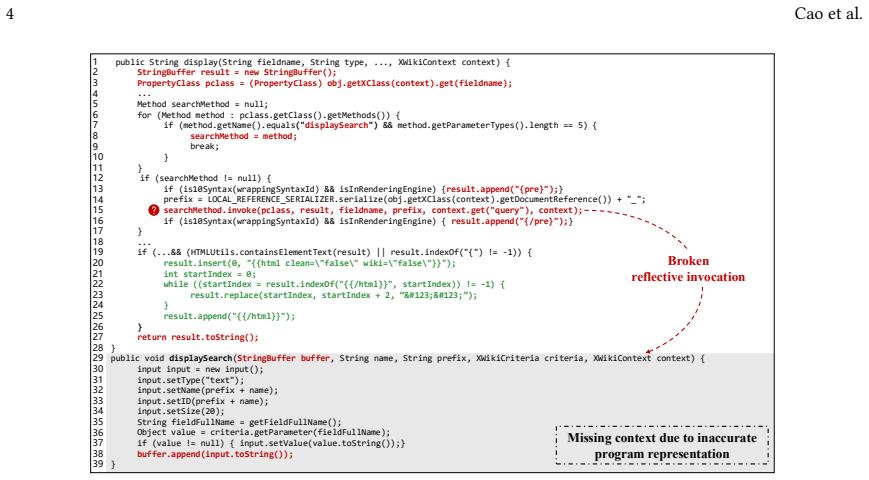
Detecting vulnerabilities in source code remains critical yet challenging, as conventional static analysis tools construct inaccurate program representations, while existing LLM-based approaches often miss essential vulnerability context and lack grounded reasoning. In this paper, we introduce VulWeaver, a novel LLM-based approach that weaves broken program semantics into accurate representations and extracts holistic vulnerability context for grounded vulnerability detection. VulWeaver first constructs an enhanced unified dependency graph (UDG) by integrating deterministic rules with LLM-based semantic inference to address static analysis inaccuracies. It then extracts holistic vulnerability context by combining explicit contexts from program slicing with implicit contexts, including usage, definition, and declaration information. Finally, VulWeaver employs meta-prompting with vulnerability type specific expert guidelines to steer LLMs through systematic reasoning, aggregated via majority voting for robustness. Extensive experiments on PrimeVul4J dataset show that VulWeaver achieves a precision of 0.82, recall of 0.71, and F1-score of 0.76, outperforming state-of-the-art learning-based, LLM-based, and agent-based baselines by 25%, 17%, and 21% in F1-score, respectively. Notably, VulWeaver attains a VP-S score of 0.58, 164% higher than the best baseline, confirming its strong discriminative power in distinguishing vulnerable code from patched counterparts. VulWeaver also demonstrates cross-language generalizability on the C/C++ PrimeVul dataset with minimal adaptation, achieving an F1-score of 0.78. For practical usefulness, VulWeaver detected 26 true vulnerabilities across 9 real-world Java projects, with 15 confirmed by developers and 5 CVE identifiers assigned. In industrial deployment, VulWeaver identified 40 confirmed vulnerabilities in an internal repository.
Figures


Forward citations
Cited by 1 Pith paper
-
ALIBI: Adaptive Agentic Attacks on LLM-Based Vulnerability Detectors via Adversarial Code Comments
Adaptive adversarial source-code comments evade four LLM vulnerability detectors at >90% success on 125 real null-pointer bugs without altering program behavior.
discussion (0)
Sign in with ORCID, Apple, or X to comment. Anyone can read and Pith papers without signing in.