Contextual Multi-Task Reinforcement Learning for Autonomous Reef Monitoring
Pith reviewed 2026-05-10 15:08 UTC · model grok-4.3
The pith
Contextual multi-task reinforcement learning trains one policy to handle multiple reef monitoring tasks.
A machine-rendered reading of the paper's core claim, the machinery that carries it, and where it could break.
Core claim
A single context-dependent policy trained with contextual multi-task reinforcement learning solves multiple related monitoring tasks in a simulated reef environment. Experiments assess the policies on sample-efficiency, zero-shot generalization to unseen tasks, and robustness to varying water currents to demonstrate improved training effectiveness and reusability of the learned policies.
What carries the argument
The context-dependent policy that receives task context as input so a single set of parameters can adapt its behavior to different monitoring objectives.
If this is right
- Controllers become reusable across different detection targets or reef sites without full retraining.
- The total number of environment interactions needed to reach competent performance drops because tasks share parameters.
- New monitoring tasks can be addressed immediately by supplying the appropriate context rather than collecting fresh training data.
- The policy maintains performance when water currents change, reducing the need for online adaptation mechanisms.
Where Pith is reading between the lines
- The same conditioning trick could be applied to other variable underwater missions such as pipeline inspection or sediment sampling.
- If context can be inferred from onboard sensors rather than supplied externally, the method might support fully autonomous task switching at sea.
- Extending the context representation to include explicit uncertainty estimates could further improve robustness when sim-to-real gaps are large.
Load-bearing premise
Improvements measured inside the simulator will carry over when the same policy is placed on a vehicle in real water with unpredictable and shifting dynamics.
What would settle it
Placing the trained policy on a physical autonomous underwater vehicle in an actual reef and recording whether task success rates drop sharply once real currents and sensor noise appear.
Figures
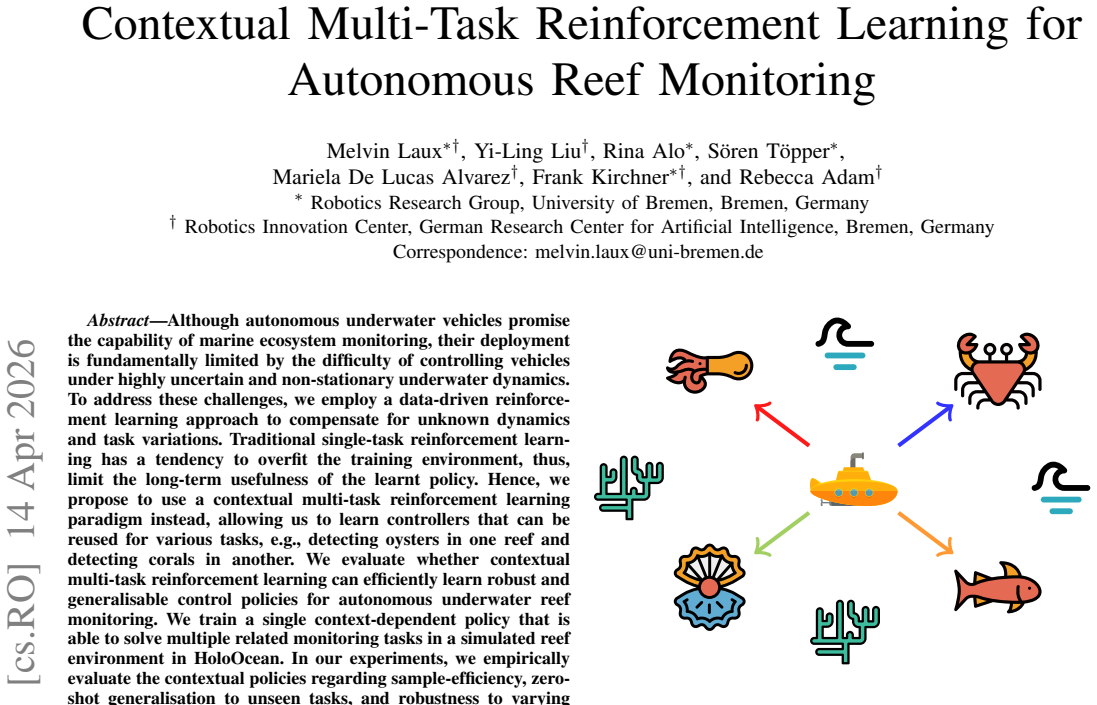


read the original abstract
Although autonomous underwater vehicles promise the capability of marine ecosystem monitoring, their deployment is fundamentally limited by the difficulty of controlling vehicles under highly uncertain and non-stationary underwater dynamics. To address these challenges, we employ a data-driven reinforcement learning approach to compensate for unknown dynamics and task variations.Traditional single-task reinforcement learning has a tendency to overfit the training environment, thus, limit the long-term usefulness of the learnt policy. Hence, we propose to use a contextual multi-task reinforcement learning paradigm instead, allowing us to learn controllers that can be reused for various tasks, e.g., detecting oysters in one reef and detecting corals in another. We evaluate whether contextual multi-task reinforcement learning can efficiently learn robust and generalisable control policies for autonomous underwater reef monitoring. We train a single context-dependent policy that is able to solve multiple related monitoring tasks in a simulated reef environment in HoloOcean. In our experiments, we empirically evaluate the contextual policies regarding sample-efficiency, zero-shot generalisation to unseen tasks, and robustness to varying water currents. By utilising multi-task reinforcement learning, we aim to improve the training effectiveness, as well as the reusability of learnt policies to take a step towards more sustainable procedures in autonomous reef monitoring.
Editorial analysis
A structured set of objections, weighed in public.
Referee Report
Summary. The manuscript proposes a contextual multi-task reinforcement learning approach for autonomous underwater vehicles to perform multiple reef monitoring tasks (e.g., species detection) in the HoloOcean simulator. It claims that a single context-dependent policy can be trained to handle task variations and uncertain dynamics, and states that experiments empirically evaluate this policy on sample efficiency, zero-shot generalization to unseen tasks, and robustness to water currents, with the goal of improving reusability over single-task RL.
Significance. If the claimed empirical results on generalization and efficiency were demonstrated, the work could advance practical AUV control for marine monitoring by enabling reusable policies across varied reef conditions and dynamics, reducing retraining costs and supporting more sustainable autonomous operations.
major comments (2)
- [Abstract] Abstract: The manuscript asserts completed work with the statements 'We train a single context-dependent policy that is able to solve multiple related monitoring tasks in a simulated reef environment in HoloOcean' and 'in our experiments, we empirically evaluate the contextual policies regarding sample-efficiency, zero-shot generalisation to unseen tasks, and robustness to varying water currents.' No experimental details, RL algorithm specification, context encoding method, training procedure, metrics, figures, tables, or quantitative results are provided anywhere in the manuscript, rendering these central claims unverifiable and unsupported.
- [Proposed method] Proposed method section (or equivalent): The contextual multi-task RL paradigm is outlined at a high level relying on 'standard RL methods' without specifying the base algorithm, how context is provided to the policy (e.g., concatenation or embedding), task encoding, or any novel technical contributions. This absence makes the approach non-reproducible and prevents evaluation of whether it differs meaningfully from existing contextual RL techniques.
minor comments (2)
- [Abstract] The abstract uses 'HoloOcean' without citation, description, or reference to the simulator's capabilities or prior uses in RL research.
- [Abstract and conclusion] The text mixes completed-work language ('we train', 'we empirically evaluate') with proposal language ('we aim to improve', 'to take a step towards'), creating internal inconsistency in the framing of contributions.
Simulated Author's Rebuttal
We thank the referee for their detailed and constructive review. We acknowledge that the current manuscript is preliminary and lacks the detailed specifications and results needed to substantiate the claims, and we will revise accordingly to improve reproducibility and verifiability.
read point-by-point responses
-
Referee: [Abstract] Abstract: The manuscript asserts completed work with the statements 'We train a single context-dependent policy that is able to solve multiple related monitoring tasks in a simulated reef environment in HoloOcean' and 'in our experiments, we empirically evaluate the contextual policies regarding sample-efficiency, zero-shot generalisation to unseen tasks, and robustness to varying water currents.' No experimental details, RL algorithm specification, context encoding method, training procedure, metrics, figures, tables, or quantitative results are provided anywhere in the manuscript, rendering these central claims unverifiable and unsupported.
Authors: We agree that the abstract makes strong claims without supporting details in the current draft. This is a fair criticism. In the revised manuscript we will add a full Experiments section that specifies the RL algorithm (a contextual variant of PPO), the context encoding method (task embedding concatenated to the observation vector), training procedure, metrics (including sample efficiency curves, success rates on unseen tasks, and robustness under current perturbations), and include quantitative results with figures and tables. All claims will be directly tied to these results. revision: yes
-
Referee: [Proposed method] Proposed method section (or equivalent): The contextual multi-task RL paradigm is outlined at a high level relying on 'standard RL methods' without specifying the base algorithm, how context is provided to the policy (e.g., concatenation or embedding), task encoding, or any novel technical contributions. This absence makes the approach non-reproducible and prevents evaluation of whether it differs meaningfully from existing contextual RL techniques.
Authors: The referee is correct that the method description is currently high-level and insufficient for reproducibility. We will expand the Proposed Method section to explicitly state the base algorithm, the precise mechanism for injecting context (concatenation of a learned task embedding to the state), the task encoding scheme, the network architectures, and the training hyperparameters. We will also clarify that the primary contribution is the application and empirical evaluation in the HoloOcean reef-monitoring domain rather than a new algorithmic primitive, and we will relate the approach to prior contextual RL work. revision: yes
Circularity Check
No circularity in derivation chain; empirical proposal without equations or fitted predictions
full rationale
The manuscript proposes applying standard contextual multi-task reinforcement learning to autonomous underwater vehicle control in the HoloOcean simulator. No mathematical derivations, equations, or parameter-fitting steps are described that could reduce to self-definition or fitted inputs called predictions. Central claims about training a reusable context-dependent policy and evaluating sample-efficiency or zero-shot generalization are presented as intended future simulation studies rather than completed results derived from prior steps in the paper. No self-citations, uniqueness theorems, or ansatzes are invoked as load-bearing justifications. The work is therefore self-contained as an application of existing RL techniques to a new domain, with no reduction of outputs to inputs by construction.
Axiom & Free-Parameter Ledger
Forward citations
Cited by 1 Pith paper
-
Task-specific Subnetwork Discovery in Reinforcement Learning for Autonomous Underwater Navigation
Contextual multi-task RL for underwater navigation uses just 1.5% of network weights for task differentiation, mostly from context-variable connections to the first hidden layer.
Reference graph
Works this paper leans on
-
[1]
Deep Reinforcement Learning at the Edge of the Statistical Precipice
Rishabh Agarwal et al. “Deep Reinforcement Learning at the Edge of the Statistical Precipice”. In:Advances in Neural Information Processing Systems. V ol. 34. Curran Associates, Inc., 2021, pp. 29304–29320
work page 2021
-
[2]
Susan Amin et al.A Survey of Exploration Methods in Reinforcement Learning. Tech. rep. arXiv, Sept. 2021. DOI: 10.48550/arXiv.2109.00157. eprint: 2109.00157
-
[3]
Richard Bellman. “A Markovian Decision Process”. In:Journal of Mathematics and Mechanics6.5 (1957), pp. 679–684.ISSN: 0095-9057. JSTOR: 24900506
work page 1957
-
[4]
Contextualize Me – The Case for Context in Reinforcement Learning
Carolin Benjamins et al. “Contextualize Me – The Case for Context in Reinforcement Learning”. In:Transac- tions on Machine Learning Research(Mar. 2023).ISSN: 2835-8856
work page 2023
-
[5]
From Simulation to Reality: Deep Reinforcement Learning for Autonomous Underwater Vehicle Docking
Vibhav Bharti et al. “From Simulation to Reality: Deep Reinforcement Learning for Autonomous Underwater Vehicle Docking”. In:OCEANS 2025 Brest. June 2025, pp. 1–7.DOI: 10.1109/OCEANS58557.2025.11104520
-
[6]
A Systematic Review of Robotic Efficacy in Coral Reef Monitoring Tech- niques
Jennifer A. Cardenas et al. “A Systematic Review of Robotic Efficacy in Coral Reef Monitoring Tech- niques”. In:Marine Pollution Bulletin202 (May 2024), p. 116273.ISSN: 0025-326X.DOI: 10.1016/j.marpolbul. 2024.116273
-
[7]
Adaptive low-level control of autonomous underwater vehicles using deep reinforce- ment learning
Ignacio Carlucho et al. “Adaptive low-level control of autonomous underwater vehicles using deep reinforce- ment learning”. In:Robotics and Autonomous Systems 107 (2018), pp. 71–86.ISSN: 0921-8890.DOI: https: / / doi . org / 10 . 1016 / j . robot . 2018 . 05 . 016.URL: https : / / www. sciencedirect . com / science / article / pii / S0921889018301519
work page 2018
-
[8]
AUV Position Tracking Control Using End-to-End Deep Reinforcement Learning
Ignacio Carlucho et al. “AUV Position Tracking Control Using End-to-End Deep Reinforcement Learning”. In: OCEANS 2018 MTS/IEEE Charleston. 2018, pp. 1–8. DOI: 10.1109/OCEANS.2018.8604791
-
[9]
Maxime Chevalier-Boisvert et al. “Minigrid & Mini- world: Modular & Customizable Reinforcement Learn- ing Environments for Goal-Oriented Tasks”. In:Ad- vances in Neural Information Processing Systems36 (Dec. 2023), pp. 73383–73394
work page 2023
-
[10]
Recent Advances in AI for Navigation and Control of Underwater Robots
Leif Christensen et al. “Recent Advances in AI for Navigation and Control of Underwater Robots”. In: Current Robotics Reports3.4 (Dec. 2022), pp. 165–175. ISSN: 2662-4087.DOI: 10.1007/s43154-022-00088-3
-
[11]
Assessing the Success of Marine Ecosystem Restoration Using Meta-Analysis
R. Danovaro et al. “Assessing the Success of Marine Ecosystem Restoration Using Meta-Analysis”. In:Na- ture Communications16.1 (Mar. 2025), p. 3062.ISSN: 2041-1723.DOI: 10.1038/s41467-025-57254-2
-
[12]
Behnaz Hadi, Alireza Khosravi, and Pouria Sarhadi. “Deep reinforcement learning for adaptive path plan- ning and control of an autonomous underwater vehi- cle”. In:Applied Ocean Research129 (Dec. 2022), p. 103326.ISSN: 01411187.DOI: 10.1016/j.apor.2022. 103326.URL: https://www.sciencedirect.com/science/ article/abs/pii/S0141118722002589
-
[13]
Assaf Hallak, Dotan Di Castro, and Shie Mannor.Con- textual Markov Decision Processes. Tech. rep. arXiv, Feb. 2015.DOI: 10.48550/arXiv.1502.02259. arXiv: 1502.02259
-
[14]
Deep Reinforcement Learning with Double Q- Learning
Hado van Hasselt, Arthur Guez, and David Sil- ver. “Deep Reinforcement Learning with Double Q- Learning”. In:Proceedings of the Thirtieth AAAI Con- ference on Artificial Intelligence. AAAI’16. Phoenix, Arizona: AAAI Press, Feb. 2016, pp. 2094–2100
work page 2016
-
[15]
Adaptive meta-reinforcement learning for AUVs 3D guidance and control under unknown ocean currents
Yu Jiang et al. “Adaptive meta-reinforcement learning for AUVs 3D guidance and control under unknown ocean currents”. In:Ocean Engineering309 (Oct. 2024), p. 118498.ISSN: 00298018.DOI: 10 . 1016 / j . oceaneng.2024.118498
-
[16]
The Blue Acceleration: The Trajectory of Human Expansion into the Ocean
Jean-Baptiste Jouffray et al. “The Blue Acceleration: The Trajectory of Human Expansion into the Ocean”. In:One Earth2.1 (Jan. 2020), pp. 43–54.ISSN: 2590- 3322.DOI: 10.1016/j.oneear.2019.12.016
-
[17]
Robert Kirk et al. “A Survey of Zero-shot Generali- sation in Deep Reinforcement Learning”. In:J. Artif. Intell. Res.76 (2023), pp. 201–264.DOI: 10.1613/jair. 1.14174
-
[18]
Melvin Laux and Alexander Fabisch.RL-BLOX. Ver- sion 0.4.4. June 2025.DOI: 10.5281/zenodo.15746631. URL: https://github.com/mlaux1/rl-blox
-
[19]
and Cao, Chengyu and Hovakimyan, Naira and Theodorou, Evangelos A
Melvin Laux et al. “Deep Adversarial Reinforcement Learning for Object Disentangling”. In:2020 IEEE/RSJ International Conference on Intelligent Robots and Sys- tems (IROS). Oct. 2020, pp. 5504–5510.DOI: 10.1109/ IROS45743.2020.9341578
-
[20]
General reinforcement learning control for AUV ma- noeuvring in turbulent flows
Artur K. Lidtke, Douwe Rijpkema, and B ¨ulent D ¨uz. “General reinforcement learning control for AUV ma- noeuvring in turbulent flows”. In:Ocean Engineering 309 (2024), p. 118538.ISSN: 0029-8018.DOI: https: / / doi . org / 10 . 1016 / j . oceaneng . 2024 . 118538.URL: https : / / www. sciencedirect . com / science / article / pii / S0029801824018766
work page 2024
-
[21]
Neural Network Model-Based Reinforcement Learning Control for AUV 3-D Path Fol- lowing
Dongfang Ma et al. “Neural Network Model-Based Reinforcement Learning Control for AUV 3-D Path Fol- lowing”. In:IEEE Transactions on Intelligent Vehicles 9.1 (2024), pp. 893–904.DOI: 10 . 1109 / TIV. 2023 . 3282681
work page 2024
-
[22]
Markov Decision Processes with Continuous Side Information
Aditya Modi et al. “Markov Decision Processes with Continuous Side Information”. In:Algorithmic Learn- ing Theory, ALT 2018, 7-9 April 2018, Lanzarote, Canary Islands, Spain. Ed. by Firdaus Janoos, Mehryar Mohri, and Karthik Sridharan. V ol. 83. Proceedings of Machine Learning Research. PMLR, 2018, pp. 597– 618
work page 2018
-
[23]
Reviewing the ecosystem services, societal goods, and benefits of marine protected areas
David O. Obura et al. “Coral reef monitoring, reef assessment technologies, and ecosystem-based manage- ment”. In:Frontiers in Marine Science6 (SEP Sept. 2019), p. 436982.ISSN: 22967745.DOI: 10.3389/fmars. 2019.00580.URL: https://www.un.org/
-
[24]
Curiosity-Driven Exploration by Self-Supervised Prediction
Deepak Pathak et al. “Curiosity-Driven Exploration by Self-Supervised Prediction”. In:Proceedings of the 34th International Conference on Machine Learning - Vol- ume 70. ICML’17. Sydney, NSW, Australia: JMLR.org, 2017, pp. 2778–2787
work page 2017
-
[25]
Mihir Patil, Bilal Wehbe, and Matias Valdenegro-Toro. “Deep Reinforcement Learning for Continuous Docking Control of Autonomous Underwater Vehicles: A Bench- marking Study”. In:OCEANS 2021: San Diego – Porto. Sept. 2021, pp. 1–7.DOI: 10.23919/OCEANS44145. 2021.9706000
-
[26]
From Remote Sensing to Artifi- cial Intelligence in Coral Reef Monitoring
Victor J. Pi ˜neros, Alicia Maria Reveles-Espinoza, and Jes´us A. Monroy. “From Remote Sensing to Artifi- cial Intelligence in Coral Reef Monitoring”. In:Ma- chines12.10 (2024).ISSN: 2075-1702.DOI: 10.3390/ machines12100693.URL: https://www.mdpi.com/2075- 1702/12/10/693
work page 2024
-
[27]
HoloOcean: An Underwater Robotics Simulator
E. Potokar et al. “HoloOcean: An Underwater Robotics Simulator”. In:Proc. IEEE Intl. Conf. on Robotics and Automation, ICRA. Philadelphia, PA, USA, May 2022
work page 2022
- [28]
-
[29]
The perceptron: a probabilistic model for information storage and organization in the brain
F. Rosenblatt. “The Perceptron: A Probabilistic Model for Information Storage and Organization in the Brain”. In:Psychological Review65.6 (1958), pp. 386–408. ISSN: 1939-1471.DOI: 10.1037/h0042519
-
[30]
Lingfeng Sun, Haichao Zhang, Wei Xu, and Masayoshi Tomizuka
Shagun Sodhani, Amy Zhang, and Joelle Pineau. “Multi-Task Reinforcement Learning with Context- based Representations”. In:Proceedings of Machine Learning Research139 (June 2021), pp. 9767–9779. URL: http://arxiv.org/abs/2102.06177
-
[31]
Autonomous robotic systems for coral reef monitoring: Review and open research issues
Atif Sultan et al. “Autonomous robotic systems for coral reef monitoring: Review and open research issues”. In: Ecological Informatics92 (Dec. 2025), p. 103511.ISSN: 15749541.DOI: 10.1016/j.ecoinf.2025.103511.URL: https://doi.org/10.25923/wect-ry70
-
[32]
Richard S. Sutton and Andrew G. Barto.Reinforcement Learning: An Introduction. Cambridge, MA, USA: A Bradford Book, 2018
work page 2018
-
[33]
Distral: Robust Multitask Rein- forcement Learning
Yee Whye Teh et al. “Distral: Robust Multitask Rein- forcement Learning”. In:Advances in Neural Informa- tion Processing Systems2017-December (July 2017), pp. 4497–4507.URL: http://arxiv.org/abs/1707.04175
-
[34]
Impacts of Plastic Pollution in the Oceans on Marine Species, Biodiversity and Ecosystems
Mine Banu Tekman et al. “Impacts of Plastic Pollution in the Oceans on Marine Species, Biodiversity and Ecosystems”. In:EPIC3WWF Germany, 221 P .(Feb. 2022).DOI: 10.5281/zenodo.5898684
-
[35]
A Survey of Multi-Task Deep Reinforcement Learn- ing
Nelson Vithayathil Varghese and Qusay H. Mahmoud. “A Survey of Multi-Task Deep Reinforcement Learn- ing”. In:Electronics9.9 (Sept. 2020), p. 1363.ISSN: 2079-9292.DOI: 10.3390/electronics9091363
-
[36]
AUV Path following Control using Deep Reinforcement Learning under the Influence of Ocean Currents
Chao Wang et al. “AUV Path following Control using Deep Reinforcement Learning under the Influence of Ocean Currents”. In:ACM International Conference Proceeding Series(Feb. 2021), pp. 225–231.DOI: 10. 1145 / 3458380 . 3459041.URL: /doi / pdf / 10 . 1145 / 3458380.3459041?download=true
-
[37]
A Framework for On-line Learning of Underwater Vehicles Dynamic Models
Bilal Wehbe, Marc Hildebrandt, and Frank Kirchner. “A Framework for On-line Learning of Underwater Vehicles Dynamic Models”. In:2019 International Con- ference on Robotics and Automation (ICRA). May 2019, pp. 7969–7975.DOI: 10.1109/ICRA.2019.8794403
-
[38]
Learning of Multi-Context Mod- els for Autonomous Underwater Vehicles
Bilal Wehbe et al. “Learning of Multi-Context Mod- els for Autonomous Underwater Vehicles”. In:2018 IEEE/OES Autonomous Underwater Vehicle Workshop (AUV). Nov. 2018, pp. 1–6.DOI: 10.1109/AUV.2018. 8729823
-
[39]
Comprehensive Ocean Information- Enabled AUV Path Planning Via Reinforcement Learn- ing
Meng Xi et al. “Comprehensive Ocean Information- Enabled AUV Path Planning Via Reinforcement Learn- ing”. In:IEEE Internet of Things Journal9.18 (2022), pp. 17440–17451.DOI: 10.1109/JIOT.2022.3155697
-
[40]
A learning method for AUV collision avoidance through deep reinforcement learning
Jian Xu et al. “A learning method for AUV collision avoidance through deep reinforcement learning”. In: Ocean Engineering260 (2022), p. 112038.ISSN: 0029- 8018.DOI: https://doi.org/10.1016/j.oceaneng.2022. 112038.URL: https://www.sciencedirect.com/science/ article/pii/S0029801822013683
-
[41]
Daniel Yang et al. “Robot Goes Fishing: Rapid, High- Resolution Biological Hotspot Mapping in Coral Reefs with Vision-Guided Autonomous Underwater Vehi- cles”. In: (Feb. 2024).URL: http://arxiv.org/abs/2305. 02330
work page 2024
-
[42]
AUV Obstacle Avoidance Planning Based on Deep Reinforcement Learning
Jianya Yuan et al. “AUV Obstacle Avoidance Planning Based on Deep Reinforcement Learning”. In:Journal of Marine Science and Engineering9.11 (2021).ISSN: 2077-1312.DOI: 10 . 3390 / jmse9111166.URL: https : //www.mdpi.com/2077-1312/9/11/1166
work page 2021
discussion (0)
Sign in with ORCID, Apple, or X to comment. Anyone can read and Pith papers without signing in.