Recognition: unknown
BID-LoRA: A Parameter-Efficient Framework for Continual Learning and Unlearning
Pith reviewed 2026-05-10 15:03 UTC · model grok-4.3
The pith
BID-LoRA uses three separate low-rank adapter paths plus escape unlearning to add new knowledge and delete old knowledge while limiting leakage across cycles.
A machine-rendered reading of the paper's core claim, the machinery that carries it, and where it could break.
Core claim
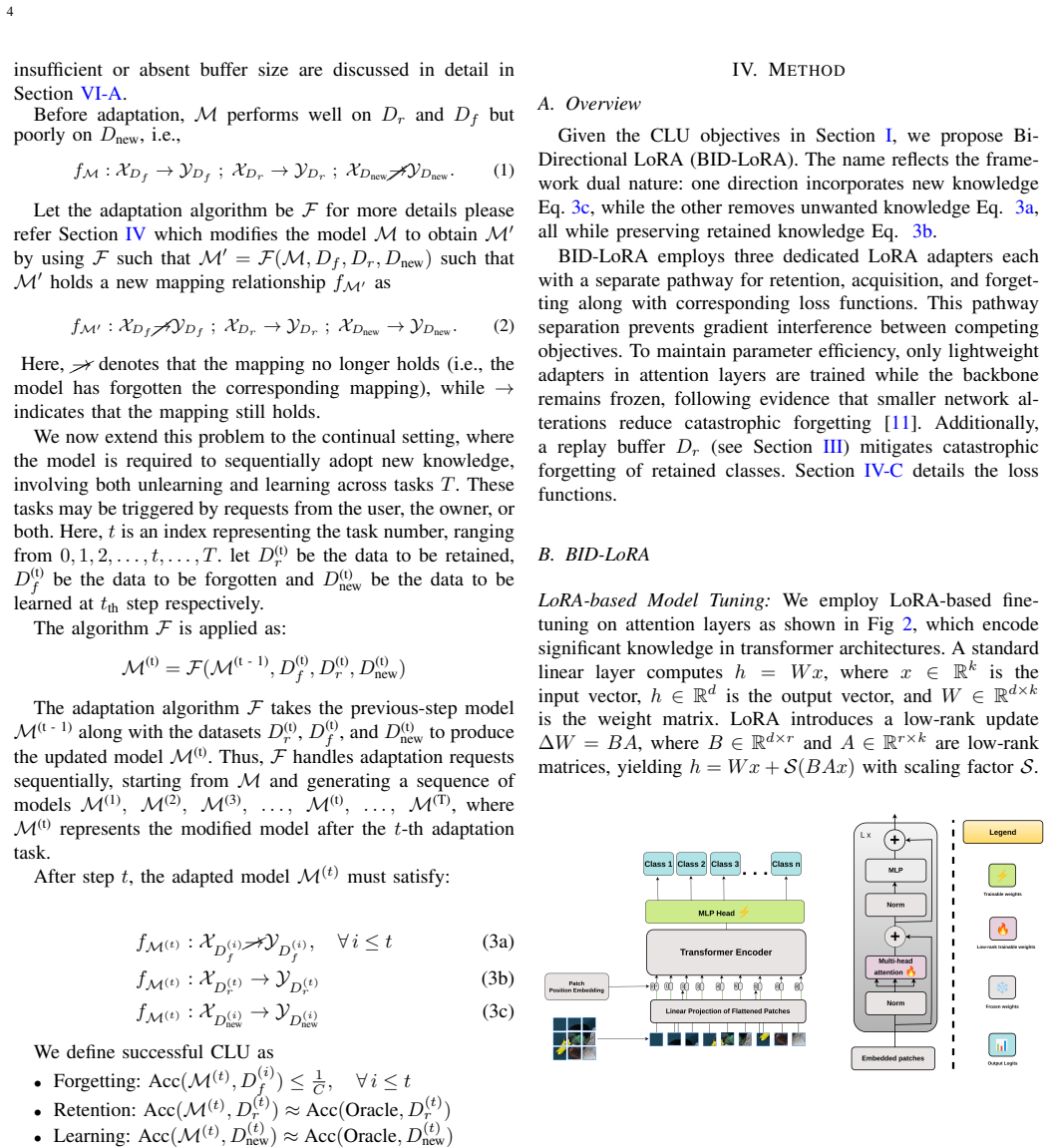
BID-LoRA is a parameter-efficient framework that applies three dedicated low-rank adapter pathways (retain, new, and unlearn) to attention layers together with escape unlearning that repositions forget-class embeddings at maximum distance from retained knowledge, thereby satisfying the three CLU goals of precise deletion, efficient integration, and minimal leakage while updating only 5 percent of parameters.
What carries the argument
Three dedicated adapter pathways (retain, new, unlearn) combined with escape unlearning that maximizes the distance of forget-class embeddings from retained knowledge.
If this is right
- Multiple cycles of adding and removing knowledge can be performed without progressive degradation of retained performance.
- Real-world identity systems can enroll new users and remove withdrawn users while updating only 5 percent of parameters.
- Unified CLU training reduces reliance on separate continual-learning and machine-unlearning pipelines.
- The same architecture applies to both image classification and face-recognition tasks without architecture changes.
Where Pith is reading between the lines
- The escape-unlearning distance mechanism could be tested on language models to forget specific training examples while acquiring new capabilities.
- Repeated-cycle stability might allow deployment in privacy-regulated environments where user data must be added and deleted on demand.
- The three-pathway design could be combined with other low-rank methods to handle larger base models.
Load-bearing premise
The three separate adapter pathways and escape unlearning together will block knowledge leakage and preserve retained-task accuracy without new instabilities or dataset-specific retuning.
What would settle it
If accuracy on retained classes declines or forgotten data can be reconstructed after several adaptation cycles on CIFAR-100 or CASIA-Face100, the leakage-prevention claim is falsified.
Figures



read the original abstract
Recent advances in deep learning underscore the need for systems that can not only acquire new knowledge through Continual Learning (CL) but also remove outdated, sensitive, or private information through Machine Unlearning (MU). However, while CL methods are well-developed, MU techniques remain in early stages, creating a critical gap for unified frameworks that depend on both capabilities. We find that naively combining existing CL and MU approaches results in knowledge leakage a gradual degradation of foundational knowledge across repeated adaptation cycles. To address this, we formalize Continual Learning Unlearning (CLU) as a unified paradigm with three key goals: (i) precise deletion of unwanted knowledge, (ii) efficient integration of new knowledge while preserving prior information, and (iii) minimizing knowledge leakage across cycles. We propose Bi-Directional Low-Rank Adaptation (BID-LoRA), a novel framework featuring three dedicated adapter pathways-retain, new, and unlearn applied to attention layers, combined with escape unlearning that pushes forget-class embeddings to positions maximally distant from retained knowledge, updating only 5% of parameters. Experiments on CIFAR-100 show that BID-LoRA outperforms CLU baselines across multiple adaptation cycles. We further evaluate on CASIA-Face100, a curated face recognition subset, demonstrating practical applicability to real-world identity management systems where new users must be enrolled and withdrawn users removed.
Editorial analysis
A structured set of objections, weighed in public.
Referee Report
Summary. The paper proposes BID-LoRA as a parameter-efficient framework for the unified Continual Learning Unlearning (CLU) paradigm. It introduces three dedicated low-rank adapter pathways (retain, new, and unlearn) applied to attention layers, combined with an escape unlearning strategy that pushes forget-class embeddings maximally distant from retained knowledge while updating only 5% of parameters. The central claims are that this prevents knowledge leakage across repeated adaptation cycles and outperforms existing CLU baselines on CIFAR-100, with additional evaluation on CASIA-Face100 demonstrating applicability to real-world identity management.
Significance. If the empirical results and stability claims hold, the work could be significant for addressing the gap between continual learning and machine unlearning in a single efficient framework. The 5% parameter update budget and explicit handling of leakage via dedicated pathways and embedding distancing offer a practical advance for privacy-sensitive continual adaptation tasks, such as enrolling and removing users in face recognition systems. The architectural separation of pathways is a clear strength if it can be shown to avoid the instabilities noted in naive combinations.
major comments (2)
- [Abstract] Abstract: The claim that 'Experiments on CIFAR-100 show that BID-LoRA outperforms CLU baselines across multiple adaptation cycles' supplies no quantitative metrics, baseline names, error bars, leakage measurement protocol, or cycle counts. This absence makes the central empirical claim unverifiable and load-bearing for the paper's contribution.
- [Method (escape unlearning)] Escape unlearning description: The strategy of maximizing embedding distance for forget classes assumes the retain and new adapters maintain stable decision boundaries without interference or gradient conflicts in a continual regime. No analysis of cross-pathway interactions, retained-class embedding distances, or boundary shifts under the 5% update constraint (applied only to attention layers) is provided, which directly undermines the no-leakage and stability guarantees.
minor comments (1)
- [Introduction] The three CLU goals are listed but could be more explicitly tied to the architectural choices in the introduction for improved clarity.
Simulated Author's Rebuttal
We thank the referee for the constructive feedback on our manuscript. We address each major comment below and will incorporate revisions to improve clarity and completeness.
read point-by-point responses
-
Referee: [Abstract] Abstract: The claim that 'Experiments on CIFAR-100 show that BID-LoRA outperforms CLU baselines across multiple adaptation cycles' supplies no quantitative metrics, baseline names, error bars, leakage measurement protocol, or cycle counts. This absence makes the central empirical claim unverifiable and load-bearing for the paper's contribution.
Authors: We agree that the abstract would be strengthened by including more specific details. In the revised manuscript, we will update the abstract to reference key quantitative results from the CIFAR-100 experiments, including accuracy metrics with error bars, the specific CLU baselines used for comparison, the leakage measurement protocol, and the number of adaptation cycles evaluated. Given typical abstract length constraints, we will prioritize the most salient metrics while ensuring the full experimental protocols, tables, and figures remain detailed in the Experiments section. revision: yes
-
Referee: [Method (escape unlearning)] Escape unlearning description: The strategy of maximizing embedding distance for forget classes assumes the retain and new adapters maintain stable decision boundaries without interference or gradient conflicts in a continual regime. No analysis of cross-pathway interactions, retained-class embedding distances, or boundary shifts under the 5% update constraint (applied only to attention layers) is provided, which directly undermines the no-leakage and stability guarantees.
Authors: We acknowledge this as a valid observation regarding the depth of analysis in the current draft. Although the empirical results demonstrate reduced leakage across cycles, the manuscript does not explicitly analyze cross-pathway interactions or boundary dynamics. In the revision, we will add a new analysis subsection (likely in Experiments or an extended Methods discussion) that quantifies: (i) embedding distances for both forget and retain classes before and after escape unlearning, (ii) potential interference or gradient conflicts among the retain/new/unlearn pathways, and (iii) decision boundary stability under the 5% parameter budget restricted to attention layers. This will include additional metrics, visualizations, and discussion to support the stability claims. revision: yes
Circularity Check
No circularity: BID-LoRA is an empirical architecture proposal with no self-referential derivations
full rationale
The paper defines BID-LoRA as a new three-pathway adapter architecture plus escape unlearning, then reports empirical outperformance on CIFAR-100 and CASIA-Face100. No equations, uniqueness theorems, or first-principles results are presented that reduce by construction to quantities defined in terms of the method's own fitted parameters or prior self-citations. The central claims rest on experimental comparisons rather than tautological redefinitions or load-bearing self-references.
Axiom & Free-Parameter Ledger
free parameters (1)
- adapter rank and scaling
axioms (2)
- domain assumption Independent low-rank adapters applied to attention layers can be trained without mutual interference or base-model degradation.
- ad hoc to paper Maximizing embedding distance for forget classes achieves precise deletion without collateral damage to retained knowledge.
invented entities (2)
-
retain, new, and unlearn adapter pathways
no independent evidence
-
escape unlearning
no independent evidence
Forward citations
Cited by 1 Pith paper
-
BackFlush: Knowledge-Free Backdoor Detection and Elimination with Watermark Preservation in Large Language Models
BackFlush detects backdoors via susceptibility amplification and eliminates them with RoPE unlearning to reach 1% ASR and 99% clean accuracy while preserving watermarks.
Reference graph
Works this paper leans on
-
[1]
Scaling Laws for Neural Language Models
J. Kaplan, S. McCandlish, T. Henighan, T. B. Brown, B. Chess, R. Child, S. Gray, A. Radford, J. Wu, and D. Amodei, “Scaling laws for neural language models,”arXiv preprint arXiv:2001.08361, 2020
work page internal anchor Pith review Pith/arXiv arXiv 2001
-
[2]
A unified framework for continual learning and unlearning.arXiv preprint arXiv:2408.11374,
R. Chatterjee, V . Chundawat, A. Tarun, A. Mali, and M. Mandal, “A unified framework for continual learning and unlearning,”arXiv preprint arXiv:2408.11374, 2024
-
[3]
Continual learning and private unlearning,
B. Liu, Q. Liu, and P. Stone, “Continual learning and private unlearning,” inConference on Lifelong Learning Agents. PMLR, 2022, pp. 243–254
2022
-
[4]
Overcoming catastrophic forgetting in neural networks,
J. Kirkpatrick, R. Pascanu, N. Rabinowitz, J. Veness, G. Desjardins, A. A. Rusu, K. Milan, J. Quan, T. Ramalho, A. Grabska-Barwinska et al., “Overcoming catastrophic forgetting in neural networks,”Pro- ceedings of the national academy of sciences, vol. 114, no. 13, pp. 3521–3526, 2017
2017
-
[5]
Dark experience for general continual learning: a strong, simple baseline,
P. Buzzega, M. Boschini, A. Porrello, D. Abati, and S. Calderara, “Dark experience for general continual learning: a strong, simple baseline,” Advances in neural information processing systems, vol. 33, pp. 15 920– 15 930, 2020
2020
-
[6]
New insights on reducing abrupt representation change in online continual learning,
L. Caccia, R. Aljundi, N. Asadi, T. Tuytelaars, J. Pineau, and E. Belilovsky, “New insights on reducing abrupt representation change in online continual learning,”arXiv preprint arXiv:2104.05025, 2021
-
[7]
Dytox: Trans- formers for continual learning with dynamic token expansion,
A. Douillard, A. Ram ´e, G. Couairon, and M. Cord, “Dytox: Trans- formers for continual learning with dynamic token expansion,” inPro- ceedings of the IEEE/CVF conference on computer vision and pattern recognition, 2022, pp. 9285–9295
2022
-
[8]
Exemplar-free continual learning of vision transformers via gated class- attention and cascaded feature drift compensation,
M. Cotogni, F. Yang, C. Cusano, A. D. Bagdanov, and J. van de Weijer, “Exemplar-free continual learning of vision transformers via gated class- attention and cascaded feature drift compensation,”International Journal of Computer Vision, pp. 1–19, 2025
2025
-
[9]
D3former: Debiased dual distilled transformer for incremental learning,
A. Mohamed, R. Grandhe, K. Joseph, S. Khan, and F. Khan, “D3former: Debiased dual distilled transformer for incremental learning,” inPro- ceedings of the IEEE/CVF Conference on Computer Vision and Pattern Recognition, 2023, pp. 2421–2430
2023
-
[10]
Towards unbounded machine unlearning,
M. Kurmanji, P. Triantafillou, J. Hayes, and E. Triantafillou, “Towards unbounded machine unlearning,”Advances in neural information pro- cessing systems, vol. 36, pp. 1957–1987, 2023
1957
-
[11]
Continual forgetting for pre-trained vision models,
H. Zhao, B. Ni, J. Fan, Y . Wang, Y . Chen, G. Meng, and Z. Zhang, “Continual forgetting for pre-trained vision models,” inProceedings of the IEEE/CVF Conference on Computer Vision and Pattern Recognition, 2024, pp. 28 631–28 642. 11
2024
-
[12]
Learning to unlearn: Instance-wise unlearning for pre-trained classifiers,
S. Cha, S. Cho, D. Hwang, H. Lee, T. Moon, and M. Lee, “Learning to unlearn: Instance-wise unlearning for pre-trained classifiers,” in Proceedings of the AAAI conference on artificial intelligence, vol. 38, no. 10, 2024, pp. 11 186–11 194
2024
-
[13]
arXiv preprint arXiv:2310.12508 (2023)
C. Fan, J. Liu, Y . Zhang, E. Wong, D. Wei, and S. Liu, “Salun: Em- powering machine unlearning via gradient-based weight saliency in both image classification and generation,”arXiv preprint arXiv:2310.12508, 2023
-
[14]
Fast yet effective machine unlearning,
A. K. Tarun, V . S. Chundawat, M. Mandal, and M. Kankanhalli, “Fast yet effective machine unlearning,”IEEE Transactions on Neural Networks and Learning Systems, vol. 35, no. 9, pp. 13 046–13 055, 2023
2023
-
[15]
An introduction to the california consumer privacy act (ccpa),
E. Goldman, “An introduction to the california consumer privacy act (ccpa),”Santa Clara Univ. Legal Studies Research Paper, 2020
2020
-
[16]
General data protection regulation (gdpr),
G. Data, “General data protection regulation (gdpr),”Intersoft Consult- ing, Accessed in October, vol. 24, no. 1, 2018
2018
-
[17]
Model inversion attacks that exploit confidence information and basic countermeasures,
M. Fredrikson, S. Jha, and T. Ristenpart, “Model inversion attacks that exploit confidence information and basic countermeasures,” in Proceedings of the 22nd ACM SIGSAC conference on computer and communications security, 2015, pp. 1322–1333
2015
-
[18]
Deep leakage from gradients,
L. Zhu, Z. Liu, and S. Han, “Deep leakage from gradients,”Advances in neural information processing systems, vol. 32, 2019
2019
-
[19]
The secret revealer: Generative model-inversion attacks against deep neural net- works,
Y . Zhang, R. Jia, H. Pei, W. Wang, B. Li, and D. Song, “The secret revealer: Generative model-inversion attacks against deep neural net- works,” inProceedings of the IEEE/CVF conference on computer vision and pattern recognition, 2020, pp. 253–261
2020
-
[20]
Parameter-efficient transfer learning for nlp,
N. Houlsby, A. Giurgiu, S. Jastrzebski, B. Morrone, Q. De Laroussilhe, A. Gesmundo, M. Attariyan, and S. Gelly, “Parameter-efficient transfer learning for nlp,” inInternational conference on machine learning. PMLR, 2019, pp. 2790–2799
2019
-
[21]
Lora: Low-rank adaptation of large language models
E. J. Hu, Y . Shen, P. Wallis, Z. Allen-Zhu, Y . Li, S. Wang, L. Wang, W. Chenet al., “Lora: Low-rank adaptation of large language models.” ICLR, vol. 1, no. 2, p. 3, 2022
2022
-
[22]
Prefix-Tuning: Optimizing Continuous Prompts for Generation
X. L. Li and P. Liang, “Prefix-tuning: Optimizing continuous prompts for generation,”arXiv preprint arXiv:2101.00190, 2021
work page internal anchor Pith review arXiv 2021
-
[23]
Transformer Feed-Forward Layers Are Key-Value Memories
M. Geva, R. Schuster, J. Berant, and O. Levy, “Transformer feed-forward layers are key-value memories,”arXiv preprint arXiv:2012.14913, 2020
work page internal anchor Pith review arXiv 2012
-
[24]
Packnet: Adding multiple tasks to a single network by iterative pruning,
A. Mallya and S. Lazebnik, “Packnet: Adding multiple tasks to a single network by iterative pruning,” inProceedings of the IEEE conference on Computer Vision and Pattern Recognition, 2018, pp. 7765–7773
2018
-
[25]
Piggyback: Adapting a single network to multiple tasks by learning to mask weights,
A. Mallya, D. Davis, and S. Lazebnik, “Piggyback: Adapting a single network to multiple tasks by learning to mask weights,” inProceedings of the European conference on computer vision (ECCV), 2018, pp. 67– 82
2018
-
[26]
Learning to prompt for continual learning,
Z. Wang, Z. Zhang, C.-Y . Lee, H. Zhang, R. Sun, X. Ren, G. Su, V . Perot, J. Dy, and T. Pfister, “Learning to prompt for continual learning,” inProceedings of the IEEE/CVF conference on computer vision and pattern recognition, 2022, pp. 139–149
2022
-
[27]
Continual stereo matching of continuous driving scenes with growing architecture,
C. Zhang, K. Tian, B. Fan, G. Meng, Z. Zhang, and C. Pan, “Continual stereo matching of continuous driving scenes with growing architecture,” inProceedings of the IEEE/CVF Conference on Computer Vision and Pattern Recognition, 2022, pp. 18 901–18 910
2022
-
[28]
Fast: Feature aware similarity thresholding for weak unlearning in black-box generative models,
S. Panda and A. Prathosh, “Fast: Feature aware similarity thresholding for weak unlearning in black-box generative models,”IEEE Transactions on Artificial Intelligence, 2024
2024
-
[29]
Malicious clients and contribution co- aware federated unlearning,
Y . Wang, X. Li, and S. Chen, “Malicious clients and contribution co- aware federated unlearning,”IEEE Transactions on Artificial Intelli- gence, 2025
2025
-
[30]
Gpt understands, too,
X. Liu, Y . Zheng, Z. Du, M. Ding, Y . Qian, Z. Yang, and J. Tang, “Gpt understands, too,”AI Open, vol. 5, pp. 208–215, 2024
2024
-
[31]
What would elsa do? freezing layers during transformer fine-tuning.arXiv preprint arXiv:1911.03090,
J. Lee, R. Tang, and J. Lin, “What would elsa do? freezing layers during transformer fine-tuning,”arXiv preprint arXiv:1911.03090, 2019
-
[32]
One-for-all: Generalized lora for parameter-efficient fine-tuning.arXiv preprint arXiv:2306.07967,
A. Chavan, Z. Liu, D. Gupta, E. Xing, and Z. Shen, “One-for-all: Generalized lora for parameter-efficient fine-tuning,”arXiv preprint arXiv:2306.07967, 2023
-
[33]
M. Valipour, M. Rezagholizadeh, I. Kobyzev, and A. Ghodsi, “Dylora: Parameter efficient tuning of pre-trained models using dynamic search- free low-rank adaptation,”arXiv preprint arXiv:2210.07558, 2022
-
[34]
Learning with selective forgetting
T. Shibata, G. Irie, D. Ikami, and Y . Mitsuzumi, “Learning with selective forgetting.” inIJCAI, vol. 3, 2021, p. 4
2021
-
[35]
Z. Huang, X. Cheng, J. Zhang, J. Zheng, H. Wang, Z. He, T. Li, and X. Huang, “A unified gradient-based framework for task-agnostic continual learning-unlearning,”arXiv preprint arXiv:2505.15178, 2025
-
[36]
An unlearning framework for continual learning.arXiv preprint arXiv:2509.17530, 2025
S. Adhikari, V . Kumaravelu, and P. Srijith, “An unlearning framework for continual learning,”arXiv preprint arXiv:2509.17530, 2025
-
[37]
Learning multiple layers of features from tiny images,
A. Krizhevsky, G. Hintonet al., “Learning multiple layers of features from tiny images,” 2009
2009
-
[38]
Training data-efficient image transformers & distillation through attention,
H. Touvron, M. Cord, M. Douze, F. Massa, A. Sablayrolles, and H. J ´egou, “Training data-efficient image transformers & distillation through attention,” inInternational conference on machine learning. PMLR, 2021, pp. 10 347–10 357
2021
-
[39]
Learning Face Representation from Scratch
D. Yi, Z. Lei, S. Liao, and S. Z. Li, “Learning face representation from scratch,”arXiv preprint arXiv:1411.7923, 2014
work page Pith review arXiv 2014
-
[40]
Face transformer for recognition,
Y . Zhong and W. Deng, “Face transformer for recognition,”arXiv preprint arXiv:2103.14803, 2021
-
[41]
Label- only membership inference attacks,
C. A. Choquette-Choo, F. Tramer, N. Carlini, and N. Papernot, “Label- only membership inference attacks,” inInternational conference on machine learning. PMLR, 2021, pp. 1964–1974
2021
-
[42]
Towards source-free machine unlearning,
S. M. Ahmed, U. Y . Basaran, D. S. Raychaudhuri, A. Dutta, R. Kundu, F. F. Niloy, B. Guler, and A. K. Roy-Chowdhury, “Towards source-free machine unlearning,” inProceedings of the Computer Vision and Pattern Recognition Conference, 2025, pp. 4948–4957
2025
-
[43]
Llm unlearning via loss adjustment with only forget data,
Y . Wang, J. Wei, C. Y . Liu, J. Pang, Q. Liu, A. P. Shah, Y . Bao, Y . Liu, and W. Wei, “Llm unlearning via loss adjustment with only forget data,” arXiv preprint arXiv:2410.11143, 2024
-
[44]
Erasing concepts from diffusion models,
R. Gandikota, J. Materzynska, J. Fiotto-Kaufman, and D. Bau, “Erasing concepts from diffusion models,” inProceedings of the IEEE/CVF international conference on computer vision, 2023, pp. 2426–2436
2023
discussion (0)
Sign in with ORCID, Apple, or X to comment. Anyone can read and Pith papers without signing in.