Knowing When to Quit: A Principled Framework for Dynamic Abstention in LLM Reasoning
Reviewed by Pith T0 review T1 audit T2 compute T3 formal T4 kernel 2026-07-05 12:09 UTCglm-5.2pith:U62UDQVYrecord.jsonopen to challenge →
The pith
Stop generating when confidence drops: a principled rule for LLM abstention
A machine-rendered reading of the paper's core claim, the machinery that carries it, and where it could break.
Core claim
The central object is the dynamic value-thresholding policy: at each token position, compare the value function V_0(s_{1:t})—the probability that the current partial generation will end in a correct answer—against the abstention reward r⊥, and halt if the former falls below the latter. The authors prove this policy achieves value dominance (its value function is everywhere at least as large as both the base policy's value and r⊥), which yields strict improvement over no abstention whenever abstention occurs with positive probability, dominance over fixed-position abstention via an explicit recovery-surplus term, and full optimality among all abstention-augmented policies when the base policy
What carries the argument
KL-regularized MDP formulation with augmented action space; value function V_β(s_{1:t}) reducing to P(correct | s_{1:t}) under binary rewards and zero KL; two-layer MLP probe trained with binary cross-entropy on final-layer hidden states; abstention reward r⊥ as a tunable threshold controlling the accuracy-compute frontier
If this is right
- If the value function can be cheaply estimated from hidden states, any LLM deployment with verifiable rewards can trade accuracy for compute savings by simply setting a threshold, with provable guarantees against degradation relative to the base policy.
- The framework extends to any bounded reward, not just binary correctness—continuous preference scores or partial-credit rubrics could plug in directly by switching the probe loss from BCE to MSE.
- The dominance proofs assume oracle value access; the gap between theory and practice depends entirely on whether hidden states encode enough information about eventual correctness for a small probe to extract.
- The cross-dataset transfer results suggest the probe captures general properties of reasoning trajectories rather than dataset-specific surface cues, which would make the method deployable without per-task retraining.
Where Pith is reading between the lines
- If hidden states at early token positions already encode substantial information about eventual correctness—as prior probing work suggests—then the bulk of compute savings come from aborting traces that are doomed from the start, and the dynamic advantage over input-only abstention may be smaller than the advantage over fixed-position abstention.
- A state-dependent abstention reward r⊥(s_{1:t}) that accounts for remaining generation length could capture the intuition that a nearly-complete high-confidence trace is worth continuing even at moderate confidence, potentially improving compute efficiency beyond the fixed-r⊥ rule.
- The Lipschitz improvement bound (Proposition 4.9) implies that models whose value functions change gradually—e.g., those that self-correct via phrases like 'wait'—benefit less from dynamic abstention in absolute terms, since the value drops slowly rather than cliff-diving.
- Combining dynamic value-thresholding with layer-wise early exit could yield compound compute savings along both the sequence and depth dimensions simultaneously.
Load-bearing premise
The theory assumes access to the true value function, but the practical method replaces it with a small MLP trained on hidden states. The bridge between the two—whether a two-layer probe on final-layer representations can actually recover the probability of eventual correctness—rests on a realizability assumption that is plausible but unproven, and no formal bound on performance degradation under approximation error is provided.
What would settle it
If a well-trained probe on hidden states cannot rank partial generations by probability of eventual correctness better than chance, the threshold rule would abstain at arbitrary points and the dominance guarantees would not transfer to the learned estimator.
Figures


read the original abstract
LLMs utilizing chain-of-thought reasoning often waste substantial compute by producing long, incorrect responses. Abstention can mitigate this by withholding outputs unlikely to be correct. While most abstention methods decide to withhold outputs before or after generation, dynamic mid-generation abstention considers early termination of unpromising reasoning traces at each token position. Prior work has explored empirical variants of this idea, but principled guidance for the abstention rule remains lacking. We present a formal analysis of dynamic abstention for LLMs, modeling abstention as an explicit action within a regularized reinforcement learning framework. An abstention reward parameter controls the trade-off between compute and information. We show that abstaining when the value function falls below this reward strictly outperforms natural baselines under general conditions. We further derive a principled and efficient method to approximate the value function. Empirical results on mathematical reasoning and toxicity avoidance tasks support our theory and demonstrate improved selective accuracy over existing methods.
Editorial analysis
A structured set of objections, weighed in public.
Referee Report
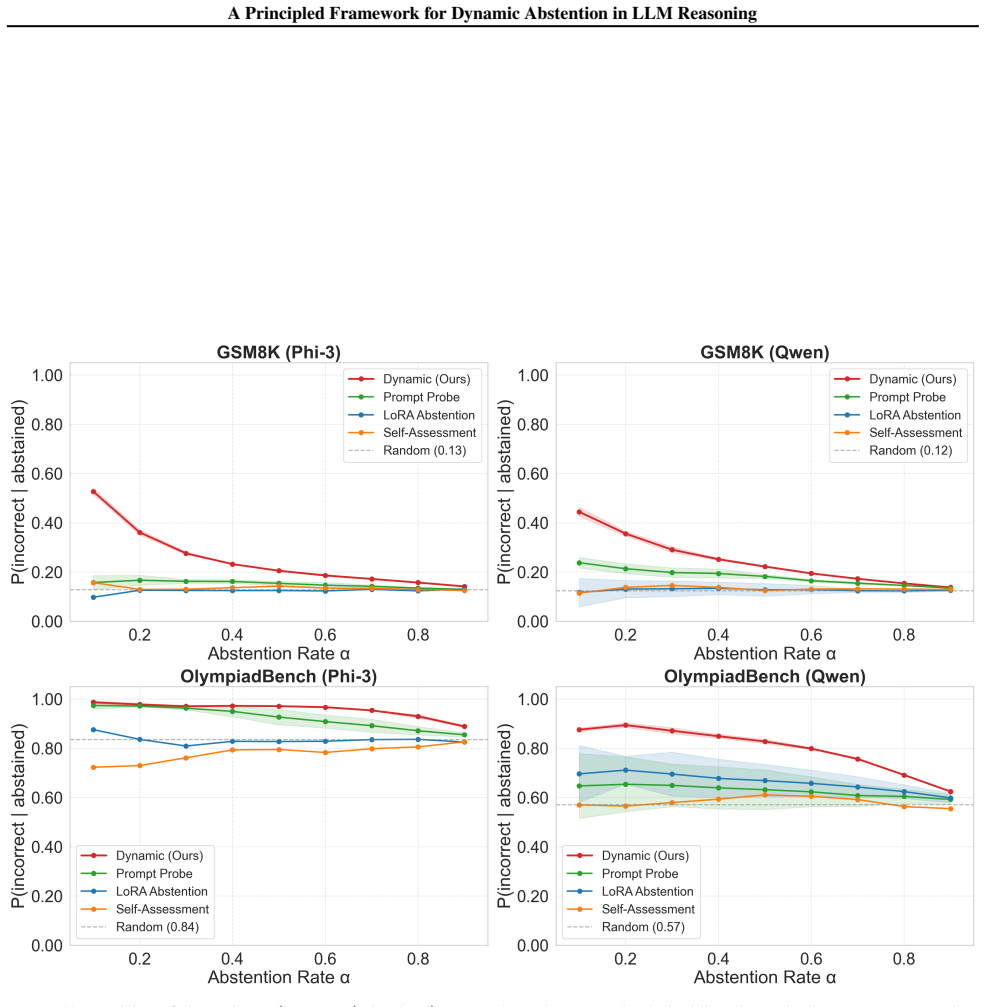
Summary. This paper presents a formal analysis of dynamic mid-generation abstention for LLMs. The authors model abstention as an explicit action in a KL-regularized RL framework, with a scalar abstention reward r⊥ controlling the accuracy-compute tradeoff. They prove that dynamic value-thresholding—abstaining when the value function falls below r⊥—dominates no-abstention and fixed-position abstention under general conditions (Propositions 4.2, 4.4), is optimal among all abstention-enabled policies when β=0 and the base policy is optimal (Proposition 4.7), and improves linearly in the abstention rate under a Lipschitz condition (Proposition 4.9). For practical instantiation, they show that under binary rewards and β=0, the value function reduces to P(correct | s_{1:t}), enabling estimation via a two-layer MLP probe trained with BCE on hidden states. Empirically, they evaluate on GSM8K, OlympiadBench, and RealToxicityPrompts with Qwen2.5-7B and Phi-3, showing improved selective accuracy over input-processing and fixed-position baselines across abstention rates.
Significance. The paper provides a clean theoretical framework connecting sequential selective classification to LLM reasoning abstention. The proofs (Appendix B) are correct: Lemma 4.1 by backward induction, Propositions 4.2/4.4 by direct application of value dominance, Proposition 4.7 by construction, and Proposition 4.9 by a careful stopping-time argument. The reduction of value estimation to binary cross-entropy (Proposition B.2) under realizability is a useful bridge between theory and practice. The empirical methodology is generally sound, with 5-seed averaging, calibration analysis (Appendix D), cross-dataset transfer (Section 6.3), and robustness checks (Appendix G). The code release and falsifiable predictions (e.g., linear improvement bound) are commendable.
major comments (1)
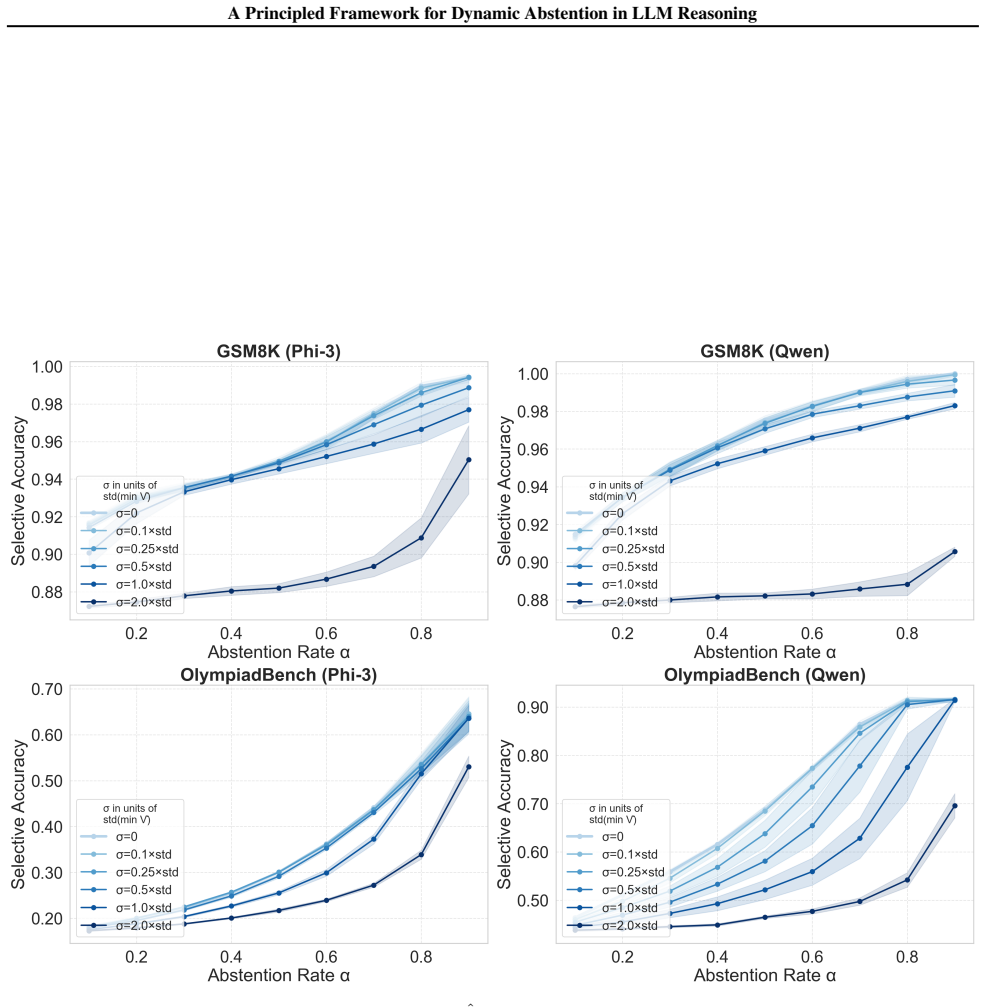
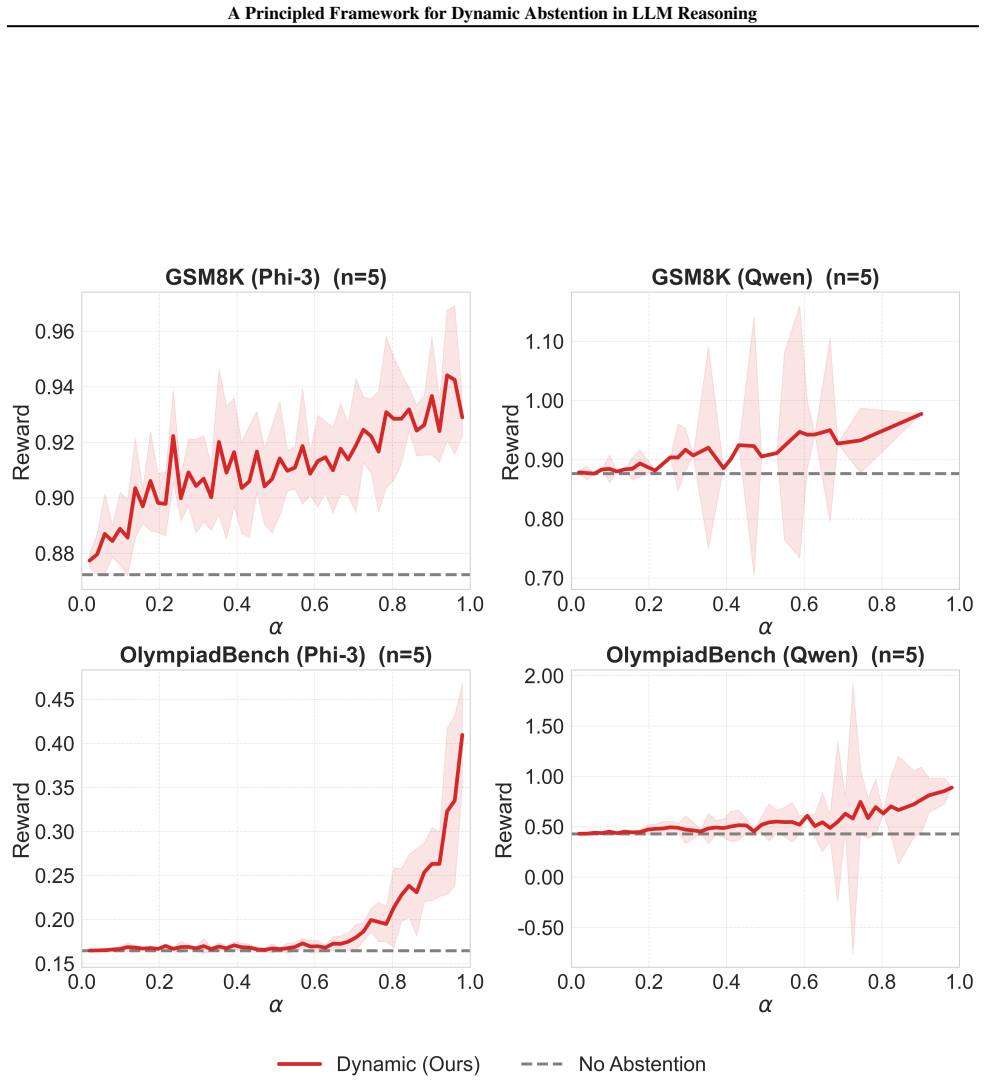
- §6.1, Figure 2 and Appendix K: The empirical comparison between dynamic and fixed-position abstention confounds the decision rule with training-data quantity. The dynamic probe is trained using Eq. (13), which sums BCE loss over all non-terminal positions of every trajectory, while the fixed-position Constant Step Probe baseline is 'retrained specifically at position k' (Appendix K), training only on position k. For GSM8K with ~100-token trajectories, the dynamic probe thus sees roughly 100x more training examples with shared parameters. The paper states this 'ensures a fair comparison,' but it gives the dynamic method two simultaneous advantages: (a) the dynamic decision rule (the theoretical contribution) and (b) substantially more training data. The empirical gap in Figure 2 could be largely attributable to (b) rather than (a). A cleaner comparison would train a single all-position-tf
minor comments (6)
- The paper uses several non-standard or inconsistent symbols (e.g., ⊥ for abstention token, r⊥ for reward, π⊥ for policy) that can be confusing on first read. A notation table would help.
- §6.1: The values of k (k=20 for GSM8K, k=100 for OlympiadBench) are described as 'arbitrary.' While the paper argues this arbitrariness supports the dynamic approach, reporting results for multiple k values would strengthen the empirical case.
- Appendix H mentions evaluation on 'Phi-3-small-8k-instruct and Mistral-7B-Instruct-v0.3' which do not appear in the main text. Clarify whether these were used and if so, why results are omitted.
- Figure 2: The token savings labels are useful but would benefit from a separate panel or table for clarity, as they overlap with the selective accuracy curves.
- §5, Eq. (13): The loss sums over non-terminal positions, but the definition of 'non-terminal' depends on the trajectory length c, which varies. Clarify how trajectories of different lengths are handled in the batch.
- The paper would benefit from citing and comparing to Manvi et al. (2024) more prominently in the main text, as their mid-generation self-evaluation approach is closely related.
Simulated Author's Rebuttal
We thank the referee for the careful reading and the positive assessment of our theoretical contributions, proofs, and empirical methodology. The referee raises one major concern regarding a potential confound in the fixed-position baseline comparison. We address this below and commit to a revision that resolves the issue.
read point-by-point responses
-
Referee: The empirical comparison between dynamic and fixed-position abstention confounds the decision rule with training-data quantity. The dynamic probe is trained using Eq. (13), which sums BCE loss over all non-terminal positions of every trajectory, while the fixed-position Constant Step Probe baseline is 'retrained specifically at position k' (Appendix K), training only on position k. For GSM8K with ~100-token trajectories, the dynamic probe thus sees roughly 100x more training examples with shared parameters. The paper states this 'ensures a fair comparison,' but it gives the dynamic method two simultaneous advantages: (a) the dynamic decision rule (the theoretical contribution) and (b) substantially more training data. The empirical gap in Figure 2 could be largely attributable to (b) rather than (a). A cleaner comparison would train a single all-position probe and evaluate it at both the
Authors: The referee raises a valid and important point. We agree that the current experimental design confounds the decision rule (dynamic vs. fixed-position) with training-data quantity (all-position loss vs. position-k-only loss). This is a genuine weakness in the baseline comparison as currently presented, and we will fix it in the revision. revision: yes
Circularity Check
No circularity found: theory derives from MDP first principles, estimation uses standard supervised learning, no fitted constants relabeled as predictions.
full rationale
The paper's theoretical results (Propositions 4.2, 4.4, 4.7, 4.9) derive from Bellman optimality and the sparse reward structure of the MDP formulation (Sections 2-3). The value function V_0(s_{1:t}) = P(correct | s_{1:t}) (Eq. 12) follows from Proposition B.1, which is a standard application of the law of iterated expectations under sparse rewards—no fitted parameter is relabeled as a prediction. The practical estimator (Eq. 13) uses binary cross-entropy to train an MLP probe, and Proposition B.2 proves BCE recovers V_0 under a stated realizability assumption, which is a standard learning-theory result with no circular dependency. The abstention threshold r_perp is a practitioner-set hyperparameter, not a fitted constant. The dominance proofs (Appendix B) proceed by backward induction on the value function, using only the MDP structure and the definition of the dynamic policy (Eq. 8). No self-citation chain is load-bearing: the theoretical results are self-contained within the paper. The skeptic's concern about training-data confounds between dynamic and fixed-position baselines (Eq. 13 vs Appendix K) is a valid experimental design critique but is not a circularity issue—it does not involve any prediction reducing to its inputs by construction. The paper is self-contained against external benchmarks and its derivation chain is non-circular.
Axiom & Free-Parameter Ledger
free parameters (4)
- r⊥ (abstention reward)
- k (fixed-position baseline token position) =
20 (GSM8K), 100 (OlympiadBench)
- MLP probe architecture (2 layers)
- Learning rate, batch size, epochs =
lr=1e-4, batch=8 (or 2), epochs=3
axioms (5)
- domain assumption Text generation can be modeled as an MDP with sparse, binary terminal rewards.
- standard math Bellman's principle of optimality applies to the augmented MDP with abstention action.
- domain assumption Realizability: the MLP probe hypothesis class can represent V_0(s_{1:t}) = P(correct | s_{1:t}).
- domain assumption β=0 (no KL regularization) for the optimality result and value-as-probability simplification.
- domain assumption Lipschitz continuity of the value function for the improvement bound.
invented entities (1)
-
Abstention token ⊥
independent evidence
Forward citations
Cited by 1 Pith paper
-
Doomed from the Start: Early Abort of LLM Agent Episodes via a Recall-Controlled Probe Cascade
A cascade of recall-calibrated gates on LLM agent hidden states aborts doomed episodes early, saving up to 47% compute at a 90% global success-recall target.
discussion (0)
Sign in with ORCID, Apple, or X to comment. Anyone can read and Pith papers without signing in.