From Actions to Understanding: Conformal Interpretability of Temporal Concepts in LLM Agents
Reviewed by Pith T0 review T1 audit T2 compute T3 formal T4 kernel 2026-05-14 22:29 UTCgrok-4.3pith:UG5FKO4Wrecord.jsonopen to challenge →
The pith
Conformal prediction on step-wise rewards reveals linearly separable temporal concepts in LLM agent activations that align with task success.
A machine-rendered reading of the paper's core claim, the machinery that carries it, and where it could break.
Core claim
The authors claim that by applying conformal prediction to step-wise reward signals, one can statistically annotate an LLM agent's hidden states at each timestep, after which linear probes trained on those annotations recover directions in activation space that represent temporal concepts such as success or reasoning drift, and that these directions are linearly separable in the tested environments while correlating with overall task success.
What carries the argument
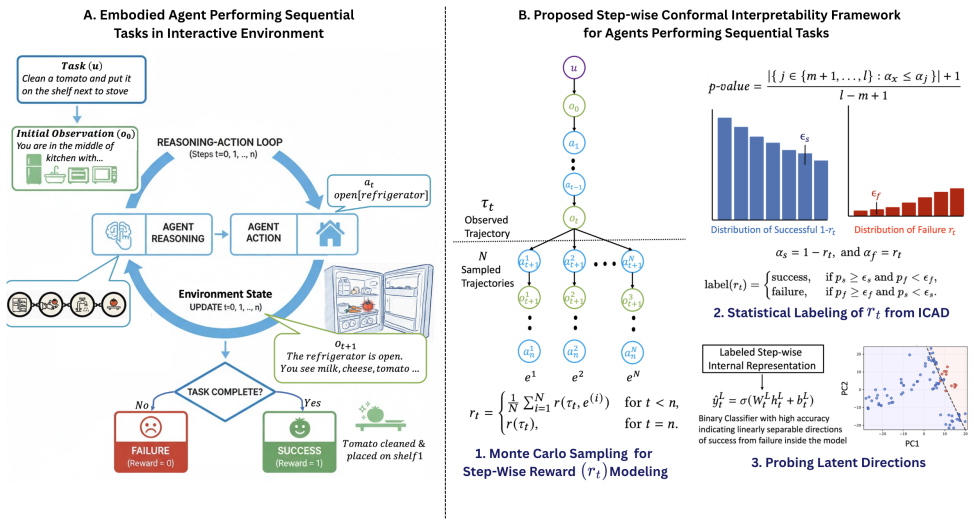
Conformal interpretability framework combining step-wise reward modeling and conformal prediction to label activations, followed by linear probing to extract temporal concept directions.
Load-bearing premise
That conformal prediction applied to step-wise reward models provides accurate, low-noise labels for the agent's internal representations at each step.
What would settle it
Finding a new interactive task where the trained linear probes achieve no better than random accuracy in separating successful from failing steps, or where steering does not improve outcomes.
Figures


read the original abstract
Large Language Models (LLMs) are increasingly deployed as autonomous agents capable of reasoning, planning, and acting within interactive environments. Despite their growing capability to perform multi-step reasoning and decision-making tasks, internal mechanisms guiding their sequential behavior remain opaque. This paper presents a framework for interpreting the temporal evolution of concepts in LLM agents through a step-wise conformal lens. We introduce the conformal interpretability framework for temporal tasks, which combines step-wise reward modeling with conformal prediction to statistically label model's internal representation at each step as successful or failing. Linear probes are then trained on these representations to identify directions of temporal concepts - latent directions in the model's activation space that correspond to consistent notions of success, failure or reasoning drift. Experimental results on two simulated interactive environments, namely ScienceWorld and AlfWorld, demonstrate that these temporal concepts are linearly separable, revealing interpretable structures aligned with task success. We further show preliminary results on improving an LLM agent's performance by leveraging the proposed framework for steering the identified successful directions inside the model. The proposed approach, thus, offers a principled method for early failure detection as well as intervention in LLM-based agents, paving the path towards trustworthy autonomous language models in complex interactive settings.
Editorial analysis
A structured set of objections, weighed in public.
Referee Report
Summary. The paper introduces a conformal interpretability framework for LLM agents that combines step-wise reward modeling with conformal prediction to label internal activations at each timestep as successful or failing. Linear probes are then trained on these labeled representations to recover directions corresponding to temporal concepts such as success, failure, and reasoning drift. Experiments on ScienceWorld and AlfWorld are reported to show that these directions are linearly separable and aligned with task success, with preliminary results on using the directions for steering agent behavior toward improved performance.
Significance. If the labeling step is shown to be reliable, the framework would provide a statistically grounded method for interpreting and intervening in the sequential decision-making of LLM agents, with potential applications in early failure detection and trustworthy autonomy. The approach builds on standard linear probing and conformal techniques but applies them to temporal agent trajectories, which could be useful if the core separability result is robustly validated.
major comments (2)
- [Abstract and §4] Abstract and §4 (Experiments): The central claim that temporal concepts are linearly separable rests on the step-wise reward model plus conformal prediction producing accurate success/failure labels. No quantitative validation (accuracy, calibration error, or agreement with simulator ground-truth outcomes) is reported for the labeling step on ScienceWorld or AlfWorld trajectories, leaving open the possibility that the recovered directions reflect reward-model artifacts rather than genuine internal representations.
- [§3] §3 (Method): The description of how conformal prediction is applied to produce per-step labels does not specify the nonconformity score, the calibration set construction, or how the reward model is trained (e.g., on proxy signals versus verified environment outcomes). Without these details, it is impossible to assess whether the labeling procedure introduces systematic bias that would undermine the subsequent linear-probe results.
minor comments (2)
- [Abstract] The abstract mentions 'preliminary results on improving an LLM agent's performance' via steering but provides no quantitative metrics, baselines, or statistical tests for the steering experiments.
- [§4] Figure captions and experimental tables should include error bars, number of runs, and exact definitions of the linear-probe metrics used to claim separability.
Simulated Author's Rebuttal
We thank the referee for the constructive comments that identify key areas for strengthening the rigor and clarity of the manuscript. We address each major comment below and will revise the paper accordingly to incorporate the requested details and validations.
read point-by-point responses
-
Referee: [Abstract and §4] Abstract and §4 (Experiments): The central claim that temporal concepts are linearly separable rests on the step-wise reward model plus conformal prediction producing accurate success/failure labels. No quantitative validation (accuracy, calibration error, or agreement with simulator ground-truth outcomes) is reported for the labeling step on ScienceWorld or AlfWorld trajectories, leaving open the possibility that the recovered directions reflect reward-model artifacts rather than genuine internal representations.
Authors: We agree that explicit quantitative validation of the labeling step is essential to substantiate the central claims. In the revised manuscript, we will add a dedicated subsection in §4 reporting accuracy, calibration error, and agreement with simulator ground-truth outcomes for the conformal labels on both ScienceWorld and AlfWorld trajectories. These results will demonstrate that the labels are reliable and that the recovered directions reflect genuine internal representations rather than artifacts. revision: yes
-
Referee: [§3] §3 (Method): The description of how conformal prediction is applied to produce per-step labels does not specify the nonconformity score, the calibration set construction, or how the reward model is trained (e.g., on proxy signals versus verified environment outcomes). Without these details, it is impossible to assess whether the labeling procedure introduces systematic bias that would undermine the subsequent linear-probe results.
Authors: We acknowledge that the current description of the conformal prediction procedure lacks necessary technical details. The revised §3 will fully specify the nonconformity score (defined as the absolute prediction error from the reward model), the construction of the calibration set (from held-out trajectories with verified environment outcomes), and the reward model training process (including the use of proxy signals versus ground-truth). These additions will enable readers to evaluate potential biases and ensure the labeling procedure is transparent. revision: yes
Circularity Check
No significant circularity detected; framework relies on standard external techniques
full rationale
The paper introduces a conformal interpretability framework that applies step-wise reward modeling and conformal prediction to label LLM activations, followed by training linear probes to detect temporal concepts. No equations, derivations, or self-citations are shown that reduce the claimed linear separability result to a fitted parameter or input by construction. The experimental demonstration on ScienceWorld and AlfWorld trajectories uses externally validated techniques (conformal prediction, linear probing) whose correctness does not depend on the target claim. The central result is presented as an empirical finding rather than a tautological renaming or self-referential definition, making the derivation self-contained against external benchmarks.
Axiom & Free-Parameter Ledger
Lean theorems connected to this paper
-
IndisputableMonolith/Foundation/AbsoluteFloorClosure.leanabsolute_floor_iff_bare_distinguishability unclear?
unclearRelation between the paper passage and the cited Recognition theorem.
We introduce the conformal interpretability framework for temporal tasks, which combines step-wise reward modeling with conformal prediction to statistically label model's internal representation at each step as successful or failing. Linear probes are then trained on these representations to identify directions of temporal concepts
-
IndisputableMonolith/Cost/FunctionalEquation.leanJ_uniquely_calibrated_via_higher_derivative unclear?
unclearRelation between the paper passage and the cited Recognition theorem.
Tables 1-6 report probe accuracy/F1 on ScienceWorld and AlfWorld trajectories; steering via RepE contrastive directions yields 1.1% accuracy gain
What do these tags mean?
- matches
- The paper's claim is directly supported by a theorem in the formal canon.
- supports
- The theorem supports part of the paper's argument, but the paper may add assumptions or extra steps.
- extends
- The paper goes beyond the formal theorem; the theorem is a base layer rather than the whole result.
- uses
- The paper appears to rely on the theorem as machinery.
- contradicts
- The paper's claim conflicts with a theorem or certificate in the canon.
- unclear
- Pith found a possible connection, but the passage is too broad, indirect, or ambiguous to say the theorem truly supports the claim.
Forward citations
Cited by 1 Pith paper
-
Doomed from the Start: Early Abort of LLM Agent Episodes via a Recall-Controlled Probe Cascade
A cascade of recall-calibrated gates on LLM agent hidden states aborts doomed episodes early, saving up to 47% compute at a 90% global success-recall target.
discussion (0)
Sign in with ORCID, Apple, or X to comment. Anyone can read and Pith papers without signing in.