Recognition: unknown
Task-Driven Co-Design of Heterogeneous Multi-Robot Systems
Pith reviewed 2026-05-09 21:18 UTC · model grok-4.3
The pith
Monotone co-design theory abstracts robots, fleets, planners, executors, and evaluators as interconnected design problems to enable joint optimization for given tasks.
A machine-rendered reading of the paper's core claim, the machinery that carries it, and where it could break.
Core claim
We present a formal and compositional framework for the task-driven co-design of heterogeneous multi-robot systems. Building on a monotone co-design theory, we introduce general abstractions of robots, fleets, planners, executors, and evaluators as interconnected design problems with well-defined interfaces that are agnostic to both implementations and tasks. This structure enables efficient joint optimization of robot design, fleet composition, and planning under task-specific performance constraints. A series of case studies demonstrates the capabilities of the framework, where various component models can be seamlessly incorporated and non-obvious design alternatives are systematically 6.
What carries the argument
Monotone co-design theory applied to abstractions of robots, fleets, planners, executors, and evaluators as interconnected design problems with well-defined interfaces.
If this is right
- Efficient joint optimization of robot design, fleet composition, and planning under task-specific performance constraints becomes possible.
- Various component models including new robot types, task profiles, and probabilistic sensing objectives can be incorporated seamlessly.
- Non-obvious design alternatives are uncovered systematically with optimality guarantees.
- The framework provides flexibility, scalability, and interpretability for reasoning about complex heterogeneous multi-robot systems.
Where Pith is reading between the lines
- Engineers could apply the abstractions to explore hardware-software trade-offs in robot teams without iterative manual tuning of each subsystem.
- The compositional structure may extend to co-design problems in related areas such as swarm systems or automated logistics fleets.
- Applying the framework to real deployments with sensor noise or dynamic obstacles would test where the interfaces need refinement.
Load-bearing premise
The abstractions of robots, fleets, planners, executors, and evaluators form interconnected design problems with well-defined interfaces that remain valid and useful when applied to real heterogeneous multi-robot tasks and implementations.
What would settle it
A concrete multi-robot task in which the framework's joint optimization produces a design that violates task constraints or underperforms a design obtained by optimizing robot choice, fleet size, and planner separately.
Figures






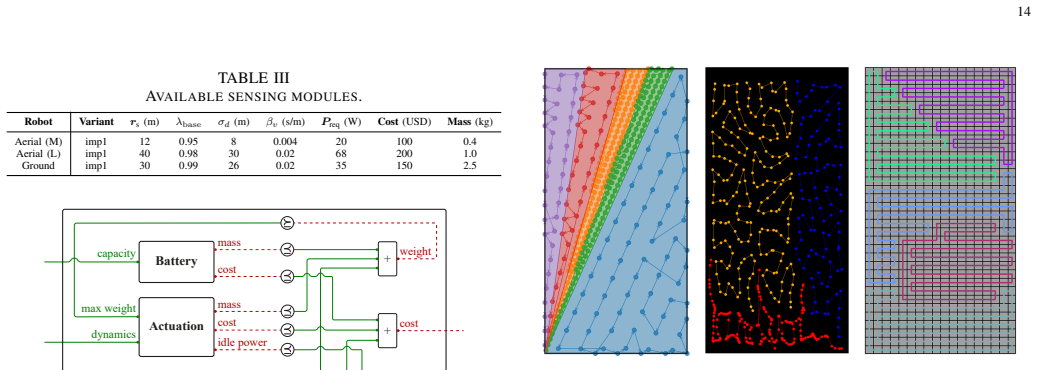


read the original abstract
Designing multi-agent robotic systems requires reasoning across tightly coupled decisions spanning heterogeneous domains, including robot design, fleet composition, and planning. Much effort has been devoted to isolated improvements in these domains, whereas system-level co-design considering trade-offs and task requirements remains underexplored. In this work, we present a formal and compositional framework for the task-driven co-design of heterogeneous multi-robot systems. Building on a monotone co-design theory, we introduce general abstractions of robots, fleets, planners, executors, and evaluators as interconnected design problems with well-defined interfaces that are agnostic to both implementations and tasks. This structure enables efficient joint optimization of robot design, fleet composition, and planning under task-specific performance constraints. A series of case studies demonstrates the capabilities of the framework. Various component models can be seamlessly incorporated, including new robot types, task profiles, and probabilistic sensing objectives, while non-obvious design alternatives are systematically uncovered with optimality guarantees. The results highlight the flexibility, scalability, and interpretability of the proposed approach, and illustrate how formal co-design enables principled reasoning about complex heterogeneous multi-robot systems.
Editorial analysis
A structured set of objections, weighed in public.
Referee Report
Summary. The paper presents a formal and compositional framework for the task-driven co-design of heterogeneous multi-robot systems. Building on monotone co-design theory, it defines general abstractions of robots, fleets, planners, executors, and evaluators as interconnected design problems with well-defined interfaces that are agnostic to implementations and tasks. This enables efficient joint optimization of robot design, fleet composition, and planning under task-specific performance constraints. Case studies demonstrate the approach by incorporating new robot types, task profiles, and probabilistic sensing objectives, recovering non-obvious designs with claimed optimality guarantees and highlighting flexibility, scalability, and interpretability.
Significance. If the framework and its guarantees hold, the work offers a principled advance in multi-robot co-design by providing a compositional structure that integrates decisions across heterogeneous domains while preserving extensibility and optimality from the underlying monotone theory. Credit is due for the explicit interface specifications that support seamless model incorporation and for the case studies that function as existence proofs of extensibility to new components and objectives, directly addressing concerns about abstraction validity through demonstrated application rather than assertion.
minor comments (2)
- The abstract summarizes the case studies at a high level without referencing any specific quantitative outcome or recovered design; adding one concrete illustration would improve reader comprehension of the framework's impact.
- Notation and interface definitions for the design problems would benefit from accompanying diagrams or explicit pseudocode to reduce potential ambiguity in how the abstractions interconnect.
Simulated Author's Rebuttal
We thank the referee for the positive assessment of our work and the recommendation for minor revision. No major comments were raised in the report.
Circularity Check
Framework is self-contained; no circular reductions in abstractions or case studies
full rationale
The manuscript introduces a compositional framework by defining abstractions for robots, fleets, planners, executors, and evaluators as interconnected design problems with explicit, implementation-agnostic interfaces. These definitions are presented as extensions of the cited monotone co-design theory rather than reductions of any fitted quantity or self-referential prediction. Case studies function as existence proofs of extensibility (new robot types, probabilistic objectives) without claiming statistical predictions that collapse to input fits. No equations, parameter estimation steps, or uniqueness theorems internal to the authors appear in the provided text; monotonicity assumptions are imported from prior external theory and not used to force the central claim by construction. The structure therefore qualifies as an independent formalization rather than a renaming or self-definition of its inputs.
Axiom & Free-Parameter Ledger
axioms (1)
- domain assumption Monotone co-design theory can be used to compose design problems for robots, fleets, planners, executors, and evaluators with well-defined interfaces.
invented entities (1)
-
General abstractions of robots, fleets, planners, executors, and evaluators as interconnected design problems
no independent evidence
Forward citations
Cited by 1 Pith paper
-
Compositional Online Learning for Multi-Objective System Co-Design
An elimination-based rejection-sampling algorithm with optimistic evaluators identifies target-feasible antichains in monotone co-design problems and propagates bounds compositionally through multigraphs.
Reference graph
Works this paper leans on
-
[1]
Coordinating Hundreds of Cooperative, Autonomous Vehicles in Warehouses,
P. R. Wurman, R. D’Andrea, and M. Mountz, “Coordinating Hundreds of Cooperative, Autonomous Vehicles in Warehouses,”AI magazine, vol. 29, no. 1, pp. 9–9, 2008
2008
-
[2]
Finding Optimal Solutions to Cooperative Pathfinding Problems,
T. Standley, “Finding Optimal Solutions to Cooperative Pathfinding Problems,” inProceedings of the AAAI Conference on Artificial Intelli- gence, vol. 24, no. 1, 2010, pp. 173–178
2010
-
[3]
A Survey on Coverage Path Planning for Robotics,
E. Galceran and M. Carreras, “A Survey on Coverage Path Planning for Robotics,”Robotics and Autonomous Systems, vol. 61, no. 12, pp. 1258–1276, 2013
2013
-
[4]
A Survey on Gas Leak Detection and Localization Techniques,
P.-S. Murvay and I. Silea, “A Survey on Gas Leak Detection and Localization Techniques,”Journal of Loss Prevention in the Process Industries, vol. 25, no. 6, pp. 966–973, 2012
2012
-
[5]
Charting the Trade- off Between Design Complexity and Plan Execution Under Probabilistic Actions,
F. Z. Saberifar, D. A. Shell, and J. M. O’Kane, “Charting the Trade- off Between Design Complexity and Plan Execution Under Probabilistic Actions,” in2022 International Conference on Robotics and Automation (ICRA). IEEE, 2022, pp. 135–141
2022
-
[6]
Co-design of Complex Systems: From Autonomy to Future Mobility Systems,
G. Zardini, “Co-design of Complex Systems: From Autonomy to Future Mobility Systems,” Ph.D. dissertation, ETH Zurich, 2023
2023
-
[7]
Reactivity and Statefulness: Action- based Sensors, Plans, and Necessary State,
G. McFassel and D. A. Shell, “Reactivity and Statefulness: Action- based Sensors, Plans, and Necessary State,”The International Journal of Robotics Research, vol. 42, no. 6, pp. 385–411, 2023
2023
-
[8]
A mathematical theory of co-design.arXiv preprint arXiv:1512.08055(2015)
A. Censi, “A Mathematical Theory of Co-Design,”arXiv preprint arXiv:1512.08055, 2015
-
[9]
An Unmanned Aircraft System for Automatic Forest Fire Monitoring and Measurement,
L. Merino, F. Caballero, J. R. Mart ´ınez-de Dios, I. Maza, and A. Ollero, “An Unmanned Aircraft System for Automatic Forest Fire Monitoring and Measurement,”Journal of Intelligent & Robotic Systems, vol. 65, no. 1, pp. 533–548, 2012
2012
-
[10]
A Team-based Deployment Approach for Heterogeneous Mobile Sensor Networks,
A. Mesbahi, F. Abbasi, and J. M. Velni, “A Team-based Deployment Approach for Heterogeneous Mobile Sensor Networks,”Automatica, vol. 106, pp. 327–338, 2019
2019
-
[11]
Range Limited Coverage Control using Air-Ground Multi-Robot Teams,
M. Rudolph, S. Wilson, and M. Egerstedt, “Range Limited Coverage Control using Air-Ground Multi-Robot Teams,” in2021 IEEE Interna- tional Conference on Robotics and Automation (ICRA). IEEE, 2021, pp. 3525–3530
2021
-
[12]
Mag- neBike: Toward Multi Climbing Robots for Power Plant Inspection,
A. Breitenmoser, F. T ˆache, G. Caprari, R. Siegwart, and R. Moser, “Mag- neBike: Toward Multi Climbing Robots for Power Plant Inspection,” in Proceedings of the 9th International Conference on Autonomous Agents and Multiagent Systems: Industry track, 2010, pp. 1713–1720
2010
-
[13]
Unmanned Aerial Vehicle Systems for Disaster Relief: Tornado Alley,
W. DeBusk, “Unmanned Aerial Vehicle Systems for Disaster Relief: Tornado Alley,” inAIAA Infotech@ Aerospace 2010, 2010, p. 3506
2010
-
[14]
A Supervisory Control Method for Multi-robot Task Allocation in Urban Search and Rescue,
Y . Liu, M. Ficocelli, and G. Nejat, “A Supervisory Control Method for Multi-robot Task Allocation in Urban Search and Rescue,” in2015 IEEE International Symposium on Safety, Security, and Rescue Robotics (SSRR). IEEE, 2015, pp. 1–6
2015
-
[15]
Collaborative Multi-Robot Search and Rescue: Planning, Coordination, Perception, and Active Vision,
J. P. Queralta, J. Taipalmaa, B. C. Pullinen, V . K. Sarker, T. N. Gia, H. Tenhunen, M. Gabbouj, J. Raitoharju, and T. Westerlund, “Collaborative Multi-Robot Search and Rescue: Planning, Coordination, Perception, and Active Vision,”IEEE Access, vol. 8, pp. 191 617– 191 643, 2020
2020
-
[16]
S. Kazemdehbashi, “Adaptive Grid-based Decomposition for UA V-based Coverage Path Planning in Maritime Search and Rescue,”arXiv preprint arXiv:2412.00899, 2024
-
[17]
A Survey on Multi-robot Coverage Path Planning for Model Reconstruction and Mapping,
R. Almadhoun, T. Taha, L. Seneviratne, and Y . Zweiri, “A Survey on Multi-robot Coverage Path Planning for Model Reconstruction and Mapping,”SN Applied Sciences, vol. 1, no. 8, p. 847, 2019
2019
-
[18]
Large-Scale Heterogeneous Multi-robot Coverage via Domain Decomposition and Generative Allocation,
J. Hu, H. Coffin, J. Whitman, M. Travers, and H. Choset, “Large-Scale Heterogeneous Multi-robot Coverage via Domain Decomposition and Generative Allocation,” inInternational Workshop on the Algorithmic Foundations of Robotics. Springer, 2022, pp. 52–67. 19
2022
-
[19]
DARP: Divide Areas Algorithm for Optimal Multi-Robot Coverage Path Planning,
A. C. Kapoutsis, S. A. Chatzichristofis, and E. B. Kosmatopoulos, “DARP: Divide Areas Algorithm for Optimal Multi-Robot Coverage Path Planning,”Journal of Intelligent & Robotic Systems, vol. 86, no. 3, pp. 663–680, 2017
2017
-
[20]
Multiple UA V Cooperative Searching Op- eration Using Polygon Area Decomposition and Efficient Coverage Algorithms,
I. Maza and A. Ollero, “Multiple UA V Cooperative Searching Op- eration Using Polygon Area Decomposition and Efficient Coverage Algorithms,” inDistributed Autonomous Robotic Systems 6. Springer, 2007, pp. 221–230
2007
-
[21]
Distributed coverage control for concave areas by a heterogeneous robot–swarm with visibility sensing constraints,
Y . Kantaros, M. Thanou, and A. Tzes, “Distributed coverage control for concave areas by a heterogeneous robot–swarm with visibility sensing constraints,”Automatica, vol. 53, pp. 195–207, 2015
2015
-
[22]
Integration of UA Vs in Urban Search and Rescue Missions,
H. Surmann, R. Worst, T. Buschmann, A. Leinweber, A. Schmitz, G. Senkowski, and N. Goddemeier, “Integration of UA Vs in Urban Search and Rescue Missions,” in2019 IEEE International Symposium on Safety, Security, and Rescue Robotics (SSRR). IEEE, 2019, pp. 203–209
2019
-
[23]
Guaranteed Coverage with a Blind Unreliable Robot,
J. S. Lewis, D. A. Feshbach, and J. M. O’Kane, “Guaranteed Coverage with a Blind Unreliable Robot,” in2018 IEEE/RSJ International Con- ference on Intelligent Robots and Systems (IROS). IEEE, 2018, pp. 7383–7390
2018
-
[24]
On the Design of Minimal Robots That Can Solve Planning Problems,
D. A. Shell, J. M. O’Kane, and F. Z. Saberifar, “On the Design of Minimal Robots That Can Solve Planning Problems,”IEEE Transactions on Automation Science and Engineering, vol. 18, no. 3, pp. 876–887, 2021
2021
-
[25]
Robot Co-design: Beyond the Monotone Case,
L. Carlone and C. Pinciroli, “Robot Co-design: Beyond the Monotone Case,” in2019 International Conference on Robotics and Automation (ICRA). IEEE, 2019, pp. 3024–3030
2019
-
[26]
Applied Compositional Thinking for Engineering,
A. Censi, J. Lorand, and G. Zardini, “Applied Compositional Thinking for Engineering,” 2024, work-in-progress book
2024
-
[27]
CODEI: Resource-Efficient Task-Driven Co-Design of Perception and Decision Making for Mobile Robots Applied to Autonomous Vehicles,
D. Milojevic, G. Zardini, M. Elser, A. Censi, and E. Frazzoli, “CODEI: Resource-Efficient Task-Driven Co-Design of Perception and Decision Making for Mobile Robots Applied to Autonomous Vehicles,”IEEE Transactions on Robotics, vol. 41, pp. 2727–2748, 2025
2025
-
[28]
On the Co-Design of Components and Racing Strategies in Formula 1,
M.-P. Neumann, G. Zardini, A. Cerofolini, and C. H. Onder, “On the Co-Design of Components and Racing Strategies in Formula 1,” in2024 IEEE Intelligent Vehicles Symposium (IV). IEEE, 2024, pp. 2876–2881
2024
-
[29]
Co- Design to Enable User-Friendly Tools to Assess the Impact of Future Mobility Solutions,
G. Zardini, N. Lanzetti, A. Censi, E. Frazzoli, and M. Pavone, “Co- Design to Enable User-Friendly Tools to Assess the Impact of Future Mobility Solutions,”IEEE Transactions on Network Science and Engi- neering, vol. 10, no. 2, pp. 827–844, 2022
2022
-
[30]
SwarmCoDe: A Scalable Co-Design Framework for Heterogeneous Robot Swarms via Dynamic Speciation
A. Wilhelm and J. Hughes, “SwarmCoDe: A Scalable Co-Design Framework for Heterogeneous Robot Swarms via Dynamic Speciation,” arXiv preprint arXiv:2603.26240, 2026
work page internal anchor Pith review Pith/arXiv arXiv 2026
-
[31]
S. M. LaValle,Planning Algorithms. Cambridge University Press, 2006
2006
-
[32]
Polygon Area Decomposition for Multiple- Robot Workspace Division,
S. Hert and V . Lumelsky, “Polygon Area Decomposition for Multiple- Robot Workspace Division,”International Journal of Computational Geometry & Applications, vol. 8, no. 04, pp. 437–466, 1998
1998
-
[33]
Worst-Case Analysis of a New Heuristic for the Travelling Salesman Problem,
N. Christofides, “Worst-Case Analysis of a New Heuristic for the Travelling Salesman Problem,” inOperations Research Forum, vol. 3, no. 1. Springer, 2022, p. 20
2022
-
[34]
Quality Evaluation of Solution Sets in Multiobjective Optimisation: A Survey,
M. Li and X. Yao, “Quality Evaluation of Solution Sets in Multiobjective Optimisation: A Survey,”ACM Computing Surveys (CSUR), vol. 52, no. 2, pp. 1–38, 2019
2019
-
[35]
Distributional Uncertainty and Adaptive Decision-Making in System Co-design,
Y . Huang and G. Zardini, “Distributional Uncertainty and Adaptive Decision-Making in System Co-design,”arXiv preprint arXiv:2603.14047, 2026
discussion (0)
Sign in with ORCID, Apple, or X to comment. Anyone can read and Pith papers without signing in.