Quantum Dispersive Waves and Multimode Squeezing in Pure-Kerr Parametrically Driven Cavity Solitons
Pith reviewed 2026-06-30 23:54 UTC · model grok-4.3
The pith
Pure-Kerr PDCS produce up to 20 dB multimode squeezing and quantum dispersive waves above threshold.
A machine-rendered reading of the paper's core claim, the machinery that carries it, and where it could break.
Core claim
Parametrically driven cavity solitons in pure-Kerr media admit a multimode quantum description that verifies single- and two-mode squeezing below the oscillation threshold and reveals novel quantum dispersive waves above threshold, achieving squeezing levels up to 20 dB limited only by overcoupling and intrinsic losses under routine experimental conditions.
What carries the argument
Multimode quantum model of the pure-Kerr parametric driving equations, which tracks fluctuations around the soliton to produce squeezing spectra and dispersive wave formation.
If this is right
- Single- and two-mode squeezing is verified in the below-threshold regime.
- Quantum dispersive waves appear above threshold as the quantum analog of soliton Cherenkov radiation.
- Squeezing reaches 20 dB and is limited only by overcoupling and intrinsic losses for routine parameters.
- The model supplies a pathway to observe strong multimode quantum noise reduction in these systems.
Where Pith is reading between the lines
- If losses can be reduced below current routine levels the same equations predict still higher squeezing.
- The quantum dispersive waves may produce measurable correlations in the soliton spectrum that experiments could target.
- The multimode structure could be used to generate entangled light across multiple frequency modes in cavity-based sources.
Load-bearing premise
The pure-Kerr parametric driving equations fully capture the multimode quantum dynamics without additional loss mechanisms or higher-order effects that would appear in real devices.
What would settle it
An experiment measuring the quantum noise spectrum of a pure-Kerr PDCS that finds squeezing levels or wave intensities inconsistent with the model's predictions once overcoupling and intrinsic losses are accounted for.
Figures
read the original abstract
Parametrically driven cavity solitons (PDCS), unlike single-pumped cavity solitons, are localized optical pulses arising from parametric processes. These cavity solitons, recently discovered in pure-Kerr media, offer great promise for nonlinear dynamics studies and metrology. Here, we present the first multimode quantum description of pure-Kerr PDCS. In the below threshold regime, we verify single- and two-mode squeezing, while above threshold we uncover novel "quantum" dispersive waves - the quantum analog of soliton Cherenkov radiation. Besides revealing these unexplored quantum properties, we show that PDCS generates up to 20 dB of squeezing, only limited by overcoupling and intrinsic losses for experimentally routine parameters. We therefore provide a pathway to observe strong multimode quantum noise reduction in these systems.
Editorial analysis
A structured set of objections, weighed in public.
Referee Report
Summary. The manuscript presents the first multimode quantum description of pure-Kerr parametrically driven cavity solitons (PDCS). Below threshold it verifies single- and two-mode squeezing; above threshold it identifies novel quantum dispersive waves (quantum analog of soliton Cherenkov radiation). It further claims that PDCS can generate up to 20 dB of squeezing, limited only by overcoupling and intrinsic losses under experimentally routine parameters, thereby providing a pathway to strong multimode quantum noise reduction.
Significance. If the underlying quantum model is complete and the reported squeezing levels and wave identifications hold, the work would be significant for quantum nonlinear optics. It supplies the first multimode quantum treatment of pure-Kerr PDCS, extends the classical soliton literature into the quantum regime, and predicts experimentally accessible squeezing levels that could impact metrology applications. The identification of quantum dispersive waves constitutes a new predicted phenomenon whose experimental confirmation would be of broad interest.
major comments (2)
- [Abstract] Abstract: the central claims (first multimode quantum description, verified squeezing, novel quantum dispersive waves, and the 20 dB figure) rest on a quantum model derived from the classical pure-Kerr parametric driving equations, yet the abstract supplies no derivations, master-equation or stochastic formulation, mode-basis truncation details, or quantization of loss channels. Without these elements the 20 dB prediction and the existence of the reported quantum Cherenkov-like waves cannot be assessed.
- [Abstract] Abstract: the statement that squeezing is 'only limited by overcoupling and intrinsic losses' presupposes that all relevant loss mechanisms are included as Markovian baths coupled to every mode and that no higher-order dispersion or nonlinear corrections materially alter the fluctuation spectrum; the provided text gives no indication of how these assumptions are implemented or validated.
Simulated Author's Rebuttal
We thank the referee for their careful reading of the manuscript. The abstract is a concise summary of results; the full technical details of the quantum model are developed in the body of the paper. We address the comments point by point below.
read point-by-point responses
-
Referee: [Abstract] Abstract: the central claims (first multimode quantum description, verified squeezing, novel quantum dispersive waves, and the 20 dB figure) rest on a quantum model derived from the classical pure-Kerr parametric driving equations, yet the abstract supplies no derivations, master-equation or stochastic formulation, mode-basis truncation details, or quantization of loss channels. Without these elements the 20 dB prediction and the existence of the reported quantum Cherenkov-like waves cannot be assessed.
Authors: We agree that the abstract does not contain the technical derivations, as is conventional for abstracts. The multimode quantum model is derived from the classical equations in Section II, where the master equation, stochastic formulation (via the truncated Wigner approximation), mode-basis truncation (retaining the fundamental and first 20 sideband modes), and quantization of loss channels (Markovian baths for each mode) are presented in full. The 20 dB squeezing and quantum dispersive waves are computed from this model and validated in Sections III–V and Figures 3–7. The abstract therefore summarizes results whose validity can be assessed from the main text. revision: no
-
Referee: [Abstract] Abstract: the statement that squeezing is 'only limited by overcoupling and intrinsic losses' presupposes that all relevant loss mechanisms are included as Markovian baths coupled to every mode and that no higher-order dispersion or nonlinear corrections materially alter the fluctuation spectrum; the provided text gives no indication of how these assumptions are implemented or validated.
Authors: Section II explicitly quantizes the system with independent Markovian loss baths coupled to every mode (both signal and idler sidebands), with rates set by the cavity finesse and overcoupling ratio. In Section V we numerically confirm that higher-order dispersion and Kerr corrections beyond the parametric driving term produce negligible changes to the squeezing spectrum for the experimentally relevant parameters; these checks are reported in the text and supplementary figures. The 20 dB value is obtained directly from the steady-state covariance matrix under these loss conditions. revision: no
Circularity Check
No circularity detected; quantum model presented as derived from classical PDCS equations without self-referential reduction
full rationale
The provided abstract and context describe a first multimode quantum description derived from the classical pure-Kerr parametric driving equations, with squeezing and dispersive waves as outputs. No equations, fitting procedures, self-citations, or ansatzes are visible that would reduce predictions to inputs by construction. The 20 dB figure is stated as limited by overcoupling and losses rather than fitted or renamed. Per rules, absent explicit reduction in quoted steps, score is 0 as the derivation is treated as self-contained against external benchmarks.
Axiom & Free-Parameter Ledger
Forward citations
Cited by 1 Pith paper
-
Quantum and classical noise characteristics of parametrically driven cavity solitons in dispersive Kerr resonators
Theoretical analysis finds that pure-Kerr parametrically driven cavity solitons exhibit superior resistance to pump phase noise and lower quantum timing jitter than conventional cavity solitons, even with uncorrelated...
Reference graph
Works this paper leans on
-
[1]
Quantum Dispersive Waves and Multimode Squeezing in Pure-Kerr Parametrically Driven Cavity Solitons
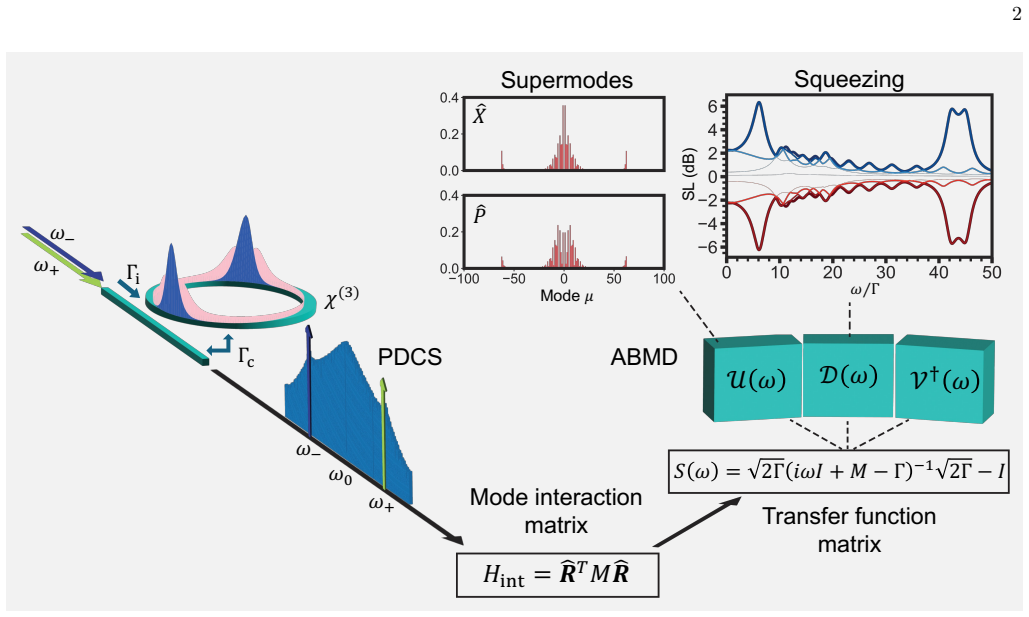
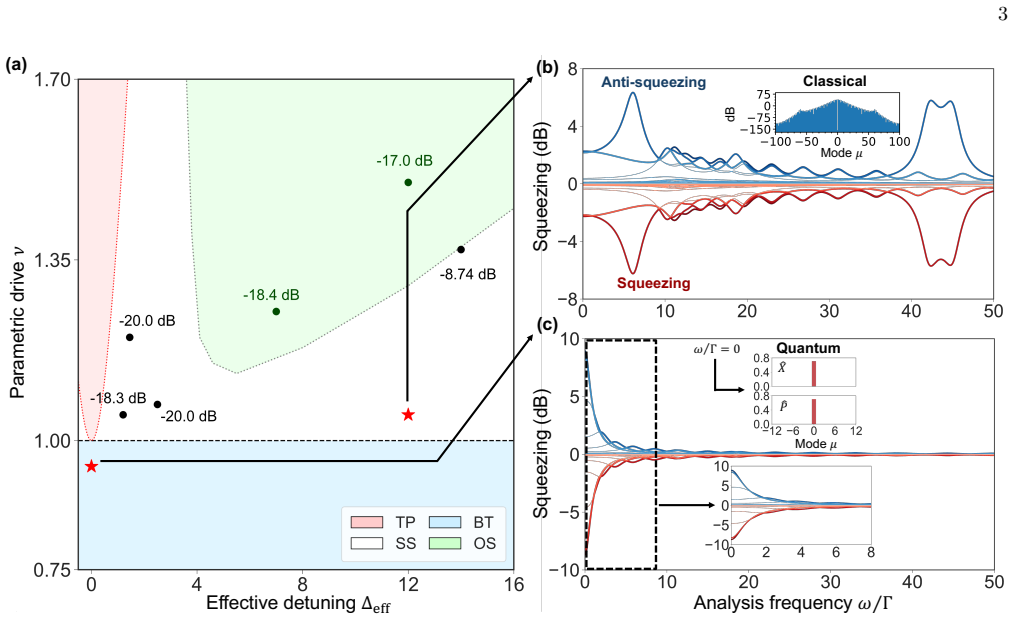
of the PDCS reveals highly squeezed states saturat- ing the limits on quantum noise reduction set by the overcoupling and intrinsic loss across strikingly differ- ent regimes of the system’s classical phase diagram. Be- low the soliton threshold, we see clean single- and two- mode squeezing associated with degenerate and non- degenerate optical parametric...
work page internal anchor Pith review Pith/arXiv arXiv 2026
-
[2]
A. Mecozzi, W. L. Kath, P. Kumar, and C. G. Goedde, Long-term storage of a soliton bit stream by use of phase- sensitive amplification, Opt. Lett.19, 2050 (1994)
work page 2050
-
[3]
Longhi, Ultrashort-pulse generation in degenerate op- tical parametric oscillators, Opt
S. Longhi, Ultrashort-pulse generation in degenerate op- tical parametric oscillators, Opt. Lett.20, 695 (1995)
work page 1995
-
[4]
G. J. de Valc´ arcel and K. Staliunas, Phase-bistable kerr cavity solitons and patterns, Phys. Rev. A87, 043802 (2013)
work page 2013
-
[5]
N. Englebert, F. De Lucia, P. Parra-Rivas, C. M. Arab´ ı, P.-J. Sazio, S.-P. Gorza, and F. Leo, Parametrically driven kerr cavity solitons, Nature Photonics15, 857 (2021)
work page 2021
- [6]
-
[7]
G. Moille, P. Shandilya, J. Stone, R. Beard, S.-C. Ou, 6 Z. Li, M. Harrington, K. Liu, R. Rockmore, C. R. Menyuk, D. J. Blumenthal, S. P. Krzyzewski, M. Erk- intalo, and K. Srinivasan, Self-aligned optical microcomb emerging between octave separated lasers, arXiv preprint arXiv:2602.05151 (2026)
-
[8]
´E. Gouzien, S. Tanzilli, V. D’Auria, and G. Patera, Morphing Supermodes: A Full Characterization for En- abling Multimode Quantum Optics, Phys. Rev. Lett. 125, 103601 (2020)
work page 2020
-
[9]
Z. Yang, M. Jahanbozorgi, D. Jeong, S. Sun, O. Pfister, H. Lee, and X. Yi, A squeezed quantum microcomb on a chip, Nature Communications12, 4781 (2021)
work page 2021
-
[10]
M. Jahanbozorgi, Z. Yang, S. Sun, H. Chen, R. Liu, B. Wang, and X. Yi, Generation of squeezed quantum microcombs with silicon nitride integrated photonic cir- cuits, Optica, OPTICA10, 1100 (2023)
work page 2023
-
[11]
X. Jia, C. Zhai, X. Zhu, C. You, Y. Cao, X. Zhang, Y. Zheng, Z. Fu, J. Mao, T. Dai, L. Chang, X. Su, Q. Gong, and J. Wang, Continuous-variable multipar- tite entanglement in an integrated microcomb, Nature 10.1038/s41586-025-08602-1 (2025)
-
[12]
Z. Wang, K. Li, Y. Wang, X. Zhou, Y. Cheng, B. Jing, F. Sun, J. Li, Z. Li, B. Wu,et al., Large-scale cluster quantum microcombs, Light: Science & Applications14, 164 (2025)
work page 2025
-
[13]
Y. Shen, P.-Y. Hsieh, D. Srinivasan, A. Henry, G. Moille, S. K. Sridhar, A. Restelli, Y.-C. Chang, K. Srinivasan, T. A. Smith, and A. Dutt, Highly squeezed nanophotonic quantum microcombs with broadband frequency tunabil- ity (2025), arXiv:2505.03734 [physics]
-
[14]
T. Herr, K. Hartinger, J. Riemensberger, C. Y. Wang, E. Gavartin, R. Holzwarth, M. L. Gorodetsky, and T. J. Kippenberg, Universal formation dynamics and noise of Kerr-frequency combs in microresonators, Nat Photon6, 480 (2012)
work page 2012
-
[15]
Y. K. Chembo, Quantum dynamics of Kerr optical fre- quency combs below and above threshold: Spontaneous four-wave mixing, entanglement, and squeezed states of light, Phys. Rev. A93, 033820 (2016)
work page 2016
-
[16]
G. J. de Valc´ arcel, G. Patera, N. Treps, and C. Fabre, Multimode squeezing of frequency combs, Phys. Rev. A 74, 061801 (2006)
work page 2006
-
[17]
S. Z. Uddin, N. Rivera, D. Seyler, and et al., Noise- immune quantum correlations of intense light, Nature Photonics19, 751 (2025)
work page 2025
-
[18]
M. A. Guidry, D. M. Lukin, K. Y. Yang, and J. Vuˇ ckovi´ c, Multimode squeezing in soliton crystal microcombs, Op- tica10, 694 (2023)
work page 2023
-
[19]
M. Chen, N. C. Menicucci, and O. Pfister, Experimental realization of multipartite entanglement of 60 modes of a quantum optical frequency comb, Phys. Rev. Lett.112, 120505 (2014)
work page 2014
-
[20]
O. Pfister, Continuous-variable quantum computing in the quantum optical frequency comb, Journal of Physics B: Atomic, Molecular and Optical Physics53, 012001 (2019)
work page 2019
- [21]
- [22]
-
[23]
Intermittency in the Not-so-Smooth Elastic Turbulence
Y. Zhang, M. Menotti, K. Tan, V. D. Vaidya, D. H. Mahler, L. G. Helt, L. Zatti, M. Liscidini, B. Morri- son, and Z. Vernon, Squeezed light from a nanophotonic molecule, Nature Communications12, 10.1038/s41467- 021-22540-2 (2021)
-
[24]
Y. Zhao, Y. Okawachi, J. K. Jang, X. Ji, M. Lipson, and A. L. Gaeta, Near-degenerate quadrature-squeezed vacuum generation on a silicon-nitride chip, Phys. Rev. Lett.124, 193601 (2020)
work page 2020
-
[25]
J. Aasi, J. Abadie, B. Abbott, R. Abbott, T. Abbott, M. Abernathy, C. Adams, T. Adams, P. Addesso, R. Ad- hikari,et al., Enhanced sensitivity of the LIGO gravita- tional wave detector by using squeezed states of light, Nature Photonics7, 613 (2013)
work page 2013
- [26]
-
[27]
G. Frascella, R. V. Zakharov, O. V. Tikhonova, and M. V. Chekhova, Multimode optical parametric amplification in the phase-sensitive regime, Opt. Lett.46, 2364 (2021)
work page 2021
- [28]
-
[29]
S. Virally, P. Cusson, and D. V. Seletskiy, Enhanced electro-optic sampling with quantum probes, Phys. Rev. Lett.127, 270504 (2021)
work page 2021
-
[30]
M. Wolinsky and H. J. Carmichael, Quantum noise in the parametric oscillator: From squeezed states to coherent- state superpositions, Physical Review Letters60, 1836 (1988)
work page 1988
-
[31]
P. D. Drummond and M. D. Reid, Correlations in non- degenerate parametric oscillation. ii. below threshold re- sults, Phys. Rev. A41, 3930 (1990)
work page 1990
- [32]
-
[33]
N. Akhmediev and M. Karlsson, Cherenkov radiation emitted by solitons in optical fibers, Phys. Rev. A51, 2602 (1995)
work page 1995
- [34]
-
[35]
S. S. Shamailov and M. Erkintalo, Quantum and classical noise characteristics of parametrically driven cavity solitons in dispersive kerr resonators, arXiv preprint arXiv:2605.29321 (2026), arXiv:2605.29321 [physics.optics]
work page internal anchor Pith review Pith/arXiv arXiv 2026
-
[36]
M. Kues, C. Reimer, J. M. Lukens, W. J. Munro, A. M. Weiner, D. J. Moss, and R. Morandotti, Quantum optical microcombs, Nature Photon13, 170 (2019), number: 3
work page 2019
-
[37]
L. Zhang, C. Cui, J. Yan, Y. Guo, J. Wang, and L. Fan, On-chip parallel processing of quantum frequency comb, npj Quantum Information9, 10.1038/s41534-023-00725- 5 (2023)
-
[38]
W. Wen, W. Yan, C. Lu, L. Lu, X. Wu, Y. Lu, S. Zhu, and X.-S. Ma, Polarization-entangled quantum frequency comb from a silicon nitride microring resonator, Phys. Rev. Appl.20, 064032 (2023)
work page 2023
-
[39]
D. I. Herman, M. Walsh, M. K. Kreider, N. Lordi, E. J. Tsao, A. J. Lind, M. Heyrich, J. Combes, J. Genest, and S. A. Diddams, Squeezed dual-comb spectroscopy, 7 Science387, 653 (2025)
work page 2025
-
[40]
P. Renault, P. Yard, R. C. Pooser, M. Eaton, and H. A. Zaidi, End-to-end switchless architecture for fault- tolerant photonic quantum computing, Quantum9, 1796 (2025)
work page 2025
- [41]
-
[42]
M. Bondila, I. V. Barashenkov, and M. M. Bogdan, To- pography of attractors of the parametrically driven non- linear schr¨ odinger equation, Physica D: Nonlinear Phe- nomena87, 314 (1995), proceedings of the Conference on The Nonlinear Schrodinger Equation
work page 1995
-
[43]
´E. Gouzien, L. Labont´ e, J. Etesse, A. Zavatta, S. Tanzilli, V. D’Auria, and G. Patera, Hidden and detectable squeezing from microresonators, Phys. Rev. Res.5, 023178 (2023)
work page 2023
-
[44]
C. W. Gardiner and P. Zoller,Quantum noise, Springer Series in Synergetics (Springer, Berlin, Germany, 2010)
work page 2010
-
[45]
C. Cui, C. N. Gagatsos, S. Guha, and L. Fan, High-purity pulsed squeezing generation with integrated photonics, Phys. Rev. Research3, 013199 (2021)
work page 2021
- [46]
-
[47]
A. Karnieli, P.-A. Mor, C. Roques-Carmes, E. Lustig, J. Sloan, J. Vuˇ ckovi´ c, D. A. B. Miller, and S. Fan, Vari- ational processing of multimode squeezed light (2025), arXiv:2509.16753 [quant-ph]
-
[48]
G. Patera and A. Pugliese, Avoided crossings, degenera- cies and berry phases in the spectrum of quantum noise of driven-dissipative bosonic systems, arXiv preprint arXiv:2504.20730 (2025)
- [49]
-
[50]
T. J. Kippenberg, A. L. Gaeta, M. Lipson, and M. L. Gorodetsky, Dissipative Kerr solitons in optical microres- onators, Science361, eaan8083 (2018)
work page 2018
- [51]
-
[52]
S. Coen and M. Erkintalo, Universal scaling laws of Kerr frequency combs, Optics Letters38, 1790 (2013). 8 Supplementary Material S.1. P ARAMETRICALL Y-DRIVEN NONLINEAR SCHR ¨ODINGER EQUA TION The dynamics of parametrically driven cavity solitons can be simulated using the extended Lugiato-Lefever equation (LLE) [5, 40]: tR ∂E(t, τ) ∂t = " −Γ +i γL|E| 2 −...
work page 2013
discussion (0)
Sign in with ORCID, Apple, or X to comment. Anyone can read and Pith papers without signing in.