A Factor-Graph Formulation of CSS Syndrome Decoding: Joint BP and Four-State BP
Pith reviewed 2026-05-08 16:11 UTC · model grok-4.3
The pith
Joint belief propagation on the coupled binary factor graph yields the same posteriors as four-state BP for CSS syndrome decoding after relabeling and marginalization.
A machine-rendered reading of the paper's core claim, the machinery that carries it, and where it could break.
Core claim
The sum-product algorithm on the joint binary factor graph for CSS codes produces the same posterior weights, messages, and beliefs as the four-state Pauli-label factor graph after relabeling the four local Pauli states and marginalizing the irrelevant binary component.
What carries the argument
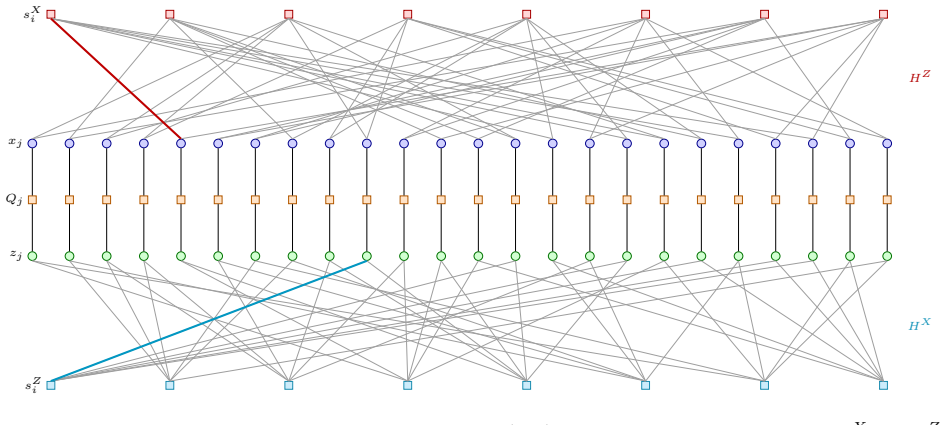
The binary factor graph with two Tanner graphs coupled only through the local joint prior at each qubit, on which joint belief propagation operates while retaining X-Z error correlations.
If this is right
- The two algorithms produce interchangeable results for any CSS code, so one can be substituted for the other without changing the posteriors.
- Messages and beliefs match exactly after the relabeling and marginalization steps, preserving all information from the local priors.
- Joint BP retains the channel correlation between Pauli components in the same way as four-state BP.
- The equivalence holds exactly rather than approximately for the full posterior.
Where Pith is reading between the lines
- Implementations could choose the binary or four-state representation depending on which is simpler to code or more efficient for a given platform.
- Any future optimization to message scheduling or approximation in one version would transfer directly to the other via the established mapping.
- The binary factorization might simplify theoretical analysis of convergence or fixed points by leveraging standard binary BP tools.
Load-bearing premise
The posterior distribution over Pauli errors given the syndrome can be exactly represented as a binary factor graph consisting of two Tanner graphs coupled only through the local joint prior at each qubit.
What would settle it
For a concrete CSS code and error model, run both algorithms and check whether the final beliefs differ after relabeling the four Pauli states and marginalizing the binary component.
Figures


read the original abstract
For CSS syndrome decoding, the two check matrices impose binary parity-check constraints on the two Pauli error components. The posterior can therefore be written as a binary factor graph with two Tanner graphs coupled by the local joint prior at each qubit. We call the sum-product algorithm on this factorization joint belief propagation (joint BP). Joint BP retains the local channel correlation between the two Pauli components. This note compares joint BP with the four-state Pauli-label factor graph used for four-state BP. The two algorithms are shown to have the same posterior weights, messages, and beliefs after relabeling the four local Pauli states and marginalizing the irrelevant binary component.
Editorial analysis
A structured set of objections, weighed in public.
Referee Report
Summary. The manuscript formulates CSS syndrome decoding as a binary factor graph consisting of two Tanner graphs coupled only through the local joint prior at each qubit, on which the sum-product algorithm yields joint belief propagation (joint BP). It then exhibits an explicit relabeling of the four Pauli states together with marginalization of the irrelevant binary component under which the messages, beliefs, and posterior weights of joint BP coincide exactly with those of the conventional four-state Pauli-label factor graph.
Significance. The equivalence is derived directly from standard factor-graph semantics without hidden independence assumptions or channel symmetry beyond what is stated. This supplies a parameter-free bridge between binary BP implementations and four-state decoding while retaining local X/Z correlations, which is useful for realistic noise models in CSS codes. The explicit relabeling and marginalization constitute a verifiable, machine-checkable identity that strengthens the result.
minor comments (2)
- [Section 3] The relabeling map (I/X/Y/Z to binary pairs) is described in the text but would benefit from an explicit table or equation block for immediate reference.
- A one-qubit or small-code numerical check confirming that the two BP implementations produce identical marginals after the stated operations would make the equivalence more immediately verifiable.
Simulated Author's Rebuttal
We thank the referee for their positive assessment of the manuscript and for recommending acceptance. There are no major comments requiring a point-by-point response.
Circularity Check
No significant circularity; derivation is direct and self-contained
full rationale
The manuscript constructs the joint-BP factor graph explicitly from the CSS check matrices and the local joint prior at each qubit, then exhibits an explicit relabeling (I/X/Y/Z to binary pairs plus marginalization) under which the sum-product messages and beliefs coincide with those of the four-state graph. All steps use only standard factor-graph semantics; no parameters are fitted to data, no self-citations are invoked as load-bearing premises, and the claimed equivalence is obtained by direct algebraic comparison rather than by renaming or re-deriving the input. The central claim therefore does not reduce to its own inputs by construction.
Axiom & Free-Parameter Ledger
axioms (2)
- standard math The sum-product algorithm computes correct marginal posteriors on the described factor graph.
- domain assumption The posterior over Pauli errors admits an exact factorization into two coupled binary Tanner graphs linked only by per-qubit joint priors.
Forward citations
Cited by 1 Pith paper
-
A Two-Branch Finite-Field Construction for Regular CSS LDPC Bases
A finite-field two-branch coset construction generates regular CSS LDPC bases for multiple (J,L) pairs, with a (3,10) example lifted 64-fold to a [[10240,4108,10≤d≤32]] code and post-processed FER of 1e-7 at p=0.058.
Reference graph
Works this paper leans on
-
[1]
Low-density parity-check codes,
R. G. Gallager, “Low-density parity-check codes,”IRE Transactions on Information Theory, vol. 8, no. 1, pp. 21–28, 1962
work page 1962
-
[2]
A recursive approach to low complexity codes,
R. M. Tanner, “A recursive approach to low complexity codes,”IEEE Transactions on Infor- mation Theory, vol. 27, no. 5, pp. 533–547, 1981
work page 1981
-
[3]
The generalized distributive law,
S. M. Aji and R. J. McEliece, “The generalized distributive law,”IEEE Transactions on Information Theory, vol. 46, no. 2, pp. 325–343, 2000. 12
work page 2000
-
[4]
Factor graphs and the sum-product algo- rithm,
F. R. Kschischang, B. J. Frey, and H.-A. Loeliger, “Factor graphs and the sum-product algo- rithm,”IEEE Transactions on Information Theory, vol. 47, no. 2, pp. 498–519, 2001
work page 2001
-
[5]
The capacity of low-density parity-check codes under message-passing decoding,
T. J. Richardson and R. L. Urbanke, “The capacity of low-density parity-check codes under message-passing decoding,”IEEE Transactions on Information Theory, vol. 47, no. 2, pp. 599–618, 2001
work page 2001
-
[6]
On the design of low- density parity-check codes within 0.0045 dB of the Shannon limit,
S.-Y. Chung, G. D. Forney, Jr., T. J. Richardson, and R. Urbanke, “On the design of low- density parity-check codes within 0.0045 dB of the Shannon limit,”IEEE Communications Letters, vol. 5, no. 2, pp. 58–60, 2001
work page 2001
-
[7]
Improved low-density parity-check codes using irregular graphs,
M. G. Luby, M. Mitzenmacher, M. A. Shokrollahi, and D. A. Spielman, “Improved low-density parity-check codes using irregular graphs,”IEEE Transactions on Information Theory, vol. 47, no. 2, pp. 585–598, 2001
work page 2001
-
[8]
T. Richardson and R. Urbanke,Modern Coding Theory. Cambridge University Press, 2008
work page 2008
-
[9]
Good quantum error-correcting codes exist,
A. R. Calderbank and P. W. Shor, “Good quantum error-correcting codes exist,”Physical Review A, vol. 54, no. 2, pp. 1098–1105, 1996
work page 1996
-
[10]
Error correcting codes in quantum theory,
A. M. Steane, “Error correcting codes in quantum theory,”Physical Review Letters, vol. 77, no. 5, pp. 793–797, 1996
work page 1996
-
[11]
Fifteen years of quantum LDPC coding and improved decoding strategies,
Z. Babar, P. Botsinis, D. Alanis, S. X. Ng, and L. Hanzo, “Fifteen years of quantum LDPC coding and improved decoding strategies,”IEEE Access, vol. 3, pp. 2492–2519, 2015
work page 2015
-
[12]
Modified belief propagation decoders for quantum low-density parity-check codes,
A. Rigby, J. C. Olivier, and P. Jarvis, “Modified belief propagation decoders for quantum low-density parity-check codes,”Physical Review A, vol. 100, no. 1, p. 012330, 2019
work page 2019
-
[13]
Decoding across the quantum low- density parity-check code landscape,
J. Roffe, D. R. White, S. Burton, and E. T. Campbell, “Decoding across the quantum low- density parity-check code landscape,”Physical Review Research, vol. 2, no. 4, p. 043423, 2020
work page 2020
-
[14]
Degenerate quantum LDPC codes with good finite length performance,
P. Panteleev and G. Kalachev, “Degenerate quantum LDPC codes with good finite length performance,”Quantum, vol. 5, p. 585, 2021
work page 2021
-
[15]
Classical product code constructions for quantum Calderbank-Shor-Steane codes,
D. Ostrev, D. Orsucci, F. L´ azaro, and B. Matuz, “Classical product code constructions for quantum Calderbank-Shor-Steane codes,”Quantum, vol. 8, p. 1420, 2024
work page 2024
-
[16]
Informed dynamic scheduling for QLDPC codes,
T.-H. Huang and Y.-L. Ueng, “Informed dynamic scheduling for QLDPC codes,”Quantum, vol. 10, p. 1967, 2026
work page 1967
-
[17]
Sparse-graph codes for quantum error correction,
D. J. C. MacKay, G. Mitchison, and P. L. McFadden, “Sparse-graph codes for quantum error correction,”IEEE Transactions on Information Theory, vol. 50, no. 10, pp. 2315–2330, 2004
work page 2004
-
[18]
On the iterative decoding of sparse quantum codes,
D. Poulin and Y. Chung, “On the iterative decoding of sparse quantum codes,”Quantum Information and Computation, vol. 8, no. 10, pp. 987–1000, 2008
work page 2008
-
[19]
Refined belief propagation decoding of sparse-graph quantum codes,
K.-Y. Kuo and C.-Y. Lai, “Refined belief propagation decoding of sparse-graph quantum codes,”IEEE Journal on Selected Areas in Information Theory, vol. 1, no. 2, pp. 487–498, 2020
work page 2020
-
[20]
A decoding algorithm for CSS codes using the X/Z correlations,
N. Delfosse and J.-P. Tillich, “A decoding algorithm for CSS codes using the X/Z correlations,” inProceedings of the IEEE International Symposium on Information Theory, 2014, pp. 1071– 1075. 13
work page 2014
-
[21]
H. Goto and H. Uchikawa, “Fault-tolerant quantum computation with a soft-decision decoder for error correction and detection by teleportation,”Scientific Reports, vol. 3, p. 2044, 2013
work page 2044
-
[22]
Soft-decision decoder for quantum erasure and probabilistic-gate error models,
——, “Soft-decision decoder for quantum erasure and probabilistic-gate error models,”Physical Review A, vol. 89, no. 2, p. 022322, 2014
work page 2014
-
[23]
Quantum error correction near the coding theoretical bound,
D. Komoto and K. Kasai, “Quantum error correction near the coding theoretical bound,”npj Quantum Information, vol. 11, p. 154, 2025
work page 2025
-
[24]
Quantum error correction via codes over GF(4),
A. R. Calderbank, E. M. Rains, P. W. Shor, and N. J. A. Sloane, “Quantum error correction via codes over GF(4),”IEEE Transactions on Information Theory, vol. 44, no. 4, pp. 1369–1387, 1998
work page 1998
-
[25]
R. Matsumoto and T. Uyematsu, “Constructing quantum error-correcting codes forp m-state systems from classical error-correcting codes,”IEICE Transactions on Fundamentals of Elec- tronics, Communications and Computer Sciences, vol. E83-A, no. 10, pp. 1878–1883, 2000
work page 2000
-
[26]
Quantum error correction beyond the bounded distance decoding limit,
K. Kasai, M. Hagiwara, H. Imai, and K. Sakaniwa, “Quantum error correction beyond the bounded distance decoding limit,”IEEE Transactions on Information Theory, vol. 58, no. 2, pp. 1223–1230, 2012
work page 2012
-
[27]
Random construction of quantum LDPC codes,
K. Okada and K. Kasai, “Random construction of quantum LDPC codes,” 2025. [Online]. Available: https://arxiv.org/abs/2511.04634 14
discussion (0)
Sign in with ORCID, Apple, or X to comment. Anyone can read and Pith papers without signing in.