Query-efficient model evaluation using cached responses
Pith reviewed 2026-05-11 00:50 UTC · model grok-4.3
The pith
DKPS with cached responses allows benchmark evaluation of new models using far fewer queries while matching baseline accuracy.
A machine-rendered reading of the paper's core claim, the machinery that carries it, and where it could break.
Core claim
The authors claim that DKPS-based methods achieve the same mean absolute error as baselines with a substantially decreased query budget by leveraging cached model responses. They provide theoretical results on query-efficiency under certain conditions and empirical validation on benchmarks, plus an offline query selection method that improves accuracy over random choice.
What carries the argument
The Data Kernel Perspective Space (DKPS), which quantifies relationships between models in the black-box setting to leverage cached responses for performance prediction.
If this is right
- Benchmark performance can be estimated accurately without querying every test case.
- Existing caches of model responses become a resource for reducing evaluation costs of future models.
- Query selection can be done offline to maximize prediction quality based on reference models.
- The approach applies when theoretical conditions on model similarities hold in practice.
Where Pith is reading between the lines
- Shared evaluation caches could become standard in model development to speed up testing.
- The method might extend to selecting minimal query sets for entire model families.
- It suggests potential for dynamic evaluation strategies that adapt based on observed similarities.
Load-bearing premise
The Data Kernel Perspective Space reliably quantifies black-box relationships between models, allowing the theoretical query-efficiency conditions to hold in actual benchmark evaluations.
What would settle it
An experiment on a standard benchmark where the DKPS method requires the same or more queries than a non-DKPS baseline to achieve equivalent mean absolute error in performance prediction.
Figures




read the original abstract
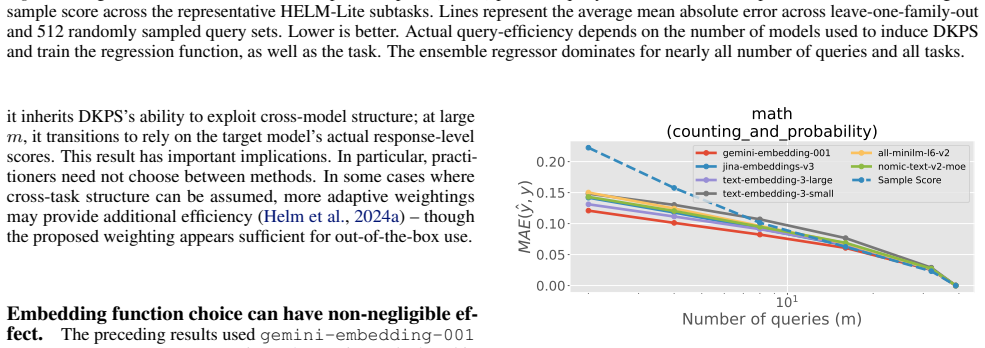
Evaluating a new model on an existing benchmark is often necessary to understand its behavior before deployment. For modern evaluation frameworks, generating and evaluating a response for all queries can be prohibitively expensive. In practice, responses from previously-evaluated models are often cached -- creating a potential opportunity to use this additional information to decrease the number of queries required to accurately evaluate a new model. In this paper, we introduce an approach for predicting benchmark performance that leverages cached model responses based on the Data Kernel Perspective Space (DKPS), a method for quantifying the relationship between models in the black-box setting. Theoretically, we show that DKPS-based methods are query-efficient under certain conditions. Empirically, we demonstrate that DKPS-based methods achieve the same mean absolute error as baselines with a substantially decreased query budget. We conclude by proposing an offline method for selecting a set of queries that maximizes the goodness-of-fit on reference models, improving prediction accuracy over random query selection.
Editorial analysis
A structured set of objections, weighed in public.
Referee Report
Summary. The paper introduces DKPS (Data Kernel Perspective Space) as a black-box method to leverage cached responses from previously evaluated models, enabling query-efficient prediction of a new model's full benchmark score. It provides theoretical conditions under which DKPS-based predictors are query-efficient, demonstrates empirically that they match baseline mean absolute error at substantially lower query budgets, and proposes an offline procedure that selects a fixed query subset by maximizing goodness-of-fit on a reference model cache.
Significance. If the central claims hold, the work offers a practical route to amortize the cost of large-scale benchmarking by reusing cached model outputs, which is increasingly relevant as evaluation budgets grow. The offline query-selection method and the explicit statement of kernel-span conditions are concrete strengths that could be built upon.
major comments (2)
- [Experiments] The empirical protocol (Experiments section) evaluates only models whose response vectors lie inside the linear/kernel span of the cached reference set; no out-of-distribution trials are reported in which the target model belongs to a qualitatively different architecture family or training regime. Because the DKPS coordinate estimation and the claimed MAE preservation both rely on the new model remaining well-conditioned within that span, the absence of such tests makes the general query-efficiency claim load-bearing and unverified.
- [§3] §3 (theoretical analysis): the query-efficiency guarantee is stated to hold “under certain conditions” on the kernel matrix and the target response vector, yet the manuscript does not quantify how often these conditions are satisfied for realistic model caches or provide a diagnostic that practitioners could use to check them before deployment.
minor comments (2)
- [§2] Notation for the DKPS kernel and the projection operator is introduced without an explicit comparison table to standard kernel ridge regression or Nyström approximations; a short side-by-side would clarify the novelty.
- [Abstract] The abstract claims “substantially decreased query budget” but supplies neither the exact reduction factor nor the identity of the strongest baseline; these numbers should appear in the abstract or a prominent table.
Simulated Author's Rebuttal
We thank the referee for the constructive review and for recognizing the practical relevance of amortizing benchmark costs via cached responses. We address each major comment below and commit to revisions that strengthen the manuscript without altering its core claims.
read point-by-point responses
-
Referee: [Experiments] The empirical protocol (Experiments section) evaluates only models whose response vectors lie inside the linear/kernel span of the cached reference set; no out-of-distribution trials are reported in which the target model belongs to a qualitatively different architecture family or training regime. Because the DKPS coordinate estimation and the claimed MAE preservation both rely on the new model remaining well-conditioned within that span, the absence of such tests makes the general query-efficiency claim load-bearing and unverified.
Authors: We agree that the reported experiments focus on in-span models, which is the setting in which the theoretical guarantees of DKPS hold. The method is explicitly intended for cases where the target response vector lies in the kernel span of the reference cache; out-of-span models are expected to exhibit higher error, consistent with the analysis in §3. To clarify the scope of the query-efficiency claim, we will add a new subsection in the Experiments section that includes out-of-distribution trials using models from qualitatively different architecture families and training regimes. These results will show the anticipated degradation in MAE when the span condition is violated, together with a discussion of how practitioners can detect such cases. This addition will make the boundaries of the method explicit rather than leaving the claim unverified. revision: yes
-
Referee: [§3] §3 (theoretical analysis): the query-efficiency guarantee is stated to hold “under certain conditions” on the kernel matrix and the target response vector, yet the manuscript does not quantify how often these conditions are satisfied for realistic model caches or provide a diagnostic that practitioners could use to check them before deployment.
Authors: We will expand §3 with a new subsection that empirically quantifies the prevalence of the required conditions across the reference caches used in the paper. Concretely, we will report the distribution of kernel-matrix condition numbers, effective ranks, and residual norms of the projection of held-out target vectors onto the span for each benchmark and cache size. In addition, we will define and validate a simple, computable diagnostic: the normalized residual norm of the target response vector after projection onto the cached kernel span (which can be evaluated using only the existing cache before any new queries are made). This diagnostic will be presented with threshold guidelines derived from the empirical distributions, enabling practitioners to decide whether DKPS is likely to be query-efficient for a given new model. revision: yes
Circularity Check
No significant circularity; DKPS derivation and query selection remain independent of target predictions
full rationale
The paper introduces DKPS as a black-box quantification of model relationships, derives query-efficiency under stated theoretical conditions, and empirically shows equivalent MAE at lower query budgets. The offline query-selection procedure optimizes goodness-of-fit explicitly on reference models before applying the reduced set to new models; this is presented as an engineering improvement rather than a statistical tautology. No equations or claims reduce a prediction to a fitted quantity by construction, no load-bearing self-citations close the central argument, and the derivation chain does not rely on renaming or smuggling an ansatz. The result is therefore self-contained against external benchmarks and receives only a minor score for the inherent reference-set dependence of any caching method.
Axiom & Free-Parameter Ledger
Lean theorems connected to this paper
-
IndisputableMonolith/Cost/FunctionalEquation.leanwashburn_uniqueness_aczel unclear?
unclearRelation between the paper passage and the cited Recognition theorem.
DKPS representations … argmin … (||zi − zj|| − Dii′)² … nearest neighbor regression … Assumption 1 (Lipschitz Score Function)
-
IndisputableMonolith/Foundation/RealityFromDistinction.leanreality_from_one_distinction unclear?
unclearRelation between the paper passage and the cited Recognition theorem.
Theorem 2 … MSE(ŷNN) ≤ ε … query-efficient relative to ŷQ
What do these tags mean?
- matches
- The paper's claim is directly supported by a theorem in the formal canon.
- supports
- The theorem supports part of the paper's argument, but the paper may add assumptions or extra steps.
- extends
- The paper goes beyond the formal theorem; the theorem is a base layer rather than the whole result.
- uses
- The paper appears to rely on the theorem as machinery.
- contradicts
- The paper's claim conflicts with a theorem or certificate in the canon.
- unclear
- Pith found a possible connection, but the passage is too broad, indirect, or ambiguous to say the theorem truly supports the claim.
Forward citations
Cited by 1 Pith paper
-
Jailbreak susceptibility prediction and mitigation via the behavioral geometry of models
Behavioral geometry of model populations enables high-accuracy jailbreak susceptibility prediction and defense transfer with 98% fewer evaluations.
discussion (0)
Sign in with ORCID, Apple, or X to comment. Anyone can read and Pith papers without signing in.