REVIEW 2 major objections 2 minor 1 cited by
LQM-ContextRoute routes among equivalent tool providers by ranking them on expected answer quality per service cycle rather than additive rewards.
Reviewed by Pith at T0; open to challenge. T0 means a machine referee read the full paper against a public rubric. the ladder, T0–T4 →
T0 review · grok-4.3
2026-06-30 21:41 UTC pith:P3PYPFER
load-bearing objection LQM-ContextRoute introduces latency-quality matching for tool provider routing but relies on unverified LLM-as-judge signals for its claims. the 2 major comments →
Latency-Quality Routing for Functionally Equivalent Tools in LLM Agents
The pith
A machine-rendered reading of the paper's core claim, the machinery that carries it, and where it could break.
Core claim
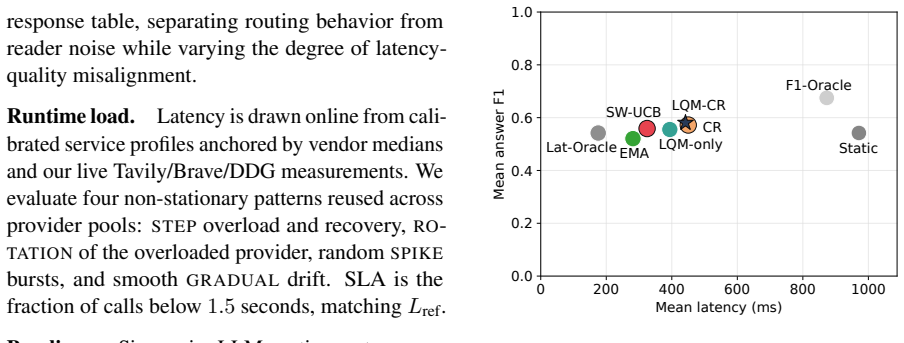
LQM-ContextRoute is a contextual bandit router whose key design is latency-quality matching: it ranks providers by expected answer quality per service cycle. Combined with query-specific quality estimation and LLM-as-judge feedback, it adapts online to load changes and provider-quality differences, improving F1 by 2.18 points on web-search load benchmark, accuracy by up to 18 points in heterogeneous StrategyQA, and NDCG by 2.91-3.22 points on retriever pools, all while staying on the latency-quality frontier.
What carries the argument
Latency-quality matching, which scores providers on expected answer quality per service cycle instead of additive reward that lets latency offset poor quality.
Load-bearing premise
Query-specific quality estimation combined with LLM-as-judge feedback enables online adaptation to load changes and provider-quality differences without gold labels at deployment time.
What would settle it
Run the router with an LLM judge whose scores show no correlation with human-rated answer quality on a held-out set of queries; if performance then drops to baseline levels, the claim is falsified.
If this is right
- On web-search benchmarks it raises F1 score by 2.18 percentage points over SW-UCB while remaining on the latency-quality frontier.
- In high-heterogeneity settings it prevents additive-reward collapse and raises accuracy by as much as 18 percentage points.
- On pools of heterogeneous retrievers it lifts NDCG by 2.91 to 3.22 percentage points.
- The method works without gold labels at deployment time by relying on online LLM-as-judge feedback.
Where Pith is reading between the lines
- This routing logic may extend to choosing among multiple LLM backends or cloud APIs where both speed and output quality matter.
- Query-specific quality models appear necessary; a single global quality estimate would likely fail when heterogeneity is high.
- Future routers could incorporate additional capacity signals such as cost or energy use in the same per-cycle framework.
Editorial analysis
A structured set of objections, weighed in public.
Referee Report
Summary. The manuscript introduces LQM-ContextRoute, a contextual bandit router for selecting among functionally equivalent tool providers (e.g., multiple web-search APIs) in LLM agents under runtime load. Its core design is latency-quality matching, which ranks providers by expected answer quality per service cycle rather than additive rewards; this is combined with query-specific quality estimation via LLM-as-judge feedback to enable online adaptation to load changes and provider-quality differences without gold labels at deployment. Experiments report gains over SW-UCB: +2.18 pp F1 on the main web-search load benchmark (while remaining on the latency-quality frontier), up to +18 pp accuracy in a high-heterogeneity StrategyQA setting, and +2.91 to +3.22 pp NDCG on heterogeneous retriever pools.
Significance. If the results hold, the work is significant for practical tool-augmented LLM agent systems, as it offers a concrete method for handling provider heterogeneity and load without requiring gold labels. The conceptual distinction between additive-reward routing and capacity-aware (quality-per-cycle) routing is a useful contribution that directly addresses collapse under heterogeneity. The paper supplies empirical evidence across three distinct settings with varying heterogeneity, which strengthens the case for the approach.
major comments (2)
- [§4 and abstract] §4 (experiments) and abstract: The reported gains (+2.18 pp F1, +18 pp accuracy, +2.91–+3.22 pp NDCG) rest on LLM-as-judge feedback producing reliable per-query quality signals for the contextual bandit, yet the manuscript provides no prompting details, calibration procedure, inter-judge agreement statistics, or validation against held-out labels; systematic judge bias would directly invalidate the adaptation claim and the performance deltas over SW-UCB.
- [§3] §3 (method): The latency-quality matching score is presented as the key mechanism that avoids additive-reward collapse, but without an explicit equation or derivation showing how expected quality per service cycle is computed and combined with the bandit (e.g., no formulation equivalent to a capacity-adjusted reward), it is impossible to verify that the ranking is non-circular or independent of fitted parameters.
minor comments (2)
- [abstract] The abstract refers to "staying on the latency-quality frontier" without defining the frontier or showing the corresponding plot/table; a brief clarification or cross-reference would improve readability.
- [§3] Notation for the contextual bandit (e.g., how context features encode load and query type) is introduced without an accompanying table of symbols or pseudocode; adding this would aid reproducibility.
Simulated Author's Rebuttal
We thank the referee for the constructive comments, which highlight areas where additional clarity will strengthen the manuscript. We address each major point below and will incorporate revisions to provide the requested details and formulations.
read point-by-point responses
-
Referee: [§4 and abstract] §4 (experiments) and abstract: The reported gains (+2.18 pp F1, +18 pp accuracy, +2.91–+3.22 pp NDCG) rest on LLM-as-judge feedback producing reliable per-query quality signals for the contextual bandit, yet the manuscript provides no prompting details, calibration procedure, inter-judge agreement statistics, or validation against held-out labels; systematic judge bias would directly invalidate the adaptation claim and the performance deltas over SW-UCB.
Authors: We agree this information is essential for validating the quality signals and the reported gains. The current version omits these details. In revision we will add: (i) the exact prompting templates and judge instructions, (ii) the calibration procedure used to map judge outputs to quality scores, (iii) inter-judge agreement statistics (e.g., pairwise agreement and Cohen’s kappa), and (iv) validation of judge scores against held-out human labels on a subset of queries. These additions will directly address concerns about potential bias and support the adaptation claims. revision: yes
-
Referee: [§3] §3 (method): The latency-quality matching score is presented as the key mechanism that avoids additive-reward collapse, but without an explicit equation or derivation showing how expected quality per service cycle is computed and combined with the bandit (e.g., no formulation equivalent to a capacity-adjusted reward), it is impossible to verify that the ranking is non-circular or independent of fitted parameters.
Authors: We acknowledge the need for an explicit formulation. The latency-quality score is computed as E[quality | query, provider] / E[latency | provider], which ranks providers by quality per service cycle rather than additive reward. This formulation is independent of the contextual bandit’s parameter estimates and is used only for ranking before the bandit update. In the revision we will insert the precise equation and a short derivation in §3 demonstrating non-circularity and independence from fitted parameters. revision: yes
Circularity Check
No circularity: empirical algorithm with external benchmarks
full rationale
The paper introduces LQM-ContextRoute as a contextual bandit using latency-quality matching and LLM-as-judge feedback for provider routing. All reported gains (+2.18 pp F1, +18 pp accuracy, +2.91–3.22 pp NDCG) are measured directly against the external baseline SW-UCB on standard benchmarks (web-search load, StrategyQA, heterogeneous retrievers). No equations, fitted parameters renamed as predictions, self-citations, or ansatzes are invoked that reduce the central claims to the inputs by construction. The design choices are presented as algorithmic decisions validated empirically rather than derived from self-referential quantities.
Axiom & Free-Parameter Ledger
axioms (1)
- domain assumption LLM-as-judge feedback supplies reliable quality signals without gold labels
read the original abstract
Tool-augmented LLM agents increasingly access the same tool type through multiple functionally equivalent providers, such as web-search APIs, retrievers, or LLM backends exposed behind a shared interface. This creates a provider-routing problem under runtime load: the router must choose among providers that differ in latency, reliability, and answer quality, often without gold labels at deployment time. We introduce LQM-ContextRoute, a contextual bandit router for same-function tool providers. Its key design is latency-quality matching: instead of letting low latency offset poor answers in an additive reward, the router ranks providers by expected answer quality per service cycle. It combines this capacity-aware score with query-specific quality estimation and LLM-as-judge feedback, allowing it to adapt online to both load changes and provider-quality differences. On the main web-search load benchmark, LQM-ContextRoute improves F1 by +2.18 pp over SW-UCB while staying on the latency-quality frontier. In a high-heterogeneity StrategyQA setting, LQM-ContextRoute avoids additive-reward collapse and improves accuracy by up to +18 pp over SW-UCB; on heterogeneous retriever pools, it improves NDCG by +2.91--+3.22 pp over SW-UCB. These results show that same-function tool routing benefits from treating latency as service capacity, especially when runtime pressure and provider-quality heterogeneity coexist.
Figures


Forward citations
Cited by 1 Pith paper
-
CoWeaver: A Bi-directional, Learnable and Explainable Matching Engine for Mixed Human-Agent Science Collaboration
CoWeaver combines capability-gap matching, UCB exploration, and LLM-based simulated negotiation to recommend collaborations in mixed human-agent networks, evaluated only on a synthetic benchmark.
Reference graph
Works this paper leans on
-
[1]
1966.Lectures on Functional Equations and Their Applications
János Aczél. 1966.Lectures on Functional Equations and Their Applications. Academic Press. Shipra Agrawal and Nikhil R. Devanur
work page 1966
-
[2]
Model Context Protocol Specifi- cation. https://modelcontextprotocol. io/specification/2024-11-05/. Proto- col revision 2024-11-05; accessed: 2026-05-02. Ashwinkumar Badanidiyuru, Robert Kleinberg, and Aleksandrs Slivkins
work page 2024
-
[3]
LiteLLM Routing and Load Balanc- ing Documentation. https://docs.litellm. ai/docs/routing. Accessed: 2026-05-02. Nihir Chadderwala
work page 2026
-
[4]
arXiv preprint arXiv:2512.03065
Optimizing life sciences agents in real-time using reinforcement learning. arXiv preprint arXiv:2512.03065. Richard Combes, Chong Jiang, and R. Srikant
-
[5]
https: //www.digitalapplied.com/blog/mcp- server-reliability-100-server- stress-test-study
100 MCP Servers Stress-Tested: Reliability Findings. https: //www.digitalapplied.com/blog/mcp- server-reliability-100-server- stress-test-study. Accessed: 2026-05-02. Dujian Ding, Ankur Mallick, Shaokun Zhang, Chi Wang, Daniel Madrigal, Mirian Del Carmen Hipolito Garcia, Menglin Xia, Laks V . S. Lakshmanan, Qingyun Wu, and Victor Rühle
work page 2026
-
[6]
ReliabilityBench: Evaluating LLM agent reliability under production-like stress conditions.arXiv preprint arXiv:2601.06112. Qitian Jason Hu, Jacob Bieker, Xiuyu Li, Nan Jiang, Benjamin Keigwin, Gaurav Ranganath, Kurt Keutzer, and Shriyash Kaustubh Upadhyay
-
[7]
RouterBench: A Benchmark for Multi-LLM Routing System
Router- Bench: A benchmark for multi-LLM routing system. arXiv preprint arXiv:2403.12031. Yuxuan Jiang and Francis Ferraro
work page internal anchor Pith review Pith/arXiv arXiv
-
[8]
SCRIBE: Structured mid-level supervision for tool-using lan- guage models.Preprint, arXiv:2601.03555. Wittawat Jitkrittum, Harikrishna Narasimhan, Ankit Singh Rawat, Jeevesh Juneja, Congchao Wang, Zifeng Wang, Alec Go, Chen-Yu Lee, Pradeep Shenoy, Rina Panigrahy, Aditya Krishna Menon, and Sanjiv Kumar
work page internal anchor Pith review Pith/arXiv arXiv
-
[9]
LLMRouterBench: A massive benchmark and unified framework for LLM routing,
LLMRouterBench: A massive benchmark and unified framework for LLM routing.arXiv preprint arXiv:2601.07206. Lihong Li, Wei Chu, John Langford, and Robert E. Schapire
-
[10]
RouteLLM: Learning to Route LLMs with Preference Data
RouteLLM: Learning to route LLMs with preference data.arXiv preprint arXiv:2406.18665. 9 Pranoy Panda, Raghav Magazine, Chaitanya Devagup- tapu, Sho Takemori, and Vishal Sharma
work page internal anchor Pith review Pith/arXiv arXiv
-
[11]
InFind- ings of the Association for Computational Linguistics: EMNLP 2025, pages 23934–23949
Adap- tive LLM routing under budget constraints. InFind- ings of the Association for Computational Linguistics: EMNLP 2025, pages 23934–23949. Association for Computational Linguistics. Shishir G. Patil, Tianjun Zhang, Xin Wang, and Joseph E. Gonzalez
work page 2025
-
[12]
On- line multi-LLM selection via contextual bandits un- der unstructured context evolution.arXiv preprint arXiv:2506.17670. Portkey. 2025a. Failover Routing Strate- gies for LLMs in Production. https: //portkey.ai/blog/failover-routing- strategies-for-llms-in-production/ . Accessed: 2026-05-02. Portkey. 2025b. The Most Reliable AI Gateway for Production S...
-
[13]
InInternational Conference on Learning Representations
ToolLLM: Facilitating large language models to master 16000+ real-world APIs. InInternational Conference on Learning Representations. Sheldon M. Ross. 1996.Stochastic Processes, 2nd edition. Wiley. Renewal-reward theorem (Theorem 3.6.1). Yoan Russac, Claire Vernade, and Olivier Cappé
work page 1996
-
[14]
ParetoBandit: Budget-Paced Adaptive Routing for Non-Stationary LLM Serving
ParetoBandit: Budget- paced adaptive routing for non-stationary LLM serv- ing.arXiv preprint arXiv:2604.00136. Nandan Thakur and 1 others
work page internal anchor Pith review Pith/arXiv arXiv
-
[15]
Fact or fiction: Verifying scientific claims. InProceedings of the 2020 Con- ference on Empirical Methods in Natural Language Processing (EMNLP), pages 7534–7550. Association for Computational Linguistics. Wang Wei, Tiankai Yang, Hongjie Chen, Yue Zhao, Franck Dernoncourt, Ryan A. Rossi, and Hoda El- dardiry
work page 2020
-
[16]
Ningning Xu, Yuxuan Jiang, Shubhashis Roy Dipta, and Hengyuan Zhang
Learning to route LLMs from ban- dit feedback: One policy, many trade-offs.arXiv preprint arXiv:2510.07429. Ningning Xu, Yuxuan Jiang, Shubhashis Roy Dipta, and Hengyuan Zhang
-
[17]
How do we select right LLM for each query? MAR: Multi-armed recommender for online LLM selection. OpenReview preprint. ICLR 2025 withdrawn submission; OpenReview ID AfA3qNY0Fq. Hengyuan Zhang, Shiping Yang, Xiao Liang, Chen- ming Shang, Yuxuan Jiang, Chaofan Tao, Jing Xiong, Hayden Kwok-Hay So, Ruobing Xie, An- gel X. Chang, and 1 others
work page 2025
-
[18]
Find Your Optimal Teacher: Personalized Data Synthesis via Router-Guided Multi-Teacher Distillation
Find your opti- mal teacher: Personalized data synthesis via router- guided multi-teacher distillation.arXiv preprint arXiv:2510.10925. A LQM-CONTEXTROUTEonline algorithm This appendix gives the full online loop correspond- ing to Fig. 5 and Eq
work page internal anchor Pith review Pith/arXiv arXiv
-
[19]
The pseudo-code makes explicit the two-stage score computation: quality estimates are computed for all active providers be- fore the cross-provider gap term is formed. 10 Algorithm 1LQM-CONTEXTROUTEonline rout- ing 1:inputridgeλ r, deflationλ, latency scaleL ref 2: init Ai ←λ rI, A−1 i ←λ −1 r I, bi ←0 , ˆτi ←τ 0 for each provideri 3:fort= 1, . . . , Tdo ...
work page 2018
-
[20]
Pareto routing methods and budget-paced LLM routers expose a quality-cost frontier or allocate traffic under a global budget (Mei et al., 2025; Taberner-Miller, 2026). LQM-CONTEXTROUTE instead provides a single online selection rule for a gateway that has already selected the tool type and must choose a provider under current load. The renewal-rate score ...
work page 2025
-
[21]
Sliding-window concentration gives the usual non- stationary additive term O(√TlogT·V T )
satisfies RT ≤ X i:∆V i >0 C(1 +L −1 ref )2σ2 logT ∆V i +o(logT). Sliding-window concentration gives the usual non- stationary additive term O(√TlogT·V T ). The guarantee is stated for the unmodulated optimistic form; the λ >0 gap modulation used in Eq. 3 is an empirical exploration control for arms whose current quality estimate is dominated. Characteris...
work page 1996
-
[22]
3), and the renewal cycle fixesα=
depend only on (1 +z 2)/(1 +z 1); standard multiplicative functional-equation arguments yield T(u, z) = u(1 +z) −α (Aczél, 1966, Ch. 3), and the renewal cycle fixesα=
work page 1966
-
[23]
Separation from additive composites. Theorem 2(Renewal-reward vs. additive separa- tion).Fix α∈(0,1) and let radd i (α) =αu i − (1−α)˜τi with ˜τ= min{τ /Lref,1} . There exists a two-arm instance where the additive score chooses the lower-quality faster arm while Vi =u i/(1+ ˜τi) chooses the higher-quality arm whenever u2∆˜τ 1 + ˜τ2 <∆ u < 1−α α ∆˜τ. The i...
discussion (0)
Sign in with ORCID, Apple, or X to comment. Anyone can read and Pith papers without signing in.