REVIEW 2 major objections 1 minor 1 cited by
Reviewed by Pith at T0; open to challenge.
T0 means a machine referee read the full paper against a public rubric. The mark states how deep the mechanical check went, never who wrote it. the ladder, T0–T4 →
T0 review · grok-4.3
Optimizing the temporal weight for quadrature extraction raises the signal-to-noise ratio in ultrafast homodyne detection of quantum light.
2026-06-30 20:08 UTC pith:37J4WPY3
load-bearing objection The paper gives a practical optimization for temporal weighting in ultrafast homodyne detection that lifts observed squeezing levels, but the gains rest on untested assumptions about noise autocorrelation stability. the 2 major comments →
Efficient ultrafast homodyne detection of quantum light
The pith
A machine-rendered reading of the paper's core claim, the machinery that carries it, and where it could break.
Core claim
By analyzing the autocorrelations of shot noise and electronic noise and determining the optimal weight by solving a generalized Rayleigh quotient problem, the optimal weight enhances the squeezing and anti-squeezing levels observed experimentally in ultrafast homodyne detection of quantum light.
What carries the argument
The optimal temporal weight derived by solving the generalized Rayleigh quotient from measured noise autocorrelations.
Load-bearing premise
The autocorrelations of shot noise and electronic noise can be accurately characterized and remain stable enough that the solved weight genuinely improves detection without being limited by unmodeled effects.
What would settle it
A side-by-side comparison of quadrature variance or squeezing level measured with the optimal weight versus a conventional uniform weight, where the expected SNR gain fails to appear.
If this is right
- Higher detection efficiency becomes available for ultrafast continuous-variable quantum states.
- Squeezing and anti-squeezing measurements reach higher observed values without hardware changes.
- Quantum technology applications that rely on ultrafast homodyne detection gain practical performance improvement through signal processing.
Where Pith is reading between the lines
- The same noise-correlation approach could be tested on other pulsed detection schemes where temporal structure is present.
- Stability of the derived weight over long experimental runs would reveal whether recalibration is needed in practice.
- Combining this weight optimization with existing hardware upgrades might produce additive gains in overall system efficiency.
Editorial analysis
A structured set of objections, weighed in public.
Referee Report
Summary. The manuscript claims that optimizing the temporal weight for quadrature extraction in ultrafast homodyne detection—obtained by solving a generalized Rayleigh quotient from measured shot-noise and electronic-noise autocorrelations—yields a substantial SNR improvement and thereby higher detection efficiency, with the optimal weight experimentally enhancing observed squeezing and anti-squeezing levels.
Significance. If the experimental claims hold under independent verification, the result would be significant for continuous-variable quantum optics: it offers a post-processing route to higher effective efficiency for ultrafast states without hardware redesign, and the Rayleigh-quotient formulation provides a principled, data-driven way to exploit detector noise correlations.
major comments (2)
- [Abstract / experimental results] The central experimental claim (optimal weight enhances squeezing/anti-squeezing) rests on the untested assumption that the measured autocorrelations are stationary and that no unmodeled effects (nonlinearity, timing jitter, power-dependent cross-talk) dominate once the weight is applied; no re-measurement on independent datasets or at varied optical powers is described to rule out overfitting.
- [Method / results] The generalized Rayleigh quotient solution is presented as yielding a genuine efficiency gain, yet the manuscript provides no quantitative check (e.g., comparison of SNR or squeezing variance before/after on held-out data) that the reported improvement survives when the autocorrelation estimates are recomputed from fresh traces.
minor comments (1)
- [Abstract] The abstract would be strengthened by stating the numerical improvement in squeezing level or effective efficiency (with uncertainty) rather than the qualitative term 'substantial'.
Simulated Author's Rebuttal
We thank the referee for their careful reading and constructive comments on our manuscript. Below we respond point by point to the major comments and indicate the revisions we will incorporate.
read point-by-point responses
-
Referee: [Abstract / experimental results] The central experimental claim (optimal weight enhances squeezing/anti-squeezing) rests on the untested assumption that the measured autocorrelations are stationary and that no unmodeled effects (nonlinearity, timing jitter, power-dependent cross-talk) dominate once the weight is applied; no re-measurement on independent datasets or at varied optical powers is described to rule out overfitting.
Authors: We acknowledge the importance of verifying stationarity and ruling out unmodeled effects or overfitting. The autocorrelations were measured under the same experimental conditions and over long acquisition times as the quadrature data, supporting the assumption of stationarity for the detector noise. To directly address the concern, the revised manuscript will include additional measurements on independent datasets collected at separate times and at varied optical powers. These will show that the optimal weight remains consistent and that the SNR and squeezing improvements are reproducible. revision: yes
-
Referee: [Method / results] The generalized Rayleigh quotient solution is presented as yielding a genuine efficiency gain, yet the manuscript provides no quantitative check (e.g., comparison of SNR or squeezing variance before/after on held-out data) that the reported improvement survives when the autocorrelation estimates are recomputed from fresh traces.
Authors: We agree that explicit validation on held-out data strengthens the claim of a genuine efficiency gain. The revised manuscript will add a cross-validation section in which autocorrelations are estimated from one subset of traces, the optimal weight is computed, and the SNR/squeezing performance is then evaluated on a disjoint held-out set of traces. Quantitative before/after comparisons on this held-out data will be reported to confirm that the improvement persists. revision: yes
Circularity Check
No significant circularity; derivation self-contained
full rationale
The central derivation solves a generalized Rayleigh quotient on separately measured shot-noise and electronic-noise autocorrelations to obtain an optimal temporal weight, then applies that weight to quadrature extraction on quantum-light data. The noise autocorrelations are independent inputs distinct from the target squeezing/anti-squeezing observables; no equation reduces the claimed SNR gain to a fit of those observables, no self-citation chain is load-bearing, and no ansatz or uniqueness result is smuggled in. The method therefore remains externally falsifiable via re-measurement of the autocorrelations on independent runs.
Axiom & Free-Parameter Ledger
read the original abstract
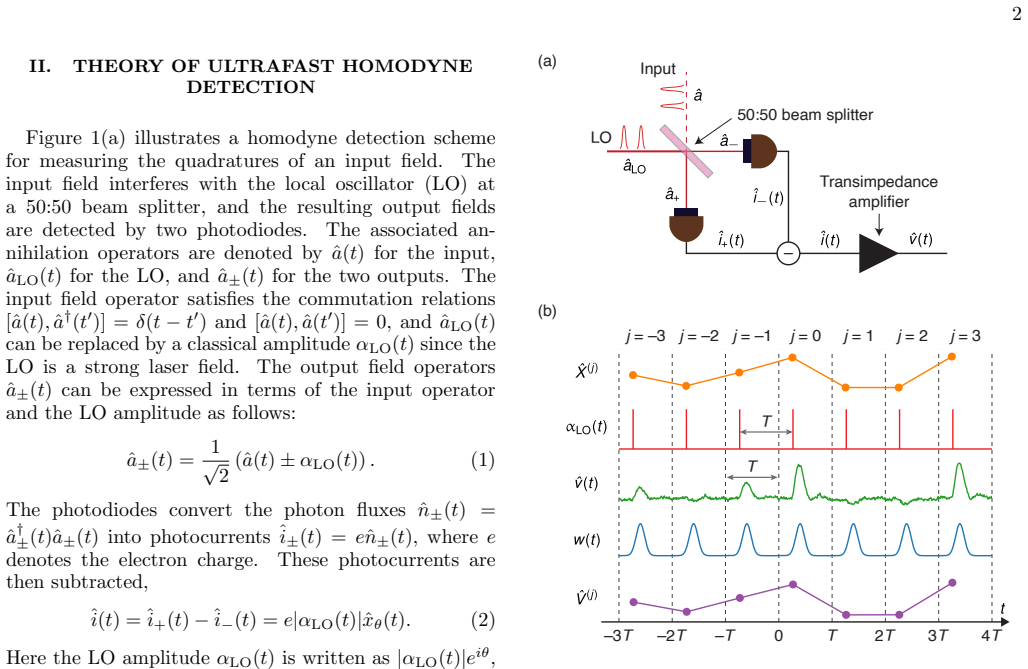
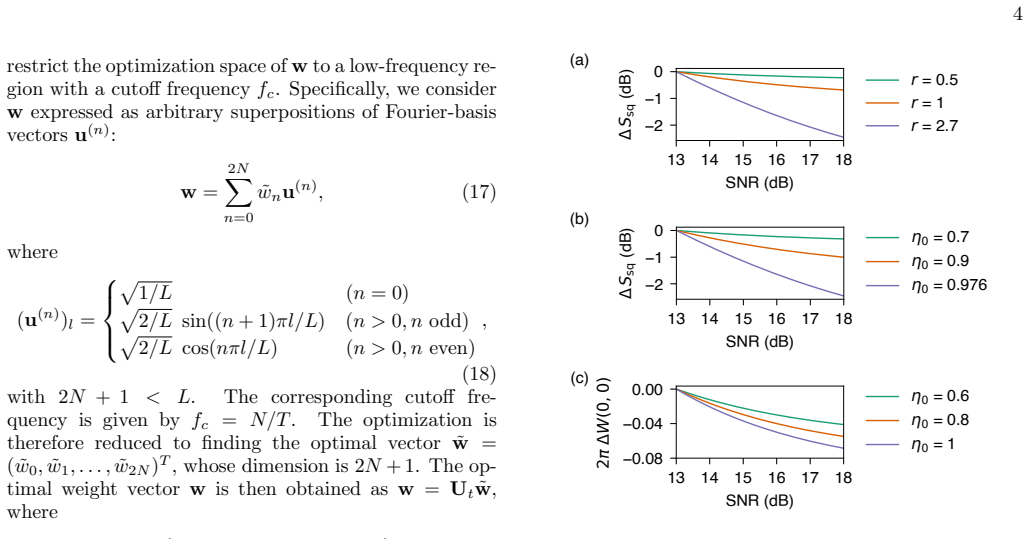
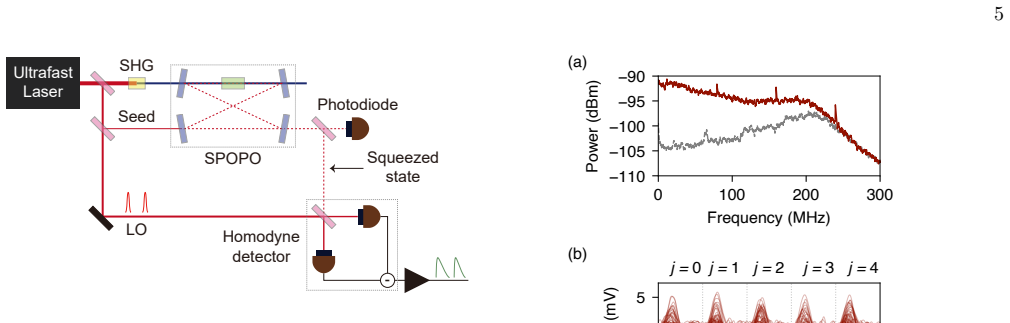
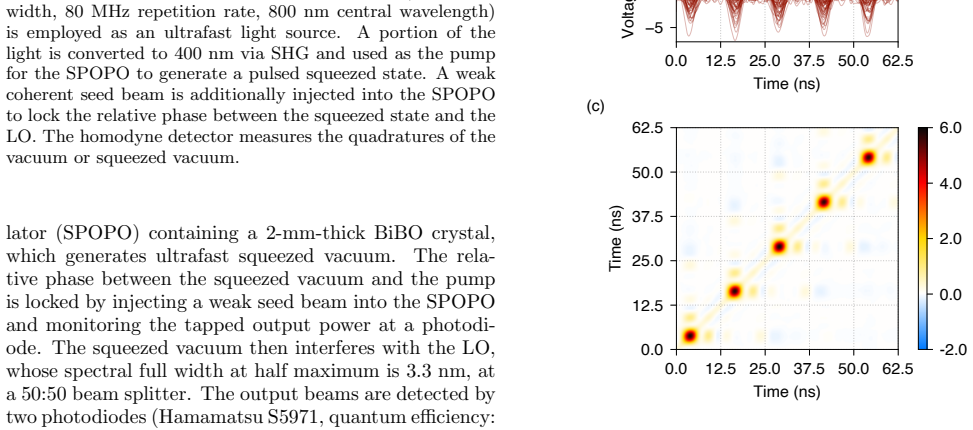
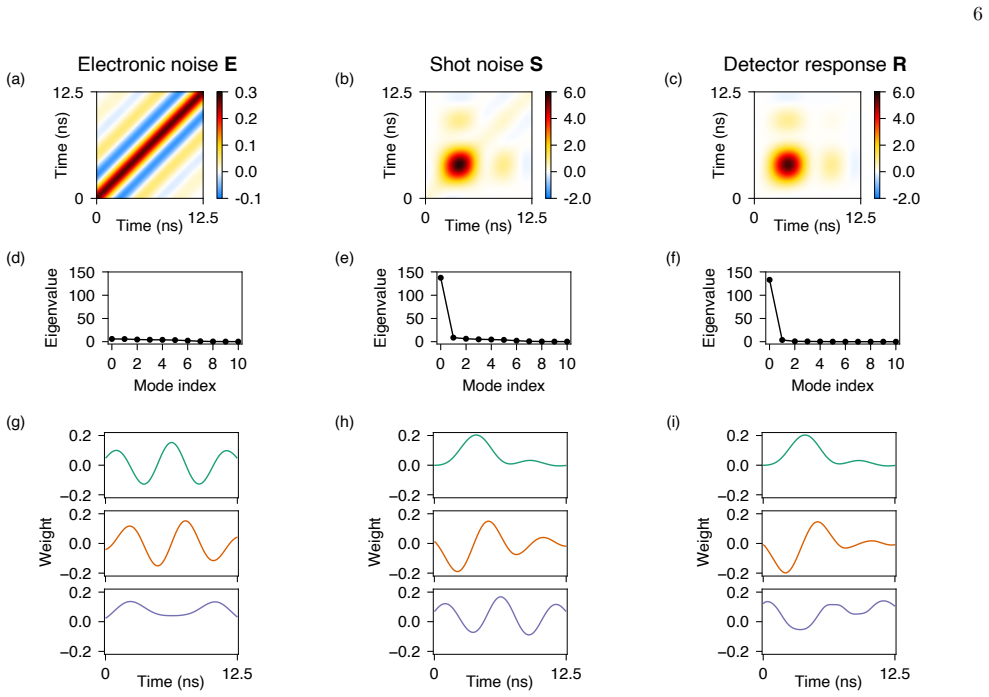
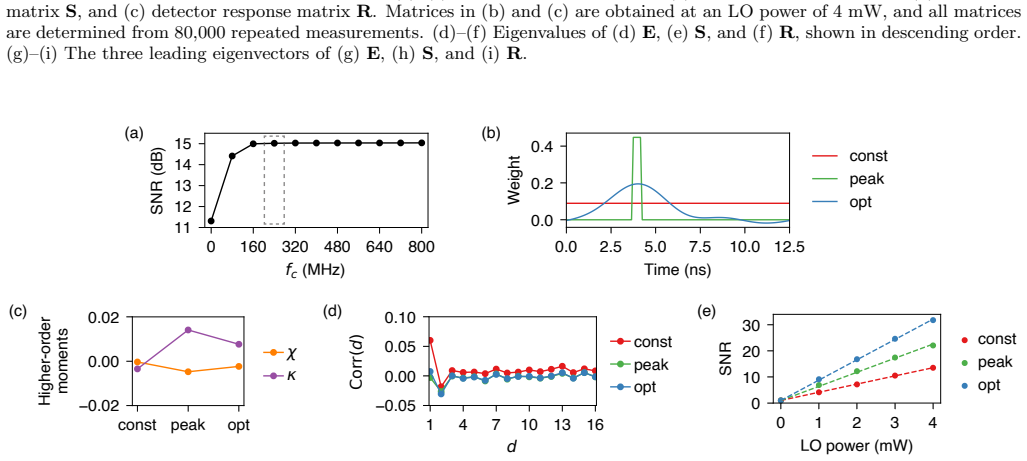
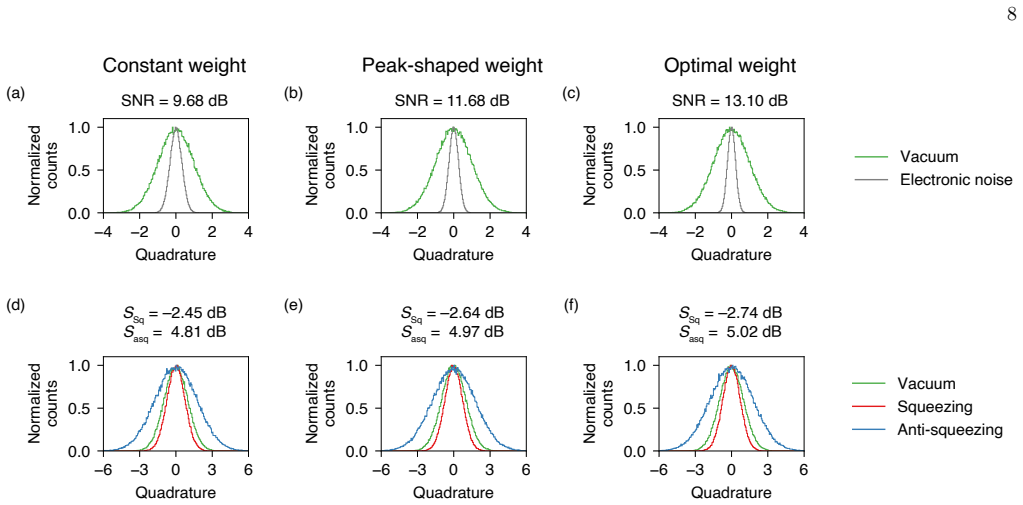
Ultrafast continuous-variable quantum states offer new opportunities for advanced quantum technologies, but efficient homodyne detection of these states remains challenging. Here, we present a method for efficient ultrafast homodyne detection by exploiting temporal correlations in detector signals. By optimizing the temporal weight used to extract quadrature outcomes, we achieve a substantial increase in the signal-to-noise ratio of ultrafast homodyne detection, thereby improving the detection efficiency. We analyze the autocorrelations of shot noise and electronic noise and determine the optimal weight by solving a generalized Rayleigh quotient problem. The optimal weight enhances the squeezing and anti-squeezing levels observed experimentally. These results highlight the importance of optimized signal processing for efficient quantum measurements.
Figures
Forward citations
Cited by 1 Pith paper
-
Attosecond metrology of bright quantum light
Attosecond streaking of bright squeezed light produces distinct sub-cycle modulations that encode quantum field quadrature fluctuations, enabling squeezing certification beyond conventional tomography limits.
Reference graph
Works this paper leans on
-
[1]
Larsen, M. V., Guo, X., Breum, C. R., Neergaard- Nielsen, J. S. & Andersen, U. L. Deterministic generation of a two-dimensional cluster state.Science366, 369–372 (2019)
work page 2019
-
[2]
Asavanant, W.et al.Generation of time-domain- multiplexed two-dimensional cluster state.Science366, 373–376 (2019)
work page 2019
-
[3]
Guo, X.et al.Distributed quantum sensing in a continuous-variable entangled network.Nat. Phys.16, 281–284 (2020)
work page 2020
-
[4]
Photonics Res.9, 2351–2359 (2021)
Kovalenko, O.et al.Frequency-multiplexed entangle- ment for continuous-variable quantum key distribution. Photonics Res.9, 2351–2359 (2021)
work page 2021
-
[5]
Deng, Y.-H.et al.Gaussian Boson Sampling with Pseudo-Photon-Number-Resolving Detectors and Quan- tum Computational Advantage.Phys. Rev. Lett.131, 150601 (2023)
work page 2023
-
[6]
Aghaee Rad, H.et al.Scaling and networking a modu- lar photonic quantum computer.Nature638, 912–919 (2025)
work page 2025
-
[7]
Jia, X.et al.Continuous-variable multipartite entangle- ment in an integrated microcomb.Nature639, 329–336 (2025)
work page 2025
-
[8]
Liu, Z.-H.et al.Quantum learning advantage on a scal- able photonic platform.Science389, 1332–1335 (2025)
work page 2025
-
[9]
Andersen, U. L., Gehring, T., Marquardt, C. & Leuchs, G. 30 years of squeezed light generation.Phys. Scr.91, 053001 (2016)
work page 2016
-
[10]
A.et al.Quantum-enhanced nonlinear mi- croscopy.Nature594, 201–206 (2021)
Casacio, C. A.et al.Quantum-enhanced nonlinear mi- croscopy.Nature594, 201–206 (2021)
work page 2021
-
[11]
Nehra, R.et al.Few-cycle vacuum squeezing in nanopho- tonics.Science377, 1333–1337 (2022)
work page 2022
-
[12]
Rasputnyi, A.et al.High-harmonic generation by a bright squeezed vacuum.Nat. Phys.20, 1960–1965 (2024)
work page 1960
-
[13]
I.et al.Squeezed dual-comb spectroscopy
Herman, D. I.et al.Squeezed dual-comb spectroscopy. Science387, 653–658 (2025)
work page 2025
-
[14]
Sennary, M.et al.Attosecond quantum uncertainty dy- namics and ultrafast squeezed light for quantum commu- nication.Light Sci. Appl.14, 350 (2025)
work page 2025
-
[15]
Cimini, V.et al.Large-scale quantum reservoir comput- ing using a Gaussian Boson Sampler.npj Quantum Inf. (2026)
work page 2026
-
[16]
Ra, Y.-S.et al.Non-Gaussian quantum states of a mul- 11 timode light field.Nat. Phys.16, 144–147 (2020)
work page 2020
-
[17]
Kouadou, T.et al.Spectrally shaped and pulse-by-pulse multiplexed multimode squeezed states of light.APL Photonics8, 086113 (2023)
work page 2023
-
[18]
Roh, C., Gwak, G., Yoon, Y.-D. & Ra, Y.-S. Genera- tion of three-dimensional cluster entangled state.Nat. Photon.19, 526–532 (2025)
work page 2025
-
[19]
Kalash, M., Han, U.-N., Ra, Y.-S. & Chekhova, M. V. Efficient detection of spectrally multimode squeezed light through optical parametric amplification (2025). Preprint athttps://arxiv.org/abs/2508.04502
-
[20]
Gwak, G., Roh, C., Yoon, Y.-D., Kim, M. S. & Ra, Y.-S. Completely characterizing multimode second-order non- linear optical quantum processes.Nat. Photon.20, 156– 162 (2026)
work page 2026
-
[21]
Experimental Quantum Tomography of Multimode Gaussian States
Roh, C., Gwak, G., Yoon, Y.-D. & Ra, Y.-S. Ex- perimental Quantum Tomography of Multimode Gaus- sian States (2026). Preprint athttps://arxiv.org/abs/ 2603.21380
work page internal anchor Pith review Pith/arXiv arXiv 2026
-
[22]
Bimbard, E., Jain, N., MacRae, A. & Lvovsky, A. I. Quantum-optical state engineering up to the two-photon level.Nat. Photon.4, 243–247 (2010)
work page 2010
-
[23]
Endo, M.et al.Non-Gaussian quantum state generation by multi-photon subtraction at the telecommunication wavelength.Opt. Express31, 12865–12879 (2023)
work page 2023
-
[24]
Simon, H., Caron, L., Journet, R., Cotte, V. & Tualle- Brouri, R. Experimental Demonstration of a Versatile and Scalable Scheme for Iterative Generation of Non- Gaussian States of Light.Phys. Rev. Lett.133, 173603 (2024)
work page 2024
-
[25]
Barakat, I.et al.Simultaneous measurement of multi- mode squeezing through multimode phase-sensitive am- plification.Opt. Quantum3, 36–44 (2025)
work page 2025
-
[26]
Lamine, B., Fabre, C. & Treps, N. Quantum Improve- ment of Time Transfer between Remote Clocks.Phys. Rev. Lett.101, 123601 (2008)
work page 2008
-
[27]
Wang, S.et al.Sub-shot-noise interferometric timing measurement with a squeezed frequency comb.Phys. Rev. A98, 053821 (2018)
work page 2018
-
[28]
Bachor, H.-A. & Ralph, T. C.A Guide to Experiments in Quantum Optics(Wiley-VCH, Weinheim, 2019), 3 edn
work page 2019
-
[29]
Com- mun.285, 5259–5267 (2012)
Kumar, R.et al.Versatile wideband balanced detector for quantum optical homodyne tomography.Opt. Com- mun.285, 5259–5267 (2012)
work page 2012
-
[30]
Cooper, M., S¨ oller, C. & Smith, B. J. High-stability time- domain balanced homodyne detector for ultrafast optical pulse applications.J. Mod. Opt.60, 611–616 (2013)
work page 2013
-
[31]
Masalov, A. V., Kuzhamuratov, A. & Lvovsky, A. I. Noise spectra in balanced optical detectors based on tran- simpedance amplifiers.Rev. Sci. Instrum.88, 113109 (2017)
work page 2017
-
[32]
Hansen, H.et al.Ultrasensitive pulsed, balanced ho- modyne detector: application to time-domain quantum measurements.Opt. Lett.26, 1714–1716 (2001)
work page 2001
-
[33]
Zavatta, A., Viciani, S. & Bellini, M. Non-classical field characterization by high-frequency, time-domain quan- tum homodyne tomography.Laser Phys. Lett.3, 3–16 (2006)
work page 2006
-
[34]
Okubo, R., Hirano, M., Zhang, Y. & Hirano, T. Pulse- resolved measurement of quadrature phase amplitudes of squeezed pulse trains at a repetition rate of 76 MHz.Opt. Lett.33, 1458–1460 (2008)
work page 2008
-
[35]
Du, S., Li, Z., Liu, W., Wang, X. & Li, Y. High-speed time-domain balanced homodyne detector for nanosec- ond optical field applications.J. Opt. Soc. Am. B35, 481–486 (2018)
work page 2018
-
[36]
Kouadou, T.et al.Homodyne detection for pulse-by- pulse squeezing measurements.New J. Phys.28, 054509 (2026)
work page 2026
-
[37]
Appel, J., Hoffman, D., Figueroa, E. & Lvovsky, A. I. Electronic noise in optical homodyne tomography.Phys. Rev. A75, 035802 (2007)
work page 2007
-
[38]
Vahlbruch, H., Mehmet, M., Danzmann, K. & Schnabel, R. Detection of 15 dB Squeezed States of Light and Their Application for the Absolute Calibration of Photoelectric Quantum Efficiency.Phys. Rev. Lett.117, 110801 (2016)
work page 2016
-
[39]
Mari, A. & Eisert, J. Positive Wigner Functions Render Classical Simulation of Quantum Computation Efficient. Phys. Rev. Lett.109, 230503 (2012)
work page 2012
-
[40]
Aasi, J.et al.Enhanced sensitivity of the LIGO gravi- tational wave detector by using squeezed states of light. Nat. Photon.7, 613–619 (2013)
work page 2013
-
[41]
Gessner, M., Smerzi, A. & Pezz´ e, L. Metrological Nonlin- ear Squeezing Parameter.Phys. Rev. Lett.122, 090503 (2019)
work page 2019
-
[42]
Go, B.-Y.et al.Quantum metrology under coarse- grained measurement.Opt. Express34, 17346–17359 (2026)
work page 2026
-
[43]
Gambetta, J., Braff, W. A., Wallraff, A., Girvin, S. M. & Schoelkopf, R. J. Protocols for optimal readout of qubits using a continuous quantum nondemolition mea- surement.Phys. Rev. A76, 012325 (2007)
work page 2007
-
[44]
Eaton, M.et al.Resolution of 100 photons and quantum generation of unbiased random numbers.Nat. Photon. 17, 106–111 (2023)
work page 2023
discussion (0)
Sign in with ORCID, Apple, or X to comment. Anyone can read and Pith papers without signing in.