From bulk to interface dynamics, in and out of equilibrium
Reviewed by Pith T0 review T1 audit T2 compute T3 formal T4 kernel 2026-07-01 07:27 UTCgrok-4.3pith:XZT5XZMVrecord.jsonopen to challenge →
The pith
A precise interface definition and dynamical-action formalism map bulk fluctuating hydrodynamics to controlled linear interface dynamics for both equilibrium and non-equilibrium models.
A machine-rendered reading of the paper's core claim, the machinery that carries it, and where it could break.
Core claim
Starting from the fluctuating hydrodynamics of the phase-separating fields, and employing a well-chosen definition for the interface together with the dynamical-action formalism, the linear relaxation of the interface and the fluctuations around it are derived for a large class of models. The approach recovers known equilibrium results but also applies to non-equilibrium counterparts. Nonlinear terms can be computed systematically, and the limitations of a popular ansatz in active theories are highlighted.
What carries the argument
The dynamical-action formalism for path probabilities combined with a precise definition of the interface, which enables mapping bulk hydrodynamics to effective interface dynamics.
If this is right
- The linear relaxation of weakly deformed interfaces follows from bulk hydrodynamics in both equilibrium and active models.
- Fluctuations around the interface position are determined by the same formalism.
- Nonlinear corrections to interface dynamics can be derived systematically for models like active model A.
- The popular ansatz for interface dynamics is rigorously justified only in equilibrium and remains uncontrolled in active systems.
Where Pith is reading between the lines
- This derivation could enable more efficient simulations by evolving only the interface rather than the full field.
- Similar mappings might apply to other non-equilibrium phenomena involving phase boundaries, such as in driven systems.
- Experimental tests in active matter systems could verify the predicted relaxation rates against bulk simulations.
Load-bearing premise
A suitable definition of the interface exists that allows a controlled mapping from bulk fluctuating hydrodynamics to interface dynamics even in non-equilibrium active models.
What would settle it
Numerical simulations of an active phase-separating model that show the derived linear relaxation rates disagreeing with the full bulk dynamics would falsify the mapping's validity.
Figures


read the original abstract
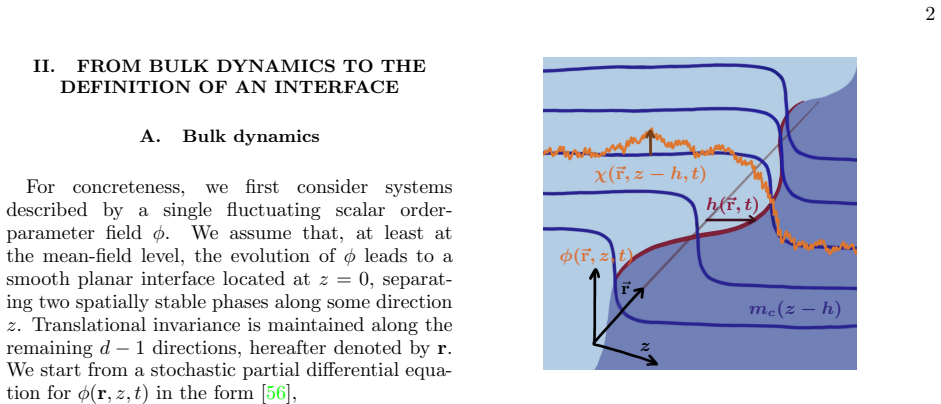
We study the dynamics of weakly deformed interfaces separating two stable phases, starting from the fluctuating hydrodynamics of the phase-separating fields. Using a well-chosen definition for the interface and the dynamical-action formalism to represent path probabilities, we derive the linear relaxation of the interface and the fluctuations around it for a large class of models. Our method applies to equilibrium dynamics, where it recovers and complements existing results, but also extends to their non-equilibrium counterparts. We explain how non-linear terms can be systematically computed and illustrate their derivations in the case of (active) model A. We highlight the danger of a popular ansatz used to derive interface dynamics, which was rigorously established in equilibrium but is uncontrolled for active field theories.
Editorial analysis
A structured set of objections, weighed in public.
Referee Report
Summary. The manuscript derives the linear relaxation dynamics and fluctuations of weakly deformed interfaces from bulk fluctuating hydrodynamics of phase-separating fields. It employs a specific interface definition together with the dynamical-action formalism for path probabilities, obtaining results for a broad class of models. The approach recovers known equilibrium results and extends in a controlled manner to non-equilibrium (active) models; non-linear corrections are shown to be systematically computable and are illustrated explicitly for active Model A. The work also identifies limitations of a popular ansatz that is rigorous only in equilibrium.
Significance. If the derivation holds, the paper supplies a systematic route from bulk fluctuating hydrodynamics to effective interface dynamics that remains controlled for active systems, where the common ansatz is uncontrolled. This constitutes a clear methodological advance for non-equilibrium phase separation. The explicit illustration of non-linear terms and the contrast with prior uncontrolled methods are concrete strengths.
minor comments (3)
- The abstract states that a 'well-chosen definition' for the interface is used but does not name the definition or the resulting effective equation; adding one sentence with the explicit form would improve accessibility.
- In the illustration for active Model A, the step that converts the bulk action into the interface action (presumably in the section containing the non-linear terms) would benefit from an intermediate equation showing the projection onto the interface coordinate.
- A short table or paragraph comparing the derived linear coefficients with known equilibrium limits (e.g., Model B) would make the recovery of prior results more transparent.
Simulated Author's Rebuttal
We thank the referee for their positive summary, significance assessment, and recommendation of minor revision. No specific major comments were provided in the report.
Circularity Check
No significant circularity
full rationale
The derivation begins from the fluctuating hydrodynamics of the phase-separating fields (an independent input) and applies a chosen interface definition together with the dynamical-action formalism for path probabilities. This mapping is used to obtain linear interface relaxation and fluctuations, with the method explicitly positioned as controlled for both equilibrium and active non-equilibrium cases while contrasting it against an uncontrolled popular ansatz. No quoted step reduces by construction to a fitted parameter, self-definition, or load-bearing self-citation chain; the central claim retains independent content from the bulk starting point and external formalism.
Axiom & Free-Parameter Ledger
axioms (2)
- domain assumption The system is described by fluctuating hydrodynamics of phase-separating fields.
- domain assumption A well-chosen definition for the interface exists that permits derivation of its dynamics.
Forward citations
Cited by 1 Pith paper
-
Nucleation and time-reversal symmetry breaking in nonconserved scalar field theories
Extends classical nucleation theory to nonequilibrium non-conserved scalar fields by showing the time-reversed-relaxation ansatz fails and deriving corrected quasipotentials via two independent routes, validated numerically.
Reference graph
Works this paper leans on
-
[1]
Deriving the Edwards-Wilkinson equation The dynamics of active model A (AMA) is de- fined by Eq. (1) with a nonequilibrium drivew[ϕ] = −λ(∇ϕ)2, leading to: ∂tϕ=− δF δϕ −λ(∇ϕ) 2 + √ 2T η(r, z, t),(146) whereF[ϕ] remains given by Eq. (2). Note that we keep the notationTfor the amplitude of the noise, even thoughTis not, thermodynamically speaking, a tempera...
-
[2]
Deriving a KPZ equation The full action for active model A is given in Eq. (149), withu 0 =ℓ 0. We shall now follow the same steps as for passive model A and implement a perturbation expansion in powers of √ T. To pro- ceed, we change variables from ¯hto ¯h′ to eliminate time derivatives from the non-Gaussian part of the action: ¯h= ¯h′ + ¯χ⊥, ∂zχ⊥ 1 +⟨∂ ...
-
[3]
Motivations for introducing active model B+ Let us now turn to the simplest nonequilibrium generalization of model B. In active matter, the motility-induced phase separation [100–106] under- gone by pairwise repulsive self-propelled particles, presents features strikingly similar to equilibrium phase separation, in spite of being an intrinsically nonequil...
-
[4]
Dynamical action for interface dynamics The mean-field steady-state profile of the active model B+ satisfies ∂2 z −∂2 z mc +f ′(mc) + 2λ−ζ 2 (∂zmc)2 = 0. (170) The lack of steady-state current enforces the stronger constraint jc =−∂ z −∂2 z mc +f ′(mc) + 2λ−ζ 2 (∂zmc)2 = 0. (171) The corresponding dynamical action truncated to quadratic order reads S0 = 1...
-
[5]
This breaking of time-reversal symmetry is expected to generate a KPZ nonlin- earity
KPZ nonlinearity in model A and symmetry of the potential In section V A 3, we have shown that, in the pres- ence of an asymmetric potential with degenerate minima, thermal fluctuations generate a nonvanish- ing drift velocity. This breaking of time-reversal symmetry is expected to generate a KPZ nonlin- earity. Let us motivate this by looking at one of t...
-
[6]
Curvature correction in model A Diehl, Kroll and Wagner [66] have shown at the level of the statics that the interfacial free energy for the Ginzburg-Landauϕ 4 field theory (the free energy of Eq. (2) with the potential of Eq. (38)) is given, in the limit of low temperature, by F[h] =σ Z r p 1 + (∇rh)2 .(B4) It has been argued [29] that the proper dynami-...
-
[7]
Let us turn to the second cumulant: such a contribution would involve two bulk fluctuation fields. The only possible combination is − 2 T 2 Z r,t Z r′,t′ (∇rh)2(r, t)¯h(r′, t′)∇rh(r′, t′)· Z z,z ′ ∂2 z mc(z) ∂zmc(z′) σ × ¯χ⊥(r, z, t)∇r∂zχ⊥(r′, z′, t′) ′ c,0 . (B9) This corresponds to the Feynman diagram h h ¯h h where in the notations of Sec. VI A 2, non-...
-
[8]
Detailed derivation of the first order Let us start from Eq. (92). Because the first eigen- value of Ω 0 is zero, the first term dominates in the long wavelength limitq→0. However, to control this expansion, we need to account for the depen- dence of L−1 q onq, and properly estimate the orders inqof the remaining terms. To make the argu- ment fully explic...
-
[9]
We find it useful to work in a system of finite size 2L
It is immediately visible that these eigenfunctions do not vanish at infinity and therefore do not have a well-defined integral for a strictly infinite system. We find it useful to work in a system of finite size 2L. Then, taking theL→ ∞limit whenever possible (in tanh terms), the normalization reads N2 k = 4L(2k2 + 1)(k2 + 2)−12 r 2 τ (k2 + 1).(C4) With ...
-
[10]
All relevant scalar products have been estimated asL→ ∞: 2q e01,L −1 q e01 =O(1) (C13) 2q ˜ek,L −1 q e01 =O 1√ L 1 |k| (C14) 2q ˜ek,L −1 q ˜el =O 1 L 1 |kl| (C15) 2q ˜e0,L −1 q e01 =O( √ L) (C16) 2q ˜e0,L −1 q ˜ek =O(1) 1 |k| (C17) 2q ˜e0,L −1 q ˜e0 =O(L) (C18) wheree 01 stands for eithere 0 ore 1,kandlare both nonzero, and the scalings ink, lindicated on...
-
[11]
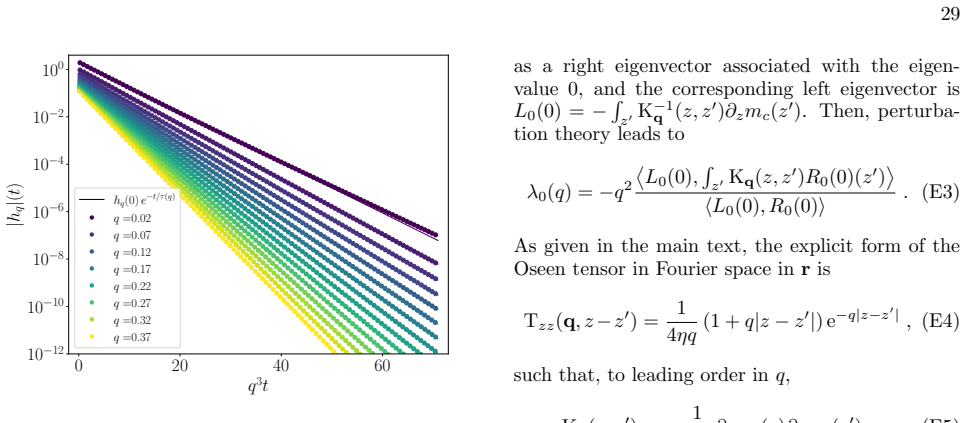
Intuition for next order correction With the expansion above, we obtain the leading order inqof the dispersion relation: iω= 2σq3 A(0) (C23) For higher orders inq, the eigenvectors other than ∂zmc start playing a role. We can however provide the reader with some intuition on the behavior of the dispersion relation to the next order. We be- gin by identify...
-
[12]
A. J. Bray, Theory of phase-ordering ki- netics, Advances in Physics51, 481 (2002), https://doi.org/10.1080/00018730110117433
-
[13]
T. Halpin-Healy and Y.-C. Zhang, Kinetic rough- ening phenomena, stochastic growth, directed polymers and all that. aspects of multidisciplinary statistical mechanics, Physics reports254, 215 (1995)
work page 1995
-
[14]
M. Perlin and W. W. Schultz, Capillary effects on surface waves, Annual review of fluid mechanics 32, 241 (2000)
work page 2000
-
[15]
T. Y. Hou, J. S. Lowengrub, and M. J. Shelley, Boundary integral methods for multicomponent fluids and multiphase materials, Journal of Com- putational Physics169, 302 (2001)
work page 2001
-
[16]
J. Casademunt, Viscous fingering as a paradigm of interfacial pattern formation: Recent results and new challenges, Chaos: An Interdisciplinary Jour- nal of Nonlinear Science14, 809 (2004)
work page 2004
-
[17]
A. Lindner and C. Wagner, Viscoelastic surface instabilities, Comptes Rendus Physique10, 712 (2009)
work page 2009
-
[18]
F. Gallaire and P.-T. Brun, Fluid dynamic insta- bilities: theory and application to pattern forming in complex media, Philosophical Transactions of the Royal Society A: Mathematical, Physical and Engineering Sciences375, 20160155 (2017)
work page 2017
-
[19]
O. Hallatschek, P. Hersen, S. Ramanathan, and D. R. Nelson, Genetic drift at expanding frontiers promotes gene segregation, Proceedings of the Na- tional Academy of Sciences104, 19926 (2007)
work page 2007
-
[20]
S. Douezan, K. Guevorkian, R. Naouar, S. Dufour, D. Cuvelier, and F. Brochard-Wyart, Spreading dynamics and wetting transition of cellular aggre- gates, Proceedings of the National Academy of Sci- ences108, 7315 (2011)
work page 2011
-
[21]
J.-F. Joanny and S. Ramaswamy, A drop of active matter, Journal of fluid mechanics705, 46 (2012). 30
work page 2012
-
[22]
N. Sep´ ulveda, L. Petitjean, O. Cochet, E. Grasland-Mongrain, P. Silberzan, and V. Hakim, Collective cell motion in an ep- ithelial sheet can be quantitatively described by a stochastic interacting particle model, PLoS computational biology9, e1002944 (2013)
work page 2013
- [23]
- [24]
- [25]
-
[26]
V. Soni, E. S. Bililign, S. Magkiriadou, S. Sacanna, D. Bartolo, M. J. Shelley, and W. T. Irvine, The odd free surface flows of a colloidal chiral fluid, Nature physics15, 1188 (2019)
work page 2019
-
[27]
C. P´ erez-Gonz´ alez, R. Alert, C. Blanch-Mercader, M. G´ omez-Gonz´ alez, T. Kolodziej, E. Bazellieres, J. Casademunt, and X. Trepat, Active wetting of epithelial tissues, Nature physics15, 79 (2019)
work page 2019
-
[28]
F. Cagnetta, M. R. Evans, and D. Marenduzzo, Statistical mechanics of a single active slider on a fluctuating interface, Physical Review E99, 042124 (2019)
work page 2019
-
[29]
J. Agudo-Canalejo, S. W. Schultz, H. Chino, S. M. Migliano, C. Saito, I. Koyama-Honda, H. Sten- mark, A. Brech, A. I. May, N. Mizushima,et al., Wetting regulates autophagy of phase-separated compartments and the cytosol, Nature591, 142 (2021)
work page 2021
- [30]
- [31]
- [32]
-
[33]
M. E. Pallar` es, I. Pi-Jaum` a, I. C. Fortunato, V. Grazu, M. G´ omez-Gonz´ alez, P. Roca-Cusachs, J. M. de la Fuente, R. Alert, R. Sunyer, J. Casade- munt,et al., Stiffness-dependent active wetting enables optimal collective cell durotaxis, Nature Physics19, 279 (2023)
work page 2023
-
[34]
L. Langford and A. K. Omar, Theory of capil- lary tension and interfacial dynamics of motility- induced phases, Physical Review E110, 054604 (2024)
work page 2024
-
[35]
A. Fins Carreira, A. Wysocki, C. Ybert, M. Leoc- mach, H. Rieger, and C. Cottin-Bizonne, How to steer active colloids up a vertical wall, Nature com- munications15, 1710 (2024)
work page 2024
-
[36]
Y. Zhao, R. Zakine, A. Daerr, Y. Kafri, J. Tailleur, and F. van Wijland, Active young-dupr´ e equation: How self-organized currents stabilize partial wet- ting, arXiv preprint arXiv:2405.20651 (2024)
work page internal anchor Pith review Pith/arXiv arXiv 2024
-
[37]
F. Caballero, A. Maitra, and C. Nardini, Interface dynamics of wet active systems, Physical Review Letters134, 087105 (2025)
work page 2025
-
[38]
B. C. Sessa, F. Cao, R. A. Pelcovits, T. R. Powers, and G. Duclos, Interfacial instability of confined three-dimensional active droplets, Physical Review Research8, 013120 (2026)
work page 2026
-
[39]
J. Laprade, L. B. Frechette, C. Amey, A. T. Cusi, A. Baskaran, W. B. Rogers, and G. Duclos, The coarsening of biomimetic condensates in an active fluid is non-self-similar, Nature physics , 1 (2026)
work page 2026
- [40]
-
[41]
K. Kawasaki and T. Ohta, Kinetic Drumhead Model of Interface. I, Progress of Theoretical Physics67, 147 (1982)
work page 1982
-
[42]
K. Kawasaki and T. Ohta, Kinetic Drumhead Models of Interface. II, Progress of Theoretical Physics68, 129 (1982)
work page 1982
-
[43]
K. Kawasaki, Variational approach to dynamics of interfaces and quantized vortex lines, Physica A: Statistical Mechanics and its Applications119, 17 (1983)
work page 1983
-
[44]
K. Kawasaki and T. Ohta, Kinetics of fluctua- tions for systems undergoing phase transitions- interfacial approach, Physica A: Statistical Me- chanics and its Applications118, 175 (1983)
work page 1983
-
[45]
T. Ohta, Scaling law in the ordering process of quenched thermodynamically unstable systems, Annals of Physics158, 31 (1984)
work page 1984
-
[46]
S. Ohta, T. Ohta, and K. Kawasaki, Dynamics of topological defects in critical binary fluids, meta- magnets and 3he-4he mixtures, Physica A: Statis- tical Mechanics and its Applications128, 1 (1984)
work page 1984
-
[47]
D. Jasnow and R. K. Zia, Crossover of interfacial dynamics, Physical Review A36, 2243 (1987)
work page 1987
-
[48]
R. Zia, R. Bausch, H. Janssen, and V. Dohm, Dy- namics of an interface coupled to a diffusive bulk mode, Modern Physics Letters B2, 961 (1988)
work page 1988
- [49]
- [50]
-
[51]
A. Shinozaki and Y. Oono, Dispersion relation around the kink solution of the cahn-hilliard equa- tion, Physical Review E47, 804 (1993)
work page 1993
-
[52]
A. Shinozaki, Dispersion relation around a kink solution in binary fluids undergoing spinodal de- composition, Physical Review E48, 1984 (1993)
work page 1984
-
[53]
R. Zia, Normal coordinates and curvature terms in an interface hamiltonian, Nuclear Physics B251, 676 (1985)
work page 1985
-
[54]
N. Caballero, E. Agoritsas, V. Lecomte, and T. Giamarchi, From bulk descriptions to emer- 31 gent interfaces: Connecting the ginzburg-landau and elastic-line models, Physical Review B102, 104204 (2020)
work page 2020
-
[55]
Y. Kuramoto, Instability and turbulence of wavefronts in reaction-diffusion systems, Progress of Theoretical Physics63, 1885 (1980), https://academic.oup.com/ptp/article- pdf/63/6/1885/5221609/63-6-1885.pdf
work page 1980
- [56]
-
[57]
Kardar, Nonequilibrium dynamics of interfaces and lines, Physics reports301, 85 (1998)
M. Kardar, Nonequilibrium dynamics of interfaces and lines, Physics reports301, 85 (1998)
work page 1998
-
[58]
A. J. Bray, A. Cavagna, and R. D. M. Travasso, In- terface fluctuations, burgers equations, and coars- ening under shear, Phys. Rev. E65, 016104 (2001)
work page 2001
-
[59]
M. Lucassen, H. Van Driel, C. M. Smith, and R. Duine, Current-driven and field-driven domain walls at nonzero temperature, Physical Review B—Condensed Matter and Materials Physics79, 224411 (2009)
work page 2009
-
[60]
M. Kardar, Fluctuation-induced forces in and out of equilibrium, inActive Matter and Nonequilib- rium Statistical Physics: Lecture Notes of the Les Houches Summer School: Volume 112, September 2018(Oxford University Press, 2022)
work page 2018
-
[61]
D. S. Dean, P. Gersberg, and P. C. Holdsworth, The effect of driving on model c interfaces, Journal of Statistical Mechanics: Theory and Experiment 2020, 033206 (2020)
work page 2020
- [62]
-
[63]
L. Langford and A. K. Omar, Phase separation, capillarity, and odd-surface flows in chiral ac- tive matter, Physical Review Letters134, 068301 (2025)
work page 2025
- [64]
- [65]
-
[66]
S. Burekovi´ c, F. De Luca, M. E. Cates, and C. Nardini, Active cahn–hilliard theory for non- equilibrium phase separation: quantitative macro- scopic predictions and a microscopic derivation, arXiv preprint arXiv:2601.16539 (2026)
-
[67]
P. C. Hohenberg and B. I. Halperin, Theory of dynamic critical phenomena, Rev. Mod. Phys.49, 435 (1977)
work page 1977
-
[68]
M. E. Cates, Active field theories (2019), arXiv:1904.01330 [cond-mat.stat-mech]
work page internal anchor Pith review Pith/arXiv arXiv 2019
-
[69]
J. O’Byrne, Nonequilibrium currents in stochastic field theories: A geometric insight, Physical Re- view E107, 054105 (2023)
work page 2023
-
[70]
J. O’Byrne and M. E. Cates, Geometric theory of (extended) time-reversal symmetries in stochastic processes: I. finite dimension, Journal of Statis- tical Mechanics: Theory and Experiment2024, 113207 (2024)
work page 2024
-
[71]
J. O’Byrne and M. Cates, Geometric theory of (extended) time-reversal symmetries in stochastic processes: Ii. field theory, Journal of Statistical Mechanics: Theory and Experiment2025, 053204 (2025)
work page 2025
-
[72]
H. T. Davis, Capillary waves and the mean field theory of interfaces, The Journal of Chemical Physics67, 3636 (1977)
work page 1977
-
[73]
L. A. Turski and J. S. Langer, Dynamics of a dif- fuse liquid-vapor interface, Phys. Rev. A22, 2189 (1980)
work page 1980
-
[74]
R. F. Dashen, B. Hasslacher, and A. Neveu, Non- perturbative methods and extended-hadron mod- els in field theory. ii. two-dimensional models and extended hadrons, Physical Review D10, 4130 (1974)
work page 1974
-
[75]
J.-L. Gervais and B. Sakita, Extended particles in quantum field theories, Physical Review D11, 2943 (1975)
work page 1975
-
[76]
J.-L. Gervais, A. Jevicki, and B. Sakita, Perturba- tion expansion around extended-particle states in quantum field theory, Physical Review D12, 1038 (1975)
work page 1975
-
[77]
H. W. Diehl, D. M. Kroll, and H. Wagner, The interface in a ginsburg-landau-wilson model: Derivation of the drumhead model in the low- temperature limit, Zeitschrift f¨ ur Physik B Con- densed Matter36, 329 (1980)
work page 1980
-
[78]
L. Langford and A. K. Omar, The mechanics of nucleation and growth and the surface tensions of active matter, The Journal of Chemical Physics 163(2025)
work page 2025
-
[79]
See sections 2.3 and 2.4 of [1] for models A and B, respectively
- [80]
discussion (0)
Sign in with ORCID, Apple, or X to comment. Anyone can read and Pith papers without signing in.