Large-Scale Quantum Kernels for Hyperspectral Data Classification
Pith reviewed 2026-05-20 12:32 UTC · model grok-4.3
The pith
Simulated fidelity quantum kernels achieve competitive or better accuracy than classical methods on hyperspectral classification without heavy dimensionality reduction.
A machine-rendered reading of the paper's core claim, the machinery that carries it, and where it could break.
Core claim
By simulating the fidelity quantum kernel through tensor-network contraction, the authors obtain kernel matrices for data vectors with up to 75 spectral bands and feed them to a support vector machine. On selected 50-band splits of Indian Pines the quantum model records 78.0 pm 6.2 percent accuracy on a binary task versus 72.0 pm 5.0 percent for the radial basis function kernel; on a four-class task it reaches 83.3 pm 3.1 percent while outperforming several classical baselines. Similar modest gains appear on five 75-band splits of the methane detection set. Bandwidth optimization is shown to be essential for maintaining useful kernel values and generalization.
What carries the argument
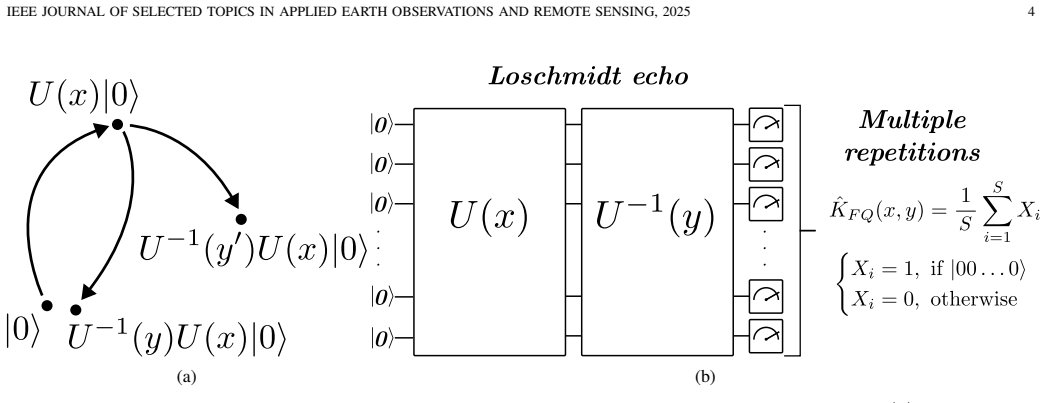
The fidelity quantum kernel, which returns the squared overlap of two quantum states prepared from the input vectors, evaluated at large scale by contracting tensor networks that represent the corresponding quantum circuits.
If this is right
- Quantum kernels become practical for remote-sensing tasks that retain the original spectral dimensionality.
- Bandwidth selection must be treated as a first-order hyperparameter to avoid kernel collapse.
- The quadratic scaling in qubit number opens the door to datasets with several hundred bands.
- Multiclass performance gains suggest the quantum feature space separates certain land-cover classes more cleanly than the classical RBF space.
Where Pith is reading between the lines
- If fault-tolerant quantum processors become available, the same kernel construction could be executed natively and might reveal advantages invisible to tensor-network simulation.
- The tensor-network technique itself could be repurposed to generate improved classical kernel approximations for other high-dimensional sensor data.
- The observed edge on Indian Pines multiclass splits invites targeted tests on additional hyperspectral benchmarks to determine whether the pattern generalizes.
Load-bearing premise
The tensor-network simulation of the fidelity quantum kernel produces the same generalization behavior that a genuine quantum device would exhibit on hyperspectral data once the bandwidth has been chosen.
What would settle it
Running the identical bandwidth-optimized kernel on actual quantum hardware and obtaining test accuracies well below the simulated figures on the same Indian Pines or methane splits would show that the classical simulation misses effects required for the reported performance.
Figures


read the original abstract
Quantum kernel methods have emerged as a promising approach for leveraging high-dimensional feature spaces in machine learning, particularly in domains where classical kernel methods face scalability limitations. In this work, we present the first large-scale study of fidelity-quantum-kernel support vector machines for hyperspectral data classification without requiring heavy prior feature selection or dimensionality reduction. By simulating quantum kernels using tensor network contraction techniques and GPU acceleration, we overcome the computational bottlenecks traditionally associated with quantum models, achieving quadratic scaling O(n^2) in the number of qubits. Our approach enables the evaluation of quantum kernels on hyperspectral data with hundreds of spectral bands, aligning quantum feature spaces with real-world remote sensing applications. We provide an in-depth analysis of kernel bandwidth optimization, demonstrating its crucial role in mitigating exponential concentration effects and ensuring the model's ability to generalize. Experimental results on binary classification (Indian Pines and Methane Detection) and multiclass classification (Indian Pines) demonstrate that quantum kernels achieve competitive performance compared to a broad range of state-of-the-art classical baselines. As illustrative cases, on four 50-band splits selected from Indian Pines, the quantum model achieved a 78.0 pm6.2% accuracy for a binary classification task compared to 72.0 pm5.0% for the standard radial basis function (RBF) kernel. For a four-class classification task, the quantum kernel reached 83.3 pm3.1% accuracy, outperforming several state-of-the-art baselines. On five 75-band splits selected from the Methane Detection dataset, the quantum approach yielded 58.5\pm5.0% accuracy versus 55.1\pm2.5% for the classical counterpart...
Editorial analysis
A structured set of objections, weighed in public.
Referee Report
Summary. The paper claims to conduct the first large-scale study of fidelity quantum kernels for hyperspectral data classification (Indian Pines and Methane Detection datasets) by simulating the kernels via tensor-network contraction with GPU acceleration. It reports that bandwidth optimization mitigates exponential concentration, enabling competitive or superior SVM accuracies compared to classical RBF and other baselines—for example, 78.0±6.2% versus 72.0±5.0% on four 50-band binary splits of Indian Pines and 83.3±3.1% on a four-class task—while achieving quadratic scaling O(n²) in the number of qubits without heavy prior dimensionality reduction.
Significance. If the reported accuracies prove robust under proper validation, the work would demonstrate that quantum kernels can be scaled to hundreds of qubits for real-world high-dimensional remote-sensing tasks, offering a concrete path beyond small-scale quantum ML demonstrations. The combination of tensor-network simulation and explicit bandwidth analysis to address concentration effects constitutes a technical contribution that could inform future quantum feature-map design for structured data.
major comments (3)
- [Abstract and Experimental Results] Abstract and Experimental Results: accuracy figures are supplied with error bars (e.g., 78.0 pm 6.2 % on 50-band Indian Pines binary classification) yet the manuscript supplies no description of the train-test partitioning, the number of folds or repeats in cross-validation, or whether the kernel bandwidth was tuned inside the CV loop or on the held-out test portions; this omission directly affects the reliability of the central claim that quantum kernels achieve competitive performance.
- [Abstract] Tensor-network contraction for the fidelity kernel (Abstract): the quadratic O(n²) scaling is achieved via structured contraction and GPU acceleration, but for 50-75 qubit feature maps the contraction necessarily employs finite bond dimension or truncation; no error bounds or empirical verification of the approximation error relative to the scale of the optimized bandwidth are provided, leaving open the possibility that reported kernel values and subsequent SVM boundaries do not faithfully reflect the underlying quantum feature map.
- [Kernel bandwidth optimization] Kernel bandwidth optimization section: the paper states that bandwidth selection is crucial to mitigate exponential concentration and enable generalization, yet the selection procedure is not shown to be independent of the final test-set accuracies; because performance numbers depend on this fitted hyperparameter, the experimental comparison to classical baselines risks circularity.
minor comments (2)
- [Abstract] The notation 'pm' for error bars in the abstract should be replaced by the standard LaTeX symbol ± for consistency with the rest of the manuscript.
- [Experimental Results] The description of the classical baselines could be expanded with explicit references to the precise implementations (e.g., which RBF bandwidth was used for the reported 72.0 pm 5.0 % figure) to facilitate direct reproduction.
Simulated Author's Rebuttal
We thank the referee for their careful review and constructive comments on our manuscript. The feedback highlights key areas for improving experimental transparency and technical rigor. We address each major comment point-by-point below, providing the strongest honest defense while committing to revisions that enhance reproducibility without misrepresenting our results.
read point-by-point responses
-
Referee: [Abstract and Experimental Results] Abstract and Experimental Results: accuracy figures are supplied with error bars (e.g., 78.0 pm 6.2 % on 50-band Indian Pines binary classification) yet the manuscript supplies no description of the train-test partitioning, the number of folds or repeats in cross-validation, or whether the kernel bandwidth was tuned inside the CV loop or on the held-out test portions; this omission directly affects the reliability of the central claim that quantum kernels achieve competitive performance.
Authors: We agree that explicit details on the experimental protocol are necessary to substantiate the reported accuracies and error bars. The original manuscript omitted a consolidated description of these elements. In the revision we will add a new subsection under Experimental Results that specifies: (i) the train-test partitioning (stratified random splits with 70/30 ratio, repeated over 10 independent seeds), (ii) 5-fold cross-validation with 3 repeats for error estimation, and (iii) confirmation that bandwidth optimization was performed exclusively inside the inner CV loop on training folds only, using a separate validation fold for hyperparameter selection. This protocol was followed for both quantum and classical baselines, ensuring fair comparison and eliminating test-set leakage. revision: yes
-
Referee: [Abstract] Tensor-network contraction for the fidelity kernel (Abstract): the quadratic O(n²) scaling is achieved via structured contraction and GPU acceleration, but for 50-75 qubit feature maps the contraction necessarily employs finite bond dimension or truncation; no error bounds or empirical verification of the approximation error relative to the scale of the optimized bandwidth are provided, leaving open the possibility that reported kernel values and subsequent SVM boundaries do not faithfully reflect the underlying quantum feature map.
Authors: The referee correctly notes that finite-bond-dimension approximations are inherent to tensor-network simulation at these scales. Our structured contraction exploits the specific tensor topology of the fidelity kernel to keep the required bond dimension modest; however, the manuscript did not quantify the resulting truncation error. In the revision we will insert both (a) a theoretical bound on the kernel-value error derived from the chosen truncation threshold (relative to the bandwidth scale) and (b) empirical checks comparing approximated versus exact kernel matrices on smaller (≤20-qubit) instances of the same feature map. These additions will demonstrate that the approximation error remains negligible compared with the bandwidth-induced variations that determine the SVM decision boundaries. revision: yes
-
Referee: [Kernel bandwidth optimization] Kernel bandwidth optimization section: the paper states that bandwidth selection is crucial to mitigate exponential concentration and enable generalization, yet the selection procedure is not shown to be independent of the final test-set accuracies; because performance numbers depend on this fitted hyperparameter, the experimental comparison to classical baselines risks circularity.
Authors: We acknowledge the risk of circularity if hyperparameter tuning inadvertently uses test information. Our procedure employed nested cross-validation: an outer loop for final test evaluation and an inner loop for bandwidth selection on training/validation folds only. To remove any ambiguity, the revised Kernel bandwidth optimization section will include a clear algorithmic description (pseudocode) and a diagram illustrating the data-flow separation. We will also report the range of selected bandwidth values across folds to allow readers to verify that the optimization remained independent of the held-out test accuracies. revision: yes
Circularity Check
No significant circularity in experimental claims or kernel computation
full rationale
The paper reports experimental results from tensor-network-simulated fidelity quantum kernels applied to hyperspectral classification tasks, with standard hyperparameter tuning for bandwidth to address exponential concentration. No load-bearing step reduces a claimed prediction or first-principles result to its own inputs by construction. The O(n^2) scaling refers to the computational complexity of the simulation method itself rather than a derived theoretical outcome. Accuracies are measured cross-validation scores on fixed datasets after routine ML optimization, not self-referential fits. No self-citation chains, uniqueness theorems, or ansatzes are invoked to force the central claims. The work is self-contained as an empirical study against classical baselines.
Axiom & Free-Parameter Ledger
free parameters (1)
- kernel bandwidth
axioms (1)
- domain assumption Fidelity quantum kernel can be simulated classically via tensor network contraction with quadratic scaling in the number of qubits/bands
Lean theorems connected to this paper
-
IndisputableMonolith/Cost/FunctionalEquation.leanwashburn_uniqueness_aczel unclear?
unclearRelation between the paper passage and the cited Recognition theorem.
By simulating quantum kernels using tensor network contraction techniques and GPU acceleration, we overcome the computational bottlenecks... achieving quadratic scaling O(n²) in the number of qubits... kernel bandwidth optimization, demonstrating its crucial role in mitigating exponential concentration effects
-
IndisputableMonolith/Foundation/AlphaCoordinateFixation.leanalpha_pin_under_high_calibration unclear?
unclearRelation between the paper passage and the cited Recognition theorem.
introducing the bandwidth parameter U(c·x) with c<1 restricts the set of states accessible through the transformation, thereby limiting the expressivity of the model
What do these tags mean?
- matches
- The paper's claim is directly supported by a theorem in the formal canon.
- supports
- The theorem supports part of the paper's argument, but the paper may add assumptions or extra steps.
- extends
- The paper goes beyond the formal theorem; the theorem is a base layer rather than the whole result.
- uses
- The paper appears to rely on the theorem as machinery.
- contradicts
- The paper's claim conflicts with a theorem or certificate in the canon.
- unclear
- Pith found a possible connection, but the passage is too broad, indirect, or ambiguous to say the theorem truly supports the claim.
Forward citations
Cited by 1 Pith paper
-
Adaptive Measurement Allocation for Learning Kernelized SVMs Under Noisy Observations
Introduces geometric-sensitivity and active-set-instability signals to adaptively allocate measurements for kernel SVMs under Bernoulli noise, with theory and synthetic/quantum-kernel experiments showing improved marg...
Reference graph
Works this paper leans on
-
[1]
A. M. Wijata, M.-F. Foulon, Y . Bobichon, R. Vitulli, M. Celesti, R. Ca- marero, G. Di Cosimo, F. Gascon, N. Long ´ep´e, J. Nieke, M. Gumiela, and J. Nalepa, “Taking artificial intelligence into space through objective selection of hyperspectral Earth observation applications: To bring the “brain” close to the “eyes” of satellite missions,”IEEE Geoscience...
work page 2023
-
[2]
Hyperspectral remote sensing data analysis and future challenges,
J. M. Bioucas-Dias, A. Plaza, G. Camps-Valls, P. Scheunders, N. Nasrabadi, and J. Chanussot, “Hyperspectral remote sensing data analysis and future challenges,”IEEE Geoscience and Remote Sensing Magazine, vol. 1, no. 2, pp. 6–36, 2013
work page 2013
-
[3]
Recent advances in multi- and hyperspectral image analysis,
J. Nalepa, “Recent advances in multi- and hyperspectral image analysis,”Sensors, vol. 21, no. 18, 2021. [Online]. Available: https://www.mdpi.com/1424-8220/21/18/6002
work page 2021
-
[4]
An introduction to quantum machine learning,
M. Schuld, I. Sinayskiy, and F. Petruccione, “An introduction to quantum machine learning,”Contemporary Physics, vol. 56, no. 2, pp. 172–185, 2015
work page 2015
-
[5]
J. Biamonte, P. Wittek, N. Pancotti, P. Rebentrost, N. Wiebe, and S. Lloyd, “Quantum machine learning,”Nature, vol. 549, no. 7671, pp. 195–202, 2017
work page 2017
-
[6]
Quantum machine learning in feature hilbert spaces,
M. Schuld and N. Killoran, “Quantum machine learning in feature hilbert spaces,”Physical review letters, vol. 122, no. 4, p. 040504, 2019
work page 2019
-
[7]
Supervised learning with quantum- enhanced feature spaces,
V . Havl ´ıˇcek, A. D. C ´orcoles, K. Temme, A. W. Harrow, A. Kandala, J. M. Chow, and J. M. Gambetta, “Supervised learning with quantum- enhanced feature spaces,”Nature, vol. 567, no. 7747, pp. 209–212, 2019
work page 2019
-
[8]
K.-C. Chen, T.-Y . Li, Y .-Y . Wang, S. See, C.-C. Wang, R. Wille, N.-Y . Chen, A.-C. Yang, and C.-Y . Lin, “Validating large-scale quantum ma- chine learning: Efficient simulation of quantum support vector machines using tensor networks,”Machine Learning: Science and Technology, vol. 6, no. 1, p. 015047, 2025
work page 2025
-
[9]
Power of data in quantum machine learning,
H.-Y . Huang, M. Broughton, M. Mohseni, R. Babbush, S. Boixo, H. Neven, and J. R. McClean, “Power of data in quantum machine learning,”Nature Communications, vol. 12, no. 1, p. 2631, 2021
work page 2021
-
[10]
Quantum computing for space applications: a selective review and perspectives,
P. Torta, R. Casati, S. Bruni, A. Mandarino, and E. Prati, “Quantum computing for space applications: a selective review and perspectives,” EPJ Quantum Technology, vol. 12, no. 1, p. 66, 2025
work page 2025
-
[11]
Quo vadis, quantum machine learning?: Quantum kernel methods meet earth observation,
A. Miroszewski, J. Nalepa, A. M. Wijata, J. Mielczarek, B. L. Saux, and A. Sebastianelli, “Quo vadis, quantum machine learning?: Quantum kernel methods meet earth observation,”IEEE Geoscience and Remote Sensing Magazine, pp. 2–30, 2026
work page 2026
-
[12]
Quantum machine learning for earth observation: A review and future prospects,
A. Sebastianelli, F. Mauro, A. Delilbasic, P. D. Stasio, F. Fan, G. Meoni, G. Cavallaro, X. X. Zhu, P. Gamba, and S. Ullo, “Quantum machine learning for earth observation: A review and future prospects,” 2025
work page 2025
-
[13]
Methods for accelerating geospatial data processing using quantum computers,
M. Henderson, J. Gallina, and M. Brett, “Methods for accelerating geospatial data processing using quantum computers,”Quantum Ma- chine Intelligence, vol. 3, no. 1, p. 4, 2021
work page 2021
-
[14]
Detecting clouds in multispectral satellite images using quantum-kernel support vector machines,
A. Miroszewski, J. Mielczarek, G. Czelusta, F. Szczepanek, B. Grabowski, B. Le Saux, and J. Nalepa, “Detecting clouds in multispectral satellite images using quantum-kernel support vector machines,”IEEE Journal of Selected Topics in Applied Earth Observations and Remote Sensing, vol. 16, pp. 7601–7613, 2023
work page 2023
-
[15]
Multi-spectral image classification with quantum neural network,
P. Gawron and S. Lewi ´nski, “Multi-spectral image classification with quantum neural network,” inIGARSS 2020-2020 IEEE international geoscience and remote sensing symposium. IEEE, 2020, pp. 3513– 3516
work page 2020
-
[16]
On circuit-based hybrid quantum neural networks for remote sensing imagery classification,
A. Sebastianelli, D. A. Zaidenberg, D. Spiller, B. Le Saux, and S. L. Ullo, “On circuit-based hybrid quantum neural networks for remote sensing imagery classification,”IEEE Journal of Selected Topics in Applied Earth Observations and Remote Sensing, vol. 15, pp. 565–580, 2021. IEEE JOURNAL OF SELECTED TOPICS IN APPLIED EARTH OBSERV ATIONS AND REMOTE SENSI...
work page 2021
-
[17]
Quanv4EO: empowering Earth observation by means of quanvolutional neural networks,
A. Sebastianelli, F. Mauro, G. Ciabatti, D. Spiller, B. Le Saux, P. Gamba, and S. Ullo, “Quanv4EO: empowering Earth observation by means of quanvolutional neural networks,”IEEE Transactions on Geoscience and Remote Sensing, 2025
work page 2025
-
[18]
Quantum information- empowered graph neural network for hyperspectral change detection,
C.-H. Lin, T.-H. Lin, and J. Chanussot, “Quantum information- empowered graph neural network for hyperspectral change detection,” IEEE Transactions on Geoscience and Remote Sensing, 2024
work page 2024
-
[19]
Hyperspectral image classification using quantum machine learning,
G. Priyanka and M. Venkatesan, “Hyperspectral image classification using quantum machine learning,” in2024 1st International Conference on Advanced Computing and Emerging Technologies (ACET). IEEE, 2024, pp. 1–7
work page 2024
-
[20]
R. U. Shaik, A. Unni, and W. Zeng, “Quantum based pseudo-labelling for hyperspectral imagery: A simple and efficient semi-supervised learn- ing method for machine learning classifiers,”Remote Sensing, vol. 14, no. 22, p. 5774, 2022
work page 2022
-
[21]
R. U. Shaik and S. Periasamy, “Accuracy and processing speed trade-offs in classical and quantum SVM classifier exploiting prisma hyperspectral imagery,”International Journal of Remote Sensing, vol. 43, no. 15-16, pp. 6176–6194, 2022
work page 2022
-
[22]
A quantum annealer for subset feature selection and the classification of hyperspectral images,
S. Otgonbaatar and M. Datcu, “A quantum annealer for subset feature selection and the classification of hyperspectral images,”IEEE Journal of Selected Topics in Applied Earth Observations and Remote Sensing, vol. 14, pp. 7057–7065, 2021
work page 2021
-
[23]
Queennet: Quantum-enhanced neural network for hyperspectral image classifica- tion,
Q. Wang, S. Wang, Y . Zhang, J. Song, K. Zeng, and T. Shen, “Queennet: Quantum-enhanced neural network for hyperspectral image classifica- tion,”IEEE Journal of Selected Topics in Applied Earth Observations and Remote Sensing, vol. 19, pp. 11 646–11 659, 2026
work page 2026
-
[24]
QSpeckleFilter: a quantum machine learning approach for SAR speckle filtering,
F. Mauro, A. Sebastianelli, M. P. Del Rosso, P. Gamba, and S. L. Ullo, “QSpeckleFilter: a quantum machine learning approach for SAR speckle filtering,” inIGARSS 2024-2024 IEEE International Geoscience and Remote Sensing Symposium. IEEE, 2024, pp. 450–454
work page 2024
-
[25]
Quantum machine learning for optical and SAR classification,
L. Miller, G. Uehara, A. Sharma, and A. Spanias, “Quantum machine learning for optical and SAR classification,” in2023 24th International Conference on Digital Signal Processing (DSP). IEEE, 2023, pp. 1–5
work page 2023
-
[26]
S. Otgonbaatar and M. Datcu, “Natural embedding of the stokes param- eters of polarimetric synthetic aperture radar images in a gate-based quantum computer,”IEEE Transactions on Geoscience and Remote Sensing, vol. 60, pp. 1–8, 2021
work page 2021
-
[27]
Bloch sphere representation of po- larimetric SAR targets,
A. Bhattacharya and A. Verma, “Bloch sphere representation of po- larimetric SAR targets,”IEEE Geoscience and Remote Sensing Letters, 2025
work page 2025
-
[28]
Quantum computing in the NISQ era and beyond,
J. Preskill, “Quantum computing in the NISQ era and beyond,”Quan- tum, vol. 2, p. 79, 2018
work page 2018
-
[29]
PennyLane: Automatic differentiation of hybrid quantum-classical computations
V . Bergholm, J. Izaac, M. Schuld, C. Gogolin, S. Ahmed, V . Ajith, M. S. Alam, G. Alonso-Linaje, B. AkashNarayanan, A. Asadiet al., “Pennylane: Automatic differentiation of hybrid quantum-classical com- putations,”arXiv preprint arXiv:1811.04968, 2018
work page internal anchor Pith review Pith/arXiv arXiv 2018
-
[30]
A. Javadi-Abhari, M. Treinish, K. Krsulich, C. J. Wood, J. Lishman, J. Gacon, S. Martiel, P. D. Nation, L. S. Bishop, A. W. Crosset al., “Quantum computing with Qiskit,”arXiv preprint arXiv:2405.08810, 2024
work page internal anchor Pith review Pith/arXiv arXiv 2024
-
[31]
Detection of bare soil in hyperspectral images using quantum-kernel support vector machines,
A. M. Wijata, A. Miroszewski, B. Le Saux, N. Long ´ep´e, B. Ruszczak, and J. Nalepa, “Detection of bare soil in hyperspectral images using quantum-kernel support vector machines,” inIGARSS 2024-2024 IEEE International Geoscience and Remote Sensing Symposium. IEEE, 2024, pp. 817–822
work page 2024
-
[32]
Assembly of a coreset of Earth observation images on a small quantum computer,
S. Otgonbaatar and M. Datcu, “Assembly of a coreset of Earth observation images on a small quantum computer,”Electronics, vol. 10, no. 20, p. 2482, Oct. 2021. [Online]. Available: https: //www.mdpi.com/2079-9292/10/20/2482
work page 2021
-
[33]
Quantum support vector machine algorithms for remote sensing data classification,
A. Delilbasic, G. Cavallaro, M. Willsch, F. Melgani, M. Riedel, and K. Michielsen, “Quantum support vector machine algorithms for remote sensing data classification,” in2021 IEEE International Geoscience and Remote Sensing Symposium IGARSS. IEEE, 2021, pp. 2608–2611
work page 2021
-
[34]
A single-step multiclass svm based on quantum annealing for remote sensing data classification,
A. Delilbasic, B. Le Saux, M. Riedel, K. Michielsen, and G. Cavallaro, “A single-step multiclass svm based on quantum annealing for remote sensing data classification,”IEEE journal of selected topics in applied earth observations and remote sensing, vol. 17, pp. 1434–1445, 2023
work page 2023
-
[35]
Quantum support vector regression for biophysical variable estimation in remote sensing,
E. Pasetto, A. Delilbasic, G. Cavallaro, M. Willsch, F. Melgani, M. Riedel, and K. Michielsen, “Quantum support vector regression for biophysical variable estimation in remote sensing,” inIGARSS 2022- 2022 IEEE international geoscience and remote sensing symposium. IEEE, 2022, pp. 4903–4906
work page 2022
-
[36]
Kernel methods in machine learning,
T. Hofmann, B. Sch ¨olkopf, and A. J. Smola, “Kernel methods in machine learning,” 2008
work page 2008
-
[37]
C. M. Bishop and N. M. Nasrabadi,Pattern recognition and machine learning. Springer, 2006, vol. 4, no. 4
work page 2006
-
[38]
B. Sch ¨olkopf and A. J. Smola,Learning with Kernels: Support Vector Machines, Regularization, Optimization, and Beyond. Cambridge, MA, USA: MIT Press, 2002
work page 2002
-
[39]
J. Shawe-Taylor and N. Cristianini,Kernel methods for pattern analysis. Cambridge university press, 2004
work page 2004
-
[40]
S. Sra, S. Nowozin, and S. J. Wright,Optimization for machine learning. MIT press, 2011
work page 2011
-
[41]
Stabilization of quantum computations by symmetrization,
A. Barenco, A. Berthiaume, D. Deutsch, A. Ekert, R. Jozsa, and C. Mac- chiavello, “Stabilization of quantum computations by symmetrization,” SIAM Journal on Computing, vol. 26, no. 5, pp. 1541–1557, 1997
work page 1997
-
[42]
H. Buhrman, R. Cleve, J. Watrous, and R. De Wolf, “Quantum finger- printing,”Physical review letters, vol. 87, no. 16, p. 167902, 2001
work page 2001
-
[43]
Stability of quantum motion in chaotic and regular systems,
A. Peres, “Stability of quantum motion in chaotic and regular systems,” Physical Review A, vol. 30, no. 4, p. 1610, 1984
work page 1984
-
[44]
Quantenmechanik der stoßvorg ¨ange,
M. Born, “Quantenmechanik der stoßvorg ¨ange,”Zeitschrift f ¨ur physik, vol. 38, no. 11, pp. 803–827, 1926
work page 1926
-
[45]
Barren plateaus in quantum neural network training landscapes,
J. R. McClean, S. Boixo, V . N. Smelyanskiy, R. Babbush, and H. Neven, “Barren plateaus in quantum neural network training landscapes,”Nature Communications, vol. 9, no. 1, p. 4812, Nov. 2018
work page 2018
-
[46]
Exponential concentration in quantum kernel methods,
S. Thanasilp, S. Wang, M. Cerezo, and Z. Holmes, “Exponential concentration in quantum kernel methods,”Nature Communications, vol. 15, no. 1, p. 5200, 2024. IEEE JOURNAL OF SELECTED TOPICS IN APPLIED EARTH OBSERV ATIONS AND REMOTE SENSING, 2025 19
work page 2024
-
[47]
The inductive bias of quantum kernels,
J. K ¨ubler, S. Buchholz, and B. Sch ¨olkopf, “The inductive bias of quantum kernels,”Advances in Neural Information Processing Systems, vol. 34, pp. 12 661–12 673, 2021
work page 2021
-
[48]
A review and comparison of bandwidth selection methods for kernel regression,
M. K ¨ohler, A. Schindler, and S. Sperlich, “A review and comparison of bandwidth selection methods for kernel regression,”International Statistical Review, vol. 82, no. 2, pp. 243–274, 2014
work page 2014
-
[49]
Importance of kernel bandwidth in quantum machine learning,
R. Shaydulin and S. M. Wild, “Importance of kernel bandwidth in quantum machine learning,”Physical Review A, vol. 106, no. 4, p. 042407, 2022
work page 2022
-
[50]
Bandwidth enables generalization in quantum kernel models,
A. Canatar, E. Peters, C. Pehlevan, S. M. Wild, and R. Shaydulin, “Bandwidth enables generalization in quantum kernel models,”arXiv preprint arXiv:2206.06686, 2022
-
[51]
Benchmarking Supercomputers with the J ¨ulich Univer- sal Quantum Computer Simulator,
D. Willsch, H. Lagemann, M. Willsch, F. Jin, H. De Raedt, and K. Michielsen, “Benchmarking Supercomputers with the J ¨ulich Univer- sal Quantum Computer Simulator,”arXiv preprint arXiv:1912.03243, 2019
-
[52]
cuQuantum SDK: a high-performance library for accelerating quantum science,
H. Bayraktar, A. Charara, D. Clark, S. Cohen, T. Costa, Y .-L. L. Fang, Y . Gao, J. Guan, J. Gunnels, A. Haidaret al., “cuQuantum SDK: a high-performance library for accelerating quantum science,” in2023 IEEE International Conference on Quantum Computing and Engineering (QCE), vol. 1. IEEE, 2023, pp. 1050–1061
work page 2023
-
[53]
Simulating quantum computation by contracting tensor networks,
I. L. Markov and Y . Shi, “Simulating quantum computation by contracting tensor networks,”SIAM Journal on Computing, vol. 38, no. 3, pp. 963–981, Jan. 2008, publisher: Society for Industrial and Applied Mathematics. [Online]. Available: https: //epubs.siam.org/doi/abs/10.1137/050644756
-
[54]
220 Band A VIRIS Hyperspectral Image Data Set: June 12, 1992 Indian Pine Test Site 3,
M. F. Baumgardner, L. L. Biehl, and D. A. Landgrebe, “220 Band A VIRIS Hyperspectral Image Data Set: June 12, 1992 Indian Pine Test Site 3,”Purdue University Research Repository, vol. 10, no. 7, p. 991, 2015
work page 1992
-
[55]
Validating hyperspectral image segmentation,
J. Nalepa, M. Myller, and M. Kawulok, “Validating hyperspectral image segmentation,”IEEE Geoscience and Remote Sensing Letters, vol. 16, no. 8, pp. 1264–1268, Aug. 2019. [Online]. Available: https://ieeexplore.ieee.org/abstract/document/8642388
-
[56]
Code and data for large-scale quantum kernels for hyperspectral data classification,
A. Delilbasic, A. Miroszewski, A. M. Wijata, J. Nalepa, J. Mielczarek, M. Riedel, and G. Cavallaro, “Code and data for large-scale quantum kernels for hyperspectral data classification,” https://github.com/shelky/ Large scale QSVM.git, 2025
work page 2025
-
[57]
D. R. Thompsonet al., “IS-GEO Dataset JPL-CH4-detection-2017-V1.0: A benchmark for methane source detection from imaging spectrometer data,” JPL, Tech. Rep. D-101028, 2017
work page 2017
-
[58]
M. D. Foote, P. E. Dennison, A. K. Thorpe, D. R. Thompson, S. Jon- garamrungruang, C. Frankenberg, and S. C. Joshi, “Fast and accurate retrieval of methane concentration from imaging spectrometer data using sparsity prior,”IEEE Transactions on Geoscience and Remote Sensing, vol. 58, no. 9, pp. 6480–6492, 2020
work page 2020
-
[59]
Quantum convolutional circuits for Earth observation image classification,
S. Y . Chang, B. L. Saux, S. Vallecorsa, and M. Grossi, “Quantum convolutional circuits for Earth observation image classification,” in IGARSS 2022 - 2022 IEEE International Geoscience and Remote Sensing Symposium, 2022, pp. 4907–4910
work page 2022
-
[60]
On quan- tum hyperparameters selection in hybrid classifiers for Earth observation data,
A. Sebastianelli, M. P. Del Rosso, S. L. Ullo, and P. Gamba, “On quan- tum hyperparameters selection in hybrid classifiers for Earth observation data,”IEEE Geoscience and Remote Sensing Letters, vol. 20, pp. 1–5, 2023
work page 2023
-
[61]
Potential of quantum machine learning for processing multispectral Earth observation data,
M. K. Gupta, M. Romaszewski, and P. Gawron, “Potential of quantum machine learning for processing multispectral Earth observation data,” Authorea Preprints, 2024
work page 2024
-
[62]
In search of quantum advantage: Estimating the number of shots in quantum kernel methods,
A. Miroszewski, M. F. Asiani, J. Mielczarek, B. L. Saux, and J. Nalepa, “In search of quantum advantage: Estimating the number of shots in quantum kernel methods,” 2024. [Online]. Available: https://arxiv.org/abs/2407.15776
-
[63]
Quantum-enhanced water quality monitoring: Exploitingϕsat-2 data with quanvolution,
F. Mauro, F. Razzano, P. Di Stasio, A. Sebastianelli, G. Meoni, G. Schir- inzi, P. Gamba, and S. L. Ullo, “Quantum-enhanced water quality monitoring: Exploitingϕsat-2 data with quanvolution,”IEEE Geoscience and Remote Sensing Letters, 2025
work page 2025
-
[64]
Practical bayesian optimiza- tion of machine learning algorithms,
J. Snoek, H. Larochelle, and R. P. Adams, “Practical bayesian optimiza- tion of machine learning algorithms,”Advances in neural information processing systems, vol. 25, 2012
work page 2012
-
[65]
Y . Chen, H. Jiang, C. Li, X. Jia, and P. Ghamisi, “Deep feature extraction and classification of hyperspectral images based on convolutional neural networks,”IEEE transactions on geoscience and remote sensing, vol. 54, no. 10, pp. 6232–6251, 2016
work page 2016
-
[66]
Spectralformer: Rethinking hyperspectral image classification with transformers,
D. Hong, Z. Han, J. Yao, L. Gao, B. Zhang, A. Plaza, and J. Chanus- sot, “Spectralformer: Rethinking hyperspectral image classification with transformers,”IEEE Transactions on Geoscience and Remote Sensing, vol. 60, pp. 1–15, 2021
work page 2021
-
[67]
Deep learning classifiers for hyperspectral imaging: A review,
M. E. Paoletti, J. M. Haut, J. Plaza, and A. Plaza, “Deep learning classifiers for hyperspectral imaging: A review,”ISPRS Journal of Photogrammetry and Remote Sensing, vol. 158, pp. 279–317, 2019
work page 2019
-
[68]
Deep–an accelerated cluster architecture for exascale computing,
N. Eicker and T. Lippert, “Deep–an accelerated cluster architecture for exascale computing,”Intel European Exascale Labs, p. 12, 2011
work page 2011
-
[69]
Connecting ansatz expressibility to gradient magnitudes and barren plateaus,
Z. Holmes, K. Sharma, M. Cerezo, and P. J. Coles, “Connecting ansatz expressibility to gradient magnitudes and barren plateaus,” PRX Quantum, vol. 3, no. 1, p. 010313, 2022. [Online]. Available: https://doi.org/10.1103/PRXQuantum.3.010313
-
[70]
Expressibility of the alternating layered ansatz for quantum computation,
K. Nakaji and N. Yamamoto, “Expressibility of the alternating layered ansatz for quantum computation,”Quantum, vol. 5, p. 434, 2021. [Online]. Available: https://doi.org/10.22331/q-2021-04-19-434
-
[71]
S. Sim, P. D. Johnson, and A. Aspuru-Guzik, “Expressibility and entangling capability of parameterized quantum circuits for hybrid quantum-classical algorithms,”Advanced Quantum Technologies, vol. 2, no. 12, p. 1900070, 2019. [Online]. Available: https: //doi.org/10.1002/qute.201900070
-
[72]
A. Canatar, B. Bordelon, and C. Pehlevan, “Spectral bias and task-model alignment explain generalization in kernel regression and infinitely wide neural networks,”Nature communications, vol. 12, no. 1, p. 2914, 2021
work page 2021
-
[73]
A decision-theoretic generalization of on-line learning and an application to boosting,
Y . Freund and R. E. Schapire, “A decision-theoretic generalization of on-line learning and an application to boosting,”Journal of computer and system sciences, vol. 55, no. 1, pp. 119–139, 1997
work page 1997
-
[74]
L. Breiman, J. Friedman, R. A. Olshen, and C. J. Stone,Classification and regression trees. Chapman and Hall/CRC, 2017
work page 2017
-
[75]
Updating formulae and a pairwise algorithm for computing sample variances,
T. F. Chan, G. H. Golub, and R. J. LeVeque, “Updating formulae and a pairwise algorithm for computing sample variances,” inCOMPSTAT 1982 5th Symposium held at Toulouse 1982: Part I: Proceedings in Computational Statistics. Springer, 1982, pp. 30–41
work page 1982
-
[76]
Greedy function approximation: a gradient boosting machine,
J. H. Friedman, “Greedy function approximation: a gradient boosting machine,”Annals of statistics, pp. 1189–1232, 2001
work page 2001
-
[77]
Fix,Discriminatory analysis: nonparametric discrimination, consis- tency properties
E. Fix,Discriminatory analysis: nonparametric discrimination, consis- tency properties. USAF school of Aviation Medicine, 1985, vol. 1
work page 1985
-
[78]
The regression analysis of binary sequences,
D. R. Cox, “The regression analysis of binary sequences,”Journal of the Royal Statistical Society Series B: Statistical Methodology, vol. 20, no. 2, pp. 215–232, 1958
work page 1958
-
[79]
L. Breiman, “Random forests,”Machine learning, vol. 45, no. 1, pp. 5–32, 2001
work page 2001
-
[80]
RUSBoost: A hybrid approach to alleviating class imbalance,
C. Seiffert, T. M. Khoshgoftaar, J. Van Hulse, and A. Napolitano, “RUSBoost: A hybrid approach to alleviating class imbalance,”IEEE transactions on systems, man, and cybernetics-part A: systems and humans, vol. 40, no. 1, pp. 185–197, 2009
work page 2009
discussion (0)
Sign in with ORCID, Apple, or X to comment. Anyone can read and Pith papers without signing in.