REVIEW 2 minor 1 cited by
A verification theorem characterizes equilibria in time-inconsistent singular control with running minimum under weaker regularity conditions.
Reviewed by Pith at T0; open to challenge. T0 means a machine referee read the full paper against a public rubric. the ladder, T0–T4 →
T0 review · grok-4.3
2026-06-30 18:16 UTC pith:JPL6I7ZE
load-bearing objection This extends time-inconsistent singular control by adding a running minimum process, with a verification theorem under weaker regularity and monotonicity/concavity results for the dividend boundary.
Time-Inconsistent Singular Control Problems with a Running Minimum Process
The pith
A machine-rendered reading of the paper's core claim, the machinery that carries it, and where it could break.
Core claim
The paper claims that equilibria for time-inconsistent singular control problems that incorporate a running minimum process can be characterized by a verification theorem under substantially weaker regularity conditions than those in the existing literature, and that this yields a stronger notion of equilibrium by enlarging the class of feasible perturbations. In the dividend application the running minimum produces a highly coupled nonlinear system whose solution boundary is monotone and locally concave.
What carries the argument
The verification theorem that characterizes equilibria for admissible singular control laws, built on existence and uniqueness of strong solutions to Skorokhod reflection problems involving the running minimum process.
Load-bearing premise
Existence and uniqueness of strong solutions to the class of Skorokhod reflection problems involving the running minimum process.
What would settle it
A concrete Skorokhod reflection problem with the running minimum that fails to possess a unique strong solution, or a dividend problem in which the verification theorem does not recover the true equilibrium strategy.
If this is right
- An equilibrium strategy exists for the dividend problem with running minimum.
- The equilibrium dividend boundary is monotone and locally concave.
- The monotonicity and concavity provide a mathematical explanation for dividend smoothing and scarring effects.
- Numerical solutions of the resulting system remain robust across wide parameter ranges.
Where Pith is reading between the lines
- The weaker regularity requirements may allow the same verification approach to be used on models that include jumps or other non-smooth features.
- The enlarged perturbation class could be tested in other path-dependent control settings such as insurance ruin problems.
- The coupled nonlinear system arising from the running minimum suggests that similar algebraic constraints will appear in related time-inconsistent problems with path dependence.
Editorial analysis
A structured set of objections, weighed in public.
Referee Report
Summary. The paper develops a time-inconsistent singular control framework that incorporates a running minimum process. It establishes existence and uniqueness of strong solutions to a class of Skorokhod reflection problems involving the running minimum, characterizes admissible singular controls, derives a verification theorem characterizing equilibria under weaker regularity conditions than prior work while enlarging the class of feasible perturbations, and applies the framework to a dividend problem. In the dividend application the authors obtain a highly coupled nonlinear differential-algebraic system, prove monotonicity and local concavity of the dividend boundary, and supply numerical simulations confirming robustness across parameter ranges.
Significance. If the claimed existence/uniqueness results and the verification theorem hold, the work advances the literature on time-inconsistent control by relaxing regularity assumptions and strengthening the equilibrium notion. The dividend application supplies a concrete mathematical account of smoothing and scarring effects via boundary properties, which is a useful contribution to singular stochastic control. The explicit treatment of the Skorokhod problems with running minimum and the DAE analysis for monotonicity/concavity are load-bearing strengths.
minor comments (2)
- §2 (or wherever the Skorokhod problem is stated): the precise definition of the running minimum process and the admissible control class should be cross-referenced to the verification theorem so that the weaker regularity conditions are immediately visible.
- The numerical section would benefit from an explicit statement of the discretization scheme and step-size used for the DAE system, together with a brief convergence check.
Simulated Author's Rebuttal
We thank the referee for the positive and constructive report, which accurately summarizes the contributions of the paper. The recommendation of minor revision is noted. No major comments appear in the report, so we have no specific points to address at this stage. We remain available to incorporate any additional feedback.
Circularity Check
No significant circularity detected
full rationale
The derivation begins with independent proofs of existence and uniqueness for Skorokhod reflection problems involving the running minimum process, followed by characterization of admissible controls. These foundations support a verification theorem under weakened regularity assumptions and an application to the dividend problem, where monotonicity and local concavity of the boundary are established via analysis of the resulting DAE system. No load-bearing step reduces by construction to a fitted input, self-definition, or self-citation chain; all central claims rest on external mathematical arguments that are not presupposed by the target results.
Axiom & Free-Parameter Ledger
read the original abstract
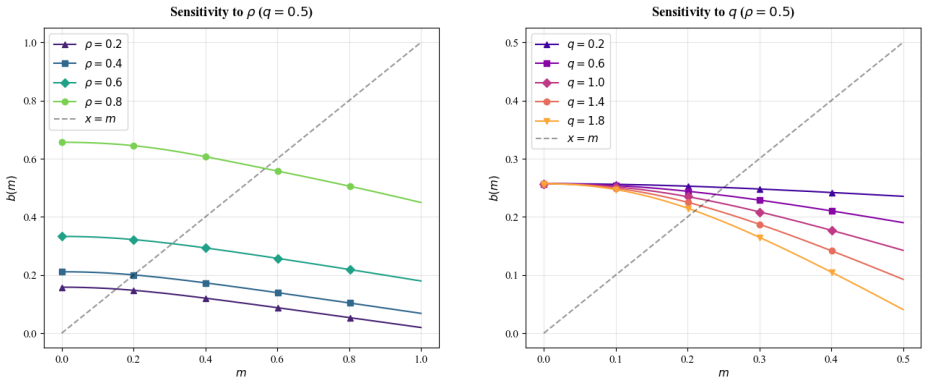
This paper develops a time-inconsistent and path-dependent singular control framework incorporating a running minimum process. We derive a verification theorem that characterizes equilibria under substantially weaker regularity conditions than those imposed in the existing literature, and we obtain a stronger notion of equilibrium by enlarging the class of feasible perturbations. We first establish the mathematical foundations of the framework by proving the existence and uniqueness of strong solutions to a class of Skorokhod reflection problems involving the running minimum and by characterizing admissible singular control laws. We further demonstrate the existence of an equilibrium through a dividend problem, where the running minimum leads to a highly coupled and nonlinear differential-algebraic system. For this problem, we prove the monotonicity and local concavity of the dividend boundary, thereby providing a mathematical explanation for dividend smoothing and scarring effects. Numerical simulations confirm the robustness of the equilibrium across a wide range of parameter values.
Figures



Forward citations
Cited by 1 Pith paper
-
Equilibrium for Regular-Singular Control under Mean-Variance Criterion
A new equilibrium concept for mixed continuous-and-jump controls under mean-variance is proven via verification and necessary conditions, with an explicit coupled reinsurance solution.
Reference graph
Works this paper leans on
-
[1]
Julian Kozlowski, Laura Veldkamp, and Venky Venkateswaran
doi: 10.1016/S0304-405X(01)00077-0. Julian Kozlowski, Laura Veldkamp, and Venky Venkateswaran. Scarring body and mind: The Long-Term belief-scarring effects of COVID-19. Working Paper 27439, National Bureau of Economic Research, Jun
-
[2]
Natalie Kulenko and Hanspeter Schmidli
URLhttps://www.nber.org/papers/w27439. Natalie Kulenko and Hanspeter Schmidli. Optimal dividend strategies in a Cram´ er-Lundberg model with capital injections.Insurance: Mathematics and Economics, 43(2):270–278, 2008. Volker Mehrmann Peter Kunkel and Volker Mehrmann.Differential-algebraic Equations. European Mathe- matical Society Z¨ urich, 2006. Zongxia...
-
[3]
Z τ D a 0 β(r−s)dr # +E x,m,y,t
Because of the convergences of{X (n) t }and{M (n) t }, we have{k (n) t }converges uniformly on [0, T]. Similarly adopting this approach within the intervals [T,2T], [2T,3T]..., we obtain the a.s. locally uniform convergences of{X (n) t },{M (n) t }and{k (n) t }on [0,∞). Denote byX= lim n→∞ X(n),M= lim n→∞ M(n), and D = lim n→∞ k(n). Passingn→ ∞in Eq. (6.4...
discussion (0)
Sign in with ORCID, Apple, or X to comment. Anyone can read and Pith papers without signing in.