Electromagnetic emission from a black-to-white hole transition -- Photospheric emission
Pith reviewed 2026-06-29 20:36 UTC · model grok-4.3
The pith
Gamma-ray spectrum from black-to-white hole transitions follows from photospheric model where photons and leptons exceed baryons.
A machine-rendered reading of the paper's core claim, the machinery that carries it, and where it could break.
Core claim
We calculate the gamma ray emission from a black-to-white hole transition. We put forward a model for the prompt emission phase, based on the photospheric emission model with the underlying idea that the number of photons and leptons emitted by the white hole will be larger than the baryon content. We calculate the spectrum of the emitted radiation and give an estimate of the total energy emitted. Finally, we estimate the cosmological density of lunar mass primordial black holes.
What carries the argument
Photospheric emission model with the premise that photons and leptons outnumber baryons, used to compute the gamma-ray spectrum and energy.
If this is right
- The gamma-ray spectrum from the transition follows directly from the photospheric calculation.
- The total energy released in the transition can be estimated from the same model.
- The cosmological density of lunar-mass primordial black holes follows as a derived quantity.
Where Pith is reading between the lines
- If such transitions occur at observable rates, their gamma-ray signals could appear in high-energy sky surveys.
- The density estimate supplies a concrete target for searches for lunar-mass black holes as dark-matter candidates.
- The model offers a route to connect quantum-gravity horizon dynamics with measurable electromagnetic output.
Load-bearing premise
The number of photons and leptons emitted by the white hole will be larger than the baryon content.
What would settle it
Direct observation of a black-to-white hole transition in which the emitted baryons exceed the photons and leptons would contradict the central premise.
Figures
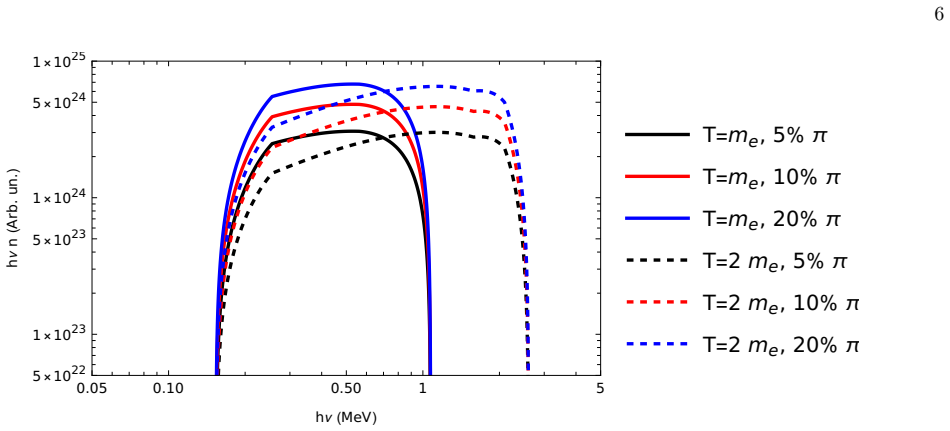
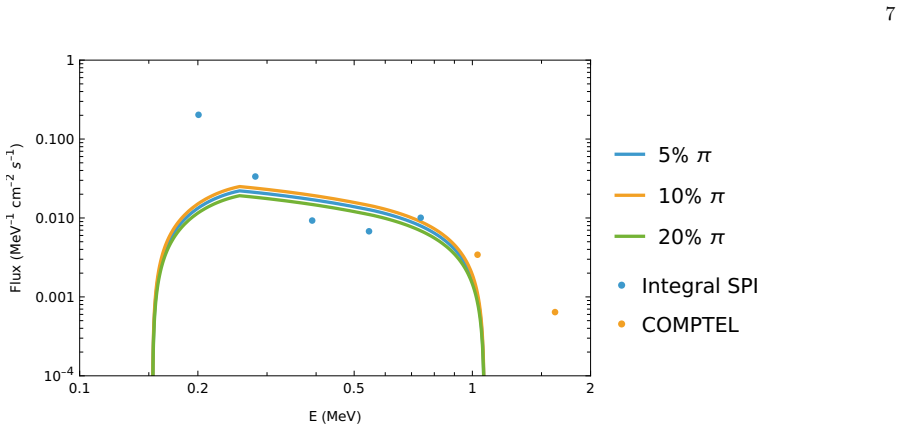
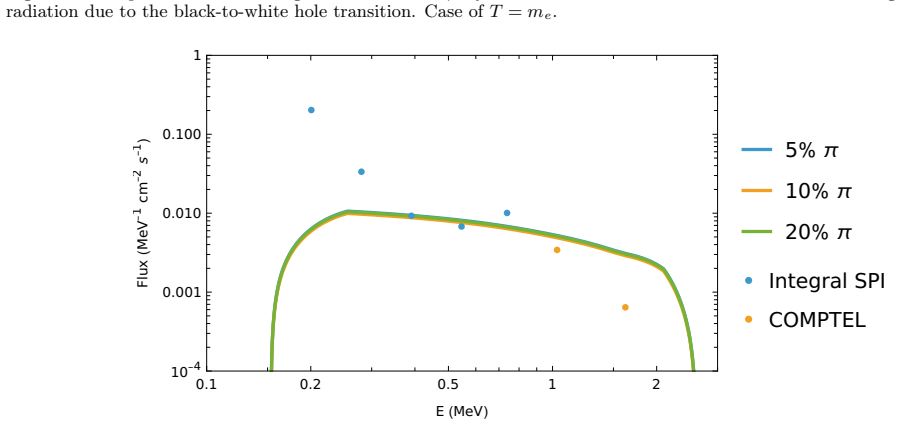
read the original abstract
We calculate the gamma ray emission from a black-to-white hole transition. We put forward a model for the prompt emission phase, based on the photospheric emission model with the underlying idea that the number of photons and leptons emitted by the white hole will be larger than the baryon content. We calculate the spectrum of the emitted radiation and give an estimate of the total energy emitted. Finally, we estimate the cosmological density of lunar mass primordial black holes.
Editorial analysis
A structured set of objections, weighed in public.
Referee Report
Summary. The manuscript calculates gamma-ray emission from a hypothetical black-to-white hole transition. It applies the photospheric emission model under the explicit assumption that the number of photons and leptons emitted exceeds the baryon content, derives the resulting spectrum and total energy output, and estimates the cosmological density of lunar-mass primordial black holes.
Significance. If the central modeling choice is independently justified and the radiative calculations are accurate, the work could link quantum-gravity-inspired transitions to observable high-energy transients and furnish new constraints on primordial black hole abundances. The approach is constructive and directly falsifiable via comparison with gamma-ray burst data, but its impact hinges on the validity of the photon/lepton dominance premise.
major comments (2)
- [Abstract, §1] Abstract and §1: The photospheric framework is invoked only after stating that 'the number of photons and leptons emitted by the white hole will be larger than the baryon content.' No derivation, order-of-magnitude estimate, or reference is supplied for this ratio; the entire spectrum and energy calculation rests on it. Without an explicit justification or sensitivity analysis, the applicability of the model cannot be assessed.
- [§3] §3 (spectrum calculation): The text states that spectra are computed, yet the abstract-level description and reader's summary indicate no explicit derivations, error propagation, or comparison to observed GRB spectra are shown. If the full manuscript likewise omits the radiative-transfer equations or the optical-depth integration, the quantitative claims remain unverifiable.
minor comments (1)
- Notation for the baryon-to-photon ratio should be defined once and used consistently; the current phrasing mixes 'number' and 'content' without a symbol.
Simulated Author's Rebuttal
We thank the referee for the thorough review and valuable suggestions. Below we provide point-by-point responses to the major comments. We will revise the manuscript accordingly to address the concerns raised.
read point-by-point responses
-
Referee: [Abstract, §1] Abstract and §1: The photospheric framework is invoked only after stating that 'the number of photons and leptons emitted by the white hole will be larger than the baryon content.' No derivation, order-of-magnitude estimate, or reference is supplied for this ratio; the entire spectrum and energy calculation rests on it. Without an explicit justification or sensitivity analysis, the applicability of the model cannot be assessed.
Authors: We acknowledge that a more detailed justification for the photon and lepton dominance assumption is necessary to fully assess the model's applicability. This assumption is central to invoking the photospheric emission model, as stated in the abstract and introduction. In the revised manuscript, we will include an order-of-magnitude estimate in §1, based on the expected high-energy processes during the black-to-white hole transition, and provide references to similar assumptions in the GRB literature. Additionally, we will perform and present a sensitivity analysis varying the photon-to-baryon ratio to show the robustness of our results. revision: yes
-
Referee: [§3] §3 (spectrum calculation): The text states that spectra are computed, yet the abstract-level description and reader's summary indicate no explicit derivations, error propagation, or comparison to observed GRB spectra are shown. If the full manuscript likewise omits the radiative-transfer equations or the optical-depth integration, the quantitative claims remain unverifiable.
Authors: We agree that the spectrum calculation section would benefit from more explicit details to ensure verifiability. Although the manuscript applies the established photospheric model, the specific radiative-transfer equations and optical-depth calculations were not fully expanded. In the revision, we will add the relevant equations, describe the integration method, include error propagation estimates, and provide a comparison of the computed spectrum with observed GRB spectra to strengthen the quantitative claims. revision: yes
Circularity Check
No significant circularity
full rationale
The paper presents a phenomenological model calculation of gamma-ray emission from a hypothetical black-to-white-hole transition, explicitly conditioned on the stated assumption that photon and lepton number exceeds baryon content. The photospheric emission framework is adopted as the basis for computing the spectrum and total energy under this condition, followed by a density estimate for lunar-mass PBHs. No load-bearing step reduces by construction to a fitted parameter renamed as a prediction, a self-citation chain, or an ansatz smuggled via prior work; the derivation chain consists of forward computation from the explicit modeling premise rather than any self-referential loop. The construction is therefore self-contained against external benchmarks.
Axiom & Free-Parameter Ledger
Reference graph
Works this paper leans on
-
[1]
Electromagnetic emission from a black-to-white hole transition -- Photospheric emission
[see also 4, for example]. The main idea is that the dying star keeps collapsing inside the event horizon until it reaches densities comparable to the Planck density: at this point (yet unknown) quantum effects revert the collapse causing the transition from a black hole to a white hole, i.e. they trigger an explosion. Due to the huge time dilation caused...
work page internal anchor Pith review Pith/arXiv arXiv 2026
-
[2]
2022, The Astrophysical Journal Letters, 930, L17,https://doi.org/10.3847/ 2041-8213/ac6756
Akiyama, K., Alberdi, A., Alef, W., et al. 2022, The Astrophysical Journal Letters, 930, L17,https://doi.org/10.3847/ 2041-8213/ac6756
2022
-
[3]
Tunable, flexible, and efficient optimization of control pulses for practical qubits,
Ashtekar, A., Pawlowski, T., & Singh, P. 2006, Phys. Rev. Lett., 96, 141301,https://doi.org/10.1103/PhysRevLett. 96.141301
-
[4]
Blumenthal, G., Gould, R., & Bremsstrahlung, S. R. 1970, Reviews of Modern Physics, 42, 237,https://doi.org/10. 1103/RevModPhys.42.237
1970
-
[5]
2011, Quantum Cosmology - A fundamental description of the Universe (Heidelberg: Springer)
Bojowald, M. 2011, Quantum Cosmology - A fundamental description of the Universe (Heidelberg: Springer)
2011
-
[6]
2008 Physical Review D, 78, 064057https://doi.org/10.1103/PhysRevD.78
Bojowald, M., Harada, T., Tibrewala, R. 2008 Physical Review D, 78, 064057https://doi.org/10.1103/PhysRevD.78. 064057
-
[7]
2008 Ap.J., 679, 1315https: //doi.org/10.1086/529489
Bouchet, L., Jourdain, E., Roques, J.-P., Strong, A., Diehl, R., Lebrun, F., Terrier, R. 2008 Ap.J., 679, 1315https: //doi.org/10.1086/529489
-
[8]
2016, Phys
Christodoulou, M., Rovelli, C., Speziale, S., & Vilensky, I. 2016, Phys. Rev. D, 94, 084035,https://doi.org/10.1103/ PhysRevD.94.084035
2016
-
[9]
2018, The Astrophysical Journal Supplement Series, 234, 3,https://doi.org/10.3847/1538-4365/aa9e84
Geng, J.-J., Huang, Y.-F., Wu, X.-F., Zhang, B., & Zong, H.-S. 2018, The Astrophysical Journal Supplement Series, 234, 3,https://doi.org/10.3847/1538-4365/aa9e84
-
[10]
Geng, J. J., Wu, X. F., Li, L., Huang, Y. F., & Dai, Z. G. 2014, The Astrophysical Journal, 792, 31,https://doi.org/ 10.1088/0004-637X/792/1/31
-
[11]
1986, ApJL, 308, L47, doi: 10.1086/184741
Goodman, J. 1986, Astrophysical Journal Letters, 308, L47,https://doi.org/10.1086/184741
-
[12]
Gould, R. J., & Schréder, G. P. 1967, Phys. Rev., 155, 1404,https://doi.org/10.1103/PhysRev.155.1404
-
[13]
Hsieh, S. H., & Spiegel, E. A. 1976, Astrophysical Journal, 207, 244,https://doi.org/10.1086/154488
-
[14]
M., & et al
Kocherlakota, P., Rezzolla, L., Falcke, H., Fromm, C. M., & et al. 2021, Phys. Rev. D, 103, 104047,https://doi.org/10. 1103/PhysRevD.103.104047
2021
-
[15]
Levinson, A., & Bromberg, O. 2008, Phys. Rev. Lett., 100, 131101,https://doi.org/10.1103/PhysRevLett.100.131101
-
[16]
2020, PhR, 866, 1, doi: 10.1016/j.physrep.2020.04.003
Levinson, A., & Nakar, E. 2020, Physics Reports, 866, 1,https://doi.org/10.1016/j.physrep.2020.04.003 9
-
[17]
Lightman, A. P., & Zdziarski, A. A. 1987, Astrophysical Journal, 319, 643,https://doi.org/10.1086/165485
-
[18]
1986, ApJL, 308, L43, doi: 10.1086/184740 Pe’Er, A., Zhang, B.-B., Ryde, F., et al
Paczynski, B. 1986, Astrophysical Journal Letters, 308, L43,https://doi.org/10.1086/184740
-
[19]
2004, Reviews of Modern Physics, 76, 1143, doi: 10.1103/RevModPhys.76.1143
Piran, T. 2005, Rev. Mod. Phys., 76, 1143,https://doi.org/10.1103/RevModPhys.76.1143
-
[20]
Planck Collaboration 2020, Planck 2018 results. VI. Cosmological parameters, A& A 641 A6,https://doi.org/10.1051/ 0004-6361/201833910
2020
-
[21]
2014, International Journal of Modern Physics D, 23, 1442026,https://doi.org/10.1142/ S0218271814420267
Rovelli, C., & Vidotto, F. 2014, International Journal of Modern Physics D, 23, 1442026,https://doi.org/10.1142/ S0218271814420267
2014
-
[22]
Samuelsson, F. A., Ryde, F., & Lundman, C. 2024, Radiation-mediated shocks in GRB prompt emission., arXiv:2403.03529 [astro-ph.HE],https://doi.org/10.48550/arXiv.2403.03529
-
[23]
1996, Diffuse galactic hard X-ray and low-energy gamma-ray continuum., A& A 120 381
Strong, AW and Bennett, K and Bloemen, H and Diehl, R and Hermsen, W and Purcell, W and Schoenfelder, V and Stacy, JG and Winkler, C and Youssefi, G, C. 1996, Diffuse galactic hard X-ray and low-energy gamma-ray continuum., A& A 120 381
1996
-
[24]
1982, Astrophysical Journal, 258, 321,https://doi.org/10.1086/160081
Svensson, R. 1982, Astrophysical Journal, 258, 321,https://doi.org/10.1086/160081
-
[25]
1983, Astrophysical Journal, 270, 300,https://doi.org/10.1086/161122
Svensson, R. 1983, Astrophysical Journal, 270, 300,https://doi.org/10.1086/161122
-
[26]
Toro, E. F. 2013, Riemann solvers and numerical methods for fluid dynamics: a practical introduction (Springer Science & Business Media)
2013
-
[27]
L., Zhang, B., Hascoët, R., et al
Uhm, Z. L., Zhang, B., Hascoët, R., et al. 2012, The Astrophysical Journal, 761, 147,https://doi.org/10.1088/ 0004-637X/761/2/147
2012
-
[28]
Zajaček, M., Tursunov, A., Eckart, A., et al. 2019, Journal of Physics: Conference Series, 1258, 012031,https://doi.org/ 10.1088/1742-6596/1258/1/012031
discussion (0)
Sign in with ORCID, Apple, or X to comment. Anyone can read and Pith papers without signing in.