Spin-dependent interactions and fine structure in the negative-parity singly heavy baryons
Pith reviewed 2026-06-29 21:36 UTC · model grok-4.3
The pith
A two-step Gaussian expansion method lets the relativized quark model match negative-parity singly heavy baryon levels to under 5 MeV average deviation.
A machine-rendered reading of the paper's core claim, the machinery that carries it, and where it could break.
Core claim
The central claim is that the two-step Gaussian expansion method removes the previous obstacle to a complete treatment of spin-dependent potentials in the relativized quark model for baryons, yielding energy levels whose averaged deviation from experiment is less than 5 MeV and thereby bringing the theoretical description of negative-parity singly heavy baryons to the same precision as current measurements.
What carries the argument
The two-step Gaussian expansion method, which expands the three-body wave function in successive Gaussian bases to incorporate spin-orbit, tensor, and other spin-dependent interactions without uncontrolled approximations.
If this is right
- The calculated spectrum supplies concrete quantum-number assignments for the observed negative-parity baryons.
- Different spin-dependent forces compete inside each state to produce the measured splittings and mixing angles.
- The same numerical method supplies an effective route to high-precision calculations of compact tetraquarks and pentaquarks.
- The large set of computed levels encodes quantitative information on the relative strengths of the underlying interactions.
Where Pith is reading between the lines
- If the method succeeds for baryons it should also allow controlled inclusion of spin-dependent forces when modeling other few-body systems where the same potentials appear.
- Direct comparison with future lattice QCD results on the same states would test whether the effective potentials reproduce the non-perturbative dynamics.
- The assignments derived from these calculations can be used to prioritize experimental searches for still-missing resonances.
Load-bearing premise
The chosen spin-dependent potentials in the relativized quark model capture the essential non-perturbative dynamics of these baryons with enough accuracy that the remaining discrepancies stay below 5 MeV.
What would settle it
Observation of any negative-parity singly heavy baryon state whose measured mass lies more than roughly 10 MeV outside the model's predicted range would falsify the claim of 5 MeV average agreement.
Figures
read the original abstract
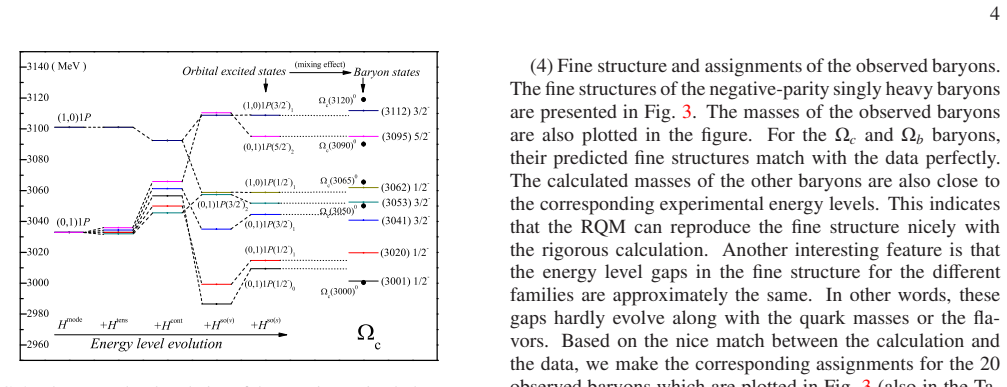
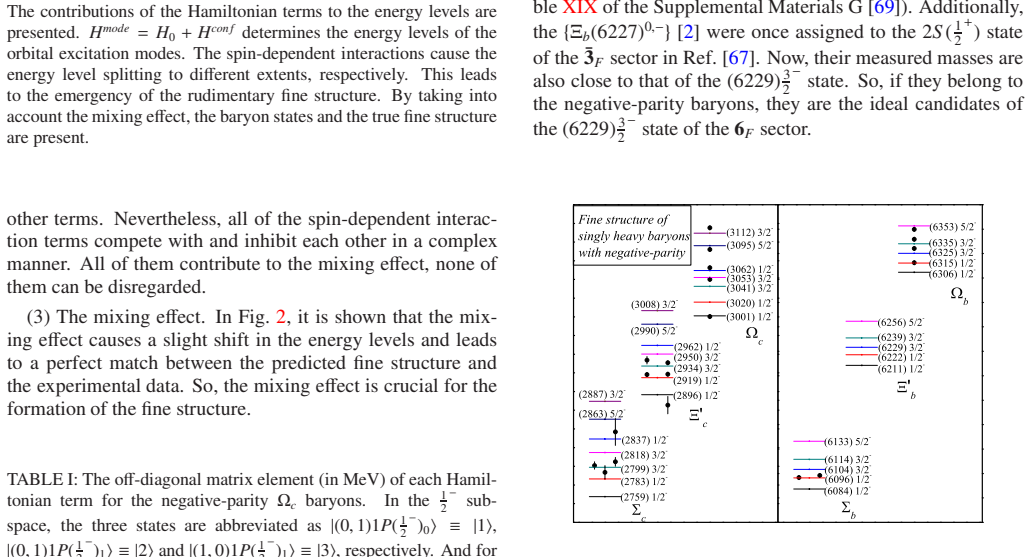
In order to meet the high-precision measurement of the current baryon spectroscopy, for the first time, we rigorously analyze the spin-dependent interactions and the fine structure of the negative-parity singly heavy baryons in the relativized quark model, which was previously unfeasible in the three-quark system. This gains access to the exploration of the strong interactions dominated by the non-perturbative QCD, and reveals how the various forms of strong interactions in a baryon compete with each other, affect the evolution of the energy levels, cause the energy level splitting and contribute to the mixing effect responsible for the formation of the fine structures. It is shown that the rigorous calculation can perfectly reproduce the data, the averaged deviation between the calculated and experimental energy levels is less than 5 MeV for the negative-parity singly heavy baryons. Therefore, the theoretical precision has reached the experimental high precision. This confirms the reliability of the calculation and also helps make reasonable assignments for the observed negative-parity baryons. The large amount of data obtained by the rigorous calculations contains a wealth of interaction information and is helpful for both of the theoretical and experimental studies. The key to the rigorous calculation in this work is the proposal of a new method, namely the two-step Gaussian expansion method. This new method not only overcomes the long-standing unresolved problem in the relativized quark model, but also provides an effective approach for the high-precision calculation of other few-body systems such as the compact tetraquarks and pentaquarks, especially for the treatment of spin-orbit interactions and tensor interactions which actually appear ubiquitously in all of quantum many-body systems.
Editorial analysis
A structured set of objections, weighed in public.
Referee Report
Summary. The paper introduces a two-step Gaussian expansion method to solve the relativized quark model three-body Schrödinger equation for negative-parity singly heavy baryons (including spin-orbit, tensor, and other spin-dependent terms). It claims this enables a numerically rigorous treatment previously unfeasible, yielding energy levels whose average deviation from experiment is <5 MeV, thereby confirming the model's reliability for state assignments and interaction studies.
Significance. If the numerical reproduction holds after full validation of parameters and basis convergence, the work would mark a technical advance in precision few-body calculations for baryons, providing a practical route to include spin-dependent forces without uncontrolled truncations and extending to tetraquarks/pentaquarks. The explicit handling of fine-structure mixing is a potential strength.
major comments (2)
- [Abstract] Abstract and § on numerical results: the central claim of averaged deviation <5 MeV is stated without a table listing calculated vs. experimental masses for each state, without quoted parameter values (quark masses, potential strengths, spin-dependent couplings), and without error analysis or basis-size convergence tests; this prevents verification that the precision arises from the method rather than parameter adjustment.
- [Method] Method section describing the two-step Gaussian expansion: the treatment of the spin-orbit and tensor operators in the three-body problem is asserted to be rigorous, but no explicit matrix-element formulas or demonstration that the two-step procedure avoids the usual center-of-mass or truncation errors for these operators is supplied, leaving open whether the fine-structure splittings are fully controlled.
minor comments (1)
- Notation for the relativized potential forms and the definition of the two-step basis should be collected in one place for clarity.
Simulated Author's Rebuttal
We thank the referee for the detailed and constructive report. The comments highlight areas where additional documentation will improve clarity and verifiability. We address each point below and will incorporate the requested material in a revised manuscript.
read point-by-point responses
-
Referee: [Abstract] Abstract and § on numerical results: the central claim of averaged deviation <5 MeV is stated without a table listing calculated vs. experimental masses for each state, without quoted parameter values (quark masses, potential strengths, spin-dependent couplings), and without error analysis or basis-size convergence tests; this prevents verification that the precision arises from the method rather than parameter adjustment.
Authors: We agree that explicit documentation is needed to substantiate the <5 MeV claim. In the revised version we will add (i) a table comparing calculated and experimental masses for all states considered, (ii) the complete set of fitted parameters (constituent quark masses, string tension, Coulomb strength, and all spin-dependent couplings), and (iii) a dedicated subsection presenting basis-size convergence tests together with an error estimate. These additions will allow readers to confirm that the quoted precision is controlled by the numerical method rather than by parameter tuning alone. revision: yes
-
Referee: [Method] Method section describing the two-step Gaussian expansion: the treatment of the spin-orbit and tensor operators in the three-body problem is asserted to be rigorous, but no explicit matrix-element formulas or demonstration that the two-step procedure avoids the usual center-of-mass or truncation errors for these operators is supplied, leaving open whether the fine-structure splittings are fully controlled.
Authors: The two-step procedure was constructed precisely to keep the center-of-mass motion exact while evaluating the full spin-orbit and tensor operators without truncation. To make this transparent we will insert, either in the main text or as an appendix, the explicit analytic expressions for the matrix elements of the spin-orbit and tensor terms between the two-step Gaussian basis functions, together with a short numerical test showing that the center-of-mass contribution remains zero to machine precision and that the fine-structure splittings converge with basis size. This will demonstrate that the reported splittings are free of the usual artifacts. revision: yes
Circularity Check
No significant circularity detected
full rationale
The paper's derivation chain centers on proposing the two-step Gaussian expansion method as a numerical technique to solve the relativized quark model three-body Schrödinger equation with spin-orbit and tensor potentials for negative-parity singly heavy baryons. The reported reproduction of experimental levels (average deviation <5 MeV) is presented as an outcome of this rigorous solution rather than a parameter fit by construction; no equations or self-citations are shown to reduce the central claim to tautological inputs, and the method is offered as an independent advance over prior approximations. The argument remains self-contained against external benchmarks without load-bearing self-definition or fitted-input renaming.
Axiom & Free-Parameter Ledger
free parameters (1)
- Quark masses, potential strengths, and spin-dependent coupling constants
axioms (1)
- domain assumption The relativized quark model with effective spin-dependent potentials accurately captures the essential non-perturbative QCD dynamics in singly heavy baryons.
Reference graph
Works this paper leans on
-
[1]
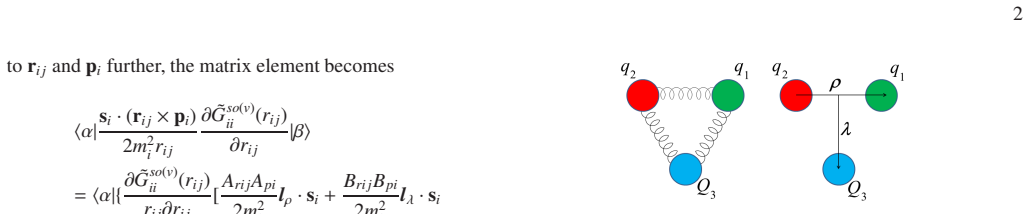
While, pi is defined in the Cartesian coordinates and ri j ≡ri - r j rep- resents the relative position vector between the i-th and j-th quarks ({i, j}= {1, 2}, {2, 3}, or {3, 1}), which is di fferent from the Jacobi coordinates (see Fig. 1). This di fference makes the calculation extremely complicated, especially in cases of {i, j} = {2, 3}and {3, 1}. By ap...
work page internal anchor Pith review Pith/arXiv arXiv 2026
-
[2]
can conveniently describe the orbital excitation modes of baryons, which are dominant in low-energy regime. In Eq. ( 1), the latter two terms are proportional to ρ ×pλ and λ ×pρ, respectively. They are the so-called three-body spin-orbit potentials ( H so−3B i j ) [ 55]. Then, the former two terms are named as the two-body inter- actions ( H so−2B i j ). ...
2024
- [3]
-
[4]
Navas, et al., (Particle Data Group), Review of Partic le Physics, Phys
S. Navas, et al., (Particle Data Group), Review of Partic le Physics, Phys. Rev. D 110 3, 030001,(2024) and 2025 update
2024
-
[5]
R. Aaij, et al., (LHCb collaboration), Observation of excited Ω0 c baryons in Ω− b → Ξ+ c K−π− decays, Phys. Rev. D 104 9 , L091102 (2021) , arXiv:2107.03419[hep- ex]
-
[6]
Aaij, et al., (LHCb collaboration), Observation of Ne w Ω0 c baryons Decay to Λ+ c K−, Phys
R. Aaij, et al., (LHCb collaboration), Observation of Ne w Ω0 c baryons Decay to Λ+ c K−, Phys. Rev. Lett. 124, 222001 (2020) , arXiv:2003.13649[hep-ex]
-
[7]
Y . B. Li, et al., (Belle Collaboration), Evidence of a structure in ¯K0Λ+ c consistant with a charged Ξc(2930)+, and updated measurement of ¯B0 → ¯K0Λ+ c ¯Λ− c at Belle, Eur. Phys. J. C 78, 928 (2018) , arXiv:1806.09182[hep-ex]
work page internal anchor Pith review Pith/arXiv arXiv 2018
-
[8]
B. Aubert, et al., (BABAR Collaboration), A study of Ex- cited Charm-Strange Baryons with Evidence for new Baryons Ξc(3055)+ and Ξc(3123)+, Phys. Rev. D 77, 012002 (2008) , arXiv:0710.5763[hep-ex]
work page internal anchor Pith review Pith/arXiv arXiv 2008
-
[9]
R. Aaij, et al.,(LHCb collaboration), Observa- tion of New Ω0 c States Decaying to the Ξ+ c K− Fi- nal State, Phys. Rev. Lett. 131 13, 131902 (2023), arXiv:2302.04733[hep-ex]
-
[10]
R. Aaij, et al., (LHCb collaboration), Observa- tion of New Baryons in the Ξ− bπ+π− and Ξ0 bπ+π− Systems, Phys. Rev. Lett. 131 17, 171901 (2023), arXiv:2307.13399[hep-ex]
-
[11]
Y . B. Li, et al., (Belle Collaboration), Observation of Ξc(2930)0 and updated measurement of B− → K−Λ+ c ¯Λ− c at Belle, Eur. Phys. J. C 78 3, 252 (2018) , arXiv:1712.03612[hep-ex]
work page internal anchor Pith review Pith/arXiv arXiv 2018
-
[12]
B. Aubert, et al., (BABAR Collaboration), Measurement s of B( ¯B0 → Λ+ c ¯p) and B( ¯B− → Λ+ c ¯pπ−) and Stud- ies of Λ+ cπ− Resonances, Phys. Rev. D 78, 112003 (2008) , arXiv:0807.4974[hep-ex]
work page internal anchor Pith review Pith/arXiv arXiv 2008
-
[13]
Very narrow excited $\Omega_c$ baryons
M. Karliner and J. L. Rosner, V ery narrow excited Ωc baryons, Phys. Rev. D 95 11, 114012 (2017), arXiv:1703.07774[hep- ph]
work page internal anchor Pith review Pith/arXiv arXiv 2017
-
[14]
E. Ortiz-Pacheco, R. Bijker, A. Giachino, and E. Santopinto, Heavy Ωc and Ωb baryons in the quark model, J. Phys. Conf. Ser. 1610 1, 012011 (2020), arXiv:2004.09409[nucl-th]
-
[15]
Z. Shah, K. Thakkar, A. K. Rai, and P . C. Vinodkumar, Excited State Mass spectra of Singly Charmed Baryons, Eur. Phys. J. A 52, 313 (2016) , arXiv:1602.06384[hep-ph]
work page internal anchor Pith review Pith/arXiv arXiv 2016
-
[16]
A. Kakadiya, Z. Shah, and A. K. Rai, Mass spectra and decay properties of singly heavy bottom-strange baryons, Int. J. Mod. Phys. A 37 11n12, 2250053 (2022) , arXiv: 2202.12048 [hep-ph]
-
[17]
K. L. Wang, L. Y . Xiao, X. H. Zhong, and Q. Zhao, Under- standing the newly observed Ωc states through their decays, Phys. Rev. D 95 11, 016010 (2017), arXiv:1703.09130[hep- ph]
work page internal anchor Pith review Pith/arXiv arXiv 2017
-
[18]
K. L. Wang, Q. F. L¨ u, and X. H. Zhong, Interpretation of the newly observed Σb(6097)± and Ξb(6227)− states as the P-wave bottom baryons, Phys. Rev. D 99 1, 014011 (2019), arXiv:1810.02205[hep-ph]
work page internal anchor Pith review Pith/arXiv arXiv 2019
-
[19]
Z. G. Wang, Analysis of Ωc(3000), Ωc(3050), Ωc(3066), Ωc(3090) and Ωc(3119) with QCD sum rules, Eur. Phys. J. C 77 5, 325 (2017) , arXiv:1704.01854[hep-ph]
work page internal anchor Pith review Pith/arXiv arXiv 2017
-
[20]
S. S. Agaev, K. Azizi, and H. Sundu, Interpreta- tion of the new Ω0 c states via their mass and width, Eur. Phys. J. C 77 6, 395 (2017) , arXiv:1704.04928[hep-ph]
work page internal anchor Pith review Pith/arXiv arXiv 2017
- [21]
- [22]
-
[23]
Heavy Baryons in a Quark Model
W. Roberts and M. Pervin, Heavy baryons in a quark model, Int. J. Mod. Phys. A 23, 2817 (2008) , arXiv:0711.2492[nucl- th]
work page internal anchor Pith review Pith/arXiv arXiv 2008
-
[24]
Spectroscopy and Regge trajectories of heavy baryons in the relativistic quark-diquark picture
D. Ebert, R. N. Faustov, and V . O. Galkin, Spectroscopy and Regge trajectories of heavy baryons in the relativis- tic quark-diquark picture, Phys. Rev. D 84, 014025 (2011) , arXiv:1105.0583[hep-ph]
work page internal anchor Pith review Pith/arXiv arXiv 2011
-
[25]
B. Chen and X. Liu, Assigning the newly reported Σb(6097) as a P-wave excited state and predicting its partners, Phys. Rev. D 98, 074032 (2018) , arXiv:1810.00389[hep-ph]
work page internal anchor Pith review Pith/arXiv arXiv 2018
-
[26]
B. Chen, K. W. Wei, X. Liu, and T. Matsuki, Low- lying charmed and charmed-strange baryon states, Eur. Phys. J. C 77, 154 (2017) , arXiv:1609.07967[hep-ph]
work page internal anchor Pith review Pith/arXiv arXiv 2017
-
[27]
Quantum Numbers of Recently Discovered $\Omega^{0}_{c}$ Baryons from Lattice QCD
M. Padmanath and N. Mathur, Quantum Numbers of Recently Discovered Ω0 c Baryons from Lattice QCD, Phys. Rev. Lett. 119 4, 042001 (2017), arXiv:1704.00259[hep- ph]
work page internal anchor Pith review Pith/arXiv arXiv 2017
-
[28]
Z. Zhao, D. D. Ye, and A. Zhang, Hadronic de- cay properties of newly observed Ωc baryons, Phys. Rev. D 95 11, 114024 (2017), arXiv:1704.02688[hep- ph]
work page internal anchor Pith review Pith/arXiv arXiv 2017
- [29]
- [30]
-
[31]
H. Garc´ ıa-Tecocoatzi, A. Giachino, and A. Ramirez-Mo rales, et al., Decay widths and mass spectra of single bottom baryon s, arXiv:2307.00505[hep-ph]
-
[32]
Lamb, and R
E, Willis, J. Lamb, and R. C. Retherford, Fine structure of the hydrogen atom by a microwave method, Phys. Rev. 1947; 72: 241-3
1947
-
[33]
M. G. Mayer, On Closed Shells in Nuclei. II, Phys. Rev. 75 , 1969 (1949)
1969
-
[34]
H. Bahtiyar, K. U. Can, G. Erkol, P . Gubler, and M. Oka, Charmed baryon spectrum from lattice QCD near the physical point, Phys. Rev. D 102 5, 054513 (2020) , arXiv:2004.08999[hep-lat]
- [36]
-
[37]
T. M. Aliev, K. Azizi, Y . Sarac, and H. Sundu, Determinat ion of the quantum numbers of Σb(6097)± via their strong decays, Phys. Rev. D 99 9, 094003 (2019) , arXiv:1811.05686[hep-ph]
work page internal anchor Pith review Pith/arXiv arXiv 2019
-
[38]
H. Y . Cheng, and C. K. Chua, Strong Decays of Charmed Baryons in Heavy Hadron Chiral Perturbation Theory: An Update, Phys. Rev. D 92 7, 074014 (2015) , arXiv:1508.05653[hep-ph]
work page internal anchor Pith review Pith/arXiv arXiv 2015
-
[39]
J. X. Lu, Y . Zhou, and H. X. Chen, et al., Dynam- ically generated JP = 1/ 2− (3/ 2−)singly charmed and bottom heavy baryons, Phys. Rev. D 92 1, 014036 (2015) , arXiv:1409.3133[hep-ph]
work page internal anchor Pith review Pith/arXiv arXiv 2015
-
[40]
H. X. Chen, W. Chen, and X. Liu, et al., A review of the open charm and open bottom systems, Rept. Prog. Phys. 80 7, 076201 (2017) , arXiv:1609.08928[hep-ph]
work page internal anchor Pith review Pith/arXiv arXiv 2017
- [41]
-
[42]
L. A. Copley, N. Isgur and G. Karl, Charmed Baryons in a Quark Model with Hyperfine Interactions, Phys. Rev. D 20, 768 (1979) , Erratum: [Phys. Rev. D 23, 817 (1981)]
1979
-
[43]
Charmed Baryon Strong Coupling Constants in a Light-Front Quark Model
S. Tawfiq, P . J. O’Donnell, and J. G. Korner, Charmed baryon strong coupling constants in a light front quark mode l, Phys. Rev. D 58, 054010 (1998) , arXiv:hep-ph/9803246
work page internal anchor Pith review Pith/arXiv arXiv 1998
- [44]
-
[45]
C. W. Hwang, Combined Chiral Dynamics and MIT Bag Model Study of Strong Σ∗Q → ΛQπ Decay, Eur. Phys. J. C 50, 793-799 (2007) , arXiv:hep-ph/0611221
work page internal anchor Pith review Pith/arXiv arXiv 2007
-
[46]
Masses of excited heavy baryons in the relativistic quark-diquark picture
D. Ebert, R. N. Faustov, and V . O. Galkin, Masses of excited heavy baryons in the relativistic quark model, Phys. Lett. B 659, 612-620 (2008) , arXiv:0705.2957
work page internal anchor Pith review Pith/arXiv arXiv 2008
-
[47]
X. H. Zhong, and Q. Zhao, Charmed baryon strong de- cays in a chiral quark model, Phys. Rev. D 77, 074008 (2008) , arXiv:0711.4645
work page internal anchor Pith review Pith/arXiv arXiv 2008
-
[48]
Spectrum of heavy baryons in the quark model
T. Y oshida, E. Hiyama, and A. Hosaka, et al., Spectrum of heavy baryons in the quark model, Phys. Rev. D 92, 114029 (2015) , arXiv:1510.01067[hep-ph]
work page internal anchor Pith review Pith/arXiv arXiv 2015
-
[49]
Q. F. L¨ u, K. L. Wang, L. Y . Xiao, and X. H. Zhong, Mass spectra and radiative transitions of doubly heavy baryons i n a relativized quark model, Phys. Rev. D 96 11, 114006 (2017), arXiv:1708.04468[hep-ph]
work page internal anchor Pith review Pith/arXiv arXiv 2017
- [50]
- [51]
- [52]
-
[53]
The structure of pentaquarks $\Omega_c^0$ in the chiral quark model
G. Yang and J. L. Ping, Dynamical study of Ω0 c in the chiral quark model, Phys. Rev. D 97 3, 034023 (2018), arXiv:1703.08845[hep-ph]
work page internal anchor Pith review Pith/arXiv arXiv 2018
- [54]
-
[55]
Godfrey and N
S. Godfrey and N. Isgur, Mesons in a Relativized Quark Mo del with Chromodynamics, Phys. Rev. D 32, 189-231 (1985)
1985
-
[56]
Capstick and N
S. Capstick and N. Isgur, Baryons in a relativized quark model with chromodynamics, Phys. Rev. D 34, 2809-2835 (1986)
1986
-
[57]
Karl, P Wave Baryons in the Quark Model, Phys
N.Isgur and G. Karl, P Wave Baryons in the Quark Model, Phys. Rev. D 18, 4187 (1978)
1978
- [58]
- [59]
- [60]
-
[61]
N.Isgur, Meson-like baryons and the spin-orbit puzzle , 7 Phys. Rev. D 62, 014025 (2000) , arXiv: hep-ph /9910272
2000
-
[62]
Anselmino, E
M. Anselmino, E. Predazzi, and S. Ekelin, et al., Diquar ks, Rev. Mod. Phys. 65, 1199-1234 (1993)
1993
- [63]
-
[64]
Hiyama, Y
E. Hiyama, Y . Kino and M. Kamimura, Gaus- sian expansion method for few-body systems, Prog. Part. Nucl. Phys. 51, 223-307 (2003)
2003
- [65]
- [66]
- [67]
- [68]
- [69]
- [70]
-
[71]
The complete calculation results are present ed, and Refs
See the Supplemental Materials for the additional deta ils on the Hamiltonian of the RQM, wave functions, Jacobi coordi- nates, HQD mechanism, GEM, o ff-digonal matrix elements, two-step GEM. The complete calculation results are present ed, and Refs. [ 53– 56, 62– 67] are also included. 8 Supplemental Materials: Spin-dependent interactions and fine structur...
-
[72]
The quarks are numbered for ease of use in calculatio ns, and the 3rd quark refers specifically to the heavy quark
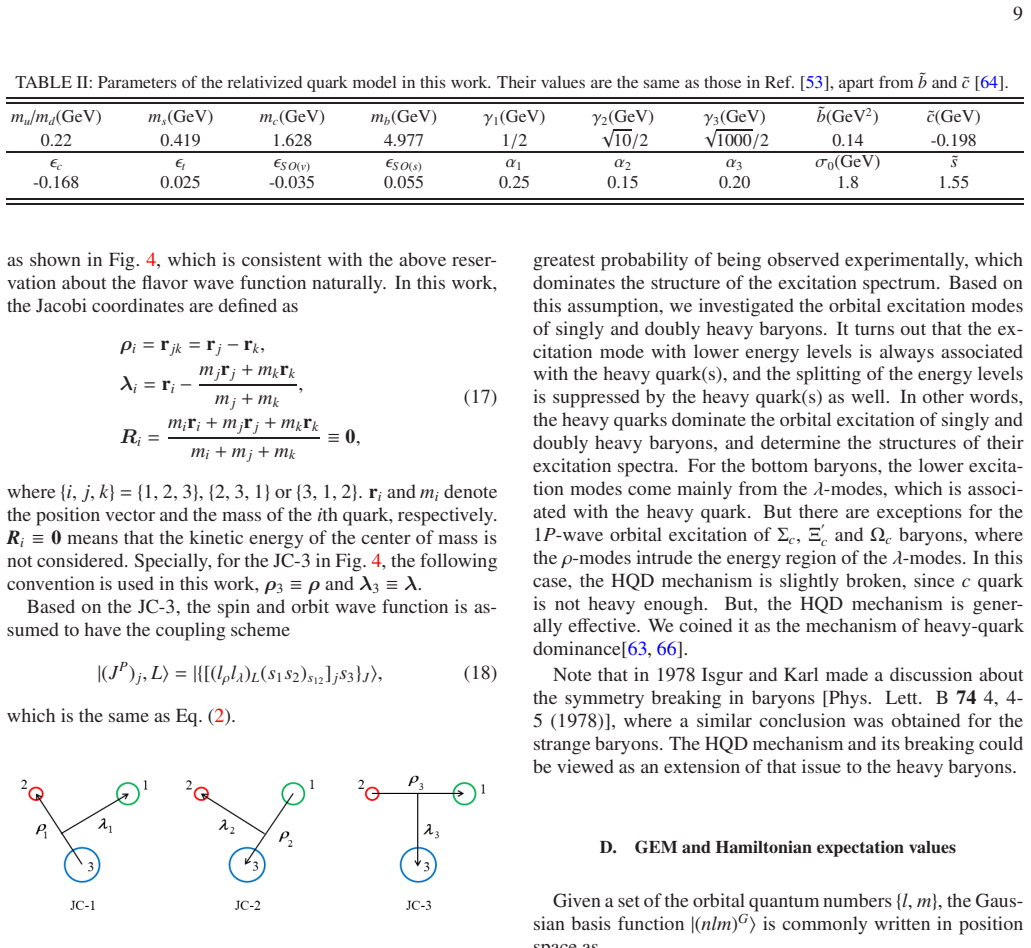
is selected for defining the orbital excited states of a sin gly heavy baryon. The quarks are numbered for ease of use in calculatio ns, and the 3rd quark refers specifically to the heavy quark. In this w ork, all the calculations are based on the JC-3. C. Orbital excitation and Heavy-quark dominance For the L-wave excitation with L=lρ+lλ, there are an infi-...
1978
-
[73]
Expanding it using the Gaussian base functions as Eq
as an example, its o ff-diagonal element is written as ⟨α| ∂˜Gso(v) ii ri j∂ri j Bri jApi 2m2 i (λ ×pρ)·si]|β⟩. Expanding it using the Gaussian base functions as Eq. ( 26), we get as many as 10000 matrix elements like ⟨(˜n,α)G| ∂˜Gso(v) ii ri j∂ri j Bri jApi 2m2 i (λ ×pρ) ·si]|(˜n′,β)G⟩, when ˜nmax =100. We first deal with the right half part of the matrix ...
-
[74]
is the key to working out those complicated matrix elements. G. Calculation results 13 TABLE III: The Hamiltonian matrix H, the eigenvalues and the eigenvectors in the 1 2 − , 3 2 − and 5 2 − subspaces of the charmed baryons. Baryon (JP) ( lρ, lλ)nL(JP) j H (MeV) Eigenvalue (MeV) Eigenvector Σc( 1 2 − ) (0, 1)1P( 1 2 − )0
-
[75]
06 −11. 33 −3. 31 −11. 33 2778 . 02 −22. 26 −3. 31 −22. 26 2828 . 13 2836.60 (0.0151428, -0.357707, 0.933711) (0, 1)1P( 1 2 − )1 2783.20 (0.757047, -0.605924, -0.244409) (1, 0)1P( 1 2 − )1 2759.41 (0.653185, 0.710564, 0.261626) Σc( 3 2 − ) (0, 1)1P( 3 2 − )1
-
[76]
09 2816 . 13 −0. 64 −26. 82 −0. 64 2877 . 37 2886.91 (-0.333973, -0.041968, 0.941648) (0, 1)1P( 3 2 − )2 2818.41 (-0.31507, -0.936575, -0.153487) (1, 0)1P( 3 2 − )1 2798.58 (-0.888365, 0.347946, -0.299568) Σc( 5 2 − ) (0 , 1)1P( 5 2 − )2 (2862.97) 2862.97 (1) Ξ′ c( 1 2 − ) (0, 1)1P( 1 2 − )0
-
[77]
77 2911 . 67 −13. 56
-
[78]
81 −13. 56 2958 . 12 2961.80 (0.0163397, -0.257791, 0.966062) (0, 1)1P( 1 2 − )1 2918.64 (0.682486, 0.708982, 0.177647) (1, 0)1P( 1 2 − )1 2895.81 (0.730716, -0.656421, -0.187523) Ξ′ c( 3 2 − ) (0, 1)1P( 3 2 − )1
-
[79]
27 1 . 85 3004 . 10 3008.23 (0.239675, 0.0565135, 0.969207) (0, 1)1P( 3 2 − )2 2950.25 (-0.395649, -0.905959, 0.150666) (1, 0)1P( 3 2 − )1 2934.03 (-0.886576, 0.419576, 0.194776) Ξ′ c( 5 2 − ) (0 , 1)1P( 5 2 − )2 (2990.24) 2990.24 (1) Ωc( 1 2 − ) (0, 1)1P( 1 2 − )0
-
[80]
38 −7. 95 5 . 63 −7. 95 3014 . 79 11 . 50
-
[81]
63 11 . 50 3058 . 84 3061.91 (0.0700441, 0.225336, 0.97176) (0, 1)1P( 1 2 − )1 3019.70 (0.648008, -0.7509, 0.127414) (1, 0)1P( 1 2 − )1 3001.40 (-0.758406, -0.620784, 0.198616) Ωc( 3 2 − ) (0, 1)1P( 3 2 − )1
discussion (0)
Sign in with ORCID, Apple, or X to comment. Anyone can read and Pith papers without signing in.