Self-calibrated multiparameter measurement of three-dimensional microwave fields
Pith reviewed 2026-06-29 19:19 UTC · model grok-4.3
The pith
Rydberg atoms extract the full three-dimensional microwave vector field, including polarization amplitudes and relative phases, from a single EIT spectrum without external references.
A machine-rendered reading of the paper's core claim, the machinery that carries it, and where it could break.
Core claim
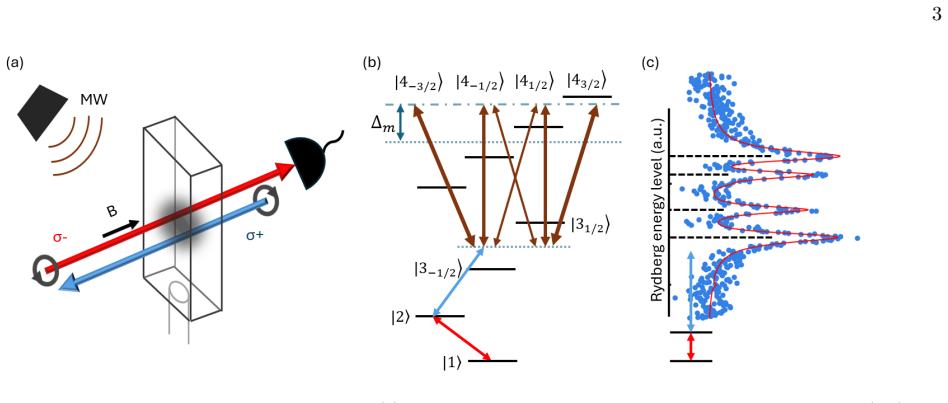
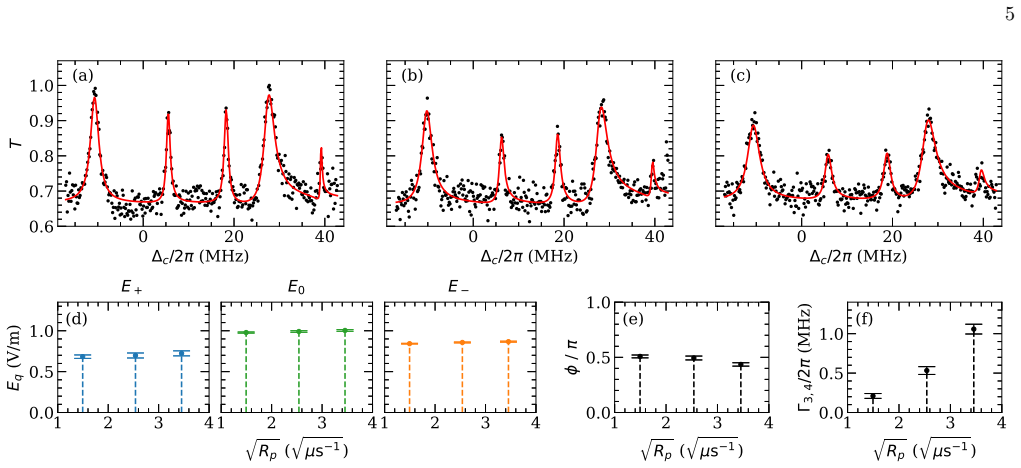
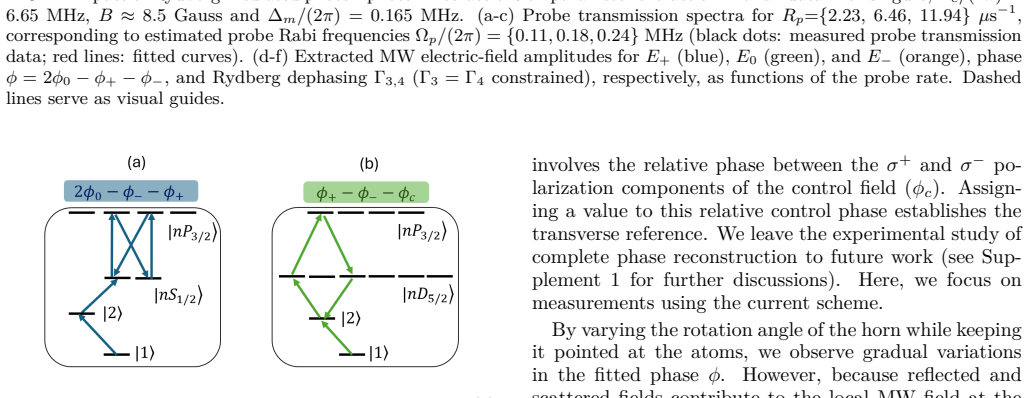
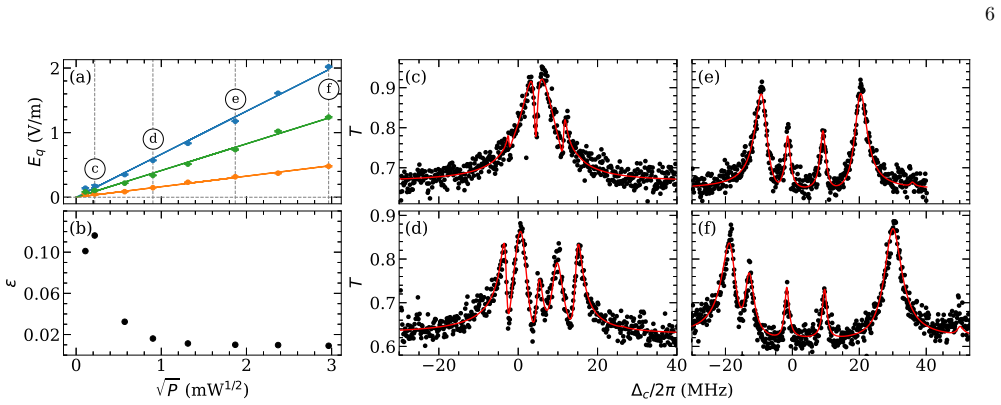
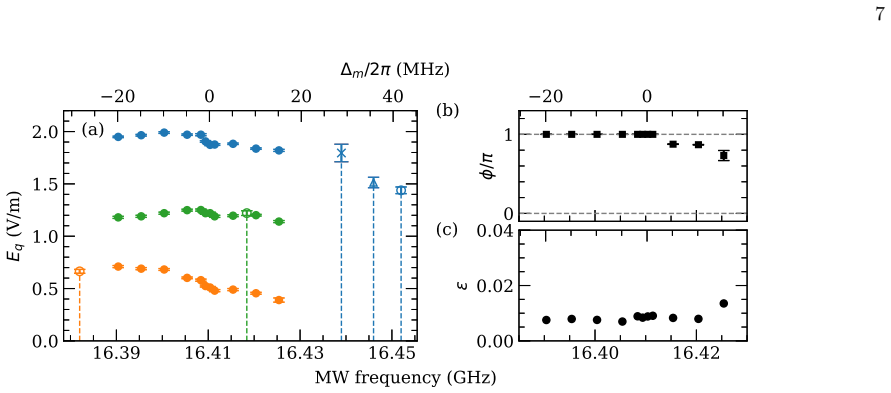
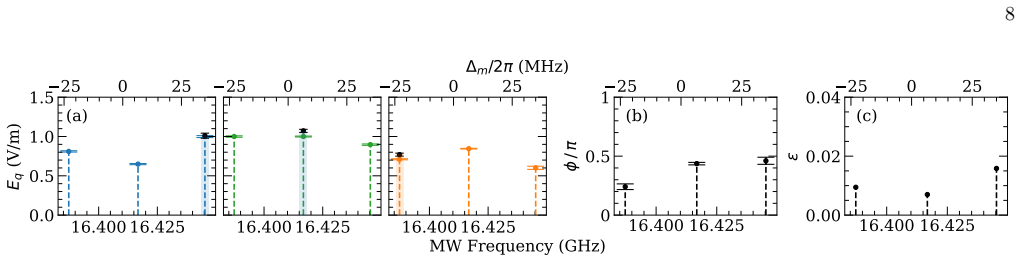
We propose and implement multi-level, Zeeman-resolved Rydberg electromagnetically induced transparency (EIT) spectroscopy in a laser-cooled atomic ensemble. We extract the three polarization amplitudes from a single spectrum and show that the MW polarization components give rise to closed interferometric loops within the atoms' internal Hilbert space, enabling extraction of their relative phases. Moreover, it is self-calibrated and requires no external reference MW fields, with MW parameters largely separable from one another and from other experimental parameters.
What carries the argument
Closed interferometric loops formed by the MW polarization components inside the atoms' internal Hilbert space, which allow relative phase extraction from the observed spectrum.
If this is right
- Full local reconstruction of the three-dimensional microwave vector field becomes possible from a single spectrum.
- No external reference microwave fields are required for calibration.
- Microwave amplitudes and phases remain separable from each other and from other experimental parameters.
- The technique applies directly to both dedicated microwave sensing and to quantum optics or quantum information experiments.
Where Pith is reading between the lines
- The separability of parameters could support simultaneous extraction of additional field or atomic properties in the same run.
- The approach might enable in-situ field mapping inside complex electromagnetic environments where external probes are impractical.
- Extension to other atomic species or different microwave frequency bands would test the generality of the loop-based phase extraction.
Load-bearing premise
The observed spectral features come mainly from the closed interferometric loops created by the MW polarization components, without large interference from other experimental effects or unmodeled couplings.
What would settle it
An independent measurement of the same microwave field using a calibrated external probe or known reference source that yields amplitudes or phases inconsistent with those extracted from the atomic EIT spectrum.
Figures
read the original abstract
Rydberg atoms are promising for microwave (MW) sensing and control, but full local MW characterization remains difficult. Existing methods generally do not provide self-calibrated reconstruction of the three-dimensional vector field, which is valuable for both atom-based sensing and in-situ field characterization in complex electromagnetic environments. We propose and implement multi-level, Zeeman-resolved Rydberg electromagnetically induced transparency (EIT) spectroscopy in a laser-cooled atomic ensemble. We extract the three polarization amplitudes from a single spectrum and show that the MW polarization components give rise to closed interferometric loops within the atoms' internal Hilbert space, enabling extraction of their relative phases. Moreover, it is self-calibrated and requires no external reference MW fields, with MW parameters largely separable from one another and from other experimental parameters. These features make it broadly applicable to dedicated sensing platforms as well as quantum optics and quantum information experiments.
Editorial analysis
A structured set of objections, weighed in public.
Referee Report
Summary. The manuscript proposes and implements a multi-level, Zeeman-resolved Rydberg EIT spectroscopy technique in a laser-cooled atomic ensemble for self-calibrated measurement of three-dimensional microwave fields. It claims extraction of the three polarization amplitudes from a single spectrum, with MW polarization components forming closed interferometric loops in the atomic Hilbert space that enable relative phase extraction; the method requires no external reference MW fields and asserts that MW parameters are largely separable from each other and from other experimental parameters.
Significance. If the central claims hold, the work provides a valuable advance in Rydberg-atom-based microwave sensing by enabling full vector-field characterization in a self-calibrated fashion without external references. This separability and loop-based phase extraction could simplify in-situ measurements in complex electromagnetic environments and find use in quantum optics and quantum information setups. The approach is framed as building directly on standard atomic-physics interactions rather than introducing new fitted quantities.
major comments (1)
- The central claim of unambiguous phase extraction and parameter separability rests on the assumption that observed spectral features arise dominantly from closed interferometric loops formed by the MW polarization components, with negligible confounding from other couplings or experimental parameters. The manuscript should supply explicit modeling or data (e.g., comparison of measured vs. predicted spectra under controlled variations) demonstrating that this dominance holds and that the extraction remains robust.
Simulated Author's Rebuttal
We thank the referee for their careful reading and constructive feedback on our manuscript. We address the single major comment below and commit to revisions that strengthen the supporting evidence for our claims.
read point-by-point responses
-
Referee: The central claim of unambiguous phase extraction and parameter separability rests on the assumption that observed spectral features arise dominantly from closed interferometric loops formed by the MW polarization components, with negligible confounding from other couplings or experimental parameters. The manuscript should supply explicit modeling or data (e.g., comparison of measured vs. predicted spectra under controlled variations) demonstrating that this dominance holds and that the extraction remains robust.
Authors: We agree that explicit demonstrations of dominance and robustness strengthen the central claims. The manuscript already presents the multi-level Hamiltonian, the closed-loop interferometric pathways arising from the three MW polarization components, and experimental spectra whose features align with the predicted loop contributions. To directly address the request, the revised manuscript will add (i) additional measured-versus-simulated spectral comparisons under controlled variations of MW amplitude and relative phase, and (ii) a quantitative assessment of residual contributions from non-loop couplings, confirming that these remain negligible within the reported parameter range. These additions will be placed in a new subsection of the results. revision: yes
Circularity Check
No significant circularity
full rationale
The derivation relies on standard Rydberg EIT spectroscopy and atomic selection rules to form closed interferometric loops from MW polarization components, allowing direct extraction of amplitudes and phases from a single Zeeman-resolved spectrum. No equation or claim reduces a fitted parameter to a renamed prediction, no self-citation chain bears the uniqueness of the separability or self-calibration, and the method is presented as internally consistent with existing atomic physics without importing ansatzes or renaming known results. The central result is therefore self-contained against external benchmarks of EIT modeling.
Axiom & Free-Parameter Ledger
axioms (1)
- domain assumption Standard multi-level atomic Hamiltonian including Zeeman shifts and microwave couplings accurately describes the observed EIT spectra.
Reference graph
Works this paper leans on
-
[1]
Self-calibrated multiparameter measurement of three-dimensional microwave fields
INTRODUCTION Rydberg atomic sensors provide sensitive and versatile means for detecting electromagnetic fields over a wide frequency range, from near-DC to terahertz regimes [ 1– 6]. In most implementations, however, the measurement is limited to the field amplitude or its projection along a single axis [ 7, 8]. In many applications, one needs the full loca...
work page internal anchor Pith review Pith/arXiv arXiv 2026
-
[2]
Physical model We consider Rydberg electromagnetically induced trans- parency (EIT) in a spin-polarized cloud of 87Rb atoms
RESULTS A. Physical model We consider Rydberg electromagnetically induced trans- parency (EIT) in a spin-polarized cloud of 87Rb atoms. The atoms are initially prepared in the ground state |1⟩ = |5S1/2, F = 2, mF = −2⟩, where F and mF de- note the hyperfine and magnetic sublevels, respectively. As shown in Fig. 1(a), a weak σ−-polarized probe laser couples...
-
[3]
CONCLUSION AND OUTLOOK In conclusion, we have demonstrated a self-calibrated method for extracting 3D MW electric-field information from Rydberg EIT spectra in a cold-atom apparatus not specifically designed for microwave sensing. By fitting the Zeeman-resolved spectral structure to a multi-level model, we simultaneously recover the amplitudes of the σ+, π, ...
-
[4]
C. S. Adams, J. D. Pritchard, and J. P. Shaffer, Rydberg atom quantum technologies, Journal of Physics B: Atomic, Molecular and Optical Physics 53, 012002 (2019)
2019
-
[5]
Kitching, J
J. Kitching, J. P. Shaffer, and D. Budker, Atom-based quantum sensing of electromagnetic fields, Optica 12, 2008 (2025)
2008
-
[6]
A. Chandra, N. Paensin, and R. Dumke, Electrometry of extremely-low frequencies from khz to sub-hz with a rydberg-atom sensor, arXiv preprint arXiv:2603.13827 (2026)
- [7]
-
[8]
D. Hammerland, R. Talashila, D. Manchaiah, N. Prajapati, N. Schlossberger, E. McKee, M. A. Highman, M. T. Simons, S. Berweger, A. B. Artusio-Glimpse, and C. L. Holloway, Mhz to sub-khz field detection with an all-dielectric potassium rydberg-atom sensor, arXiv preprint arXiv:2603.06935 (2026)
- [9]
-
[10]
J. Yuan, W. Yang, M. Jing, H. Zhang, Y. Jiao, W. Li, L. Zhang, L. Xiao, and S. Jia, Quantum sensing of microwave electric fields based on rydberg atoms, Reports on Progress in Physics 86, 106001 (2023)
2023
-
[11]
B. Liu, L. Zhang, Z. Liu, Z. Deng, D. Ding, B. Shi, and G. Guo, Electric field measurement and application based on rydberg atoms, Electromagnetic Science 1, 1 (2023)
2023
-
[12]
R. Talashila, W. J. Watterson, B. L. Moser, J. A. Gordon, A. B. Artusio-Glimpse, N. Prajapati, N. Schlossberger, M. T. Simons, and C. L. Holloway, Determining angle of arrival of radio frequency fields using subwavelength, amplitude-only measurements of standing waves in a rydberg atom sensor, arXiv preprint arXiv:2502.09835 (2025)
-
[13]
P. K. Elgee, K. C. Cox, J. C. Hill, P. D. Kunz, and D. H. Meyer, Electrically small rydberg sensor for three-dimensional determination of radio-frequency k-vectors, Physical Review Applied 23, 064022 (2025)
2025
-
[14]
Sedlacek, A
J. Sedlacek, A. Schwettmann, H. Kübler, and J. Shaffer, Atom-based vector microwave electrometry using rubidium rydberg atoms in a vapor cell, Physical review letters 111, 063001 (2013)
2013
-
[15]
Y. Jiao, L. Hao, X. Han, S. Bai, G. Raithel, J. Zhao, and S. Jia, Atom-based radio-frequency field calibration and polarization measurement using cesium n dj floquet states, Physical Review Applied 8, 014028 (2017)
2017
-
[16]
M. Cloutman, M. Chilcott, A. Elliott, J. S. Otto, A. B. Deb, and N. Kjærgaard, Quantum-enabled rydberg atomic polarimetry of radio-frequency fields, arXiv preprint arXiv:2503.17997 (2025)
work page internal anchor Pith review Pith/arXiv arXiv 2025
-
[17]
Y. Wang, F. Jia, J. Hao, Y. Cui, F. Zhou, X. Liu, J. Mei, Y. Yu, Y. Liu, J. Zhang, et al. , Precise measurement of microwave polarization using a rydberg atom-based mixer, Optics Express 31, 10449 (2023)
2023
-
[18]
Quantum-enabled complete RF-polarimetry with an optically-wired atomic sensor
M. Chilcott, L. N. Stokholm, M. Cloutman, J. S. Otto, A. B. Deb, and N. Kjærgaard, Quantum-enabled complete rf- polarimetry with an optically-wired atomic sensor, arXiv preprint arXiv:2605.14529 (2026)
work page internal anchor Pith review Pith/arXiv arXiv 2026
-
[19]
P. K. Elgee, K. C. Cox, J. C. Hill, P. D. Kunz, and D. H. Meyer, Complete three-dimensional vector polarimetry with a rydberg-atom rf electrometer, Physical Review Applied 22, 064012 (2024)
2024
-
[20]
Bohorquez, R
J. Bohorquez, R. Chinnarasu, J. Isaacs, D. Booth, M. Beck, R. McDermott, and M. Saffman, Reducing rydberg-state dc polarizability by microwave dressing, Physical Review A 108, 022805 (2023)
2023
- [21]
-
[22]
Kurdak, P
D. Kurdak, P. R. Banner, Y. Li, S. R. Muleady, A. V. Gorshkov, S. Rolston, and J. Porto, Enhancement of rydberg blockade via microwave dressing, Physical Review Letters 134, 123404 (2025)
2025
-
[23]
J. T. Young, P. Bienias, R. Belyansky, A. M. Kaufman, and A. V. Gorshkov, Asymmetric blockade and multiqubit gates via dipole-dipole interactions, Physical Review Letters 127, 120501 (2021)
2021
-
[24]
Sevinçli and T
S. Sevinçli and T. Pohl, Microwave control of rydberg atom interactions, New Journal of Physics 16, 123036 (2014)
2014
-
[25]
Shi and T
X.-F. Shi and T. Kennedy, Annulled van der waals interaction and fast rydberg quantum gates, Physical Review A 95, 043429 (2017)
2017
- [26]
-
[27]
H.-T. Tu, K.-Y. Liao, H.-L. Wang, Y.-F. Zhu, S.-Y. Qiu, H. Jiang, W. Huang, W. Bian, H. Yan, and S.-L. Zhu, Approaching the standard quantum limit of a rydberg-atom microwave electrometer, Science Advances 10, 10.1126/sciadv.ads0683 (2024)
-
[28]
Duverger, A
R. Duverger, A. Bonnin, R. Granier, Q. Marolleau, C. Blanchard, N. Zahzam, Y. Bidel, M. Cadoret, A. Bresson, and S. Schwartz, Metrology of microwave fields based on trap-loss spectroscopy with cold rydberg atoms, Physical Review Applied 22, 044039 (2024)
2024
- [29]
-
[30]
Liao, H.-T
K.-Y. Liao, H.-T. Tu, S.-Z. Yang, C.-J. Chen, X.-H. Liu, J. Liang, X.-D. Zhang, H. Yan, and S.-L. Zhu, Microwave electrometry via electromagnetically induced absorption in cold rydberg atoms, Physical Review A 101, 053432 (2020)
2020
-
[31]
F. Zhou, F. Jia, X. Liu, Y. Yu, J. Mei, J. Zhang, F. Xie, and Z. Zhong, Improving the spectral resolution and measurement range of quantum microwave electrometry by cold rydberg atoms, Journal of Physics B: Atomic, Molecular and Optical Physics 56, 025501 (2023)
2023
-
[32]
Y.-W. Zhang, D.-S. Xiang, R. Liao, H.-X. Liu, B. Xu, P. Zhou, Y. Zhou, K. Zhang, and L. Li, Microwave electrometry with quantum-limited resolutions in a rydberg atom array, arXiv preprint arXiv:2512.05413 (2025)
-
[33]
Y.-J. Wang, J. Zhang, Z.-Y. Zhang, S.-Y. Shao, Q. Li, H.-C. Chen, Y. Ma, T.-Y. Han, Q.-F. Wang, J.-D. Nan, et al. , Quantum enhanced metrology based on flipping trajectory of cold rydberg gases, Nature Communications (2026)
2026
-
[34]
C. Nill, A. Cabot, A. Trautmann, C. Groß, and I. Lesanovsky, A valanche terahertz photon detection in a rydberg tweezer array, Physical Review Letters 133, 073603 (2024)
2024
-
[35]
X. Wang, Y. Wang, and Q.-Y. Liang, Robust rydberg facilitation via rapid adiabatic passage, Physical Review Research 8, 013154 (2026)
2026
-
[36]
S. Chen, H. Fukuda, T. Inada, T. Moroi, T. Nitta, and T. Sichanugrist, Quantum enhancement in dark matter detection with quantum computation, Physical Review Letters 133, 021801 (2024)
2024
- [37]
-
[38]
S. Chen, H. Fukuda, Y. Iiyama, Y. Mino, T. Moroi, M. Nakahara, T. Nitta, and T. Sichanugrist, Background suppression in quantum sensing of dark matter via collective entangled-state projection, Physical Review D 113, 055014 (2026)
2026
-
[39]
Vendeiro, J
Z. Vendeiro, J. Ramette, A. Rudelis, M. Chong, J. Sinclair, L. Stewart, A. Urvoy, and V. Vuletić, Machine-learning- accelerated bose-einstein condensation, Physical Review Research 4, 043216 (2022)
2022
-
[40]
Panja, Y
A. Panja, Y. Wang, X. Wang, J. Wang, S. Subhankar, and Q.-Y. Liang, Electric field control for experiments with atoms in rydberg states, AIP Advances 14 (2024)
2024
- [41]
-
[42]
Arimondo, Laser phase spectroscopy in closed-loop multilevel schemes, in Exploring the World with the Laser: Dedicated to Theodor Hänsch on his 75th birthday (Springer, 2018) pp
E. Arimondo, Laser phase spectroscopy in closed-loop multilevel schemes, in Exploring the World with the Laser: Dedicated to Theodor Hänsch on his 75th birthday (Springer, 2018) pp. 665–677
2018
-
[43]
Y. Xue, G. Wang, J.-H. Wu, W.-H. Xu, H.-H. Wang, J.-Y. Gao, and S. Babin, The phase dependent double electro- magnetically induced transparency in a four-level system with closed interaction contour, Physics Letters A 324, 388 (2004)
2004
-
[44]
A. C. Davison and D. V. Hinkley, Bootstrap methods and their application , 1 (Cambridge university press, 1997)
1997
-
[45]
Hesterberg, Bootstrap, Wiley Interdisciplinary Reviews: Computational Statistics 3, 497 (2011)
T. Hesterberg, Bootstrap, Wiley Interdisciplinary Reviews: Computational Statistics 3, 497 (2011)
2011
-
[46]
Kaina, M
N. Kaina, M. Dupré, G. Lerosey, and M. Fink, Shaping complex microwave fields in reverberating media with binary tunable metasurfaces, Scientific reports 4, 6693 (2014)
2014
-
[47]
Schlossberger, A
N. Schlossberger, A. P. Rotunno, A. B. Artusio-Glimpse, N. Prajapati, S. Berweger, D. Shylla, M. T. Simons, and C. L. Holloway, Zeeman-resolved autler-townes splitting in rydberg atoms with tunable resonances and a single transition dipole moment, Phys. Rev. A 109, L021702 (2024)
2024
-
[48]
N. Schlossberger, R. Talashila, S. B. Oliver, N. Prajapati, W. J. Watterson, and C. L. Holloway, Resolving magnetic-sublevel structure in rydberg autler-townes spectra with arbitrary rf polarization (2026), arXiv:2605.05466 [physics.atom-ph]
work page internal anchor Pith review Pith/arXiv arXiv 2026
discussion (0)
Sign in with ORCID, Apple, or X to comment. Anyone can read and Pith papers without signing in.