REVIEW 4 major objections 5 minor 1 cited by
A training-free soft-budget controller decides when to run full transformer steps in cached diffusion inference, improving quality at matched compute.
Reviewed by Pith at T0; open to challenge. T0 means a machine referee read the full paper against a public rubric. the ladder, T0–T4 →
T0 review · deepseek-v4-flash
2026-08-02 13:00 UTC pith:PRKCF7AE
load-bearing objection The abstract and the full text are two different papers; the underlying control-layer idea is real but lightly supported. the 4 major comments →
BeCARE: Budgeted Cache Refresh for Diffusion Transformer Acceleration
The pith
A machine-rendered reading of the paper's core claim, the machinery that carries it, and where it could break.
Core claim
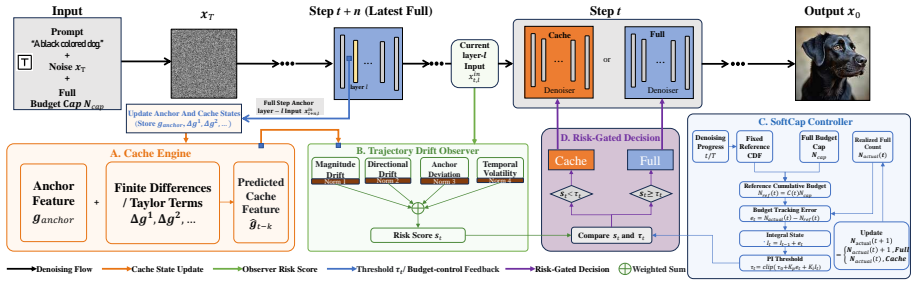
The paper's central claim is that Full/Cache selection can be regulated by separating two questions: whether the current cached trajectory looks risky (a local observer), and how strict acceptance should be under a soft compute ceiling (a global controller). The observer combines four drift cues—magnitude, direction, anchor deviation, and temporal volatility—into a per-step risk score, while the controller converts realized compute relative to a fixed reference profile into a dynamic threshold. The rule is simple: run a full evaluation when the risk score equals or exceeds the threshold. The key empirical assertion is that at matched FLOPs in the middle compute regime, this policy beats a st
What carries the argument
The Trajectory Drift Observer (TDO) is a lightweight per-step risk estimator built from four hidden-state statistics: magnitude drift, directional drift, anchor deviation, and temporal volatility. The Soft-Budget PI Controller integrates budget-tracking error into a clipped proportional-integral threshold, and the Risk-Gated Decision applies a full evaluation exactly when the risk score crosses the threshold. A fixed reference cumulative budget profile distributes the user-supplied cap over denoising progress. Together these components convert a compute cap into adaptive, prompt- and timestep-dependent refresh placement, with calibration performed once and no per-tier tuning.
Load-bearing premise
The load-bearing premise is that the four-cue risk score accurately reflects how much error the cached approximation would introduce for every prompt, seed, and timestep; if that score is not reliably related to true feature error, the gating rule cannot deliver the claimed quality-compute tradeoff.
What would settle it
Take a set of prompts and, at each gated step, measure the actual distance between the cached feature and the true full-computation feature. If the risk score is uncorrelated with that true error, or if many high-error steps never cross the threshold, the central claim fails.
If this is right
- A single calibration transfers across budget tiers: changing the compute cap does not require re-tuning the observer or controller.
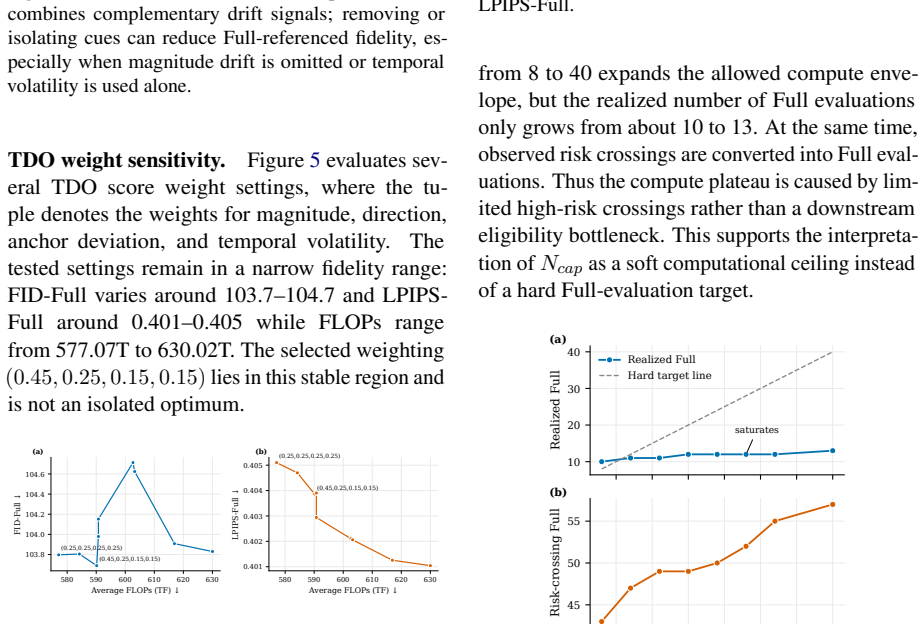
- Raising the compute cap does not automatically spend more compute; realized full-step counts plateau when trajectories remain stable.
- At matched FLOPs in the middle-compute regime, the policy improves semantic preference and fidelity over the strongest caching baseline.
- The control layer is cache-engine agnostic, so it can wrap different feature-caching or forecasting engines without retraining.
- The paper's own limitation notes a gap between actual and target full-step counts, pointing to future adaptive reference profiles for tighter budget alignment.
Where Pith is reading between the lines
- If the drift observer generalizes beyond the tested model, the same soft-budget controller could regulate cache refresh in video diffusion, where per-step costs are higher and budget control matters even more.
- The soft-ceiling property suggests a practical latency contract: a user sets a compute cap and gets bounded cost, with quality degrading only when the trajectory genuinely becomes risky.
- One could test whether the fixed calibration constants transfer across backbone families; if they do, the method becomes a drop-in control layer for any cache engine.
- Combining the observer with token- or layer-wise caching may add finer granularity: it could signal not only when but where a full refresh is needed.
Editorial analysis
A structured set of objections, weighed in public.
Referee Report
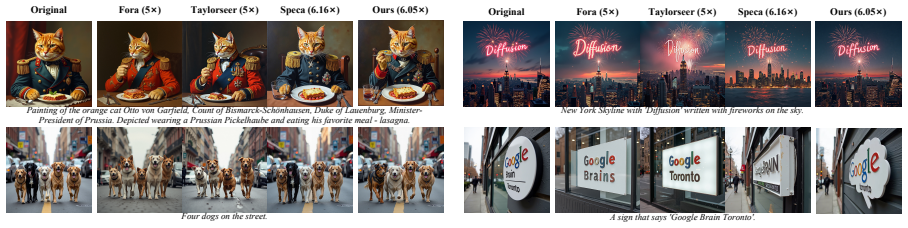
Summary. The manuscript (full text: "SoftCap: Soft-Budget Control for Diffusion Transformer Acceleration") proposes a training-free control layer for cache-based DiT inference. It couples a Trajectory Drift Observer (TDO), which estimates local cache risk from four drift cues (magnitude, direction, anchor deviation, temporal volatility), with a soft-budget PI controller that adjusts the Full-triggering threshold based on realized compute relative to a fixed reference profile C(t). Full evaluations are triggered when the risk score s_t meets or exceeds the threshold τ_t. Experiments on FLUX.1-dev with 200 prompts compare SoftCap against SpeCa, TaylorSeer, and FORA, reporting FLOPs, semantic metrics (ImageReward, CLIPScore), and internal Full-referenced fidelity metrics. The central claims are (i) a matched-compute quality improvement over SpeCa in the middle FLOPs regime (ImageReward 0.967→0.981, LPIPS-Full 0.518→0.498 at near-identical FLOPs) and (ii) that the budget parameter N_cap behaves as a soft ceiling rather than a required spending target.
Significance. The conceptual separation between a local risk observer and a global budget controller is a useful and timely idea for training-free DiT acceleration. The method is training-free, introduces only lightweight tensor statistics, and the paper includes several honest diagnostic ablations (TDO cue ablation, weight sensitivity, monitored-layer sweep, soft-ceiling diagnostic) plus an explicit limitations paragraph. If the TDO risk score is validated and the matched-compute gains are reproducible under proper statistical testing, SoftCap would be a practical plug-in policy layer for cache engines. However, the current empirical support is narrow—one model, 200 prompts, one run per setting—and the risk score itself is never directly validated, so the significance of the headline gains remains uncertain.
major comments (4)
- [§3.4, Eq. (2)] The entire adaptive behavior of SoftCap is mediated by the comparison s_t ≥ τ_t. The TDO is defined through Eqs. (5)–(10), but the paper provides no direct evidence that s_t is monotonically related to the actual error of the cached approximation (e.g., ||h_t − ĥ_t|| or the downstream feature error). The leave-one-out ablations in Figure 4 show each cue contributes, but they do not establish that the combined score is calibrated across timesteps, prompts, seeds, or budget settings. If s_t is not a faithful risk estimate, the PI controller is adjusting a threshold on noise, and the matched-compute gains in Table 1 are unexplained. Please add a direct validation: report correlation/rank correlation between s_t and the true cache error, or a calibration curve, on held-out prompts and seeds.
- [§4.2, Table 1] All results come from a single run on 200 prompts with no error bars, confidence intervals, or paired significance tests. The headline matched-compute improvements are small (ImageReward 0.967→0.981, LPIPS-Full 0.518→0.498). At this scale, differences of this magnitude can easily arise from prompt or seed noise. Please provide multiple seeds (or bootstrap over prompts) and paired tests for the main comparisons. If seed variation is large, the central claim is not supported.
- [Appendix A, Fig. 6; §3.5] The monitored layer is selected from a 50-prompt sweep using the same Full-referenced fidelity metrics as the main evaluation, and the normalization constants/weights are calibrated once. No independent calibration set is described, so the main 200-prompt results may partially reflect selection on the evaluation set. Also, the reference profile C(t) is said to be a lookup table from a fixed-threshold policy, but its construction and sensitivity to the policy used are not specified. Please clarify how C(t) is built, whether it is budget-dependent, and provide a calibration/validation split.
- [Eq. (16); Table 3] The PI controller gains K_p, K_i and clamp bounds (τ_0, τ_min, τ_max, I_min, I_max) are never reported, making the method difficult to reproduce. In addition, the soft-ceiling diagnostic (Table 3) reports only Full counts, not the resulting image quality. The saturation of realized Full counts as N_cap grows could indicate that the score rarely exceeds threshold, but without quality metrics per budget setting it does not demonstrate that the soft ceiling delivers a favorable quality-compute tradeoff. Please report the controller hyperparameters and include quality metrics in the target sweep.
minor comments (5)
- [Title/Abstract] The top abstract describes "BeCARE: Budgeted Cache Refresh" while the full text is titled "SoftCap: Soft-Budget Control," and the two abstracts present different headline numbers (e.g., 2.7 dB PSNR at 3.3× vs. the Table 1 matched-compute gains). This inconsistency must be resolved before publication; I have treated the full text as the paper under review.
- [§3.4] The monitored layer l, the maximum skip distance D_max, and the optional increment gain γ_t are not given numerical values or selection criteria. Please specify these details for reproducibility.
- [§4.1, Table 1] "FID-Full" is easily confused with dataset-level FID. Since these are internal generated-vs-Full metrics, consider renaming to avoid misinterpretation (e.g., "Full-FID" or "Ref-FID").
- [§5] The conclusion contains a capitalization error: "We presented SoftCap" should be "we presented SoftCap." Also, Figure 2 uses inconsistent capitalization ("Speca" vs. "SpeCa").
- [Reproducibility] No code or checkpoint link is provided. Given the number of unspecified hyperparameters, a public implementation would materially strengthen the paper.
Circularity Check
No significant circularity; SoftCap's matched-compute quality gain is an empirical comparison, not forced by construction.
full rationale
SoftCap's central claim—that a risk-gated, PI-thresholded cache policy improves ImageReward/LPIPS at matched compute versus SpeCa—is an empirical result. The decision rule (Eq. 2: Full if s_t >= tau_t) is not a tautology: s_t is a hand-designed heuristic score and tau_t is a controller output; neither is defined as equal to the reported metrics. The reference profile C(t) is a fixed lookup table tabulating a fixed-threshold reference policy, not a parameter fitted to ImageReward or LPIPS. The 'soft ceiling' property follows from the controller design (Ncap only shapes tau_t via N_ref(t)) and is confirmed empirically in Table 3; it is not used to fabricate the quality result. No load-bearing self-citation appears. The self-cited works (Qiu et al., 2025a,c; Liu et al., 2026) are cited as background in Sections 2.2 and give context on cache-error compensation and hybrid-grained caching; they are not invoked to justify the central control design or the evaluation protocol. No uniqueness theorem is imported from prior work by the same authors. Two non-circular risks are worth noting. First, the Trajectory Drift Observer's score s_t is never validated against the true approximation error; if s_t is not monotonically related to actual drift, the risk gate controls a noisy proxy and the Table 1 gains could be benchmark-specific. This is an external-validity/correctness risk, not circularity, because s_t is not constructed from the downstream ImageReward or LPIPS values. Second, the monitored layer is selected from a 50-prompt sweep ('best Full-referenced fidelity... layer 37') and the TDO normalization constants/weights are 'calibrated once' without demonstrating that the calibration set is disjoint from the 200-prompt benchmark; this is a selection/overfitting risk, not a definitional reduction. The Limitations section's admission that 'there can sometimes be a substantial gap between the actual number of Full steps executed and the predefined target budget' further indicates the budget is not a fitted target. Overall, the derivation chain is self-contained and the central comparison is not circular by construction.
Axiom & Free-Parameter Ledger
free parameters (6)
- TDO normalization constants =
(0.5, 0.08, 0.5, 4.0)
- TDO cue weights =
(0.45, 0.25, 0.15, 0.15)
- PI controller gains and clamp bounds =
not reported
- Reference budget profile C(t) =
lookup table from fixed-threshold reference policy
- Monitored layer =
layer 37
- Structural safeguard values =
not reported
axioms (5)
- domain assumption Hidden features evolve smoothly enough for the Taylor cache engine to provide useful approximations.
- domain assumption The four drift cues in TDO are valid proxies for actual approximation error.
- domain assumption Full FLUX outputs are a valid reference for measuring quality.
- domain assumption The 200-prompt FLUX.1-dev benchmark is representative enough to support the matched-compute claim.
- ad hoc to paper A fixed reference profile C(t) built from a fixed-threshold policy transfers across budget tiers and prompts.
read the original abstract
Training-free feature caching accelerates diffusion transformer (DiT) inference by reusing or forecasting intermediate features. However, fixed schedules make compute predictable but ignore prompt- and timestep-dependent risk, whereas hand-tuned error thresholds adapt locally but leave realized compute difficult to control. To address these limitations, we present Budgeted Cache Refresh (BeCARE), a training-free framework that, given a user-specified cap on full computations, adaptively determines when to refresh the cache during accelerated inference. Specifically, we first derive an error-amplification profile from the sampler's noise schedule to characterize the varying impact of approximation errors across denoising timesteps. We then combine this profile with prompt-specific extrapolation residuals and cache age to form an accumulated risk score, triggering a refresh when continued caching becomes harmful. Meanwhile, we use the same profile to construct an analytic spending reference and adjust the refresh threshold through feedback, thereby distributing the limited refresh budget over the sampling trajectory. Finally, structural safeguards (a fixed warmup, a budget-derived late-stage reserve, and a maximum cache-reuse length) prevent unreliable extrapolation and premature budget exhaustion. These designs enable prompt-adaptive refresh placement and allow a single calibration to transfer across budget tiers without per-tier tuning. Experiments on FLUX.1-dev with 200 prompts and measured FLOPs show that our method consistently outperforms representative training-free caching baselines across speedups from 3x to 6x. At the main operating point (3.3x acceleration), it improves paired PSNR by 2.7 dB over the strongest baseline using no more compute. On SD3.5 Large, it also substantially improves the same Taylor cache engine over fixed-interval scheduling at matched compute.
Figures

Forward citations
Cited by 1 Pith paper
-
OmniCache: Multidimensional Hierarchical Feature Caching For Diffusion Models
Training-free hierarchical feature caching across token, frame, block, and layer axes cuts diffusion inference latency up to 35% while preserving quality better than averaging-based token merging.
Reference graph
Works this paper leans on
-
[2]
Predict to skip: Linear multistep feature forecasting for efficient diffusion transform- ers.arXiv preprint arXiv:2602.18093. Feng Liu, Shiwei Zhang, Xiaofeng Wang, Yujie Wei, Haonan Qiu, Yuzhong Zhao, Yingya Zhang, Qixi- ang Ye, and Fang Wan. 2025a. Timestep embedding tells: It’s time to cache for video diffusion model. InProceedings of the Computer Visi...
-
[5]
Relational feature caching for accelerating diffusion transformers.arXiv preprint arXiv:2602.19506. Shikang Zheng, Liang Feng, Xinyu Wang, Qinming Zhou, Peiliang Cai, Chang Zou, Jiacheng Liu, Yuqi Lin, Junjie Chen, Yue Ma, and 1 others
-
[6]
Chang Zou, Xuyang Liu, Ting Liu, Siteng Huang, and Linfeng Zhang
Tap: A token-adaptive predictor framework for training-free diffusion acceleration.arXiv preprint arXiv:2603.03792. Chang Zou, Xuyang Liu, Ting Liu, Siteng Huang, and Linfeng Zhang
-
[7]
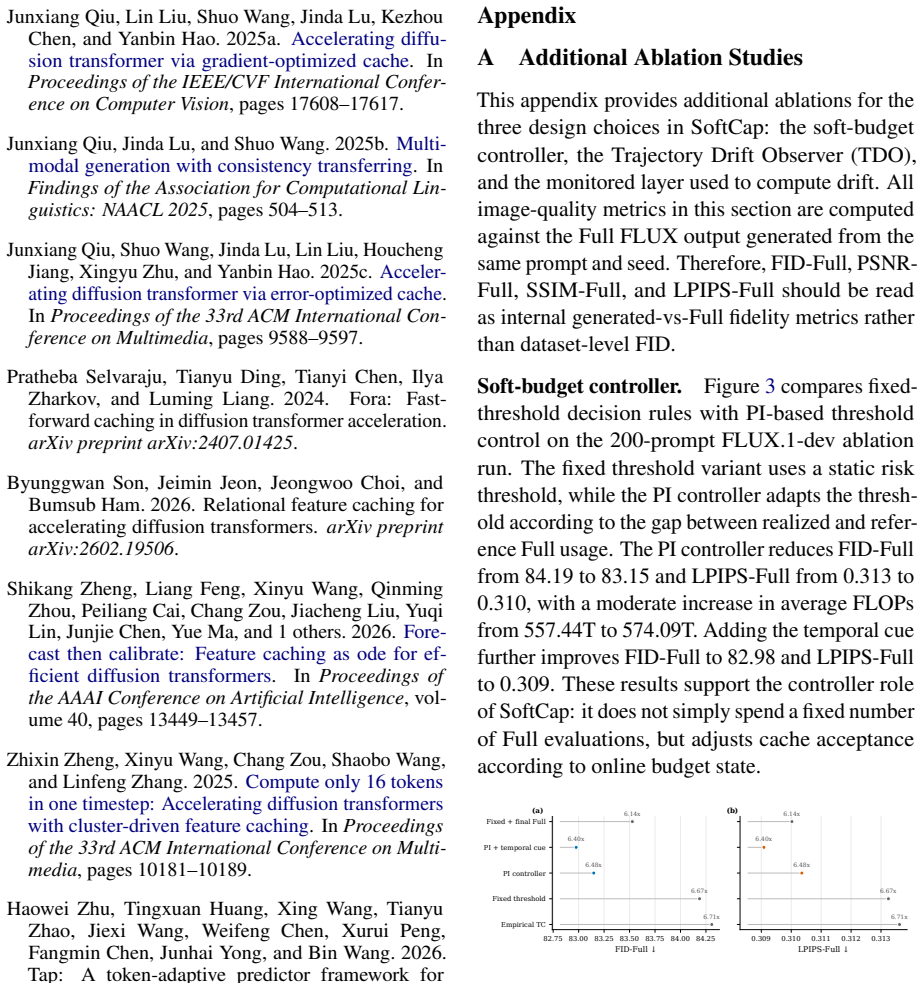
Accelerating diffusion trans- formers with token-wise feature caching.arXiv preprint arXiv:2410.05317. Appendix A Additional Ablation Studies This appendix provides additional ablations for the three design choices in SoftCap: the soft-budget controller, the Trajectory Drift Observer (TDO), and the monitored layer used to compute drift. All image-quality ...
-
[2023]
InProceedings of the IEEE/CVF international conference on computer vision, pages 4195–4205
Scalable dif- fusion models with transformers. InProceedings of the IEEE/CVF international conference on computer vision, pages 4195–4205. Junxiang Qiu, Lin Liu, Shuo Wang, Jinda Lu, Kezhou Chen, and Yanbin Hao. 2025a. Accelerating diffu- sion transformer via gradient-optimized cache. In Proceedings of the IEEE/CVF International Confer- ence on Computer V...
2025
-
[2024]
arXiv preprint arXiv:2407.01425
Fora: Fast- forward caching in diffusion transformer acceleration. arXiv preprint arXiv:2407.01425. Byunggwan Son, Jeimin Jeon, Jeongwoo Choi, and Bumsub Ham
-
[2026]
Hanshuai Cui, Zhiqing Tang, Qianli Ma, Zhi Yao, and Weijia Jia
Forecast the principal, stabi- lize the residual: Subspace-aware feature caching for efficient diffusion transformers.arXiv preprint arXiv:2601.07396. Hanshuai Cui, Zhiqing Tang, Qianli Ma, Zhi Yao, and Weijia Jia
discussion (0)
Sign in with ORCID, Apple, or X to comment. Anyone can read and Pith papers without signing in.