When the Ringing Stops: Purely Imaginary Modes in the Ringdown Spectrum of Dynamical Black Holes
Pith reviewed 2026-06-29 10:23 UTC · model grok-4.3
The pith
Dynamical black holes with constant mass growth host purely imaginary quasinormal modes that dominate late-time decay.
A machine-rendered reading of the paper's core claim, the machinery that carries it, and where it could break.
Core claim
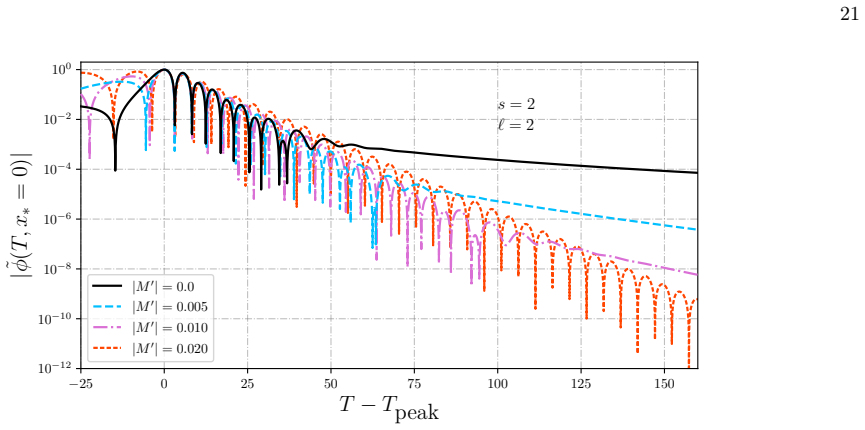
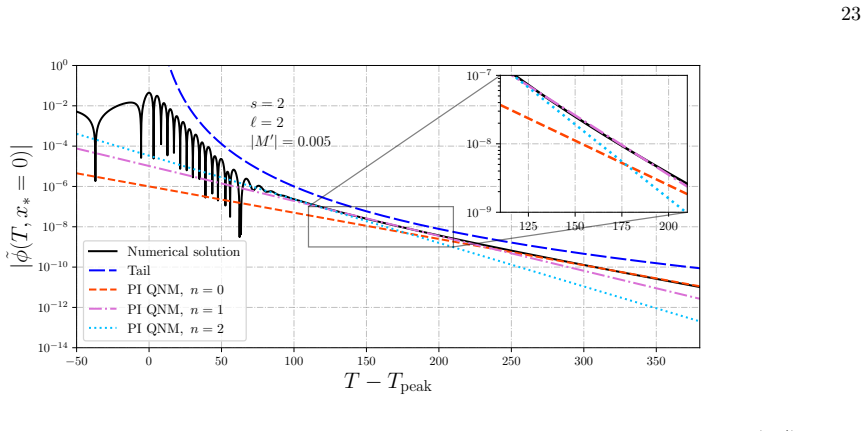
In a dynamical spherically symmetric black hole spacetime undergoing constant-rate mass evolution, the quasinormal mode spectrum contains purely imaginary eigenvalues alongside the usual light-ring modes. These imaginary modes are computed analytically from connection coefficients of Heun functions and numerically via a spectral method on hyperboloidal slices, with both approaches in excellent agreement. Time-domain simulations independently confirm that the imaginary modes control the late-time signal through exponentially decaying tails. When the mass evolution rate approaches zero, the same modes reduce to the familiar Schwarzschild power-law tail.
What carries the argument
Purely imaginary quasinormal modes whose frequencies are determined by the constant mass accretion rate, obtained from Heun connection coefficients and validated on hyperboloidal slices.
If this is right
- Late-time ringdown in accreting black holes follows exponential rather than power-law decay.
- The imaginary modes remain present and dominant for any nonzero constant accretion rate.
- Both frequency-domain (Heun and spectral) and time-domain calculations must agree on the same imaginary frequencies.
- The Schwarzschild power-law tail emerges as a continuous limit of these exponential tails when accretion ceases.
Where Pith is reading between the lines
- Gravitational-wave ringdown templates for accreting systems may need to incorporate these exponential tails instead of power-law assumptions.
- The result suggests a unified description of tails across static and slowly evolving black holes that could be tested in numerical simulations with controlled mass growth.
- If the constant-rate assumption is relaxed to more realistic accretion profiles, the imaginary modes may shift or acquire small real parts.
Load-bearing premise
The spacetime remains spherically symmetric while the black hole mass grows at a strictly constant rate.
What would settle it
A time-domain evolution of the same constant-rate accretion spacetime that shows late-time decay neither exponential nor matching the predicted imaginary frequencies would falsify the claim.
Figures
read the original abstract
We extend the frequency-domain analysis of quasinormal modes in a dynamical, spherically symmetric black hole spacetime undergoing constant-rate mass evolution. In particular, we report a novel feature of the spectrum: the presence of purely imaginary eigenvalues in addition to the usual light-ring modes. We study the frequencies of these modes both analytically and numerically. The analytical calculation uses a novel formalism based on recent advances in connection coefficients of Heun functions. We then compute the frequencies numerically using a spectral method on hyperboloidal slices and find excellent agreement between the two approaches. Finally, we validate the frequency-domain results against an independent set of time-domain simulations. Our analysis shows that the purely imaginary modes govern the late-time signal through exponentially decaying tails. In the Schwarzschild limit, both frequency- and time-domain studies consistently show that the purely imaginary modes give rise to the familiar Schwarzschild power-law tail.
Editorial analysis
A structured set of objections, weighed in public.
Referee Report
Summary. The manuscript extends frequency-domain quasinormal-mode analysis to a dynamical, spherically symmetric black-hole spacetime with constant-rate mass evolution. It reports the existence of purely imaginary eigenvalues in addition to the usual light-ring modes, obtained analytically via a novel Heun connection-coefficient formalism and numerically via a hyperboloidal spectral method; these are validated against independent time-domain simulations. The purely imaginary modes are claimed to control the late-time signal via exponentially decaying tails, reducing in the Schwarzschild limit to the familiar power-law tail.
Significance. If the eigenvalue problem is well-posed, the result supplies a spectral interpretation of late-time tails in evolving spacetimes and demonstrates consistency across analytic, frequency-domain numeric, and time-domain methods. The use of hyperboloidal slices and Heun connection coefficients for an explicitly time-dependent background constitutes a technical advance worth documenting.
major comments (2)
- The central claim rests on the existence of discrete, purely imaginary eigenvalues of a spatial operator obtained after separation of variables. For a metric whose coefficients vary explicitly with t under constant-rate mass evolution, the perturbation equation generally retains residual time dependence; the manuscript must demonstrate (via coordinate transformation, self-similar ansatz, or explicit reduction) that the spatial operator is nevertheless time-independent before the reported eigenvalues can be interpreted as modes of the dynamical system.
- The validation against time-domain simulations is presented as confirming that the purely imaginary modes govern the late-time tails. Without quantitative measures (e.g., overlap integrals, decay-rate comparisons, or residual norms) between the predicted exponential decay and the simulated late-time signal, it is unclear whether the agreement is sufficient to support the claim that these modes, rather than other contributions, dominate the tail.
minor comments (1)
- Notation for the mass-evolution parameter and the precise form of the background metric should be stated once in a dedicated section or table for reproducibility.
Simulated Author's Rebuttal
We thank the referee for the careful reading and constructive feedback on our manuscript. We address each major comment below and outline the revisions we will make.
read point-by-point responses
-
Referee: The central claim rests on the existence of discrete, purely imaginary eigenvalues of a spatial operator obtained after separation of variables. For a metric whose coefficients vary explicitly with t under constant-rate mass evolution, the perturbation equation generally retains residual time dependence; the manuscript must demonstrate (via coordinate transformation, self-similar ansatz, or explicit reduction) that the spatial operator is nevertheless time-independent before the reported eigenvalues can be interpreted as modes of the dynamical system.
Authors: We agree that an explicit demonstration is required. In Section II we introduce a self-similar coordinate transformation (Eqs. (8)–(10)) that removes the explicit time dependence from the wave equation, yielding a time-independent spatial operator whose eigenvalues are the reported modes. The reduction is performed before separation of variables. To address the referee’s concern we will add a dedicated subsection (II.C) that walks through the coordinate change step by step and verifies that no residual t dependence remains in the spatial operator. revision: yes
-
Referee: The validation against time-domain simulations is presented as confirming that the purely imaginary modes govern the late-time tails. Without quantitative measures (e.g., overlap integrals, decay-rate comparisons, or residual norms) between the predicted exponential decay and the simulated late-time signal, it is unclear whether the agreement is sufficient to support the claim that these modes, rather than other contributions, dominate the tail.
Authors: We acknowledge that the current comparison is primarily visual. In the revised manuscript we will add quantitative diagnostics: (i) overlap integrals between the predicted exponential tail and the late-time numerical waveform, (ii) direct comparison of the extracted decay rates with the imaginary parts of the computed eigenvalues, and (iii) residual norms after subtracting the predicted tail. These will be included in a new panel of Figure 5 and tabulated in Section IV. revision: yes
Circularity Check
Derivation chain self-contained; no reduction of results to inputs by construction
full rationale
The paper reports purely imaginary modes via an analytical Heun connection-coefficient formalism, a hyperboloidal spectral method, and independent time-domain simulations, with explicit cross-validation between frequency- and time-domain results. No step equates a claimed prediction or eigenvalue to a fitted parameter, self-referential definition, or load-bearing self-citation whose content is unverified. The constant-rate mass evolution model is stated as an assumption, and the separation into modes is justified within that model rather than smuggled in via prior self-citation. The central claim therefore retains independent content from the three distinct computational approaches.
Axiom & Free-Parameter Ledger
Forward citations
Cited by 1 Pith paper
-
Relaxation without ringdown for a compact object in modified gravity
A vector-supported compact object in modified gravity relaxes dissipatively without oscillatory ringdown because a hidden chiral symmetry converts perturbations into one-way transport.
Reference graph
Works this paper leans on
-
[1]
So let us introduce a parameterε=x A −x H such thatε→0as|M ′| →1/16
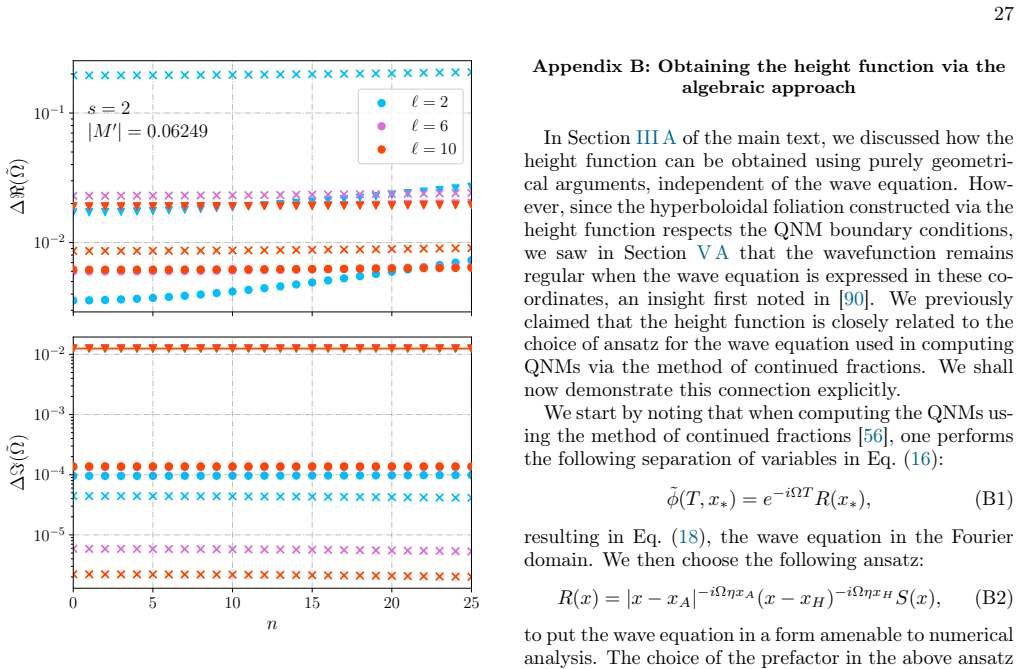
Nearly-extremal limit of the SR metric Thenearlyextremallimitcorrespondstothecasewhen the two horizons are very close to each other, that is, when|M ′| →1/16butM 0 ̸= 0. So let us introduce a parameterε=x A −x H such thatε→0as|M ′| →1/16. Then in the nearly extremal limit, we can rewrite Eq. (8) as d˜s2 = 8 " −σ(1−σ)d ˜T 2 + dσ2 σ(1−σ) # + 4dΩ2 S2 (A1) In...
-
[2]
(20) and Eq
Analytic solution As pointed out in Sec II, gravitational axial and scalar QNMs in the Nariai regime are typically affected by in- stabilities, respectively in the mass-accreting and mass- radiating case, once the physical perturbation frequency is reconstructed via Eq. (20) and Eq. (21). With this in mind, we will however focus here on the static QNM fre...
-
[3]
To establish this, we had introduced a parame- terε=x A −x H to keep track of the separation between 26 the two horizons which were kept fixed atσH = 1and σA = 0
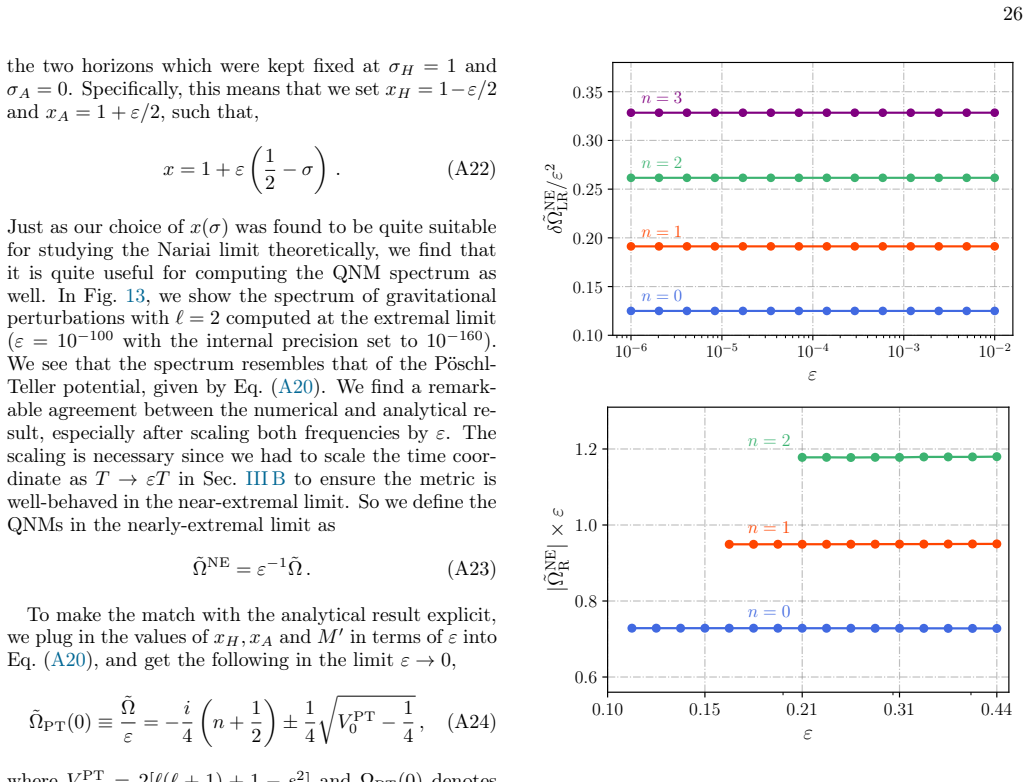
Numerical solution In this appendix, we have shown that in the nearly- extremal limit, the spacetime resembled a Nariai-like ge- ometry. To establish this, we had introduced a parame- terε=x A −x H to keep track of the separation between 26 the two horizons which were kept fixed atσH = 1and σA = 0. Specifically, this means that we setxH = 1−ε/2 andx A = 1...
-
[4]
Weak Accretion/Radiation Limit As explained in section IV, in the small M ′ limit the QNMs are computed as a series in M ′ ˜Ω = X k≥1 ˜Ω(k) M ′ k .(E1) Here we show the first few terms in the series: ˜Ω(1) =−2i(n+ℓ+ 1), ˜Ω(2) =−4i (ℓ−n)(2ℓ+ 1)−2s 2 2ℓ+ 1 , ˜Ω(3) =− 8i (1 + 2ℓ)3 h (1 + 2ℓ)2(9ℓ2 + 7ℓ+ 2 + 3n2 −6s 2) +n(1 + 2ℓ)(1−2ℓ−8ℓ 2)−4s 4 i , ˜Ω(4) =− 1...
-
[5]
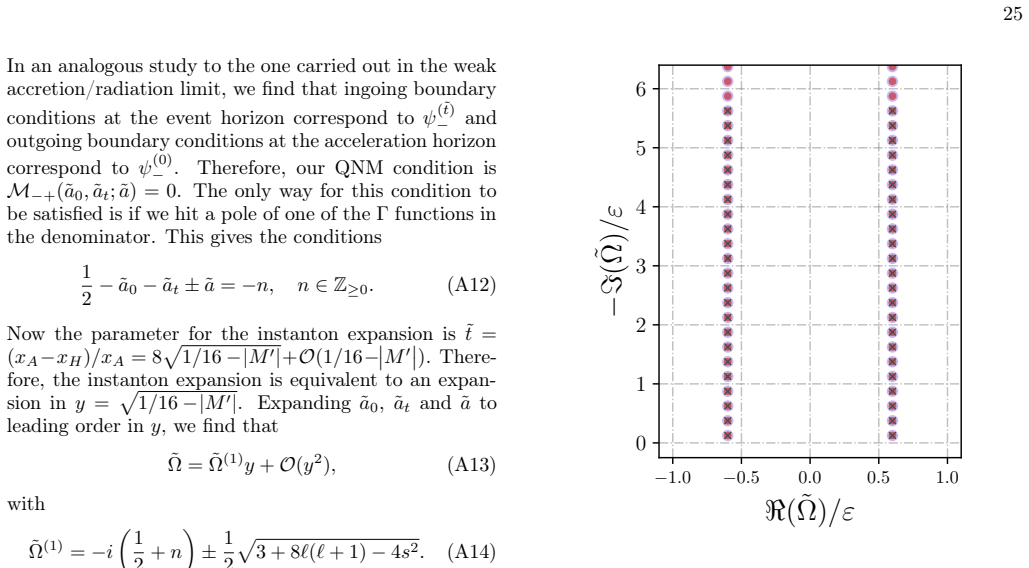
Strong Accretion/Radiation Limit In a similar fashion, in appendix A2 we explained how in the M ′ →1/16limit the QNMs are computed as a series iny= p 1/16−|M ′| ˜Ω = X k≥1 ˜Ω(k)yk.(E3) 30 Here we show the first terms of the series: ˜Ω(1) =−i 1 2 +n ± 1 2 p 3 + 8ℓ(ℓ+ 1)−4s 2, ˜Ω(2) =±4 1 + 2ℓ(ℓ+ 1)−s 2 p 3 + 8ℓ(ℓ+ 1)−4s 2 , ˜Ω(3) =∓ 16 (1 + 2ℓ+ 2ℓ2)2 +n(1 ...
-
[6]
We also mentioned that we had adopted a method to filter spurious eigenvalues and estimate the accuracy of the re- sults
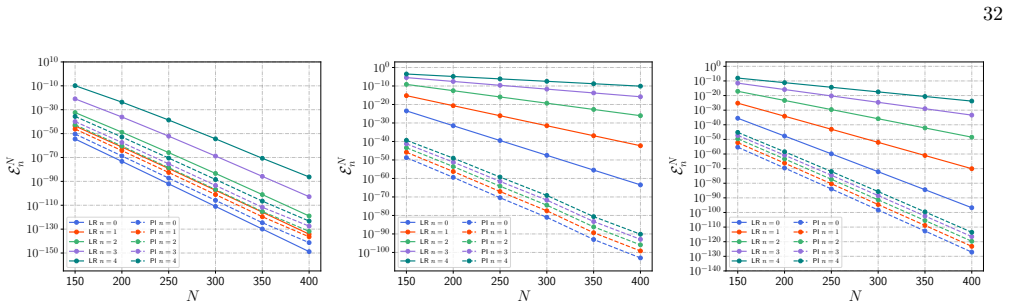
Frequency domain In Section VC, we presented the numerical results of our computation of the QNMs in the hyperboloidal framework using the Chebyshev spectral method. We also mentioned that we had adopted a method to filter spurious eigenvalues and estimate the accuracy of the re- sults. However, in order to establish the exponential con- vergence of the Q...
-
[7]
We set|M ′|= 0.01and consider the grav- itational quadrupole case
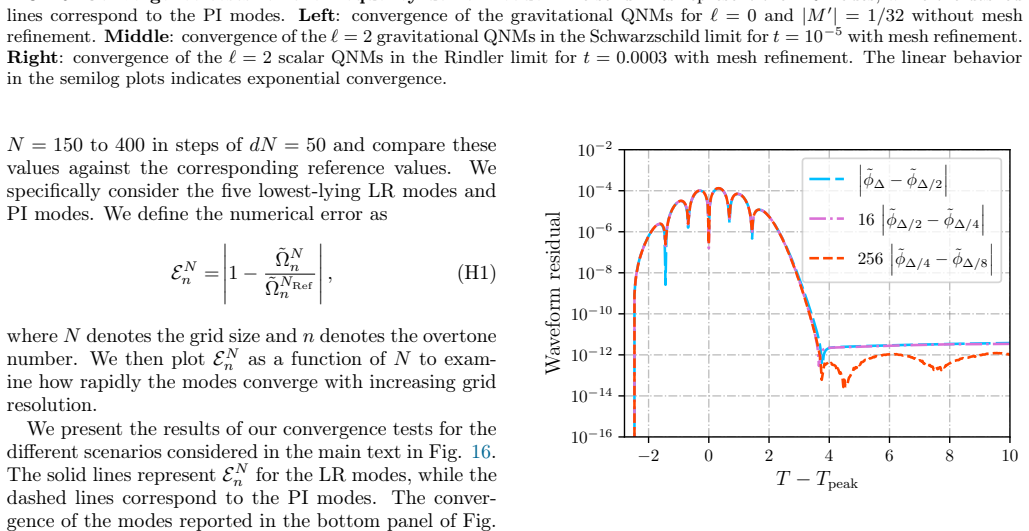
Time domain To verify the numerical accuracy of our time-domain solver, we performed a convergence test using four dif- ferent resolutions, i.e.∆,∆/2,∆/4and∆/8, with ∆ = 0.25. We set|M ′|= 0.01and consider the grav- itational quadrupole case. For each resolution, we ex- tract the waveform at a fixed observer location. We −2 0 2 4 6 8 10 T − Tpeak 10−16 10...
-
[8]
GWTC-3: Compact Binary Coales- cences Observed by LIGO and Virgo during the Second PartoftheThirdObservingRun,
R. Abbottet al., “GWTC-3: Compact Binary Coales- cences Observed by LIGO and Virgo during the Second PartoftheThirdObservingRun,”Phys. Rev. X,vol.13, no. 4, p. 041039, 2023
2023
-
[9]
Tests of General Relativity with GWTC-3,
R. Abbottet al., “Tests of General Relativity with GWTC-3,”Phys. Rev. D, vol. 112, no. 8, p. 084080, 2025
2025
-
[10]
Stability of a Schwarzschild singularity,
T. Regge and J. A. Wheeler, “Stability of a Schwarzschild singularity,”Phys. Rev., vol. 108, pp. 1063–1069, 1957
1957
-
[11]
Effective potential for even parity Regge- Wheeler gravitational perturbation equations,
F. J. Zerilli, “Effective potential for even parity Regge- Wheeler gravitational perturbation equations,”Phys. Rev. Lett., vol. 24, pp. 737–738, 1970
1970
-
[12]
Scattering of Gravitational Radi- ation by a Schwarzschild Black-hole,
C. V. Vishveshwara, “Scattering of Gravitational Radi- ation by a Schwarzschild Black-hole,”Nature (London), vol. 227, pp. 936–938, Aug. 1970
1970
-
[13]
The quasi-normal modes of the Schwarzschild black hole,
S. Chandrasekhar and S. Detweiler, “The quasi-normal modes of the Schwarzschild black hole,”Proceedings of the Royal Society of London. Series A, Mathematical and Physical Sciences, vol. 344, no. 1639, pp. 441–452, 1975
1975
-
[14]
Collision of two black holes,
P. Anninos, D. Hobill, E. Seidel, L. Smarr, and W.-M. Suen, “Collision of two black holes,”Physical Review Letters, vol. 71, p. 2851–2854, Nov. 1993
1993
-
[15]
TOPICAL REVIEW: Quasinormal modes: the characteristic ‘sound’ of black holes and neutron stars,
H.-P. Nollert, “TOPICAL REVIEW: Quasinormal modes: the characteristic ‘sound’ of black holes and neutron stars,”Class. Quant. Grav., vol. 16, pp. R159– R216, 1999
1999
-
[16]
Quasinormal modes of stars and black holes,
K. D. Kokkotas and B. G. Schmidt, “Quasinormal modes of stars and black holes,”Living Rev. Rel., vol. 2, p. 2, 1999
1999
-
[17]
Quasinormal modes of black holes and black branes,
E.Berti, V.Cardoso, andA.O.Starinets, “Quasinormal modes of black holes and black branes,”Class. Quant. Grav., vol. 26, p. 163001, 2009
2009
-
[18]
Quasinormal modes of black holes: From astrophysics to string theory,
R. A. Konoplya and A. Zhidenko, “Quasinormal modes of black holes: From astrophysics to string theory,”Re- views of Modern Physics, vol. 83, p. 793–836, July 2011
2011
-
[19]
Black hole spectroscopy: from theory to experiment,
E. Bertiet al., “Black hole spectroscopy: from theory to experiment,”arXiv, 5 2025
2025
-
[20]
Cardoso, S
V. Cardoso, S. Biswas, and S. Sarkar,The Physics of Black Holes and Their Environments: Consequences for Gravitational Wave Science. arXiv, 11 2025
2025
-
[21]
Nonspherical perturbations of relativistic gravitational collapse. i. scalar and gravitational per- turbations,
R. H. Price, “Nonspherical perturbations of relativistic gravitational collapse. i. scalar and gravitational per- turbations,”Phys. Rev. D, vol. 5, pp. 2419–2438, May 1972
1972
-
[22]
Radiation damping in a gravitational field,
B. S. DeWitt and R. W. Brehme, “Radiation damping in a gravitational field,”Annals Phys., vol. 9, pp. 220– 259, 1960
1960
-
[23]
Merging black holes with Cauchy-characteristic matching: Computa- tion of late-time tails,
S. Ma, M. A. Scheel, J. Moxon, K. C. Nelli, N. Deppe, L. E. Kidder, W. Throwe, and N. L. Vu, “Merging black holes with Cauchy-characteristic matching: Computa- tion of late-time tails,”arXiv, 12 2024
2024
-
[24]
Late-time tails in nonlinear evo- lutions of merging black holes,
M. De Amiciset al., “Late-time tails in nonlinear evo- lutions of merging black holes,”arXiv, 12 2024
2024
-
[25]
On choosing the start time of binary black hole ringdowns,
S. Bhagwat, M. Okounkova, S. W. Ballmer, D. A. Brown, M. Giesler, M. A. Scheel, and S. A. Teukol- sky, “On choosing the start time of binary black hole ringdowns,”Phys. Rev. D, vol. 97, no. 10, p. 104065, 2018
2018
-
[26]
Revisiting non-linearity in binary black hole mergers,
M. Okounkova, “Revisiting non-linearity in binary black hole mergers,”arXiv, 4 2020
2020
-
[27]
Quasinormal-mode filters: A new approach to ana- lyze the gravitational-wave ringdown of binary black- hole mergers,
S. Ma, K. Mitman, L. Sun, N. Deppe, F. Hébert, L. E. Kidder, J. Moxon, W. Throwe, N. L. Vu, and Y. Chen, “Quasinormal-mode filters: A new approach to ana- lyze the gravitational-wave ringdown of binary black- hole mergers,”Phys. Rev. D, vol. 106, no. 8, p. 084036, 2022
2022
-
[28]
Modelingring- down: Beyond the fundamental quasinormal modes,
L.London, D.Shoemaker, andJ.Healy, “Modelingring- down: Beyond the fundamental quasinormal modes,” Phys. Rev. D, vol. 90, no. 12, p. 124032, 2014. [Erra- tum: Phys.Rev.D 94, 069902 (2016)]
2014
-
[29]
Nonlinear Effects in Black Hole Ringdown,
M. H.-Y. Cheunget al., “Nonlinear Effects in Black Hole Ringdown,”Phys. Rev. Lett., vol. 130, no. 8, p. 081401, 2023
2023
-
[30]
Nonlinearities in Black Hole Ring- downs,
K. Mitmanet al., “Nonlinearities in Black Hole Ring- downs,”Phys. Rev. Lett., vol. 130, no. 8, p. 081402, 2023
2023
-
[31]
Nonlinear Ringdown at the Black Hole Horizon,
N. Khera, A. Ribes Metidieri, B. Bonga, X. Jiménez Forteza, B. Krishnan, E. Poisson, D. Pook- Kolb, E. Schnetter, and H. Yang, “Nonlinear Ringdown at the Black Hole Horizon,”Phys. Rev. Lett., vol. 131, no. 23, p. 231401, 2023
2023
-
[32]
Nonlinear Effects In Black Hole Ring- down From Scattering Experiments I: spin and initial data dependence of quadratic mode coupling,
H. Zhuet al., “Nonlinear Effects In Black Hole Ring- down From Scattering Experiments I: spin and initial data dependence of quadratic mode coupling,”arXiv, 1 2024
2024
-
[33]
Spin dependence of black hole ring- down nonlinearities,
J. Redondo-Yuste, G. Carullo, J. L. Ripley, E. Berti, and V. Cardoso, “Spin dependence of black hole ring- down nonlinearities,”arXiv, 8 2023
2023
-
[34]
Nonlinear quasi-normal modes: uniform approxima- tion,
B. Bucciotti, A. Kuntz, F. Serra, and E. Trincherini, “Nonlinear quasi-normal modes: uniform approxima- tion,”JHEP, vol. 12, p. 048, 2023
2023
-
[35]
Amplitudes and polarizations of quadratic quasi- normal modes for a Schwarzschild black hole,
B. Bucciotti, L. Juliano, A. Kuntz, and E. Trincherini, “Amplitudes and polarizations of quadratic quasi- normal modes for a Schwarzschild black hole,”JHEP, vol. 09, p. 119, 2024
2024
-
[36]
Quadratic quasinormal modes of a Schwarzschild black hole,
B. Bucciotti, L. Juliano, A. Kuntz, and E. Trincherini, “Quadratic quasinormal modes of a Schwarzschild black hole,”Phys. Rev. D, vol. 110, no. 10, p. 104048, 2024. 34
2024
-
[37]
Ringdown nonlinearities in the eikonal regime,
B. Bucciotti, V. Cardoso, A. Kuntz, D. Pereñiguez, and J. Redondo-Yuste, “Ringdown nonlinearities in the eikonal regime,”arXiv, 1 2025
2025
-
[38]
Excitation of quadratic quasinor- mal modes for Kerr black holes,
S. Ma and H. Yang, “Excitation of quadratic quasinor- mal modes for Kerr black holes,”Phys. Rev. D, vol. 109, no. 10, p. 104070, 2024
2024
-
[39]
Quadratic Mode Cou- plings in Rotating Black Holes and Their Detectability,
N. Khera, S. Ma, and H. Yang, “Quadratic Mode Cou- plings in Rotating Black Holes and Their Detectability,” arXiv, 10 2024
2024
-
[40]
Newtonian time in general relativity,
P. C. Vaidya, “Newtonian time in general relativity,” Nature, vol. 171, no. 4348, pp. 260–261, 1953
1953
-
[41]
The external field of a radiating star in general relativity,
P. C. Vaidya, “The external field of a radiating star in general relativity,”Current Science, vol. 12, pp. 183– 184, 1943
1943
-
[42]
The gravitational field of a radiating star,
P. C. Vaidya, “The gravitational field of a radiating star,”Proceedings of the Indian Academy of Sciences, Section A, vol. 33, no. 5, pp. 264–276, 1951
1951
-
[43]
The external field of a radiating star in general relativity,
P. C. Vaidya, “The external field of a radiating star in general relativity,”General Relativity and Gravitation, vol. 31, no. 1, pp. 119–120, 1999. Reprint of the 1943 Current Science paper
1999
-
[44]
The gravitational field of a radiating star,
P. C. Vaidya, “The gravitational field of a radiating star,”General Relativity and Gravitation, vol. 31, no. 1, pp. 119–135, 1999. Reprint of the 1951 paper
1999
-
[45]
Nonstatic solutions of einstein’s field equations for spheres of fluids radiating energy,
P. C. Vaidya, “Nonstatic solutions of einstein’s field equations for spheres of fluids radiating energy,”Phys. Rev., vol. 83, pp. 10–17, Jul 1951
1951
-
[46]
Vaidya’s radiating Schwarzschild metric,
R. W. Lindquist, R. A. Schwartz, and C. W. Misner, “Vaidya’s radiating Schwarzschild metric,”Phys. Rev., vol. 137, pp. B1364–B1368, Mar 1965
1965
-
[47]
Generating dynamical black hole solutions,
D. Kothawala and S. G. Ghosh, “Generating dynamical black hole solutions,”Phys. Rev. D, vol. 70, p. 104010, 2004
2004
-
[48]
Accretion discs in astrophysics,
J. E. Pringle, “Accretion discs in astrophysics,”Ann. Rev. Astron. Astrophys., vol. 19, pp. 137–160, 1981
1981
-
[49]
Black hole explosions,
S. W. Hawking, “Black hole explosions,”Nature, vol. 248, pp. 30–31, 1974
1974
-
[50]
Particle Creation by Black Holes,
S. W. Hawking, “Particle Creation by Black Holes,” Commun. Math. Phys., vol. 43, pp. 199–220, 1975. [Er- ratum: Commun.Math.Phys. 46, 206 (1976)]
1975
-
[51]
Particle Emission Rates from a Black Hole: Massless Particles from an Uncharged, Nonrotat- ing Hole,
D. N. Page, “Particle Emission Rates from a Black Hole: Massless Particles from an Uncharged, Nonrotat- ing Hole,”Phys. Rev. D, vol. 13, pp. 198–206, 1976
1976
-
[52]
Superradiance: New Frontiers in Black Hole Physics,
R. Brito, V. Cardoso, and P. Pani, “Superradiance: New Frontiers in Black Hole Physics,”Lect. Notes Phys., vol. 906, pp. pp.1–237, 2015
2015
-
[53]
A bound on energy extraction (and hairiness) from super- radiance,
C. A. R. Herdeiro, E. Radu, and N. M. Santos, “A bound on energy extraction (and hairiness) from super- radiance,”Phys. Lett. B, vol. 824, p. 136835, 2022
2022
-
[54]
Extraction of rotational energy from a black hole,
R. Penrose and R. M. Floyd, “Extraction of rotational energy from a black hole,”Nature, vol. 229, pp. 177–179, 1971
1971
-
[55]
The Four laws of black hole mechanics,
J. M. Bardeen, B. Carter, and S. W. Hawking, “The Four laws of black hole mechanics,”Commun. Math. Phys., vol. 31, pp. 161–170, 1973
1973
-
[56]
Black holes and entropy,
J. D. Bekenstein, “Black holes and entropy,”Phys. Rev. D, vol. 7, pp. 2333–2346, 1973
1973
-
[57]
Gener- alized second law and phantom cosmology: Accreting black holes,
J. A. de Freitas Pacheco and J. E. Horvath, “Gener- alized second law and phantom cosmology: Accreting black holes,”Class. Quant. Grav., vol. 24, pp. 5427– 5434, 2007
2007
-
[58]
Radiating black hole solutions in arbitrary dimensions,
S. G. Ghosh and D. Kothawala, “Radiating black hole solutions in arbitrary dimensions,”Gen. Rel. Grav., vol. 40, pp. 9–21, 2008
2008
-
[59]
Phantom accretion by black holes and the generalized second law of thermodynamics,
J. Lima, S. Pereira, J. Horvath, and D. C. Guariento, “Phantom accretion by black holes and the generalized second law of thermodynamics,”Astroparticle Physics, vol. 33, p. 292–295, June 2010
2010
-
[60]
Ringdown of a dynamical spacetime,
J. Redondo-Yuste, D. Pereñiguez, and V. Cardoso, “Ringdown of a dynamical spacetime,”Phys. Rev. D, vol. 109, no. 4, p. 044048, 2024
2024
-
[61]
Nonlinear effects in the black hole ringdown: Absorption-induced mode excitation,
L. Sberna, P. Bosch, W. E. East, S. R. Green, and L. Lehner, “Nonlinear effects in the black hole ringdown: Absorption-induced mode excitation,”Phys. Rev. D, vol. 105, p. 064046, Mar 2022
2022
-
[62]
Ringdown of a dynamical spacetime,
J. Redondo-Yuste, D. Pereñiguez, and V. Cardoso, “Ringdown of a dynamical spacetime,”Phys. Rev. D, vol. 109, p. 044048, Feb 2024
2024
-
[63]
Perturba- tions of the Vaidya metric in the frequency domain: Quasinormal modes and tidal response,
L. Capuano, L. Santoni, and E. Barausse, “Perturba- tions of the Vaidya metric in the frequency domain: Quasinormal modes and tidal response,”Phys. Rev. D, vol. 110, no. 8, p. 084081, 2024
2024
-
[64]
Under- standing photon sphere and black hole shadow in dy- namically evolving spacetimes,
A. K. Mishra, S. Chakraborty, and S. Sarkar, “Under- standing photon sphere and black hole shadow in dy- namically evolving spacetimes,”Phys. Rev. D, vol. 99, no. 10, p. 104080, 2019
2019
-
[65]
Can we detect a supertranslated black hole?,
S. Sarkar, S. Kumar, and S. Bhattacharjee, “Can we detect a supertranslated black hole?,”Phys. Rev. D, vol. 105, no. 8, p. 084001, 2022
2022
-
[66]
Photon sphere and shadow of a time-dependent black hole described by a Vaidya metric,
J. Solanki and V. Perlick, “Photon sphere and shadow of a time-dependent black hole described by a Vaidya metric,”Phys. Rev. D, vol. 105, no. 6, p. 064056, 2022
2022
-
[67]
Dynamical photon sphere and time evolving shadow around black holes with temporal accretion,
Y. Koga, N. Asaka, M. Kimura, and K. Okabayashi, “Dynamical photon sphere and time evolving shadow around black holes with temporal accretion,”Phys. Rev. D, vol. 105, no. 10, p. 104040, 2022
2022
-
[68]
Geodesic stability, Lyapunov exponents and quasinormal modes,
V. Cardoso, A. S. Miranda, E. Berti, H. Witek, and V. T. Zanchin, “Geodesic stability, Lyapunov exponents and quasinormal modes,”Phys. Rev. D, vol. 79, no. 6, p. 064016, 2009
2009
-
[69]
Dila- ton gravity in two-dimensions,
D.Grumiller, W.Kummer, andD.V.Vassilevich, “Dila- ton gravity in two-dimensions,”Phys. Rept., vol. 369, pp. 327–430, 2002
2002
-
[70]
Model for gravity at large distances,
D. Grumiller, “Model for gravity at large distances,” Phys. Rev. Lett., vol. 105, p. 211303, 2010. [Erratum: Phys.Rev.Lett. 106, 039901 (2011)]
2010
-
[71]
Spacetime structure near generic horizons and soft hair,
D. Grumiller, A. Pérez, M. M. Sheikh-Jabbari, R. Tron- coso, and C. Zwikel, “Spacetime structure near generic horizons and soft hair,”Phys. Rev. Lett., vol. 124, no. 4, p. 041601, 2020
2020
-
[72]
Rindler-type geometry inside a black hole,
H. Culetu, “Rindler-type geometry inside a black hole,” Phys. Lett. A, vol. 376, pp. 2817–2821, 2012
2012
-
[73]
Conformal gravity holography in four dimen- sions,
D. Grumiller, M. Irakleidou, I. Lovrekovic, and R. Mc- Nees, “Conformal gravity holography in four dimen- sions,”Phys. Rev. Lett., vol. 112, p. 111102, 2014
2014
-
[74]
Overdamped modes in Schwarzschild-de Sitter and a Mathematica package for the numerical computationofquasinormalmodes,
A. Jansen, “Overdamped modes in Schwarzschild-de Sitter and a Mathematica package for the numerical computationofquasinormalmodes,”Eur. Phys. J. Plus, vol. 132, no. 12, p. 546, 2017
2017
-
[75]
Quasinormal modes and Strong Cosmic Censorship,
V. Cardoso, J. L. Costa, K. Destounis, P. Hintz, and A. Jansen, “Quasinormal modes and Strong Cosmic Censorship,”Phys. Rev. Lett., vol. 120, no. 3, p. 031103, 2018
2018
-
[76]
Nonoscillatory gravitational quasinormal modes and telling tails for Schwarzschild–de Sitter black holes,
R. A. Konoplya and A. Zhidenko, “Nonoscillatory gravitational quasinormal modes and telling tails for Schwarzschild–de Sitter black holes,”Phys. Rev. D, vol. 106, no. 12, p. 124004, 2022
2022
-
[77]
Quasinormal modes of 35 the near extremal Schwarzschild-de Sitter black hole,
V. Cardoso and J. P. S. Lemos, “Quasinormal modes of 35 the near extremal Schwarzschild-de Sitter black hole,” Phys. Rev. D, vol. 67, p. 084020, 2003
2003
-
[78]
Quasinormal modes of Schwarzschild de Sitter black holes,
A. Zhidenko, “Quasinormal modes of Schwarzschild de Sitter black holes,”Class. Quant. Grav., vol. 21, pp. 273–280, 2004
2004
-
[79]
Asymptotic quasinormal frequencies for black holes in nonasymp- totically flat space-times,
V. Cardoso, J. Natario, and R. Schiappa, “Asymptotic quasinormal frequencies for black holes in nonasymp- totically flat space-times,”J. Math. Phys., vol. 45, pp. 4698–4713, 2004
2004
-
[80]
Quasinormal modes of D- dimensional de Sitter spacetime,
A. Lopez-Ortega, “Quasinormal modes of D- dimensional de Sitter spacetime,”Gen. Rel. Grav., vol. 38, pp. 1565–1591, 2006
2006
discussion (0)
Sign in with ORCID, Apple, or X to comment. Anyone can read and Pith papers without signing in.