Quantitative semidefinite certificates for ground-state energies of Pauli Hamiltonians
Pith reviewed 2026-06-29 06:52 UTC · model grok-4.3
The pith
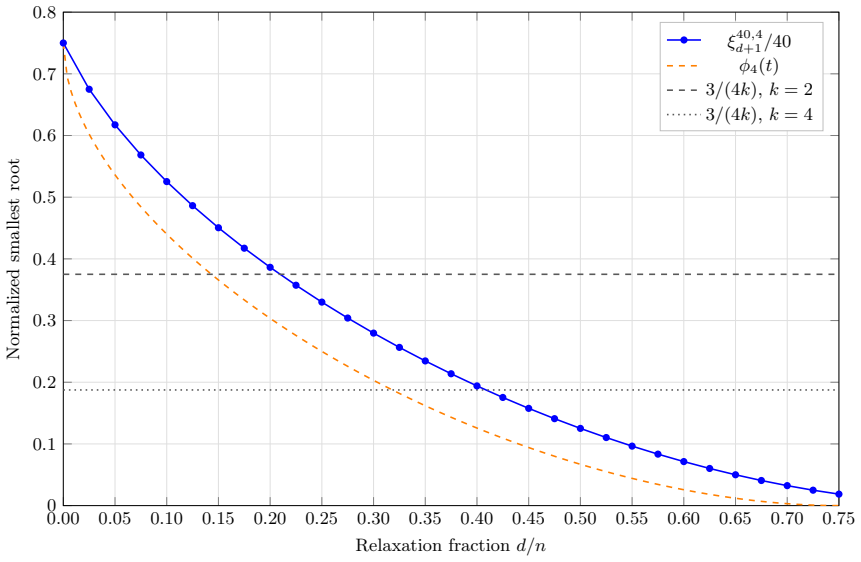
For k-local even-weight Pauli Hamiltonians both SDP hierarchies bound the ground-state energy with error at most C(k) times a Krawtchouk root divided by n.
A machine-rendered reading of the paper's core claim, the machinery that carries it, and where it could break.
Core claim
The authors show that for k-local Hamiltonians with only even-weight Pauli terms, the error of both the NPA-type lower-bound hierarchy and the upper-bound hierarchy is at most C(k) ξ^{n,4}_{d+1}/n, with C(k) independent of n and d, and that general cases reduce to this by adding one ancilla qubit. The proof relies on constructing almost-reproducing kernels for the Pauli algebra whose spectra are related to Krawtchouk polynomials.
What carries the argument
Almost-reproducing kernels for the Pauli algebra whose spectra are tied to the roots of Krawtchouk polynomials to produce the error bound.
If this is right
- The approximation error shrinks as 1/n for fixed hierarchy level d as the system size grows.
- Adding one ancilla qubit preserves the spectrum while allowing the even-weight analysis to apply.
- The constant C(k) depends only on locality k, not on system size or relaxation order.
- Low levels of the hierarchy already yield useful certificates for large n.
Where Pith is reading between the lines
- The kernel construction technique could be adapted to other algebras or Hamiltonians beyond Pauli.
- Numerical implementations might use the bound to decide when to stop increasing the hierarchy level.
- This approach connects ideas from commutative polynomial optimization to the noncommutative quantum setting.
Load-bearing premise
The almost-reproducing kernels must have spectra exactly matching the Krawtchouk polynomial roots in the manner needed to yield the stated error term.
What would settle it
Compute the actual hierarchy error for a concrete k-local even-weight Hamiltonian with small n and compare it against the predicted upper bound C(k) ξ / n; if the error exceeds the bound, the claim fails.
Figures
read the original abstract
The $k$-local Hamiltonian problem is a central model for quantum many-body systems and Hamiltonian complexity. Semidefinite programming and noncommutative sum-of-squares hierarchies provide systematic certificates for ground-state energies, but existing finite-convergence results give no quantitative guarantee on the accuracy of the low hierarchy levels accessible in computation. We prove explicit finite-level convergence rates for these hierarchies in the Pauli setting. For $k$-local Hamiltonians whose Pauli expansion contains only even-weight terms, we show that both the NPA-type lower-bound hierarchy and the upper-bound hierarchy on the spectral minimum have error at most $C(k)\xi^{n,4}_{d+1}/n$, where $\xi^{n,4}_{d+1}$ is the smallest root of a Krawtchouk polynomial and $C(k)$ is independent of the number of qubits $n$ and the hierarchy level $d$. General $k$-local Hamiltonians reduce to this even-weight case by adding one ancilla qubit while preserving the spectrum. The proof constructs almost-reproducing kernels for the Pauli algebra and relates their spectra to Krawtchouk polynomials, giving a noncommutative analogue of recent kernel-based convergence analyses for commutative polynomial optimization. These results provide the first quantitative finite-level accuracy guarantees for noncommutative semidefinite relaxations of Pauli Hamiltonians.
Editorial analysis
A structured set of objections, weighed in public.
Referee Report
Summary. The paper proves explicit quantitative convergence rates for the NPA-type lower-bound hierarchy and a matching upper-bound hierarchy on the ground-state energy of k-local Pauli Hamiltonians. For Hamiltonians whose Pauli expansion contains only even-weight terms, both hierarchies achieve error at most C(k) ξ^{n,4}_{d+1}/n, where ξ^{n,4}_{d+1} is the smallest root of a Krawtchouk polynomial of degree d+1 and C(k) is independent of n and d. The general (odd-weight) case reduces to the even-weight case by adding one ancilla qubit. The proof proceeds by constructing almost-reproducing kernels for the Pauli algebra and relating their spectra to Krawtchouk polynomials, yielding a noncommutative analogue of recent kernel-based analyses in commutative polynomial optimization.
Significance. If the central derivation holds, the result supplies the first quantitative finite-level accuracy guarantees for noncommutative SDP relaxations of Pauli Hamiltonians. This is a substantive advance for Hamiltonian complexity and quantum many-body physics, where only qualitative finite-convergence statements were previously available. The explicit 1/n scaling with a constant independent of both system size and hierarchy level, together with the Krawtchouk connection, strengthens the practical utility of low-level NPA relaxations.
major comments (1)
- [Abstract, final paragraph; kernel-construction section] Abstract (final paragraph) and the kernel-construction section: the quantitative error bound C(k) ξ^{n,4}_{d+1}/n is obtained only if the spectra of the constructed almost-reproducing kernels satisfy a precise relation to the roots of the Krawtchouk polynomial K_{d+1}^{n,4}. The manuscript must explicitly derive how the almost-reproducing property and the eigenvalue formula together produce the claimed 1/n rate independent of d; any mismatch in this spectral identification would invalidate the stated convergence rate.
minor comments (2)
- Notation for the Krawtchouk polynomials and the parameter 4 in ξ^{n,4}_{d+1} should be defined at first use and cross-referenced to the standard definition in the literature.
- The reduction via one ancilla qubit is stated to preserve the spectrum; a brief explicit verification of this step would improve readability.
Simulated Author's Rebuttal
We thank the referee for their careful reading and for identifying the need for greater explicitness in the derivation of the quantitative error bound. We address the single major comment below.
read point-by-point responses
-
Referee: [Abstract, final paragraph; kernel-construction section] Abstract (final paragraph) and the kernel-construction section: the quantitative error bound C(k) ξ^{n,4}_{d+1}/n is obtained only if the spectra of the constructed almost-reproducing kernels satisfy a precise relation to the roots of the Krawtchouk polynomial K_{d+1}^{n,4}. The manuscript must explicitly derive how the almost-reproducing property and the eigenvalue formula together produce the claimed 1/n rate independent of d; any mismatch in this spectral identification would invalidate the stated convergence rate.
Authors: The kernel-construction section already derives the eigenvalues of the almost-reproducing kernels via the representation theory of the Pauli algebra and identifies them with the roots of the Krawtchouk polynomial K_{d+1}^{n,4}. The almost-reproducing property is then used to bound the duality gap by the smallest such root; the factor 1/n arises directly from the normalization of the kernel (which scales as 1/n for the trace inner product on n qubits) together with the k-locality of the Hamiltonian, which contributes only to the constant C(k). This produces the stated rate independent of both n and d. Nevertheless, to address the referee's concern about transparency, we will insert a short dedicated paragraph immediately after the eigenvalue formula that walks through the algebraic steps from the reproducing property to the 1/n scaling. revision: yes
Circularity Check
No circularity; derivation constructs kernels and relates spectra to known Krawtchouk polynomials independently
full rationale
The paper derives the quantitative error bound C(k) ξ^{n,4}_{d+1}/n by constructing almost-reproducing kernels for the Pauli algebra and relating their spectra to Krawtchouk polynomials (standard objects from coding theory). The abstract explicitly describes this as a noncommutative analogue of existing commutative kernel analyses, with no self-citations, fitted inputs renamed as predictions, self-definitional steps, or ansatzes smuggled via prior work by the same authors. The reduction to the even-weight case via ancilla is a standard spectrum-preserving transformation. The derivation chain is self-contained against external mathematical benchmarks and does not reduce any claimed prediction to its inputs by construction.
Axiom & Free-Parameter Ledger
Forward citations
Cited by 1 Pith paper
-
Convergence rates of Sum-of-Hermitian-Squares Hierarchies for the Pauli algebra
Explicit convergence rates for noncommutative SOS hierarchies on the Pauli algebra are bounded using smallest roots of Krawtchouk polynomials.
Reference graph
Works this paper leans on
-
[1]
The Complexity of the Local Hamiltonian Problem
Julia Kempe, Alexei Kitaev, and Oded Regev. The Complexity of the Local Hamiltonian Problem. SIAM Journal on Computing, 35(5):1070–1097, January 2006.https://epubs.siam.org/doi/10. 1137/S0097539704445226
2006
-
[2]
Quantum hamiltonian complexity
Sevag Gharibian, Yichen Huang, Zeph Landau, and Seung Woo Shin. Quantum hamiltonian complexity. Foundations and Trends in Theoretical Computer Science, 10(3):159–282, 2015
2015
-
[3]
Oxford University Press, 2004
Henrik Bruus and Karsten Flensberg.Many-Body Quantum Theory in Condensed Matter Physics: An Introduction. Oxford University Press, 2004
2004
-
[4]
Certifying ground-state properties of many-body systems.Physical Review X, 14(3):031006, 2024
Jie Wang, Jacopo Surace, Irénée Frérot, Benoît Legat, Marc-Olivier Renou, Victor Magron, and Antonio Acín. Certifying ground-state properties of many-body systems.Physical Review X, 14(3):031006, 2024
2024
-
[5]
Whitfield, Jacob Biamonte, and Alán Aspuru-Guzik
James D. Whitfield, Jacob Biamonte, and Alán Aspuru-Guzik. Simulation of electronic structure hamil- tonians using quantum computers.Molecular Physics, 109(5):735–750, 2011
2011
-
[6]
Mazziotti
David A. Mazziotti. Realization of quantum chemistry without wave functions through first-order semidefinite programming.Phys. Rev. Lett., 93:213001, Nov 2004
2004
-
[7]
The complexity of antiferromagnetic interactions and 2D lat- tices.Quantum Information and Computation, 17(7&8):636–672, May 2017.http://www.rintonpress
Stephen Piddock and Ashley Montanaro. The complexity of antiferromagnetic interactions and 2D lat- tices.Quantum Information and Computation, 17(7&8):636–672, May 2017.http://www.rintonpress. com/journals/doi/QIC17.7-8-6.html
2017
-
[8]
Approximation Algorithms for QMA-Complete Problems.SIAM Journal on Computing, 41(4):1028–1050, January 2012.https://epubs.siam.org/doi/10.1137/ 110842272
Sevag Gharibian and Julia Kempe. Approximation Algorithms for QMA-Complete Problems.SIAM Journal on Computing, 41(4):1028–1050, January 2012.https://epubs.siam.org/doi/10.1137/ 110842272. 18
2012
-
[9]
Fernando G. S. L. Brandão and Aram W. Harrow. Product-state approximations to quantum states. Communications in Mathematical Physics, 342(1):47–80, 2016
2016
-
[10]
An Improved Approximation Algorithm for Quantum Max-Cut on Triangle-Free Graphs
Robbie King. An Improved Approximation Algorithm for Quantum Max-Cut on Triangle-Free Graphs. Quantum, 7:1180, November 2023.https://quantum-journal.org/papers/q-2023-11-09-1180/
2023
-
[11]
William Helton and Scott A
J. William Helton and Scott A. McCullough. A positivstellensatz for non-commutative polynomials. Trans. Am. Math. Soc., 356(9):3721–3737, 2004
2004
-
[12]
Bounding the set of quantum correlations
Miguel Navascués, Stefano Pironio, and Antonio Acín. Bounding the set of quantum correlations. Physical Review Letters, 98:010401, 2007
2007
-
[13]
A convergent hierarchy of semidefinite programs characterizing the set of quantum correlations.New Journal of Physics, 10(7):073013, 2008
Miguel Navascués, Stefano Pironio, and Antonio Acín. A convergent hierarchy of semidefinite programs characterizing the set of quantum correlations.New Journal of Physics, 10(7):073013, 2008
2008
-
[14]
Sabine Burgdorf, Igor Klep, and Janez Povh.Optimization of Polynomials in Non-Commuting Vari- ables. SpringerBriefs in Mathematics. Springer International Publishing, Cham, 2016.http://link. springer.com/10.1007/978-3-319-33338-0
-
[15]
Pironio, M
S. Pironio, M. Navascués, and A. Acín. Convergent relaxations of polynomial optimization problems with noncommuting variables.SIAM J. Optim., 20(5):2157–2180, 2010
2010
-
[16]
I. Klep, V. Magron, and J. Volčič. Complete upper bound hierarchies for spectral minimum in noncom- mutative polynomial optimization.Journal of Mathematical Analysis and Applications, 563(1), 2026
2026
-
[17]
The sum-of-squares hierarchy on the sphere and applications in quantum information theory.Mathematical Programming, 190(1):331–360, November 2021
Kun Fang and Hamza Fawzi. The sum-of-squares hierarchy on the sphere and applications in quantum information theory.Mathematical Programming, 190(1):331–360, November 2021
2021
-
[18]
An effective version of Schmüdgen’s Positivstellensatz for the hypercube.Optimization Letters, 17(3):515–530, April 2023.https://doi.org/10.1007/ s11590-022-01922-5
Monique Laurent and Lucas Slot. An effective version of Schmüdgen’s Positivstellensatz for the hypercube.Optimization Letters, 17(3):515–530, April 2023.https://doi.org/10.1007/ s11590-022-01922-5
2023
-
[19]
Sum-of-squares hierarchies for binary polynomial optimiza- tion.Mathematical Programming, 197(2):621–660, February 2023.https://doi.org/10.1007/ s10107-021-01745-9
Lucas Slot and Monique Laurent. Sum-of-squares hierarchies for binary polynomial optimiza- tion.Mathematical Programming, 197(2):621–660, February 2023.https://doi.org/10.1007/ s10107-021-01745-9
2023
-
[20]
Sum-of-squares hierarchies for polynomial optimization and the Christoffel–Darboux kernel
Lucas Slot. Sum-of-squares hierarchies for polynomial optimization and the Christoffel–Darboux kernel. SIAM Journal on Optimization, 32(4):2612–2635, 2022
2022
-
[21]
An overview of convergence rates for sum of squares hierarchies in polynomial optimization
Monique Laurent and Lucas Slot. An overview of convergence rates for sum of squares hierarchies in polynomial optimization. In Shin’ichi Oishi, Hisashi Okamoto, and Ken Hayami, editors,Recent Developments in Industrial and Applied Mathematics, pages 149–176, Singapore, 2026. Springer Nature Singapore
2026
-
[22]
Sergey Bravyi, David Gosset, Robert König, and Kristan Temme. Approximation algorithms for quantum many-body problems.Journal of Mathematical Physics, 60(3):032203, March 2019.https: //doi.org/10.1063/1.5085428
-
[23]
Lasserre
Jean B. Lasserre. Global Optimization with Polynomials and the Problem of Moments.SIAM Journal on Optimization, 11(3):796–817, January 2001
2001
-
[24]
Jean B. Lasserre. A new look at nonnegativity on closed sets and polynomial optimization.SIAM Journal on Optimization, 21(3):864–885, 2011.https://doi.org/10.1137/100806990
-
[25]
Convergence analysis for lasserre’s measure-based hierarchy of upper bounds for polynomial optimization.Mathematical Programming, 162:363–392, 2017
Etienne de Klerk, Monique Laurent, and Zhao Sun. Convergence analysis for lasserre’s measure-based hierarchy of upper bounds for polynomial optimization.Mathematical Programming, 162:363–392, 2017
2017
-
[26]
V. I. Levenshtein. Universal bounds for codes and designs.Handbook of Coding Theory, 9:499–648, 1998. 19
1998
-
[27]
MacWilliams and Neil J
Florence J. MacWilliams and Neil J. A. Sloane.The Theory of Error-Correcting Codes. Number 16 in North Holland Mathematical Library. North-Holland Publ. Comp, Amsterdam New York Oxford, 3. printing, 2. reprint edition, 1983
1983
-
[28]
Ashley Montanaro and Tobias J. Osborne. Quantum boolean functions.Chicago Journal of Theoretical Computer Science, 2010(1), January 2010
2010
-
[29]
Etienne de Klerk and Monique Laurent. Worst-Case Examples for Lasserre’s Measure–Based Hierarchy for Polynomial Optimization on the Hypercube.Mathematics of Operations Research, 45(1):86–98, 2020. https://www.jstor.org/stable/27343309
-
[30]
Relaxations and exact solutions to quantum max cut via the algebraic structure of swap operators.Quantum, 8:1352, 2024
Adam Bene Watts, Anirban Chowdhury, Aidan Epperly, J William Helton, and Igor Klep. Relaxations and exact solutions to quantum max cut via the algebraic structure of swap operators.Quantum, 8:1352, 2024
2024
-
[31]
Igor Klep, Victor Magron, and Janez Povh. Sparse noncommutative polynomial optimization.Mathe- matical Programming, 193(2):789–829, June 2022.https://doi.org/10.1007/s10107-020-01610-1
-
[32]
Convergence rates for sums-of-squares hier- archies with correlative sparsity.Mathematical Programming, 209(1):435–473, 2025
Milan Korda, Victor Magron, and Rodolfo Rios-Zertuche. Convergence rates for sums-of-squares hier- archies with correlative sparsity.Mathematical Programming, 209(1):435–473, 2025
2025
-
[33]
S. T. Belinschi, V. Magron, and V. Vinnikov. Noncommutative Christoffel-Darboux Kernels.Transac- tions of the American Mathematical Society, 376(01):181–230, 2023
2023
-
[34]
MIPco = coRE.http://arxiv.org/abs/2510.07162, 2025
Junqiao Lin. MIPco = coRE.http://arxiv.org/abs/2510.07162, 2025. arXiv:2510.07162
-
[35]
MIP* = RE.Commun
Zhengfeng Ji, Anand Natarajan, Thomas Vidick, John Wright, and Henry Yuen. MIP* = RE.Commun. ACM, 64(11):131–138, 2021. 20
2021
discussion (0)
Sign in with ORCID, Apple, or X to comment. Anyone can read and Pith papers without signing in.