Quantum Synchronization of Fock States
Pith reviewed 2026-06-29 06:53 UTC · model grok-4.3
The pith
A bosonic mode with a Fock-like limit cycle synchronizes to an external drive, producing a steady state with negative Wigner function.
A machine-rendered reading of the paper's core claim, the machinery that carries it, and where it could break.
Core claim
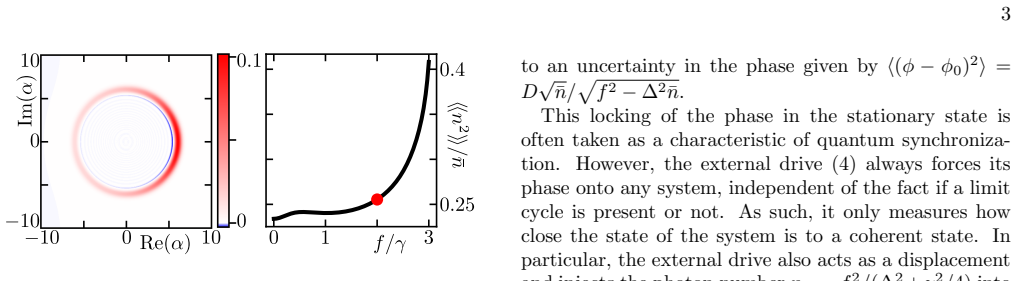
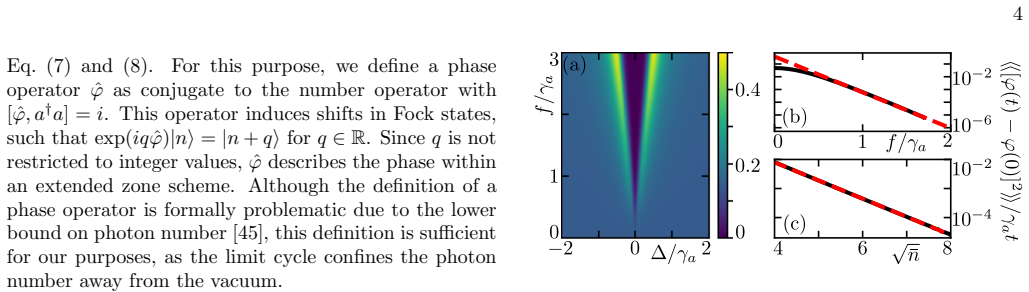
The driven steady state of the bosonic mode forms a genuine Fock-like limit cycle that phase-locks to an external drive; the resulting state exhibits a negative Wigner function, synchronization occurs inside an Arnold tongue, and the probability of phase slips falls exponentially with increasing drive strength.
What carries the argument
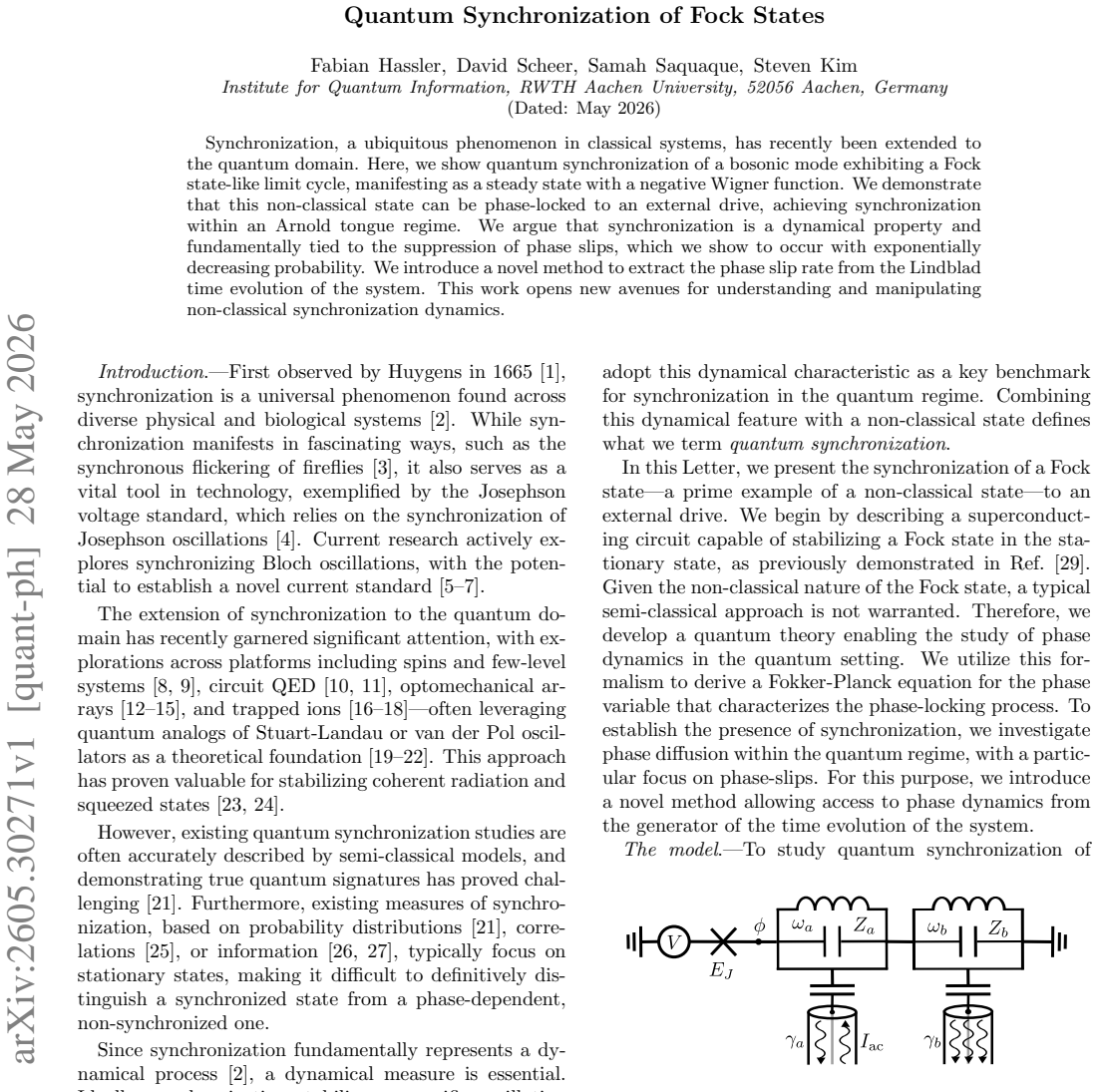
The Fock state-like limit cycle of the bosonic mode, whose phase-slip suppression under Lindblad dynamics produces the synchronized non-classical steady state.
If this is right
- Synchronization is realized inside a finite Arnold tongue in parameter space.
- Phase-slip probability decreases exponentially with drive amplitude.
- A Lindblad-time-evolution method extracts the phase-slip rate without separate classical simulations.
- Non-classical synchronization becomes accessible for bosonic modes prepared near number states.
Where Pith is reading between the lines
- The same phase-slip suppression mechanism could be tested in circuit-QED devices by preparing near-Fock states and monitoring the Wigner function under continuous drive.
- If the exponential suppression holds, synchronized Fock states might reduce phase noise in quantum metrology protocols that rely on number-state sensitivity.
- The extraction technique for slip rates could be applied to other open quantum systems where limit cycles are suspected but hard to characterize.
Load-bearing premise
The driven steady state stays a true Fock-like limit cycle instead of turning into a mixture or another non-classical state under the chosen Lindblad operators.
What would settle it
Direct measurement of the steady-state Wigner function that remains non-negative inside the claimed Arnold tongue region would falsify the existence of a synchronized Fock-like limit cycle.
Figures
read the original abstract
Synchronization, a ubiquitous phenomenon in classical systems, has recently been extended to the quantum domain. Here, we show quantum synchronization of a bosonic mode exhibiting a Fock state-like limit cycle, manifesting as a steady state with a negative Wigner function. We demonstrate that this non-classical state can be phase-locked to an external drive, achieving synchronization within an Arnold tongue regime. We argue that synchronization is a dynamical property and fundamentally tied to the suppression of phase slips, which we show to occur with exponentially decreasing probability. We introduce a novel method to extract the phase slip rate from the Lindblad time evolution of the system. This work opens new avenues for understanding and manipulating non-classical synchronization dynamics.
Editorial analysis
A structured set of objections, weighed in public.
Referee Report
Summary. The manuscript claims to demonstrate quantum synchronization of a bosonic mode possessing a Fock state-like limit cycle. The driven steady state is reported to exhibit a negative Wigner function and to phase-lock to an external drive inside an Arnold tongue. Synchronization is argued to be a dynamical property equivalent to exponential suppression of phase slips, with a new extraction method applied to the Lindblad time evolution.
Significance. If the identification of the steady state as a genuine Fock-like limit cycle is substantiated, the work would supply a concrete example of non-classical synchronization and a dynamical link between phase locking and phase-slip suppression. The proposed extraction procedure for phase-slip rates from Lindblad trajectories would constitute a useful technical addition for driven-dissipative bosonic systems.
major comments (2)
- [Abstract / steady-state characterization section] The central claim that the driven steady state constitutes a Fock state-like limit cycle rests on the observation of a negative Wigner function. This identification is load-bearing for the subsequent argument that synchronization equals exponential phase-slip suppression. The manuscript must supply independent diagnostics (photon-number variance, purity, or fidelity to a pure |n⟩⟨n| projector) to exclude the possibility that the steady state is a mixed non-classical state whose off-diagonal coherences deviate from a single Fock state; without these checks the link between negative Wigner function and limit-cycle behavior remains unclosed.
- [Section introducing the phase-slip extraction method] The novel extraction of the phase-slip rate directly from Lindblad time evolution is presented as independent evidence for the dynamical nature of synchronization. The manuscript should demonstrate that this rate is insensitive to the precise definition of the phase observable and that the exponential suppression survives when the drive strength and detuning are varied across the Arnold tongue; otherwise the claimed dynamical equivalence risks being an artifact of the chosen extraction protocol.
minor comments (1)
- [Abstract] The abstract states the central results but omits the specific Lindblad operators, the range of drive amplitudes, and the Fock level n under study; these parameters should be stated explicitly in the abstract or the first paragraph of the introduction.
Simulated Author's Rebuttal
We thank the referee for the constructive and detailed report. The comments highlight important points for strengthening the characterization of the steady state and the robustness of the phase-slip extraction. We respond to each major comment below and indicate the corresponding revisions.
read point-by-point responses
-
Referee: [Abstract / steady-state characterization section] The central claim that the driven steady state constitutes a Fock state-like limit cycle rests on the observation of a negative Wigner function. This identification is load-bearing for the subsequent argument that synchronization equals exponential phase-slip suppression. The manuscript must supply independent diagnostics (photon-number variance, purity, or fidelity to a pure |n⟩⟨n| projector) to exclude the possibility that the steady state is a mixed non-classical state whose off-diagonal coherences deviate from a single Fock state; without these checks the link between negative Wigner function and limit-cycle behavior remains unclosed.
Authors: We agree that the negative Wigner function alone does not fully close the identification. In the revised manuscript we will add the photon-number variance, the purity of the steady-state density matrix, and the fidelity to the nearest pure Fock projector |n⟩⟨n|, all computed from the Lindblad steady state. These quantities will be shown explicitly to confirm proximity to a Fock state while preserving the non-classical signature. revision: yes
-
Referee: [Section introducing the phase-slip extraction method] The novel extraction of the phase-slip rate directly from Lindblad time evolution is presented as independent evidence for the dynamical nature of synchronization. The manuscript should demonstrate that this rate is insensitive to the precise definition of the phase observable and that the exponential suppression survives when the drive strength and detuning are varied across the Arnold tongue; otherwise the claimed dynamical equivalence risks being an artifact of the chosen extraction protocol.
Authors: We accept that robustness checks are required. The revised manuscript will include (i) a comparison of the extracted phase-slip rate under two distinct phase observables (different quadrature-based definitions) and (ii) a scan of the rate across a range of drive amplitudes and detunings inside the Arnold tongue, confirming that exponential suppression holds throughout the synchronized region and is not an artifact of the original protocol. revision: yes
Circularity Check
No significant circularity detected; derivation remains self-contained.
full rationale
The abstract and provided context show the synchronization result and phase-slip suppression derived directly from Lindblad time evolution, with the phase-slip rate extracted as a novel method from the dynamics rather than fitted to the synchronization outcome. The negative Wigner function is presented as a consequence of the steady-state dynamics under the chosen master equation, without self-definitional reduction, fitted-input predictions, or load-bearing self-citations. No equations or steps reduce by construction to their inputs; the chain is independent of the target claims.
Axiom & Free-Parameter Ledger
Forward citations
Cited by 1 Pith paper
-
Synchronization in the quantum regime
The paper reviews advances in quantum synchronization, covering characterization of synchronous oscillations, nonclassical forms of synchrony, and many-body synchronization on quantum networks.
Reference graph
Works this paper leans on
-
[1]
Nijhoff, ed.,Ouevres Completes de Christian Huygens (Societe Hollandaise des Sciences, The Hague, Nether- lands, 1893), p.247 (in French)
M. Nijhoff, ed.,Ouevres Completes de Christian Huygens (Societe Hollandaise des Sciences, The Hague, Nether- lands, 1893), p.247 (in French)
-
[2]
Pikovsky, M
A. Pikovsky, M. Rosenblum, and J. Kurths,Synchroniza- tion: A Universal Concept in Nonlinear Sciences(Cam- bridge University Press, 2001)
2001
-
[3]
H. M. Smith, Synchronous Flashing of Fireflies, Science 82, 151 (1935)
1935
-
[4]
Hamilton and Richard L
Clark A. Hamilton and Richard L. Kautz and Richard L. Steiner and F. L. Lloyd, A practical Josephson voltage standard at 1 V, IEEE Electron Device Letters6, 623 (1985)
1985
-
[5]
R. S. Shaikhaidarov, K. H. Kim, J. W. Dunstan, I. V. Antonov, S. Linzen, M. Ziegler, D. S. Golubev, V. N. Antonov, E. V. Il’ichev, and O. V. Astafiev, Quantized current steps due to the ac coherent quantum phase-slip effect, Nature608, 45 (2022)
2022
-
[6]
Crescini, S
N. Crescini, S. Cailleaux, W. Guichard, C. Naud, O. Buisson, K. W. Murch, and N. Roch, Evidence of dual shapiro steps in a josephson junction array, Nature Physics19, 851 (2023)
2023
-
[7]
F. Kaap, D. Scheer, F. Hassler, and S. Lotkhov, Synchro- nization of Bloch oscillations in a strongly coupled pair of small Josephson junctions: Evidence for a Shapiro-like current step, Phys. Rev. Lett.132, 027001 (2024)
2024
-
[8]
Parra-L´ opez and J
A. Parra-L´ opez and J. Bergli, Synchronization in two- level quantum systems, Phys. Rev. A101, 062104 (2020)
2020
-
[9]
Zhang, Z
L. Zhang, Z. Wang, Y. Wang, J. Zhang, Z. Wu, J. Jie, and Y. Lu, Quantum synchronization of a single trapped-ion qubit, Phys. Rev. Res.5, 033209 (2023)
2023
-
[10]
H¨ ohe, L
F. H¨ ohe, L. Danner, C. Padurariu, B. I. C. Donvil, J. Ankerhold, and B. Kubala, Quantum synchronization in presence of shot noise, New J. Phys.27, 023039 (2025)
2025
-
[11]
Hermansen and J
C. Hermansen and J. Paaske, Synchronizing microwave circuit quantum electrodynamics limit cycle oscillators, Phys. Rev. B113, 075434 (2026)
2026
-
[12]
A. Mari, A. Farace, N. Didier, V. Giovannetti, and R. Fazio, Measures of Quantum Synchronization in Con- tinuous Variable Systems, Phys. Rev. Lett.111, 103605 (2013)
2013
-
[13]
L¨ orch, J
N. L¨ orch, J. Qian, A. Clerk, F. Marquardt, and K. Ham- merer, Laser Theory for Optomechanics: Limit Cycles in the Quantum Regime, Phys. Rev. X4, 011015 (2014)
2014
-
[14]
Weiss, A
T. Weiss, A. Kronwald, and F. Marquardt, Noise-induced transitions in optomechanical synchronization, New J. Phys.18, 013043 (2016)
2016
-
[15]
L¨ orch, S
N. L¨ orch, S. E. Nigg, A. Nunnenkamp, R. P. Tiwari, and C. Bruder, Quantum Synchronization Blockade: Energy Quantization Hinders Synchronization of Identical Oscil- lators, Phys. Rev. Lett.118, 243602 (2017)
2017
-
[16]
M. R. Hush, W. Li, S. Genway, I. Lesanovsky, and A. D. Armour, Spin correlations as a probe of quantum syn- chronization in trapped-ion phonon lasers, Phys. Rev. A 91, 061401 (2015)
2015
-
[17]
M. R. Jessop, W. Li, and A. D. Armour, Phase synchro- nization in coupled bistable oscillators, Phys. Rev. Res. 2, 013233 (2020)
2020
-
[18]
Kehrer, C
T. Kehrer, C. Bruder, and P. Solanki, Quantum Syn- chronization of Twin Limit-Cycle Oscillators, Phys. Rev. Lett.135, 063601 (2025)
2025
-
[19]
T. E. Lee and H. R. Sadeghpour, Quantum Synchroniza- tion of Quantum van der Pol Oscillators with Trapped Ions, Phys. Rev. Lett.111, 234101 (2013)
2013
-
[20]
Walter, A
S. Walter, A. Nunnenkamp, and C. Bruder, Quantum Synchronization of a Driven Self-Sustained Oscillator, Phys. Rev. Lett.112, 094102 (2014)
2014
-
[21]
L¨ orch, E
N. L¨ orch, E. Amitai, A. Nunnenkamp, and C. Bruder, Genuine Quantum Signatures in Synchronization of An- harmonic Self-Oscillators, Phys. Rev. Lett.117, 073601 (2016)
2016
-
[22]
Chia, W.-K
A. Chia, W.-K. Mok, L.-C. Kwek, and C. Noh, Quanti- zation of nonlinear non-Hamiltonian systems, Phys. Rev. E112, 054206 (2025)
2025
-
[23]
Scheer, J
D. Scheer, J. V¨ oller, and F. Hassler, The superconducting clock-circuit: Improving the coherence of Josephson ra- diation beyond the thermodynamic uncertainty relation, SciPost Phys.17, 140 (2024)
2024
-
[24]
Danner, F
L. Danner, F. H¨ ohe, C. Padurariu, J. Ankerhold, and B. Kubala, Quantum microwaves: Stabilizing squeezed light by phase locking, Phys. Rev. B111, 184519 (2025)
2025
-
[25]
A. D. Armour, B. Kubala, and J. Ankerhold, Joseph- son photonics with a two-mode superconducting circuit, Phys. Rev. B91, 184508 (2015)
2015
-
[26]
Ameri, M
V. Ameri, M. Eghbali-Arani, A. Mari, A. Farace, F. Kheirandish, V. Giovannetti, and R. Fazio, Mutual in- formation as an order parameter for quantum synchro- nization, Phys. Rev. A91, 012301 (2015)
2015
-
[27]
Jaseem, M
N. Jaseem, M. Hajduˇ sek, P. Solanki, L.-C. Kwek, R. Fazio, and S. Vinjanampathy, Generalized measure of quantum synchronization, Phys. Rev. Res.2, 043287 (2020)
2020
-
[28]
Christiansen and J
H. Christiansen and J. Paaske, Quantum desynchroniza- tion of limit cycles, arXiv:??? (2026), To be submitted
2026
-
[29]
Souquet and A
J.-R. Souquet and A. A. Clerk, Fock-state stabilization and emission in superconducting circuits using dc-biased Josephson junctions, Phys. Rev. A93, 060301 (2016)
2016
-
[30]
Peugeot, G
A. Peugeot, G. M´ enard, S. Dambach, M. Westig, B. Kubala, Y. Mukharsky, C. Altimiras, P. Joyez, D. Vion, P. Roche, D. Esteve, P. Milman, J. Lepp¨ akangas, G. Jo- hansson, M. Hofheinz, J. Ankerhold, and F. Portier, Gen- erating Two Continuous Entangled Microwave Beams Using a dc-Biased Josephson Junction, Phys. Rev. X11, 031008 (2021)
2021
-
[31]
Abramowitz and I
M. Abramowitz and I. A. Stegun, eds.,Handbook of Mathematical Functions(Dover, New York, 1972), Ch. 13
1972
-
[32]
J. Koch, F. von Oppen, and A. V. Andreev, Theory of the Franck-Condon blockade regime, Phys. Rev. B74, 205438 (2006)
2006
-
[33]
Vaneph, A
C. Vaneph, A. Morvan, G. Aiello, M. F´ echant, M. Aprili, J. Gabelli, and J. Est` eve, Observation of the Unconven- tional Photon Blockade in the Microwave Domain, Phys. Rev. Lett.121, 043602 (2018)
2018
-
[34]
Y.-H. Zhou, T. Liu, Q.-P. Su, X.-Y. Zhang, Q.-C. Wu, D.- X. Chen, Z.-C. Shi, H. Z. Shen, and C.-P. Yang, Universal Photon Blockade, Phys. Rev. Lett.134, 183601 (2025)
2025
-
[35]
Rolland, A
C. Rolland, A. Peugeot, S. Dambach, M. Westig, B. Kubala, Y. Mukharsky, C. Altimiras, H. le Sueur, P. Joyez, D. Vion, P. Roche, D. Esteve, J. Ankerhold, 6 and F. Portier, Antibunched Photons Emitted by a dc- Biased Josephson Junction, Phys. Rev. Lett.122, 186804 (2019)
2019
-
[36]
See the Supplemental Material where we provide addi- tional details
-
[37]
Kenfack and K
A. Kenfack and K. ˙Zyczkowski, Negativity of the Wigner function as an indicator of non-classicality, J. Opt. B: Quantum Semiclass. Opt.6, 396 (2004)
2004
-
[38]
Nadolny and C
T. Nadolny and C. Bruder, Quantum limit cycles and synchronization from a measurement perspective, Phys. Rev. Res.8, 023050 (2026)
2026
-
[39]
D. P. Pires, I. A. Silva, E. R. deAzevedo, D. O. Soares- Pinto, and J. G. Filgueiras, Coherence orders, decoher- ence, and quantum metrology, Phys. Rev. A98, 032101 (2018)
2018
-
[40]
M. O. Scully and M. S. Zubairy,Quantum Optics(Cam- bridge University Press, 1997)
1997
-
[41]
A. L. Schawlow and C. H. Townes, Infrared and Optical Masers, Phys. Rev.112, 1940 (1958)
1940
-
[42]
Note that this condition is necessary but not sufficient as we point out throughout this work
-
[43]
Portugal, F
P. Portugal, F. Brange, K. S. U. Kansanen, P. Samuels- son, and C. Flindt, Photon emission statistics of a driven microwave cavity, Phys. Rev. Res.5, 033091 (2023)
2023
-
[44]
Kramers, Brownian motion in a field of force and the diffusion model of chemical reactions, Physica7, 284 (1940)
H. Kramers, Brownian motion in a field of force and the diffusion model of chemical reactions, Physica7, 284 (1940)
1940
-
[45]
Susskind and J
L. Susskind and J. Glogower, Quantum mechanical phase and time operator, Physics Physique Fizika1, 49 (1964)
1964
-
[46]
Derrida and J
B. Derrida and J. L. Lebowitz, Exact Large Deviation Function in the Asymmetric Exclusion Process, Phys. Rev. Lett.80, 209 (1998)
1998
-
[47]
Bruderer, L
M. Bruderer, L. D. Contreras-Pulido, M. Thaller, L. Sironi, D. Obreschkow, and M. B. Plenio, Inverse count- ing statistics for stochastic and open quantum systems: the characteristic polynomial approach, New J. Phys.16, 033030 (2014)
2014
-
[48]
Kim and F
S. Kim and F. Hassler, Third quantization for bosons: symplectic diagonalization, non-Hermitian Hamiltonian, and symmetries, J. Phys. A: Math. Theor.56, 385303 (2023)
2023
-
[49]
Reimann, C
P. Reimann, C. Van den Broeck, H. Linke, P. H¨ anggi, J. M. Rubi, and A. P´ erez-Madrid, Diffusion in tilted peri- odic potentials: Enhancement, universality, and scaling, Phys. Rev. E65, 031104 (2002)
2002
-
[50]
1 END MA TTER In the first part of this End Matter, we will demonstrate that the stationary state alone is not a suitable measure of synchronization
Note that this condition is necessary but not sufficient as we point out throughout this work. 1 END MA TTER In the first part of this End Matter, we will demonstrate that the stationary state alone is not a suitable measure of synchronization. We show that even a simple coherent state can exhibit a feature resembling an ‘Arnold tongue’ when analyzed sole...
discussion (0)
Sign in with ORCID, Apple, or X to comment. Anyone can read and Pith papers without signing in.